11th grade homeschool curriculum
A full curriculum, starting at your child's level, with lessons connected to their interests and progress you can see.
See the work in 11th grade
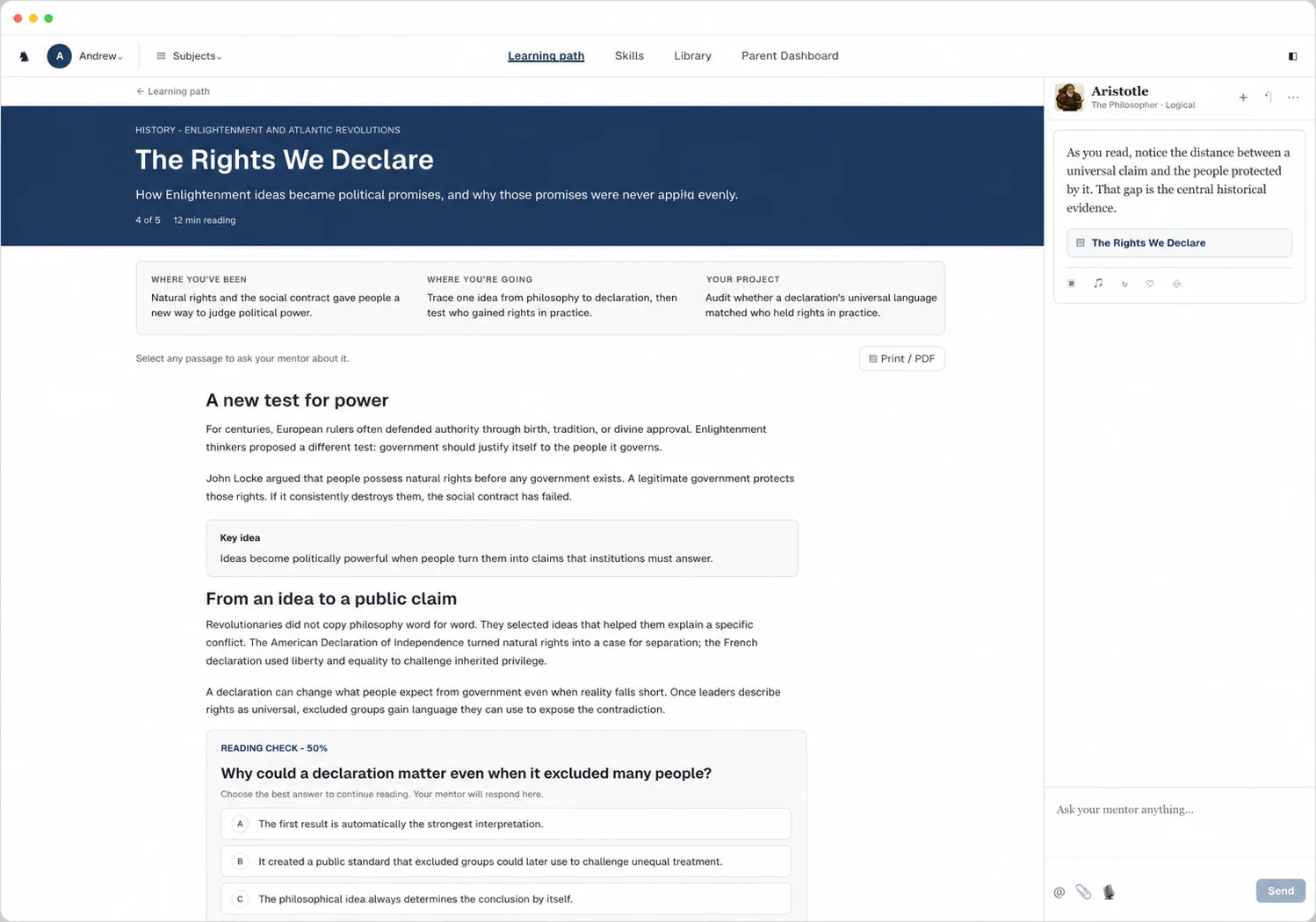
How Enlightenment ideas became political promises, and why those promises were never applied evenly.
- Lesson
- The Rights We Declare
- Goal
- Trace one idea from philosophy to declaration, then test who gained rights in practice.
- Project
- Audit whether a declaration's universal language matched who held rights in practice
Your parent dashboard
- Today
- Each subject's lesson, and whether it's done
- Grades
- Every submission graded instantly, with written feedback, so you never grade
- Records
- Attendance log and learning summary, ready to export
- Documents
- Transcripts and state-aware compliance drafts, written for you and ready to sign

11th grade scope and sequence
Math13 units · 60 skills
Polynomials6 skills
- Add polynomial expressions
- Multiply binomials
- Factor a quadratic with leading coefficient 1
- Factor a quadratic with leading coefficient greater than 1
- Divide polynomials using long division
- Use the remainder theorem
Rational expressions5 skills
- Simplify a rational expression
- Find excluded values of a rational expression
- Multiply rational expressions
- Solve a rational equation with extraneous-solution check
- Interpret a rational function asymptote
Function analysis5 skills
- Justify a function-domain restriction
- Find inverse functions on a restricted domain
- Analyze transformations of parent functions
- Compare polynomial, rational, exponential, and logarithmic behavior
- Use composition of functions in a context
Exponential and logarithmic functions5 skills
- Solve an exponential equation by taking logarithms
- Use logarithm properties to rewrite expressions
- Model compound growth with an exponential function
- Interpret logarithmic scale in data
- Compare exponential and logistic-looking data cautiously
Trigonometry5 skills
- Use radians to measure angle rotation
- Graph sine and cosine functions
- Solve a trigonometric equation on a restricted interval
- Use identities to rewrite a trigonometric expression
- Model periodic behavior with amplitude and period
Complex numbers4 skills
- Add and multiply complex numbers
- Use complex conjugates to simplify a quotient
- Solve a quadratic with complex roots
- Interpret complex roots of a polynomial
Sequences and series4 skills
- Write arithmetic and geometric sequence formulas
- Find a finite geometric series sum
- Use recursive definitions for sequences
- Compare sequence growth rates
Inference and modeling5 skills
- Design a survey with reduced bias
- Interpret standard deviation in context
- Use normal distributions for approximate probabilities
- Compare confidence and certainty in a data claim
- Critique a regression model using residuals
Conics and parametric models4 skills
- Identify a parabola from an equation
- Use the distance formula to derive a circle equation
- Interpret parametric equations as motion
- Compare explicit and parametric forms
Systems and matrices4 skills
- Represent a linear system with a matrix
- Use row operations to solve a small system
- Interpret a matrix transformation geometrically
- Use a system to model constraints
Mathematical reasoning4 skills
- Explain why a domain restriction is necessary
- Compare symbolic and graphical evidence for a function claim
- Find a hidden assumption in a data model
- Defend an algebraic transformation step
AP exam readiness4 skills
- Solve an Algebra II mixed function item with symbolic and graphical evidence
- Choose the best method for a timed polynomial, rational, logarithmic, or trigonometric item
- Explain why an Algebra II distractor answer fails
- Write a concise justification for a grade 11 function-model item
Math capstone5 skills
- Build a function model from messy data
- Defend a polynomial or rational model choice
- Use logarithms or trigonometry in a real application
- Critique a statistical argument
- Present an advanced Algebra II argument
Reading6 units · 49 skills
Literary reading10 skills
- Identify theme from repeated details
- Explain character motivation
- Analyze how setting shapes conflict
- Interpret figurative language in context
- Compare narrator perspective
- Analyze symbolism
- Trace conflict development
- Compare character arcs
- Analyze ambiguity in complex literature
- Analyze ambiguity in a passage
Informational reading10 skills
- Identify central idea
- Trace an author's claim
- Distinguish evidence from commentary
- Summarize a section objectively
- Evaluate source credibility
- Identify text structure
- Evaluate evidence relevance
- Analyze author's assumptions
- Evaluate an author's line of reasoning
- Identify unstated assumptions in nonfiction
Media and multimodal reading7 skills
- Interpret a chart embedded in an article
- Connect image evidence to a text claim
- Evaluate a caption's relationship to an image
- Compare video and print accounts of an event
- Evaluate scale in an infographic
- Interpret a timeline embedded in text
- Compare headline and article evidence
Vocabulary7 skills
- Use context clues for an unfamiliar word
- Identify connotation
- Distinguish denotation from connotation
- Use word parts to infer meaning
- Infer meaning from analogy
- Use roots and affixes
- Identify figurative versus literal meaning
Evidence8 skills
- Quote textual evidence accurately
- Paraphrase evidence without changing meaning
- Connect evidence to an inference
- Compare evidence across two texts
- Rank evidence by strength
- Explain why evidence is relevant
- Integrate evidence across genres
- Use textual evidence to qualify an interpretation
Fluency and text complexity7 skills
- Read grade-level prose with appropriate pacing
- Use punctuation to guide oral phrasing
- Identify sentence complexity in a passage
- Use background knowledge to prepare for a difficult text
- Use paragraph structure to plan reading pace
- Identify unfamiliar syntax before rereading
- Use repeated reading to improve accuracy
English language arts13 units · 60 skills
American literature6 skills
- Analyze a major theme across an American literary text
- Explain how historical context shapes meaning
- Analyze ambiguity in a complex passage
- Compare literary voices from different periods
- Use evidence to defend an interpretation of style
- Trace a motif across a long work
Foundational and civic texts5 skills
- Analyze claims in a foundational U.S. document
- Compare constitutional or civic arguments across texts
- Evaluate reasoning in a Supreme Court opinion excerpt
- Identify tension between principle and practice in a civic text
- Connect rhetoric to historical audience
Advanced rhetorical analysis5 skills
- Trace an author's line of reasoning
- Analyze syntax, diction, and arrangement together
- Evaluate how evidence and warrants support a claim
- Compare rhetorical strategies in paired passages
- Write a rhetorical analysis thesis with complexity
Advanced argument writing5 skills
- Develop a qualified claim for a complex issue
- Use sources as evidence rather than decoration
- Address counterargument and concession strategically
- Build a line of reasoning across paragraphs
- Revise an argument for precision and force
Advanced literary analysis4 skills
- Write an interpretation that accounts for ambiguity
- Use close reading of language and structure
- Integrate literary criticism cautiously
- Compare competing interpretations of a text
Research and source conversation5 skills
- Build a source conversation map
- Distinguish scholarly, journalistic, historical, and primary sources
- Use annotated bibliography notes to refine a claim
- Identify gaps and limits in available evidence
- Cite sources while preserving the writer's own reasoning
Advanced style and grammar4 skills
- Revise sentence rhythm for emphasis
- Use parallelism, antithesis, and cumulative syntax
- Edit for pronoun reference and modifier precision
- Control tone across formal and reflective writing
Speaking and listening5 skills
- Use evidence in a discussion response
- Challenge a claim with text-based reasoning
- Build on another speaker's interpretation
- Present an oral argument with concession and rebuttal
- Evaluate discussion quality using criteria
Media and civic literacy4 skills
- Analyze framing in a civic media text
- Evaluate data claims in public argument
- Compare an original document with commentary about it
- Explain how platform and audience affect message
AP-style reading and writing readiness4 skills
- Plan a rhetorical analysis essay from a cold passage
- Write an argument essay using provided sources
- Outline an AP-style argument essay
- Revise a thesis after encountering a counterexample
Independent advanced reading4 skills
- Maintain a reading notebook for a complex text
- Track contradictions and unresolved questions
- Develop an interpretive question for seminar
- Connect a text to a broader literary or civic conversation
AP exam readiness4 skills
- Analyze an American literature or civic-rhetoric passage under time limits
- Plan a defensible thesis for a junior source-based argument prompt
- Select textual evidence that best supports a grade 11 line of reasoning
- Revise a junior short response for clarity, precision, and evidence use
ELA capstone5 skills
- Write an American literature analysis essay
- Write a source-based civic argument
- Present a seminar argument with evidence
- Revise a piece for advanced style
- Defend a Grade 11 ELA portfolio with reflection
Science13 units · 59 skills
Kinematics5 skills
- Interpret position-time and velocity-time graphs
- Calculate velocity and acceleration from motion data
- Use equations of motion for constant acceleration
- Analyze projectile motion in horizontal and vertical components
- Connect calculus-style slope ideas to motion graphs
Forces and dynamics6 skills
- Draw a free-body diagram for a multi-force situation
- Apply Newton's second law quantitatively
- Analyze friction on a surface
- Explain action-reaction force pairs without canceling them
- Use force components on an incline
- Evaluate limits of a simplified force model
Energy, work, and power5 skills
- Calculate work from force and displacement
- Use conservation of mechanical energy
- Analyze energy loss to thermal transfer
- Calculate power in a physical system
- Compare energy and force explanations of motion
Momentum and collisions4 skills
- Calculate momentum and impulse
- Use conservation of momentum in one dimension
- Compare elastic and inelastic collisions
- Interpret collision data from a graph
Circular motion and gravitation5 skills
- Calculate centripetal acceleration
- Explain circular motion as changing velocity
- Use universal gravitation qualitatively and quantitatively
- Analyze orbital speed and radius relationships
- Connect satellite motion to gravitational force
Waves, sound, and light4 skills
- Use wave speed, frequency, and wavelength relationships
- Explain interference and standing waves
- Analyze Doppler-effect evidence
- Use ray models for reflection and refraction
Electricity and circuits5 skills
- Use Ohm's law in a circuit problem
- Analyze series and parallel circuits
- Calculate electric power in a device
- Explain electric fields and potential difference
- Use circuit data to identify a faulty component
Magnetism and electromagnetic induction4 skills
- Describe magnetic force on moving charges
- Explain field patterns around magnets and currents
- Analyze induction in a generator or transformer
- Connect electromagnetic waves to energy transfer
Thermal physics and fluids4 skills
- Apply conservation of energy to thermal systems
- Explain pressure in fluids
- Use density and buoyancy in a model
- Interpret phase-change energy data
Modern physics4 skills
- Explain photoelectric-effect evidence conceptually
- Compare wave and particle models of light
- Interpret nuclear decay notation
- Analyze benefits and risks of nuclear technology
Physics lab and modeling4 skills
- Linearize data to test a physics model
- Use uncertainty to compare measured and expected values
- Design a controlled mechanics or circuit investigation
- Defend a model choice from data
AP exam readiness4 skills
- Analyze a Physics-style experimental stimulus with variables and controls
- Interpret a motion, force, energy, wave, or circuit graph under time limits
- Choose evidence that supports or weakens a physical explanation
- Write a concise Physics claim-evidence-reasoning response
Science capstone5 skills
- Build and test a quantitative physics model
- Use multiple graphs to defend a motion or circuit claim
- Critique assumptions in a force or energy model
- Quantify uncertainty in an experiment
- Present a Physics-level science argument
History12 units · 58 skills
Historical argument6 skills
- Periodize U.S. history after Reconstruction using turning points and competing interpretations
- Corroborate a political cartoon with a statute, speech, court case, or economic statistic
- Distinguish social, political, economic, cultural, and constitutional evidence in a DBQ-style argument
- Write a defensible thesis using causation, comparison, or continuity-and-change categories
- Defend a Grade 11 historical claim about historical argument using conflicting evidence
- Use Supreme Court cases as historical evidence
Gilded Age industrialization5 skills
- Transcontinental Railroad
- Chinese Exclusion Act
- Analyze corporations, trusts, labor conflict, immigration, urbanization, and political machines
- Compare Social Darwinism, Gospel of Wealth, labor republicanism, populism, and regulation arguments
- Analyze railroad land grants, federal policy, Native dispossession, and corporate power in western expansion
Progressive Era and imperialism6 skills
- Plessy v. Ferguson
- Federal Reserve Act
- Analyze muckraking, settlement houses, women's suffrage, prohibition, conservation, and expertise
- Compare U.S. imperialism in Hawaii, Cuba, Puerto Rico, the Philippines, and Panama
- Defend a Grade 11 historical claim about progressive era and imperialism using conflicting evidence
- Evaluate Progressive reform through race, class, gender, expertise, and constitutional limits
World War I and the 1920s4 skills
- Fourteen Points
- Explain mobilization, dissent, Espionage Act, Great Migration, Red Scare, and treaty debate
- Analyze consumer culture, Harlem Renaissance, immigration restriction, religion, and modernism
- Compare 1920s prosperity narratives with inequality, nativism, racial violence, and labor conflict
Great Depression and New Deal5 skills
- Analyze stock crash, banking collapse, unemployment, Dust Bowl, and global depression causes
- Explain New Deal relief, recovery, reform, labor policy, Social Security, and federal expansion
- Compare New Deal critics from left, right, business, populist, and constitutional perspectives
- Evaluate New Deal effects on race, gender, labor, region, party coalitions, and state capacity
- Defend a Grade 11 historical claim about great depression and new deal using conflicting evidence
World War II home front and global power4 skills
- Japanese American incarceration
- Explain wartime mobilization, women's labor, African American activism, rationing, and propaganda
- Analyze U.S. strategy, alliance politics, Holocaust response, and atomic diplomacy
- Evaluate how World War II transformed federal power, civil rights claims, and global leadership
Cold War and suburban America4 skills
- Berlin Airlift
- Explain containment, NATO, Korea, McCarthyism, nuclear culture, and national security institutions
- Analyze suburbanization, highways, consumer credit, television, gender norms, and racial exclusion
- Compare consensus culture with dissent, poverty, immigration, and challenges to conformity
Civil rights and social movements6 skills
- Brown v. Board of Education
- Civil Rights Act of 1964
- Loving v. Virginia
- Connect social movements to legislative outcomes through strategy, coalition, courts, protest, and backlash
- Defend a Grade 11 historical claim about civil rights and social movements using conflicting evidence
- Compare NAACP litigation, direct action, Black Power, Chicano activism, feminism, and gay rights organizing
Vietnam, Watergate, and realignment4 skills
- Analyze Vietnam War escalation, antiwar movement, draft politics, media, and credibility gap
- Explain Watergate, executive power, investigative journalism, and institutional trust
- Compare conservative movement growth, Southern realignment, evangelical politics, and tax revolts
- Evaluate 1970s stagflation, energy crisis, deindustrialization, and globalization effects
Modern America and globalization5 skills
- Iran hostage crisis
- Analyze Reagan-era policy, deregulation, Cold War end, AIDS crisis, and culture wars
- Explain immigration, technology, inequality, terrorism, war on terror, financial crisis, and polarization
- Evaluate how historians should handle very recent U.S. history with contested evidence
- Analyze post-1990 policy debates over welfare, immigration, trade, climate, surveillance, and executive power
AP exam readiness4 skills
- Write a document sourcing note for a U.S. history DBQ source
- Build outside evidence for an industrialization, New Deal, civil rights, or Cold War prompt
- Group documents by argument category rather than by document order
- Draft a thesis that makes a historically defensible U.S. history claim
Advanced U.S. history capstone5 skills
- Defend a claim about federal power from the New Deal through the Great Society
- Compare civil rights strategies using courts, direct action, legislation, media, and grassroots organizing
- Analyze U.S. global power through war, diplomacy, economy, ideology, and domestic politics
- Present a DBQ-style argument with sourced evidence, outside evidence, counterargument, and complexity
- Defend a Grade 11 historical claim about advanced u.s. history capstone using conflicting evidence
FAQ
- What happens when my child is stuck in a lesson?
- Your teen can highlight any passage in Algebra 2, physics, or American literature and ask the Always-On Mentor about it, or have it sketch the idea on its board. After a missed answer it can explain the idea another way, and on a research project it guides each step while your teen does the writing.
- How much time does school take each day?
- There is no fixed daily length. Each lesson shows its estimated time, and our Parent Dashboard adds up the day, so you can see the hours against your state's instruction-time rules.
- When should my 11th grader take the SAT or ACT?
- A spring junior-year sitting leaves fall of senior year for a retake. The October eleventh-grade PSAT/NMSQT counts for National Merit; some students try both SAT and ACT formats once.
- What should be on a junior year course list?
- Usually advanced math, American literature, chemistry or physics, American history, a continuing language, and electives. Colleges set their own criteria and review the full record, including junior-year grades.
- How do homeschoolers show course rigor to colleges?
- With AP scores, dual-enrollment work, test scores, and course descriptions that explain what your teen read and did; each college sets its own criteria. Our courses save every graded assignment and its written feedback in the Parent Dashboard, so that account is already written down.
Build 11th grade around your child
Start with the 11th grade skills your child needs next, with room to move ahead in one subject and review in another.
Start your 14-day free trial
$149/month per child after the trial.