Using the Freedom of Homeschooling
Homeschooling gives a family the freedom to change how education works. That freedom matters most in the use of time, interests, and individual pace.
Guides to curriculum, routines, records, and college applications, plus essays on educational freedom.
Homeschooling gives a family the freedom to change how education works. That freedom matters most in the use of time, interests, and individual pace.
Your kid should get help at the moment a question arises. Help should return the child to the question with a clearer understanding of how to answer it.
Let your aspiring engineer finish English and spend an afternoon on robotics. Homeschool time should follow serious work, not equal daily subject blocks.
A flexible homeschool schedule can protect sustained work while preserving a broad education. Give time to the work that each learner actually needs.
Your child’s goals, interests, and emerging abilities should shape their education. Grade level is a starting point, not its purpose.
TheHomeschoolingCompany grew from my experience of leaving public school, homeschooling at my own pace, and building tools for the education I wanted.
Children shouldn't have to finish the real learning before they're allowed to care. Put their interests inside the work and help them go deeper.
The foundations of a strong homeschool education connect serious reading, hands-on work, and individual understanding.
Treat a homeschool plan as a working hypothesis, using your child's progress, questions, and changing interests to decide what should happen next.
A child's last answer should inform the next explanation. The useful connection is what each part of a course learns from the work before it.
A bigger school budget is not proof of a better education. Judge resources by the attention, knowledge, and useful work they make possible for your child.
From sounding out short words to growing independence, the foundations deserve instruction that responds to the child learning them.
New York's teacher literacy-test debate raises a basic demand: teaching standards should protect the child's education, not merely entry to a profession.
Homeschooling gives families more control over the place, pace, and continuity of learning when institutional arrangements break down.
Children invest in learning for the same reason adults invest in their careers: the effort shapes a future that belongs to them.
Your child lives with the consequences of their education. They deserve a real role in directing it, with goals that make the work their own.
A curriculum can respond to a child only when it can use what their questions, work, interests, and difficulties reveal. Homeschooling brings decisions closer.
A child's daily questions, interests, and difficulties contain information a general curriculum cannot know. Homeschooling can use it to guide individual development.
Grade levels can organize records, but actual readiness should determine the difficulty and sequence of a learner’s work.
Following instructions is too small an ambition for education. Give children practice choosing questions, making things, and beginning useful work.
When new lessons depend on a missing foundation, advancing the curriculum compounds the difficulty. Homeschooling gives you room to find and repair the gap.
A ten-year-old can be ahead in math and behind in history. Start from the child, rather than repairing a grade-level package all year.
Shared age does not imply shared readiness, questions, or ambitions. The day's work should begin from the skills each child has today.
A personal learning path needs more than adjustable speed. Interests, goals, current understanding, and family life should shape how the work unfolds.
Recurring interests can reveal useful starting points for serious reading, mathematics, science, and project work.
The Chicago Teachers Union’s guillotine post raises a direct question about trust, political culture, and a parent’s freedom to choose another education.
Grade levels organize curriculum, but a child's abilities and interests need closer attention. Learn what it means to teach the person behind the label.
The K–5 beta invitation points to a basic product principle: build around the actual needs of younger learners and their families.
Institutional spending has to justify what it does for children. Homeschooling gives families a more direct way to connect resources to learning.
Parents should be able to begin, organize, and monitor homeschooling without turning family life into curriculum administration. Ease should support serious learning.
A personal AI mentor can keep a child asking questions and working through difficult ideas. The goal is more useful thinking and less unanswered confusion.
A language arts unit can use a mission to Mars to give reading and writing a purpose beyond completing an exercise.
A lesson needs the learner's attention and understanding. Interest and appropriate pace help turn exposure to information into work a child can use.
Discipline makes sense when it serves meaningful work. An education built around compliance gives a child too little reason to invest in their own future.
We almost called TheHomeschoolingCompany Rabbit Hole. Serious interests, independent thought, and real work should help a child's originality grow.
Keep the ambition high and make the path personal. Children deserve instruction that helps them become capable, not records that hide missing knowledge.
Knowledge, learning through action, and conflicting arguments should develop independent judgment, not just supply impressive quotations.
Respecting a learner means letting their questions, interests, and choices change the education. Compliance alone is too small an ambition.
Parents need a clear view of their child's learning. They should not have to coordinate every textbook, lesson, assignment, and next step by hand.
Parents should have a practical way to choose a better education for their child, even when they cannot afford to pay for a second system.
Seventh-grade mathematics cannot repair an unresolved fractions gap by getting harder. A useful curriculum begins where the learner's understanding actually is.
Blanket accusations against homeschooling need evidence. Protecting children and respecting responsible families are commitments we should defend together.
You should be able to use your homeschool, not piece it together. Placement, lessons, support, and progress should work around the same child.
What a child repeatedly chooses can reveal useful information about their interests and aptitudes. Parents can use those observations without fixing a child's future.
AI becomes educationally useful when it changes how instruction responds to a learner, rather than decorating an unchanged routine.
Permission for every decision and disregard for a child’s interests can teach anti-agency. Education should give children practice using their own judgment.
A meaningful goal, a workable daily rhythm, and room for a serious interest can give the new homeschool year a clearer direction.
A classroom anecdote exposes a structural constraint: one student's learning depends on how attention is distributed across a group. Personal education changes that arrangement.
Homeschooling lets families connect resources directly to individual learning. Compare real support, family time, and useful work rather than price tags alone.
Parents deserve the freedom to choose a better education without being treated as suspect for leaving a system they still help fund.
The case for replacing the public school system with competing educational providers begins with a clear priority: education should serve learners, not institutions.
Mission-driven homeschooling connects a child’s long-term interests with concrete work in mathematics, science, history, and writing.
Give a child work connected to their goals and interests, at a level that makes them think. Disengagement should make us examine the curriculum.
Independence grows when a child has room to attempt meaningful work, encounter an appropriate challenge, and receive help that preserves their own thinking.
A parent's quick intervention can remove a child's chance to experience competence. Thoughtful support leaves room for effort, judgment, and earned confidence.
Meaningful chores, shared projects, and serious conversation can help children practice responsibility and initiative.
Children need reasons to invest their attention. Meaning and agency should be part of education, not rewards deferred until adulthood.
A job title doesn't settle who can organize a good education. Parents can draw on expertise without personally knowing every subject in advance.
What a child studies voluntarily can tell you where meaningful effort might begin. A strong interest can give academic work a purpose the learner recognizes.
A coherent homeschool year needs more than a collection of subject subscriptions. The work should connect to the learner's starting point and interests.
Search finds information. A course also needs a clear sequence, explanations, and work that uses the ideas. AI can help with the work parents actually carry.
Teaching one child no longer has to depend on a parent designing and explaining everything. AI changes what individual instruction can cost and provide.
Differences among children should shape instruction. Interests, explanations, future aims, and time for depth all matter when building a personal education.
Rockets, Formula 1, sewing, or a lawn-care business can give academic work a purpose. Build the curriculum around what your child wants to do.
Hands-on work, serious reading, and a curriculum connected to the learner's interests can strengthen one another within a thoughtful homeschool education.
Homeschooling removes the compromise between keeping a bored child waiting and dragging a struggling child forward. Let readiness guide the next lesson.
Homeschooling gives children room to move beyond ordinary requirements and develop specialized knowledge in something they care about.
Homeschooling can separate focused academic work from the length of an institutional day, giving learners more control over pace, attention, and serious interests.
Renaissance apprentices did not need a points counter to want to paint. Give children work connected to their ambitions and help them become good at it.
The American Revolution is a topic; explaining Yorktown is the beginning of understanding. Curriculum should produce more than content consumption.
A homeschool calendar can preserve learning through summer without copying the school year. Lighter routines and focused projects let families choose a useful rhythm.
A strong homeschool education develops the ability to ask questions, investigate uncertainty, and learn beyond the current lesson.
Books, videos, and seven subscriptions can still leave a family assembling everything. A coherent curriculum connects the next step to the child.
A curriculum can cover essential foundations while making room for a child's interests. The challenge is to connect those purposes in one coherent course of work.
Personal education should not require parents to rebuild the curriculum every week. Give children responsive instruction while keeping the family workload practical.
Your child needs an education that fits, and you need a path you can sustain. Those should be part of the same curriculum.
Talkativeness, quick reading, and physical energy can create classroom friction while containing abilities worth developing. Education should examine the context before judging the trait.
A curriculum should adapt to the child while remaining manageable for working parents and families teaching more than one learner.
A child eager to explain an octopus and a parent who can see their progress: curriculum should make that conversation easier.
Electrical engineering, philosophy, materials, law, biology, and astronomy can introduce serious questions. A useful elective gives curiosity a coherent path into deeper knowledge.
Homeschool support should reduce curriculum assembly and administrative burden so parents can focus on the child.
Bring the curriculum and support together without giving up individual pace, serious foundations, or room to pursue a deep interest.
Points can reward completion, but a real ambition gives a child a reason to learn. Build the work around something they want to become capable of doing.
Correct answers, frustration, and repeated practice all need interpretation before deciding whether a math curriculum is working.
A parent can choose a serious education without teaching every subject personally or seeking permission from the system they left.
A walk, a workbench, or a quiet desk can each serve learning. Choose the environment for the child and the task, rather than for crowd control.
Children need practice choosing worthwhile work and taking initiative. An education built around constant permission teaches the opposite habit.
Use homeschooling’s freedom to develop strengths, explain difficulties differently, and build around your child instead of a classroom timetable.
Invoking practical learning means little unless students actually use knowledge. Projects and reflection should make ideas answer to experience.
Judge educational AI by the thinking it helps a child do. Patient explanation and personal support can make difficult learning more accessible.
An arrangement can deliver instruction cheaply at scale and still miss the individual. Your child deserves an education designed for them.
Two formulas can express the same relationship. Give your child time to understand the connection instead of memorizing another rule for the test.
The twelve-minute classroom thought experiment exposes a real constraint: when your child needs a different explanation, who has time to provide it?
The Committee of Ten reminds us that school was designed by people. We can keep valuable knowledge while changing structures that no longer serve learners.
Homework isn't rigorous merely because it fills an evening. Examine the research, the purpose of practice, and what the work takes from family life.
Children need supported opportunities to make decisions about learning long before they are expected to choose a career or course of study.
A child’s repeated distress deserves attention and a real response. Changing education should mean changing the experience, not just the location.
A common timetable can bore one child and leave another behind. Change the structure so understanding, interests, and individual pace can matter.
A child’s fascination shows what attention can do when knowledge matters to them. Connect that curiosity to substantial subjects and meaningful work.
Mastery means letting understanding guide progress. A test date should not be the moment education stops caring about a gap.
A child's interests can shape the explanation and application of core subjects, giving foundational knowledge a purpose beyond a separate elective period.
Moving to the next chapter does not make missing foundations disappear. Mastery-based learning uses a check to decide what the child needs next.
Homeschooling makes it possible to challenge strengths, address confusion, and teach at a pace that fits the individual.
Debates about where influential adults educate their children raise a broader issue: every family deserves to consider which environment serves its own learner.
A fragmented homeschool setup can leave the adult carrying planning, motivation, and instruction while the learner remains passive.
Personalization should not require endless parental assembly. A coherent learning path can give your family time and attention back.
AI shortcuts expose an older incentive problem. Give students work whose purpose requires their own competence, rather than an acceptable submission alone.
A niche interest can become a serious course when it has suitable sources, a clear sequence, and meaningful opportunities to apply knowledge.
Racing and engineering can give mathematics a purpose. Personalization uses both the child’s interest and what they are ready to understand.
Spending, classroom attendance, and test scores can distract from the purpose of education: helping a learner become capable of doing something worthwhile.
Teach foundational reading deliberately, then give children books that make their new independence worth using.
Qualification, socialization, and curriculum are practical questions with workable answers. No parent has to supply every part of an education alone.
Your child can move at their pace, get focused help, and learn through their interests. Homeschooling gives your family room to connect all three.
Financial literacy, rhetoric, systems thinking, probability, and learning how to learn help children judge claims and make decisions beyond the classroom.
Robotics, astronomy, Roman engineering, or a lawn-care business: a serious interest deserves foundations and a path toward mastery.
A changing world needs people who can judge, create, and take responsibility. Education should give those abilities more practice than simple compliance.
Institutional and political interests are not automatically a child’s interests. Families need the freedom to choose an education that serves their learner.
Academic skill, relationships, and purpose belong together. Use educational freedom to develop more than a record of completed requirements.
Literacy is a basic educational obligation. Put the child's reading needs ahead of defending a method, a credential, or an institution's reputation.
A serious response to weak mathematics learning combines sound foundations, individual attention, and work whose purpose the learner can see.
Teaching standards, union incentives, and gifted opportunities should be judged by how they serve children, including their capacity to become exceptional.
Mastery, collaboration, real projects, and personal direction can turn homeschool flexibility into a coherent education with demanding and meaningful work.
The CTU members’ 2019 Venezuela visit raises a larger question: does education develop independent judgment or ask children for institutional allegiance?
Changing the pace through generic articles and quizzes leaves the explanation unchanged. Homeschooling can begin from the child's own skills and questions.
Teachers can care deeply about education and choose homeschooling for their own kids. Individual attention should be practical for families from every walk of life.
Self-paced online school can help, but personal homeschooling also changes examples, projects, and depth around what your child wants to become good at.
Social contact matters, but kids also need people to think and build with. Shared projects can give personal interests an ambitious common purpose.
A narrow course catalogue should not define a learner's possibilities. Personal education can organize serious study around an unusual interest while preserving academic foundations.
Parents can remain responsible for an education without teaching every subject, when the curriculum and its mentor carry more of the instruction.
A child’s goals should affect the examples, depth, and priorities of the curriculum, not just how quickly they complete the same assignments.
A learning system needs a path, appropriate challenge, meaningful practice, and a way to see understanding. Fluent answers are only one part of that work.
One learner may need a harder question while another needs time with an earlier skill. Sharing a grade should not force them into the same pace.
When mastery is the goal, an honest gap leads to more learning. Assessment should support understanding instead of making its appearance more valuable.
Homeschooling should reach beyond what one parent already knows. Connect your knowledge of your child to resources that make ambitious learning possible.
From 1960s rocketry to fashion design, unusual interests can support serious courses when curriculum design becomes practical for an individual learner.
Experience inside a school can sharpen the case for individual attention. Parents should be able to arrange it without becoming a faculty themselves.
A homeschool assignment should have a purpose the family can explain. Connect required foundations and personal interests to abilities the learner can understand and use.
Interests, explanations, goals, and early depth should change how we teach. A personal curriculum starts with the child instead of defending the average.
Education matters, but that does not settle who may command the labor and resources needed to provide it. A case for voluntary provision and family choice.
New tools should prove useful learning, and old institutions should face the same scrutiny. Families need a fair way to try and judge something better.
Leaving public school during sophomore year exposed a larger problem: moving schoolwork home did not make it personal. That frustration became a company.
The choice between two disruptive children and twenty-three interrupted children accepts too narrow a frame. Each deserves an education that fits.
A family still needs an education that fits its child, even when it already funds public schools. Choice matters when the existing arrangement fails.
Families should be able to choose the education that serves their child without turning that decision into a test of institutional loyalty.
AI changes the practical cost of personal instruction. Use that opening to develop an individual, rather than deliver the same standardized work faster.
Promises of equal access and quality leave essential questions unanswered. Educational freedom lets families act on what their own children need.
Children differ, learning varies, goals need different preparation, and serious practice can start early. Education should act on those facts.
Let familiar work finish and meaningful questions go deeper. Time should serve what the child is learning, not stand in for the learning itself.
Choice gives families a way to act when an education is failing. Inspect the child's actual work to judge whether the course is teaching them.
An education can respect every learner while adapting its pace, explanation, and goals to the individual.
Children deserve expertise, initiative, and the ability to contribute something of their own. Preparation for work should develop more than compliance.
A parent’s knowledge of a child should influence pace, explanations, and projects. A common standard does not require an identical learning path.
The format is only part of reading. Better content, fewer distractions, and a reason to use the text help make serious reading possible.
A child’s goals and interests should shape the work. Purpose should be built into education, not promised to arrive after graduation.
Entrepreneurship, engineering, and history give academic work different purposes. A personal curriculum connects knowledge to what the learner hopes to do.
A course can build broad foundations and still give a child room to investigate an idea deeply.
Educational responsibility needs the power to act: change the pace, repair a foundation, or give a strength room to develop.
Moving school online can free the timetable while leaving the curriculum unchanged. Homeschooling offers room to reconsider what the learner studies and why.
A child needs more than practice following assignments. Connect foundations to ambitions, real projects, and the ability to create something useful.
Historical rocketry or medieval poetry can become demanding work. Advanced learners deserve depth and challenge beyond repetition and waiting.
A serious interest gives a child questions, projects, and experiences to share. Homeschooling can make that intellectual life part of the ordinary day.
AI mentorship can help make instruction available, but its educational value depends on responsive guidance and a supported learner.
Religious and secular families deserve an education that takes their purposes seriously while preserving accurate knowledge and honest reasoning.
Time in school is not the same as lasting understanding. Connect demanding academic work to purposes that give a learner reason to keep using it.
When every homeschool task requires a reward, inspect the purpose, challenge, and ownership built into the work.
The derivative of an exponential belongs to an intelligible pattern. Mathematics should develop curiosity and reasoning beyond formula recall.
The case for homeschooling reaches beyond test averages. Personal attention can connect pace, practice, and meaningful goals to one learner’s development.
The educational value of individual attention should be available to ordinary families, not treated as a privilege of exceptional wealth.
Friendships, teams, clubs, and shared projects can give homeschoolers a rich social world. Learning at home need not mean living only at home.
Before choosing a curriculum, decide what the education should accomplish. Homeschooling lets a family organize learning around its own considered priorities.
A curriculum that recognizes individual interests should connect them to knowledge, projects, and increasing independence.
A child can succeed at school while losing their love of learning. Give ability meaningful difficulty and an interest worth pursuing.
A curriculum should help children examine ideas and develop unusual strengths. Personalization gives individual potential room to become serious ability.
Spending and institutional influence do not prove that children are learning. Families need accountability they can act on and a practical alternative.
Parents can judge the people and institutions shaping their child’s future, then choose a more personal path when trust is not deserved.
Homeschooling can give a demanding project the time it needs. Organize the day around understanding, sustained attention, and a workable family rhythm.
Different children need different approaches. Family choice gives educational providers a reason to respond, improve, and earn continued confidence.
A coherent curriculum and a mentor that offers help when your child seems stuck can take much of the teaching off a working parent, while the family keeps a real plan for care.
Philip’s choice of Aristotle as a tutor invites a larger question: what would education look like if we treated each child’s development as consequential?
Aristotle’s mentorship of Alexander sets an ambitious standard for individual attention. Technology can help make personal education practical for more families.
Bells, fixed pacing, and uniform work should not overrule a child’s possibilities. Personalization can connect discipline to something they want to become.
The ideal of an exceptional personal tutor should inspire broader access to responsive instruction, meaningful projects, and demanding individual education.
Concerns about academic outcomes should lead to more responsive instruction, meaningful goals, and visible evidence of understanding.
Education should develop knowledge, character, and agency. Compliance is not a sufficient return on the years of a childhood.
Knowledge about a learner lives in daily questions, mistakes, and interests. Homeschooling can give that local information a direct role in curriculum decisions.
A curriculum needs the local knowledge held by learners and families, alongside the general knowledge of subject experts.
Homeschooling can draw on humanity’s accumulated knowledge while keeping the individual at the center. Parents need not supply every explanation themselves.
The structure of a school day teaches habits as well as subjects. Homeschooling can give initiative, judgment, and individual ambition more room to develop.
An orderly system can still neglect individual potential. Personal homeschooling connects strong foundations to the distinct life a child is beginning to build.
If your child wants to build race cars, teach the mathematics that helps them do it. Their goals should change the work, not just its delivery device.
Personalization should offer greater depth to an advanced learner and a meaningful starting point to a disengaged one. Both deserve serious attention.
A child's interests can give a new skill a purpose, while their current understanding decides where the explanation begins.
Homeschooling lets understanding, difficulty, and genuine interests guide the day. Personalization can make that freedom more practical.
A child’s interests can become serious capabilities through demanding projects and a broad foundation. Make room for the individual contribution they might develop.
Modern homeschooling can combine family direction, shared activities, and a curriculum shaped around the learner.
Your child’s interests and understanding should change their daily education. A personal path and a mentor that guides each project step can make that ambition practical.
Choosing a different education takes resolve. Make that choice worthwhile through honest attention to the child, useful resources, and a willingness to improve.
Evaluate AI learning tools through measured resource use and real educational benefit, without treating every prompt or provider as identical.
An institution does not get to presume your trust indefinitely. Examine your child’s experience and use educational choice when it calls for a different path.
A child’s interests emerge through experience. Education should use what the family learns about them to change examples, projects, and opportunities for depth.
Interest gives a learner a reason to work. Projects give the work somewhere to go. Why the two together make homeschool lessons stick, and how we build them.
Philosophy teaches a child to define terms, test arguments, and change their mind for good reasons. Here is how it fits into homeschooling and where to start.
The Socratic method teaches by asking questions, not giving answers. Here is how it works, why it builds thinking, and how a mentor can do it.
Interest-based learning connects subject skills to what a child already cares about. See how a basketball example teaches percentages and how to check understanding.
Self-paced learning lets a child move when they have learned the material, not when the calendar says so. Here is how mastery-based pacing works at home.
Ethics education teaches children to reason about right and wrong, not just follow rules. Here is how open questions, stories, and dialogue build judgment.
Project-based learning gives subject skills a practical purpose. See how a bookshelf project uses measurement, planning, and revision, with work a learner can explain.
Homeschooling leaves room to adjust pace, timing, and examples. See how clear subject goals and saved work help lessons fit around the rest of the week.
See how one robotics interest can connect a week of math, reading, and project work while each subject keeps its own learning target.
A stay-at-home parent is not required to homeschool. The real options for working families, from co-ops to nanny shares, and how to cover instruction hours.
Do homeschoolers get enough social time? How socialization actually works outside school, which settings help, and how we free time for them.
What a teen computer science course should cover, what a student should be able to show, and how the AP Computer Science path works for homeschoolers.
What a high school chemistry course covers, how labs count for college applications, how to handle labs at home, and what the AP Chemistry path involves.
What high school biology covers, what a student should show, how labs count for college, how to handle labs and dissection at home, and the AP Biology path.
What a teen urban planning course covers, what projects a student can show, and how it connects to geography, civics, and environmental science credit.
To use our online curriculum, your child needs a laptop or tablet and a reliable internet connection. Your child can open the next piece of coursework without a live class time to follow.
The life skills that matter most, from money to critical thinking, and how learner-chosen projects can build them alongside core subjects.
How to arrange a homeschool portfolio, choose work that shows development, and combine saved coursework with outside learning.
Homeschool costs fall into curriculum, supplies, activities, and testing. See our plan prices, family rates, and the other expenses to consider.
Secular and Christian homeschool curriculum differ in how they treat worldview, science, and history. Here is the difference and where we stand.
A good math curriculum starts at the right level, requires mastery, gives feedback on every problem, and follows the child. Here is how ours does.
Find out why a homeschool week stalled, choose a manageable next day, and use the work to decide what needs to change.
Homeschooling while working means arranging care as well as lessons. See which teaching tasks we handle and what your child still needs from an adult.
What to ask before joining a homeschool co-op, from parent duties and drop-off hours to classes, friendships, and the rest of the week.
A homeschool transcript lists courses, grades, and credits, backed by course descriptions and real work. Here is what colleges expect and how we keep it.
Fit SAT or ACT preparation around homeschool coursework, use practice errors to choose what to study, and keep track of admissions requirements.
A STEM project proves mastery when it answers a real question and produces work you can examine. Here is how our projects do that.
Keep a useful record of music learning through dated recordings, repertoire, theory, and composition, including work beyond an online course.
A transcript tells colleges what your student studied. Course descriptions and saved work help show what those grades mean.
Special-needs homeschooling works best with stable routines, patience, and the freedom to go slowly. Here is how our lessons adapt to level and pace.
If your child dreads school or refuses to go, homeschooling can lower the pressure. Here is what changes, how to restart in small steps, and who to involve.
Pulling a child out of school after bullying: what to settle first, how homeschooling changes the day, and how to restart learning without rushing recovery.
Homeschooling rose sharply after 2019 in US survey data. What the Census and NCES figures show, why they differ, and the reasons families give.
How many US children are homeschooled? Census Household Pulse and NCES figures, why they differ, and what the data cannot tell you about outcomes.
Well-documented people who were homeschooled or taught at home, from Mozart to Simone Biles, and why their fame is not evidence for a method.
Do homeschoolers lack socialization, qualified teachers, a real diploma, or college access? Straight answers on five common homeschool myths.
Do employers care that a candidate was homeschooled? Most care about skills and evidence. What research exists, and what a student can show instead.
Do homeschoolers do better than public school students? What the research shows, why it is hard to compare, and how to judge outcomes for your own child.
See how teaching can respond to one child's skills and questions, and how to judge the fit during a trial.
Four things parents notice about their children, and how those observations can shape the starting level, pace, examples, and subjects.
An argument against making points, stickers, and prizes the reason to learn, and for giving children work that holds their interest.
Socialization, teaching quality, evidence, and cost deserve real answers. A familiar school should face the same questions as the alternatives.
The 'what about socialization?' objection has a real answer. General social interaction is not the hard part. Academic collaboration is. Here is what the gap looks like and where we stand on it.
How a child's interest in sailboats, Roman engineering, or another unusual subject can become a full course built around that interest.
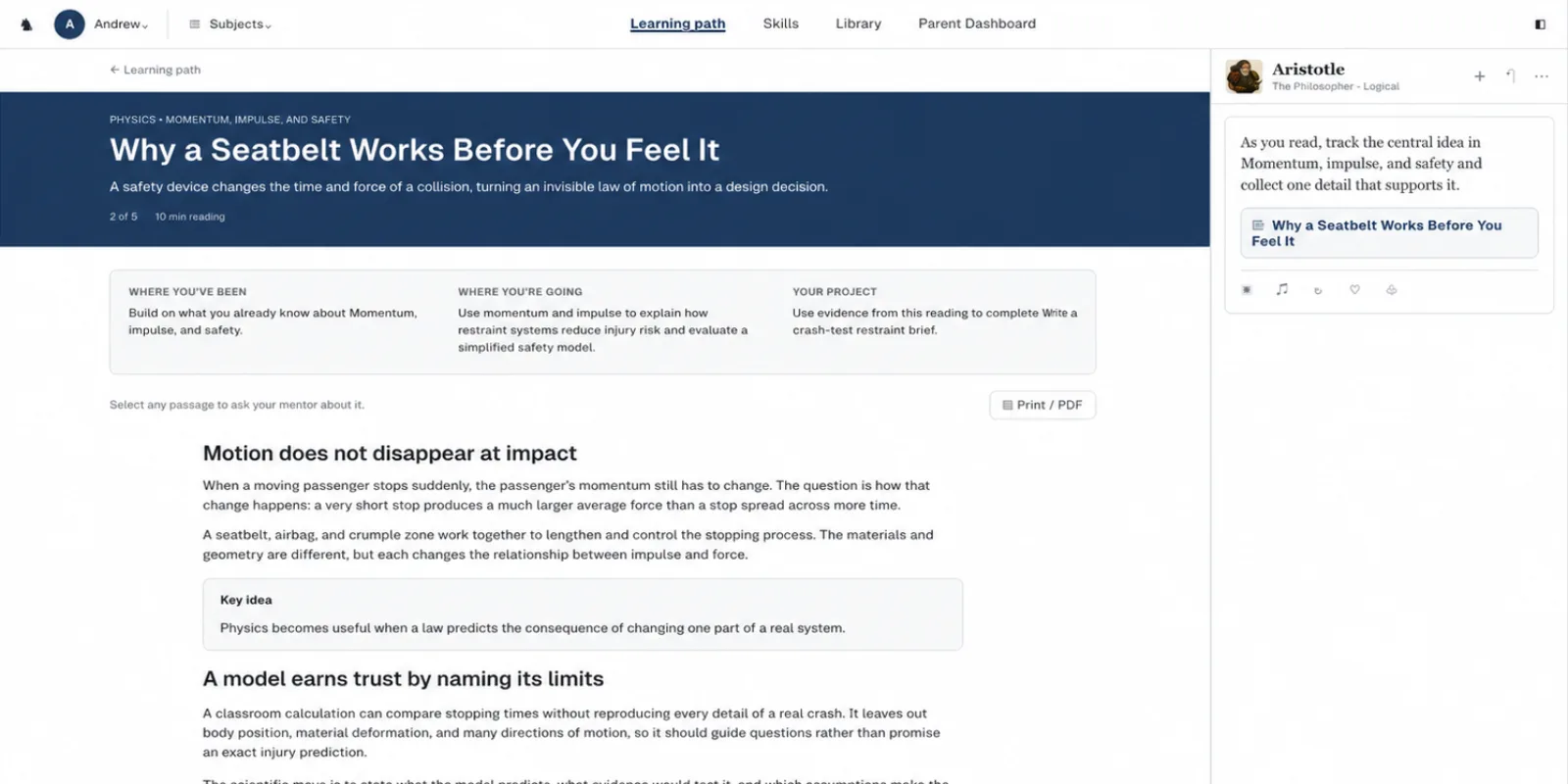
See what our mentor does beside your child's work: it answers questions about highlighted passages, offers help when they seem stuck, and explains a missed idea another way.
You signed up to give your kid a better education, not to personally explain fractions for the fourth time. What if you could direct your child's education without delivering every piece of it?
Every homeschool parent has a subject they dread. You chose to direct your child's education; you should not have to deliver every explanation, assignment, and correction yourself.
This essay argues that state education rewards expansion over outcomes, and asks what changes when teaching can begin from one child's skills.
Why a good curriculum can still need constant adjustments, and how lessons built from your child's starting level and interests change that work.
Apply Hayek's knowledge problem to education: what you know about your child can guide a course in ways a central plan cannot.
See today’s plan, completed lessons, grades, and feedback. Attendance is saved when your child checks in each day, and a weekly summary shows how the week went.

We prepare the next lesson from where your child is learning now, so you can spend less time preparing school and more time together.
$149/month per child after the trial.