The life skills that matter
Most adults can name the skills they wished school had taught them. Five come up again and again:
- Money: budgeting, how interest works, what debt costs, and how to compare a spending choice with a saving one.
- Critical thinking: judging sources, spotting weak arguments, and telling correlation from cause.
- Communication: writing a clear message, speaking to a group, and disagreeing without a fight.
- Practical know-how: reading a lease or a job offer, planning a trip, and basic cooking and home care.
- Self-management: setting a goal, breaking it into steps, and finishing it when it gets dull.
These are not extra subjects added to the day. They are skills that grow when a child does real work that uses them.
Why they are hard to teach as a list
A budgeting worksheet can teach vocabulary, but a decision shows how a child uses it. They might compare two ways to spend a fixed amount, trace a claim to its source, or explain a plan to someone who disagrees. A project leaves room to show the reasoning and the tradeoff, not just name the term.
What a life skills project looks like
A project gives the learner a question and asks for something to show at the end. A few examples a learner could choose:
- Plan a family event or trip on a fixed budget, compare options, and defend the final choice.
- Pick a claim from the news, trace it to its sources, and write what holds up and what does not.
- Design a small business idea, estimate costs and prices, and present it.
- Take a goal, such as learning a skill over eight weeks, and report on the plan and what actually happened.
Each one pulls in math, writing, and reasoning, and each leaves behind work a parent can read.
Let the decision have a constraint
For a family meal, a fixed budget and a set number of people give the learner something to work out. They can compare package sizes, calculate quantities, and decide what to change if the total is too high. Afterwards, comparing the plan with what was actually used gives the next attempt a useful starting point.
How our platform fits
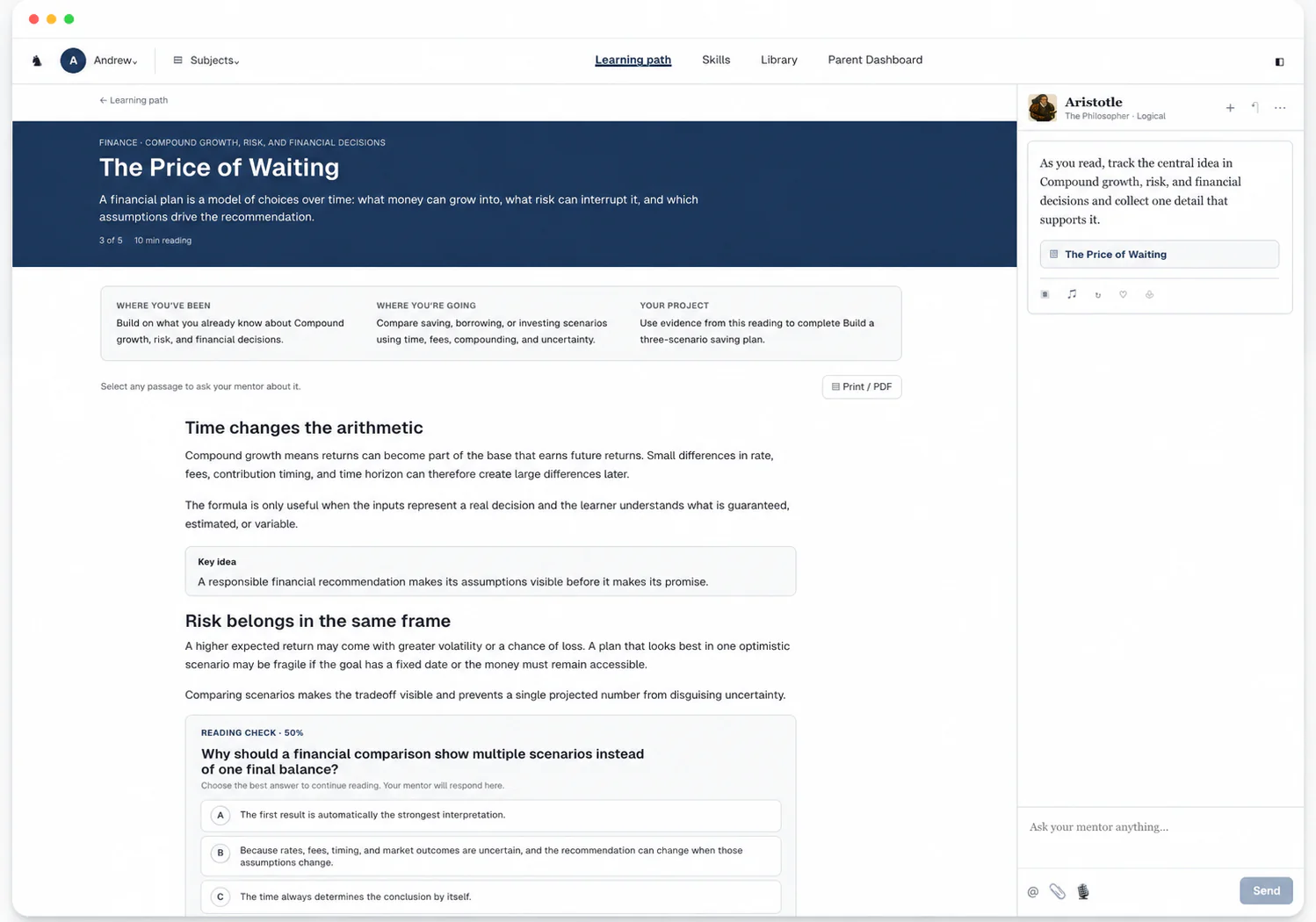
Placement, a short adaptive test, suggests a starting level, and lessons and projects can connect a skill to the child's interests. A cooking project might compare meal costs against a fixed budget; a sports project might ask the learner to chart data and explain a claim. The Always-On Mentor, software that stays open beside every project, guides each step without doing it for your child and offers help when they seem stuck. We grade everything your child submits as soon as they submit it, so grading never lands on you. When your child gets something wrong, we help them work through it, and projects come back with feedback they can revise from.
Money, writing, reasoning, and communication also appear across core subjects and electives, so life skills are not confined to a one-week unit. The child's work should show the decision, the evidence, and the explanation.