How homeschooling works here, from the first placement test through a school day to the records a state may ask for, plus the legal steps yours requires.
How homeschooling works with us
Homeschooling used to mean the parent became the teacher: choosing books, planning and teaching each lesson, marking every page, and filing the paperwork. With TheHomeschoolingCompany.com, we do that work. We find where your child starts in each subject, teach every lesson, grade the work, and save every record your state may ask for.
You decide what your child studies and when the school day happens. You also handle your state's legal steps, which in most states are a single notice or nothing at all, and we draft the paperwork for those too. The rest of your time goes back to being a parent instead of a lesson planner.
Most families use School in a Box, our full plan: up to 12 subjects at once for one child, from kindergarten through 12th grade. The rest of this guide follows a family from sign-up through the first weeks, then covers the law.
Setting up takes one sitting
Setup asks about your child, not about curriculum. It takes three steps:
- Tell us about your child. Their name and age, the things they love, where they tend to get stuck, what helps them learn, and what you would love them to accomplish this year. For kindergarten through 2nd grade, you also say which early reading and math skills they can do alone, with help, or not yet.
- Choose subjects and a mentor. Math, English language arts, science, and history come first; add electives, world languages, or any topic your child cares about, which we build as a custom elective. You and your child pick a mentor, a historical figure such as Aristotle, who will work beside them.
- Start the 14-day free trial, then placement. Your child can begin the first lessons the same day.
Placement finds where your child starts in each subject
Your child's grade on paper and the level they can actually work at often differ, especially in math. A child finishing 5th grade may be solid on multiplication and shaky on fractions. If they start 6th grade math just because they turned 11, the whole next year is built on that gap.
To start your child where they actually are, each subject begins with a placement test. The questions adapt as they answer, finding where they are ready to begin within the subject. It is 25 questions and untimed; for kindergarten through 2nd grade it is 12 questions, and every question and answer is read aloud.
Each subject gets its own starting point within a grade, with the skills your child already knows skipped and earlier gaps first. A child can start math a grade ahead and writing a grade behind, and you confirm any move away from the grade you gave us before the course is built.
If a starting point turns out wrong, your child can retake placement. A retake keeps the work your child already finished.
What a school day looks like
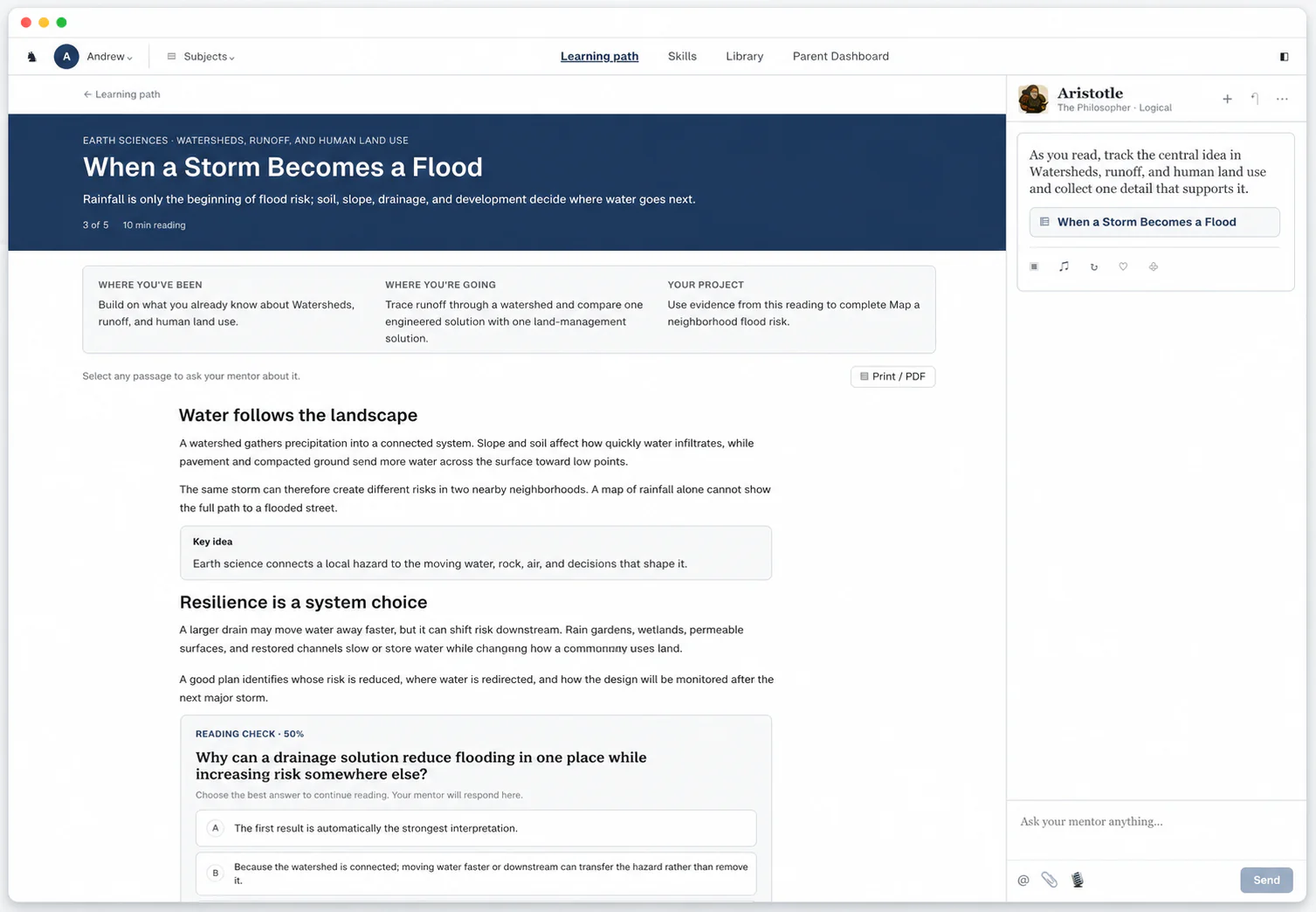
There are no live class times, so school happens whenever suits your family: mornings, afternoons, or around a parent's shift. Your child checks in for the day, which starts the attendance record, and opens the next lesson on their path in each subject. Their home screen shows today's learning goal in minutes and what is planned.
Each lesson is an interactive article written for your child, with images and videos made for them. The article weaves in your child's interests, so a child who loves soccer might meet ratios through passing statistics while the math stays the point.
It opens by saying what your child already knows, where it is going, and which project it leads to, and notes in the margin tie the idea to what they learned before.
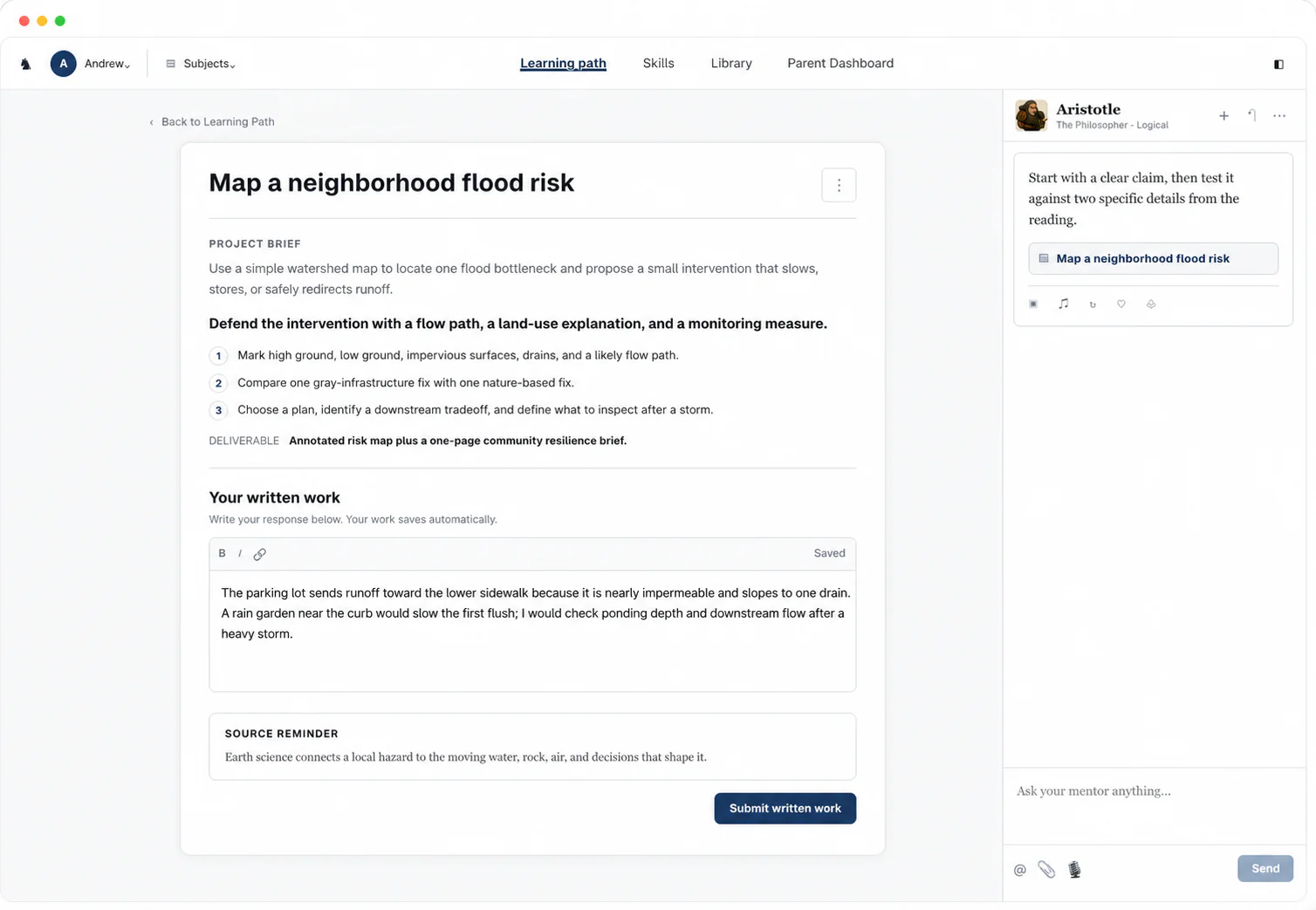
Questions throughout the article keep your child curious, progress checks along the way make sure each idea lands, and a reading check at the end decides whether they move on. Then comes a project built on the article where your child applies the idea, and problems your child works through with the mentor, back and forth until the idea clicks.
If you want a fixed rhythm, the weekly schedule builds one: pick the days, a start time, and how many minutes a day, and it lays out blocks that rotate through your child's subjects. Your child sees the plan as today's list, and you can print the week to keep on the fridge.
Notes your child can find again
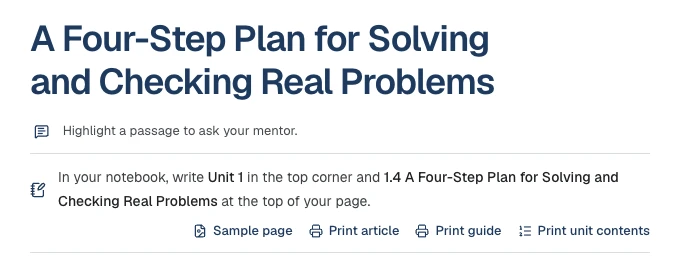
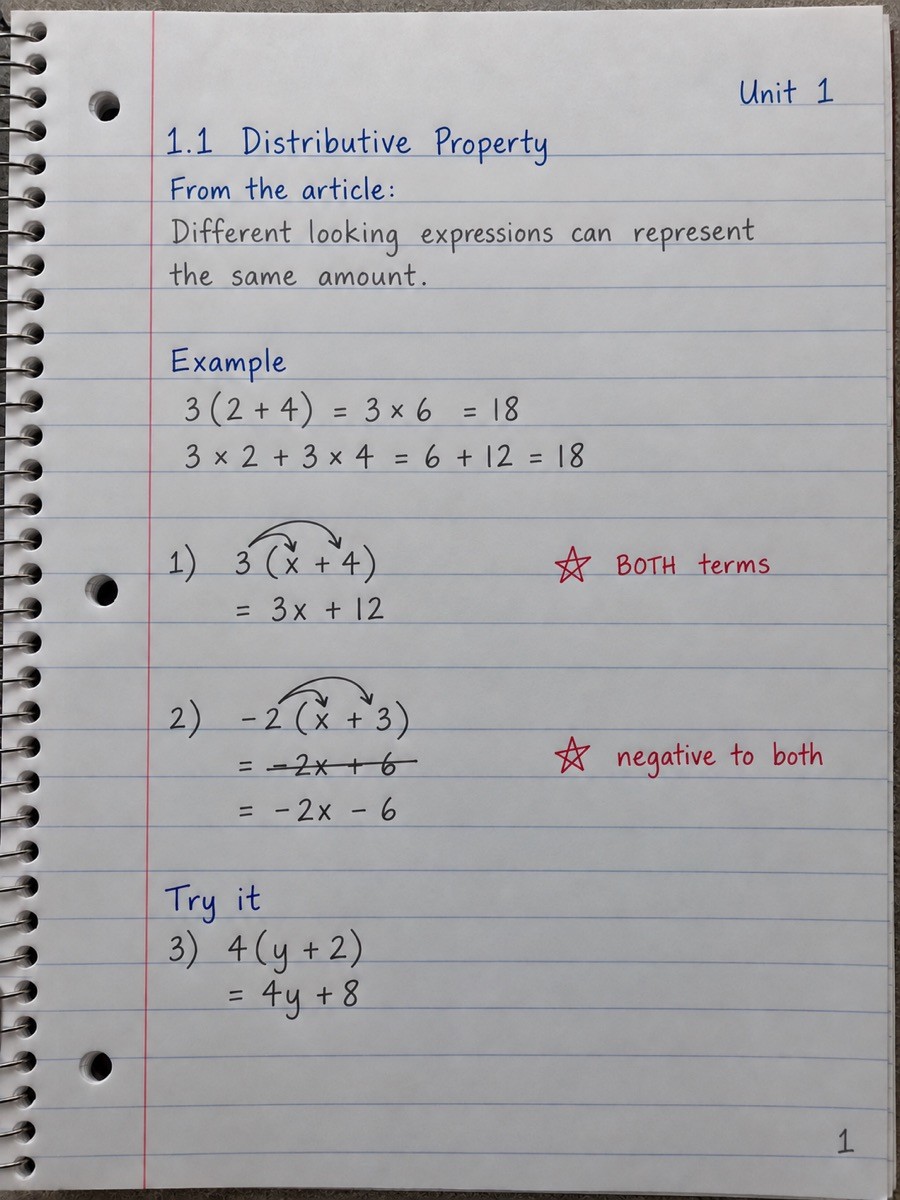
From Grade 3, every reading includes an optional notebook guide with tips for keeping useful notes. It encourages your child to add lesson headings and unit names and put ideas into their own words, so they can return to a worked example or a question later.
The printable guide offers ways to gather notes into a review sheet, including starring an idea worth remembering. Your child can scan and upload notebook pages to save their takeaways. Takeaways from places they struggled can also shape later practice problems.
When your child is stuck, help is already there
Our Always-On Mentor, the guide built into every subject, is open on your child's screen through the whole school day, so your child never waits for an adult to free up.
They can highlight any sentence and ask about it, hear a hard word pronounced, or ask the mentor to make it visual, and the mentor draws the idea step by step on its board.
It also steps in on its own: when it looks like your child is having a hard time, the mentor offers help without being asked. After a wrong answer, it explains the idea a different way.
On a project, it helps your child think through the next step without writing the answer for them, and during a reading check it answers questions about the ideas without giving the answer away.
For kindergarten through 2nd grade the mentor is voice-only: your child talks, and it answers out loud.
Grading and what you see
We grade everything your child submits as soon as they submit it, so grading never lands on you. When your child gets something wrong, we help them work through it, and projects come back with feedback they can revise from.
Our Parent Dashboard is your view of each child, behind its own PIN so your child's login cannot open it. It shows the week at a glance, today's lessons and which are done, every grade with its feedback, progress in each subject, and attendance.
A short list called Needs you brings up what actually needs you, such as records that are ready or a moment when your child asked the mentor for an answer or said something worrying to it.

What your child studies
Every plan starts with the four core subjects: math, English language arts, science, and history. From 3rd through 12th grade, the catalog adds electives such as Spanish, computer science, economics, psychology, art, and engineering, plus SAT and ACT prep and advanced courses built on AP frameworks for high schoolers.
On School in a Box, your child can also take a custom elective on anything, from marine biology to Roman engineering, built with its own readings and projects.
Kindergarten through 2nd grade is its own program, called Foundations: reading, writing, math, and science and history, with every lesson read aloud. Reading lessons use only the words your child can already sound out, so your child can read every word in them.
Many states list subjects a homeschool must cover, usually reading, writing, math, science, and history or civics, which the core subjects cover. Where a state adds more, such as health, physical education, or art in New York, those are electives in our catalog.
Your state's legal steps
Homeschooling is legal in every state, and each state writes its own rules. They fall into four rough groups.
- No notice at all. Texas, Idaho, Illinois, Michigan, Alaska, Oklahoma, and Connecticut ask you to teach the required subjects but not to file anything.
- A notice and little else. Arkansas and Mississippi want a notice by August 15 each year, Wisconsin an online enrollment report between July 1 and October 15, and Utah a one-time notification.
- A notice plus testing or an evaluation. Florida asks for a notice within 30 days of starting and a yearly evaluation. North Carolina wants a notice five business days before you start and a standardized test every year. Georgia tests every three years from the end of 3rd grade, and Colorado in grades 3, 5, 7, 9, and 11.
- More oversight. New York asks for a letter of intent by July 1, an individualized home instruction plan, four quarterly reports, and a yearly assessment. Pennsylvania wants a yearly affidavit, a portfolio, testing in grades 3, 5, and 8, and an evaluator's certificate by June 30.
Our requirements checker shows your own state's steps. Whatever they are, the document tools draft the documents your state uses, from a letter of intent or New York's home instruction plan to quarterly reports, filled in from your family's details and your child's record and ready for your signature.
Parent qualifications rarely stand in the way. Most states set none. Georgia and New Mexico require the teaching parent to have a high school diploma or its equivalent, and Washington and North Dakota have their own short lists.
Leaving school the right way
If your child is enrolled in a public or private school, withdraw them in writing before the first homeschool day. Do not simply stop sending them: an enrolled child who stops attending can be marked truant, which can bring calls or a referral before your paperwork catches up.
A few states set the order or timing. North Carolina asks you to file your notice and wait for the state to acknowledge it before you withdraw. Ohio wants its notice within five days of withdrawing, and Oregon within ten days. In Texas, a signed letter to the school is the whole step.
We draft the withdrawal letter for you. Ask the school for your child's records as you leave, including report cards, test scores, and any IEP or 504 plan, so you have them if your child ever returns or needs high school credit. If you are leaving in the middle of a term, our guide to starting mid-year covers half-finished courses.
Records your state may ask for, already kept
Records matter when your state, a district, an evaluator, or a college asks what your child did. The record builds itself. The daily check-in and your child's activity build the attendance log. Every graded project is saved with its feedback. Hours are counted for each subject from the lessons your child completes.
From our Parent Dashboard you can download an attendance PDF, a learning summary, or the whole record in one export, and generate a portfolio or a quarterly report when your state wants one. In high school, the same record becomes the transcript; our guide to homeschooling high school shows how.
The first two weeks
Nothing here requires buying a year of materials or building a plan.
- Day one: look up your state's steps, sign up, and tell us about your child. If your state wants a notice before you start, generate it and send it first.
- Days one to three: placement, then the first lessons. Withdraw from school in writing if your child is enrolled.
- The first week: your child works through lessons on whatever schedule you like, and the first grades and feedback appear in our Parent Dashboard.
- The second week: set a weekly rhythm in the plan if a fixed routine helps your family. If a subject feels too easy or too hard, your child can retake its placement.
- Day 14: the trial ends and normal billing begins, with two weeks of real graded work to judge it by.
Frequently asked questions
- Do I need a teaching degree to homeschool?
- No state requires one for the main homeschool route. Alabama asks for teaching certification only on its private-tutor option, and families there usually homeschool through a church school instead.
- Do I need to join an umbrella school or a homeschool group?
- Usually not. Most states allow independent homeschooling. Alabama's main route runs through a church school, and South Carolina families join a qualifying homeschool association.
- Can I homeschool if I work full time?
- Yes. With no live class times, your child can work mornings, evenings, or weekends around your hours, and the mentor is there when you are not.
- What does my child need to get started?
- A computer or tablet with internet, and a quiet place to work. Younger children also use paper and pencil for handwriting, and a photo of the page goes into their work.
Your child's first lessons, this week
Every subject begins where your child is ready, and the record builds itself from the first day.
$149/month per child after the trial.