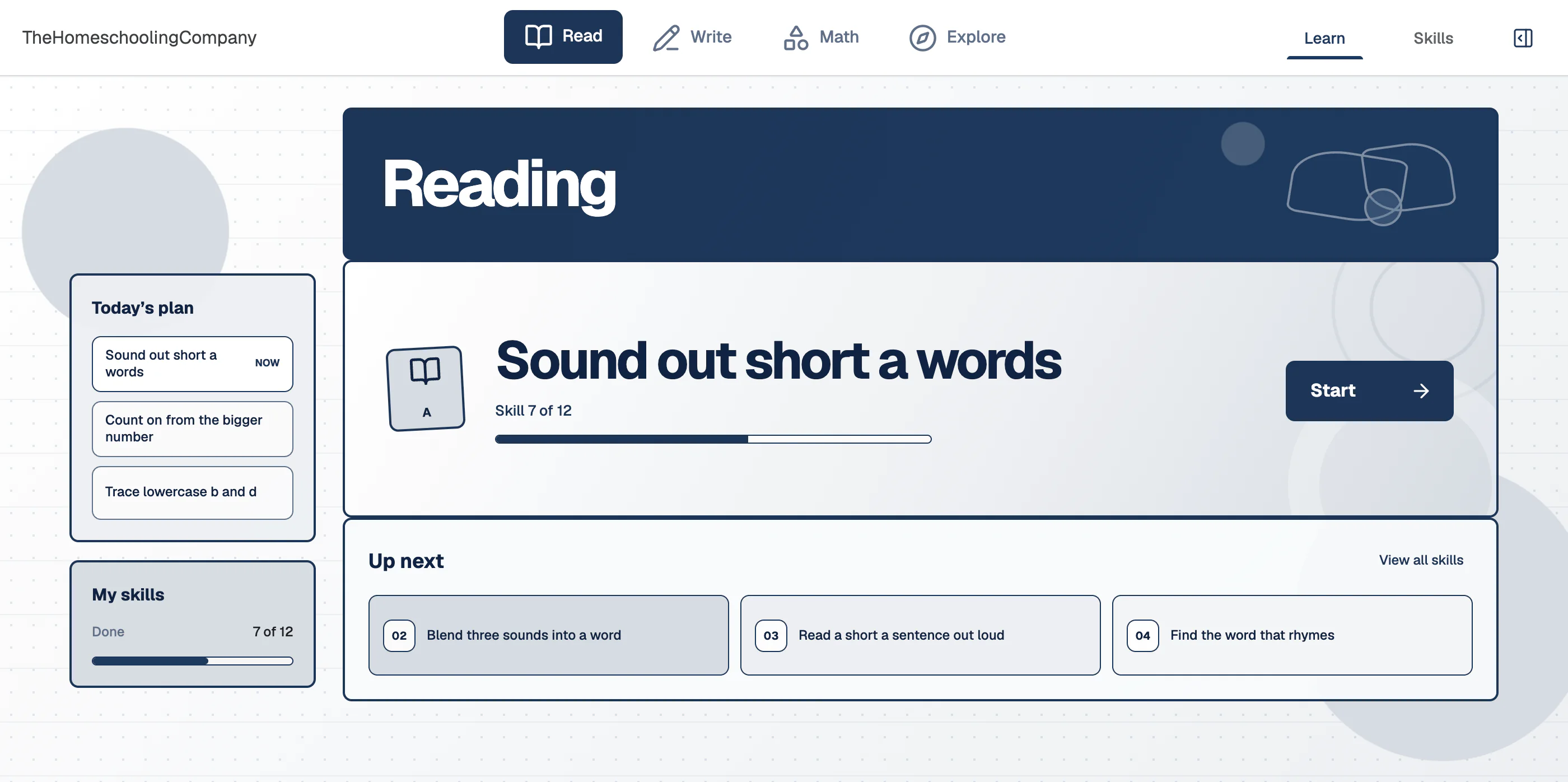
K–2 lessons built around your child.
Lessons use the things your child loves. Instructions are read aloud, and your child answers by voice or tap, with an adult nearby.
Choose the subjects your child needs. We set the starting level, write the lessons, and grade the work.
Lessons use the things your child loves. Instructions are read aloud, and your child answers by voice or tap, with an adult nearby.
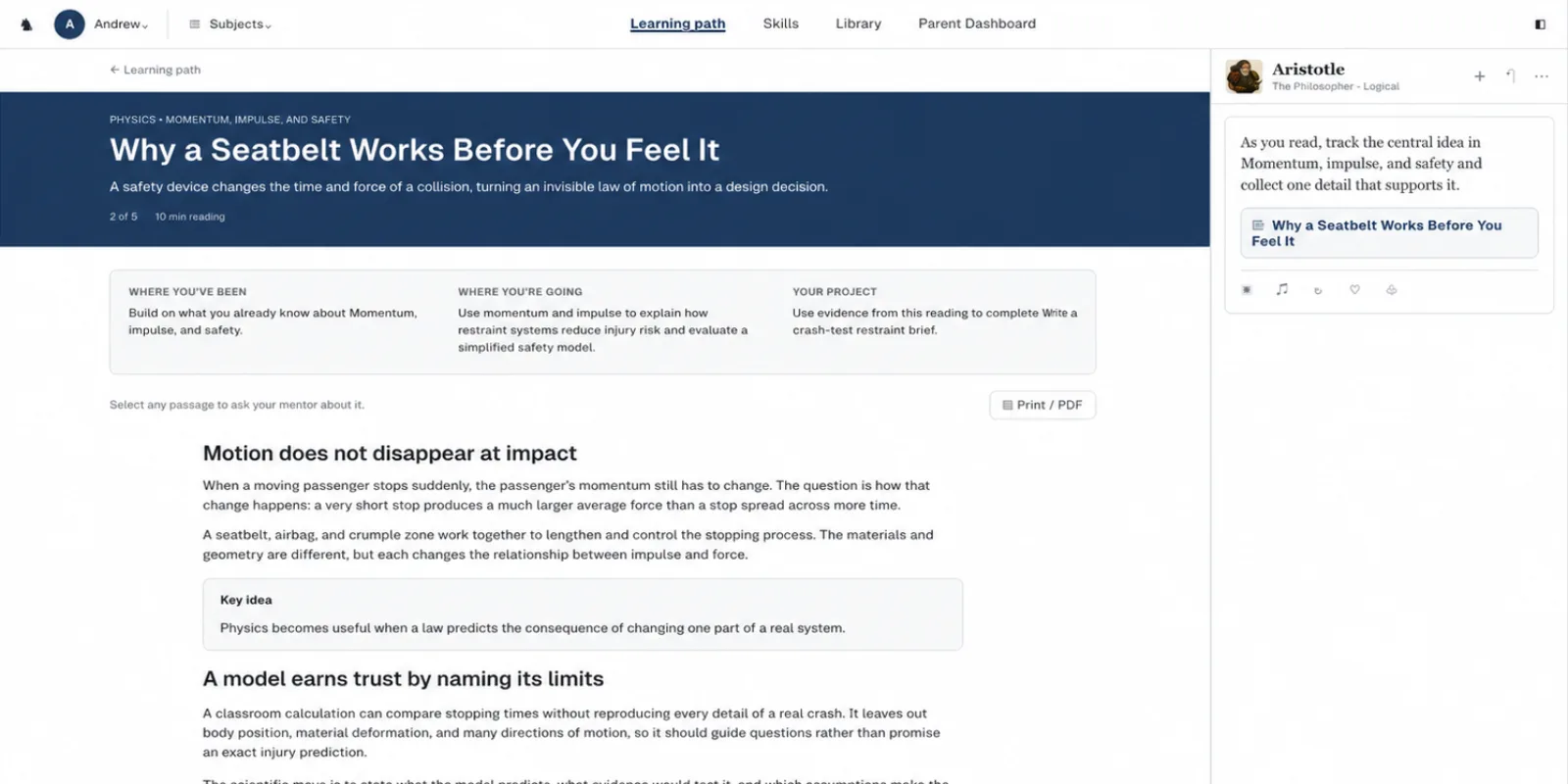
Every subject is a full sequence of lessons, starting at your child's level. Your child reads and answers checks as they go, and each check is graded the moment they submit it.
Choose a grade
Core subjects, electives, and advanced courses.
Solve equations, graph relationships, and explain each step, with lesson help and feedback when you get stuck.
Use limits, derivatives, and integrals to explain rates of change and accumulated quantities.
Draw and measure shapes, calculate area and volume, and explain each step in a geometric proof.
Build number sense, work with shapes and data, and strengthen the skills your child needs for algebra.
Compare samples, calculate probability, and decide which conclusions the data support.
AP course: Limits, differentiation, applications of derivatives, integration, differential equations, and applications of integration.
AP course: Differentiation and integration, differential equations, parametric equations, polar coordinates, vector-valued functions, and series.
AP course: Polynomial and rational functions, exponential and logarithmic functions, trigonometric functions, rates of change, model selection, and multiple representations.
AP course: Exploring data, collecting data, probability, random variables, sampling distributions, and inference.
Study planets, stars, and galaxies through observations, scale models, and space imagery.
Trace how cells, heredity, and ecosystems work, then use evidence to explain changes in living systems.
Explain how particles interact, balance reactions, and calculate the quantities a reaction needs.
Read maps and weather data, explain Earth’s changing systems, and distinguish evidence from a prediction.
Study how atomic structure affects a material's strength and behavior, then test which materials suit an engineering problem.
Use forces, motion, and energy to make predictions and explain what observations show.
Build scientific thinking through evidence, models, investigation, explanation, and a clear path into specialized science courses.
AP course: Chemistry of life, cells and energetics, heredity, gene expression, evolution, and ecology.
AP course: Atomic structure, molecular structure, reactions, kinetics, equilibrium, and thermodynamics.
AP course: Ecosystems, biodiversity, earth systems, land and water use, pollution, and global change.
AP course: Kinematics, forces, energy, momentum, rotation, and oscillations and fluids.
AP course: Thermodynamics, electric fields, circuits, magnetism, optics and waves, and modern physics.
AP course: Electrostatics, conductors and capacitors, circuits, magnetic fields, induction, and field modeling.
AP course: Kinematics, dynamics, energy, momentum, rotation, and oscillations and gravitation.
Your student learns to get far more done with AI: learn faster, research and write with sources, build working tools, and automate the busywork, while checking every result
Write, test, and debug programs, then explain the algorithms behind them.
Read circuit diagrams, calculate electrical quantities, and reason through why a circuit works or fails.
Manufacturing Engineering for grades 6-12. Your child learns how real things get made, then designs a process that can make them reliably, affordably, and at scale.
Learn the engineering behind machines by designing, analyzing, testing, and improving systems that have to work.
AP course: Types and objects, control flow, classes, arrays and arraylist, two-dimensional arrays, and code analysis.
AP course: Creative development, data, algorithms, programming, networks, and impact of computing.
Compare cultural traditions and accounts from different perspectives, then use evidence to question your first interpretation.
Read closely, support an interpretation with evidence, and revise writing for meaning and clarity.
Read and make maps, compare regions, and explain how people and environments shape one another.
Compare primary sources, trace causes and consequences, and defend a historical argument with evidence.
State a claim clearly, test its assumptions, and answer the strongest objection to it.
Compare political institutions, examine policy arguments, and explain how public decisions get made.
Examine how psychological studies test a claim, interpret their results, and consider other explanations.
Trace how a public decision gets made, apply constitutional rights to a case, and explain how citizens can respond.
AP course: African diaspora, enslavement and resistance, freedom movements, source analysis, material culture, and student project.
AP course: Regimes, institutions, participation, political culture, policy, and comparative analysis.
AP course: Rhetorical situation, claims and evidence, reasoning, style, synthesis, and argument.
AP course: Close reading, character, structure, narration, figurative language, and literary argument.
AP course: Renaissance and reform, states and science, industrialization, revolution, global conflict, and historical argument.
AP course: Geographic thinking, population, culture, political space, cities, and development.
AP course: Biological bases, cognition, development, social psychology, mental health, and research methods.
AP course: Research question, literature review, method, ethics, analysis, and paper and defense.
AP course: Question and explore, analyze arguments, evaluate perspectives, synthesize, team inquiry, and oral defense.
AP course: Foundations, branches, civil rights and liberties, political ideology, participation, and policy.
AP course: Colonial worlds, revolution and nation, expansion and civil war, industrialization, global conflict, and modern america.
AP course: Global tapestry, networks of exchange, empires, revolutions, industrialization, and global conflict.
Build Italian speaking, listening, reading, and writing skills through a progressive CEFR-aligned course
Build Spanish speaking, listening, reading, and writing skills through a progressive CEFR-aligned course
AP course: Interpretive reading, interpretive listening, interpersonal writing, interpersonal speaking, presentational writing, and presentational speaking.
AP course: Interpretive reading, interpretive listening, conversation, email reply, persuasive writing, and cultural presentation.
AP course: Interpretive reading, interpretive listening, conversation, interpersonal writing, persuasive writing, and cultural presentation.
AP course: Interpretive reading, interpretive listening, conversation, email reply, persuasive writing, and cultural comparison.
AP course: Interpretive reading, interpretive listening, interpersonal writing, conversation, presentational writing, and cultural presentation.
AP course: Vergil, pliny, sight reading, translation, meter, and textual analysis.
AP course: Medieval literature, golden age, modern literature, poetry, prose and drama, and comparative analysis.
Use supply, demand, and incentives to explain choices and weigh the effects of an economic policy.
Test a business idea against customer needs, estimate costs, and revise the plan when the evidence changes.
Build a budget, calculate compound interest, and compare the costs and risks of financial choices.
AP course: Economic indicators, aggregate demand and supply, fiscal policy, monetary policy, financial sector, and open economy.
AP course: Supply and demand, elasticity, production and cost, market structures, factor markets, and market failure.
Develop an artwork, make deliberate choices about technique and composition, and revise it after feedback.
Build a clear argument, adapt it for an audience, and revise a speech or media project after feedback.
AP course: Sustained investigation, design principles, materials and processes, iteration, written evidence, and selected works.
AP course: Form and volume, space and site, structure, fabrication, iteration, and portfolio presentation.
AP course: Visual analysis, context, comparison, attribution, global traditions, and contemporary art.
AP course: Line and mark, light and value, composition, observation, abstraction, and sustained investigation.
AP course: Pitch and rhythm, harmony, voice leading, form, aural dictation, and sight singing.
Check health claims, work through safety scenarios, and learn when to ask a trusted adult or qualified professional.
Apply biology to medical case studies, examine evidence, and explore how healthcare professionals make decisions.
Study movement, training, and recovery, then explain the choices in a fitness plan.
Adaptive ACT practice for English, Math, Reading, optional Science, and optional Writing
Draw a scaled space plan, weigh structural and environmental constraints, and revise the design.
Read a legal case, identify the rule that applies, and build an argument that addresses both sides.
Daily SAT practice, targeted review, and explanations that turn weak spots into a plan
Advanced courses follow AP frameworks. See the AP course guide.
Name their topic in the subject search during setup and choose it as a custom subject. We build units, lessons, and projects, starting at your child’s level.
Your child reads, answers checks, and completes projects on that topic, with the mentor beside every reading to answer questions and sketch ideas on its board. As in every course, each submission is graded the moment it arrives, with written feedback, so grading never lands on you.
A custom elective can stand on its own or sit alongside the core subjects in a multi-subject curriculum.
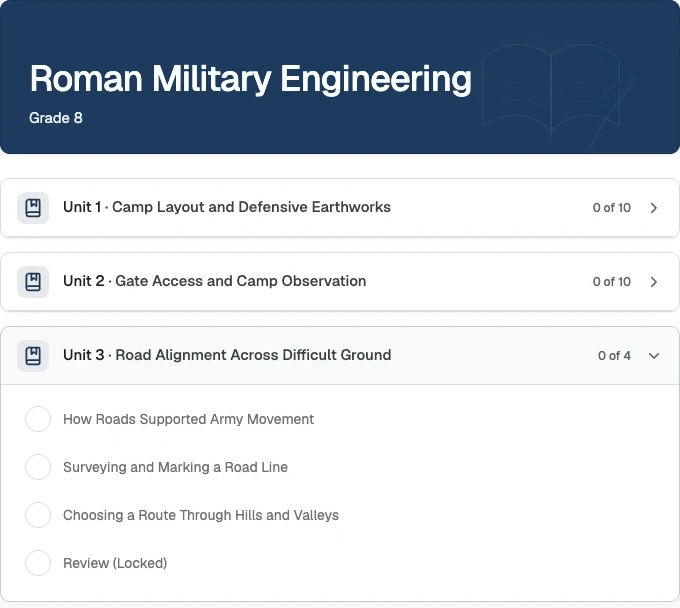
Choose a core subject, an advanced course, or a custom elective. Each becomes a full course, starting at your child’s level.
$49/month for one subject or $149/month per child for up to 12 subjects after the trial.