7th grade homeschool curriculum
A full curriculum, starting at your child's level, with lessons connected to their interests and progress you can see.
See the work in 7th grade
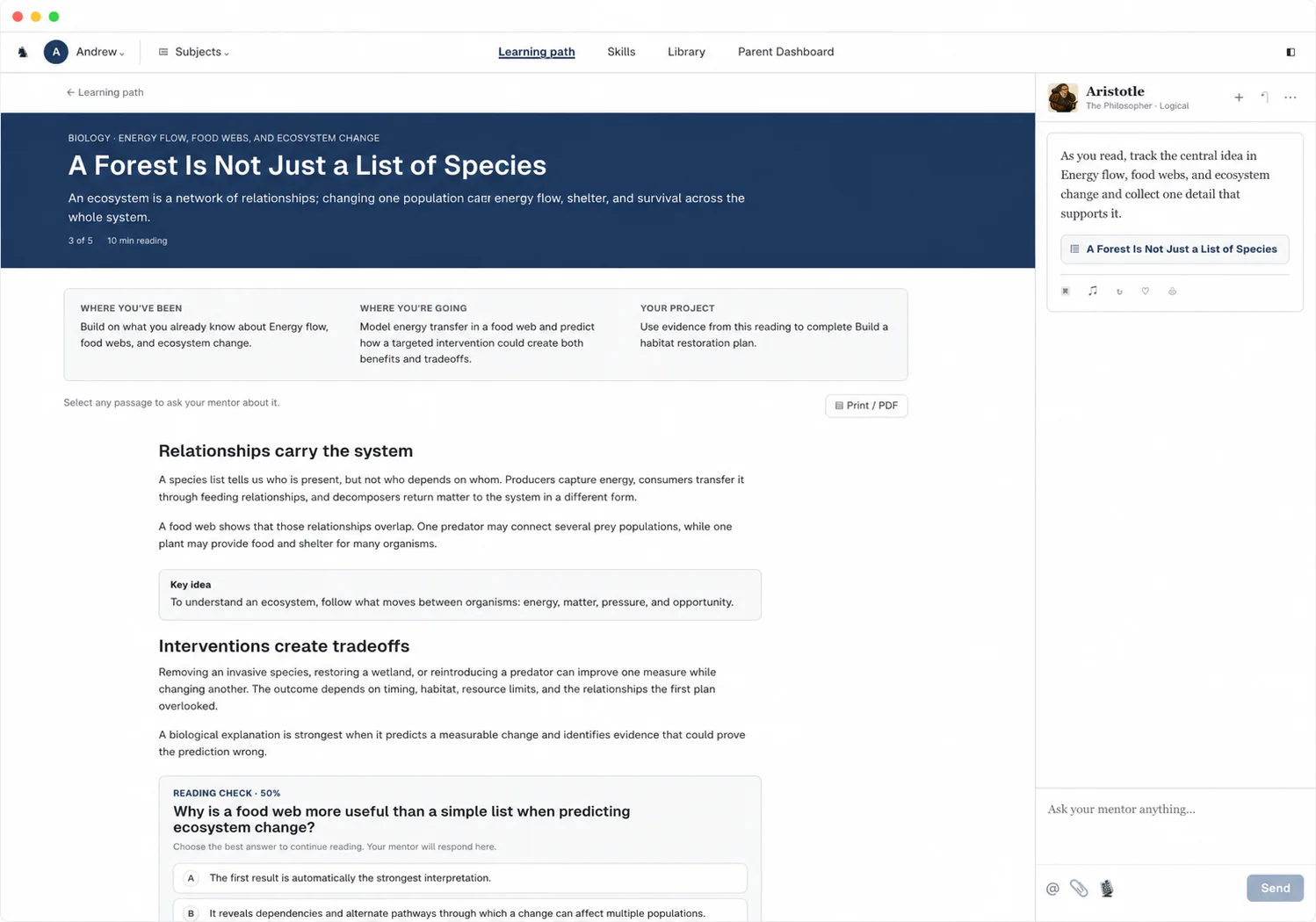
An ecosystem is a network of relationships; changing one population can change energy flow, shelter, and survival across the whole system.
- Lesson
- A Forest Is Not Just a List of Species
- Goal
- Model energy transfer in a food web and predict how a targeted intervention could create both benefits and tradeoffs.
- Project
- Build a habitat restoration plan
Your parent dashboard
- Today
- Each subject's lesson, and whether it's done
- Grades
- Every submission graded instantly, with written feedback, so you never grade
- Records
- Attendance log and learning summary, ready to export
- Documents
- Transcripts and state-aware compliance drafts, written for you and ready to sign

7th grade scope and sequence
Math12 units · 54 skills
Proportional relationships6 skills
- Identify a proportional relationship from a table
- Find the constant of proportionality
- Write a proportional equation from a context
- Graph a proportional relationship through the origin
- Use slope as a unit rate
- Compare proportional relationships across forms
Rational number operations5 skills
- Add rational numbers with opposite signs
- Subtract rational numbers using distance
- Multiply signed fractions in a context
- Divide signed rational numbers
- Explain why signs change in multiplication and division
Linear equations and inequalities5 skills
- Solve a two-step equation with rational coefficients
- Solve an equation with variables on both sides
- Write an inequality from a constraint
- Graph a one-variable inequality
- Check a solution against the original context
Percents and financial reasoning4 skills
- Solve a percent increase problem
- Solve a percent decrease problem
- Find simple interest over time
- Compare markup, discount, tax, and tip situations
Angles, circles, and scale5 skills
- Use angle relationships to find an unknown measure
- Find circumference from diameter
- Find area of a circle
- Use scale factor to compare side lengths
- Solve a composite-area problem with circles and polygons
Probability models4 skills
- Find theoretical probability from equally likely outcomes
- Estimate probability from repeated trials
- Use a tree diagram for compound events
- Compare experimental and theoretical probability
Sampling and inference4 skills
- Use a random sample to estimate a population value
- Compare two data distributions by center and spread
- Identify a biased sampling method
- Write a cautious inference from sample data
Linear model introduction4 skills
- Find slope from two points
- Interpret y-intercept in a context
- Write a line from a table
- Compare linear and nonlinear patterns
Mathematical reasoning4 skills
- Break a percent problem into smaller steps
- Use units to catch a wrong answer
- Explain why two proportional methods agree
- Choose a graph that matches a situation
Equation and geometry transfer4 skills
- Write an equation for an angle relationship
- Use an equation to find a scale length
- Model perimeter with a linear expression
- Connect circle formulas to proportional reasoning
Data project4 skills
- Design a sampling question
- Collect and display sample data
- Compare two groups using medians
- Defend a conclusion with sampling limits
Math capstone5 skills
- Solve a proportional finance problem
- Build and interpret a probability model
- Defend a geometry solution with equations
- Critique a statistical claim from a sample
- Present a connected Grade 7 math solution
Reading6 units · 47 skills
Literary reading10 skills
- Identify theme from repeated details
- Explain character motivation
- Analyze how setting shapes conflict
- Interpret figurative language in context
- Compare narrator perspective
- Analyze symbolism
- Trace conflict development
- Compare character arcs
- Analyze how dialogue reveals character
- Infer character change from dialogue
Informational reading8 skills
- Identify central idea
- Trace an author's claim
- Distinguish evidence from commentary
- Summarize a section objectively
- Evaluate source credibility
- Identify text structure
- Evaluate evidence relevance
- Analyze author's assumptions
Media and multimodal reading7 skills
- Interpret a chart embedded in an article
- Connect image evidence to a text claim
- Evaluate a caption's relationship to an image
- Compare video and print accounts of an event
- Evaluate scale in an infographic
- Interpret a timeline embedded in text
- Compare headline and article evidence
Vocabulary7 skills
- Use context clues for an unfamiliar word
- Identify connotation
- Distinguish denotation from connotation
- Use word parts to infer meaning
- Infer meaning from analogy
- Use roots and affixes
- Identify figurative versus literal meaning
Evidence8 skills
- Quote textual evidence accurately
- Paraphrase evidence without changing meaning
- Connect evidence to an inference
- Compare evidence across two texts
- Rank evidence by strength
- Explain why evidence is relevant
- Integrate evidence across genres
- Use two pieces of evidence for one inference
Fluency and text complexity7 skills
- Read grade-level prose with appropriate pacing
- Use punctuation to guide oral phrasing
- Identify sentence complexity in a passage
- Use background knowledge to prepare for a difficult text
- Use paragraph structure to plan reading pace
- Identify unfamiliar syntax before rereading
- Use repeated reading to improve accuracy
English language arts12 units · 52 skills
Literary analysis5 skills
- Analyze how setting and conflict shape character choices
- Trace theme development across a story
- Compare two narrators' points of view
- Explain how imagery shapes mood
- Use embedded quotations in a literary claim
Informational claims and evidence5 skills
- Identify claim, reason, and evidence in an article
- Distinguish strong evidence from interesting detail
- Trace how headings and sections organize an argument
- Compare two authors' explanations of one issue
- Identify loaded language in an informational text
Rhetoric introduction4 skills
- Identify audience and purpose in a speech or editorial
- Explain how repetition emphasizes a point
- Identify appeal to emotion, credibility, or logic
- Evaluate whether a rhetorical choice fits the audience
Grammar and style4 skills
- Use phrases and clauses to add detail
- Edit comma use with coordinate adjectives
- Vary sentence openings for flow
- Choose active verbs over vague verbs
Argument writing5 skills
- Write a claim with two supporting reasons
- Use evidence from multiple sources
- Explain a counterargument fairly
- Write a conclusion that extends the argument
- Revise evidence order for stronger logic
Informational writing4 skills
- Organize an explanation with categories
- Use definitions and examples to teach a concept
- Integrate a quotation smoothly
- Write transitions that show cause and effect
Narrative craft4 skills
- Use point of view deliberately
- Develop a scene with dialogue and action
- Use pacing to build tension
- Revise a narrative for voice
Source-based research4 skills
- Narrow a research question after background reading
- Evaluate source credibility for author and purpose
- Paraphrase evidence with citation
- Group notes by subtopic
Academic discussion4 skills
- Prepare a discussion question that invites evidence
- Connect a comment to another speaker's idea
- Use evidence in a discussion response
- Disagree with a reason and text support
Media literacy4 skills
- Analyze how visuals shape a message
- Compare a news story and opinion piece
- Identify sponsored or persuasive content
- Check a media claim against a source
Revision and editing4 skills
- Revise for precise academic vocabulary
- Edit pronoun-antecedent agreement
- Fix sentence fragments and run-ons
- Strengthen transitions among paragraphs
ELA capstone5 skills
- Write a multi-paragraph literary analysis
- Write a source-based argument
- Present research findings clearly
- Revise a piece through two drafts
- Defend evidence choices in a portfolio reflection
Science12 units · 53 skills
Cell structure and function5 skills
- Identify cell membrane, nucleus, cytoplasm, mitochondria, and chloroplast roles
- Compare plant and animal cells
- Use a microscope image to make a cell claim
- Explain how cell structures support life processes
- Distinguish unicellular and multicellular organization
Energy in organisms5 skills
- Trace energy through producers and consumers
- Explain photosynthesis as matter and energy change
- Explain cellular respiration at a middle-school level
- Compare food webs and energy pyramids
- Predict effects of reduced producer population
Genetics and inheritance5 skills
- Distinguish inherited and acquired traits
- Use a Punnett square for a simple trait
- Explain genotype and phenotype in a family example
- Describe mutation as a DNA change
- Interpret a pedigree for a single trait
Human body systems4 skills
- Explain how circulatory and respiratory systems interact
- Describe digestion as matter breakdown and absorption
- Explain nervous-system signaling in a reflex
- Connect exercise to body-system responses
Evolution and adaptation5 skills
- Explain natural selection with variation and environment
- Use fossil evidence to infer change over time
- Compare structural and behavioral adaptations
- Distinguish individual survival from population change
- Interpret a simple evolutionary tree
Ecosystem dynamics4 skills
- Model competition, predation, and mutualism
- Explain carrying capacity with limiting factors
- Use population data to identify a trend
- Predict effects of invasive species
Microbes and health4 skills
- Distinguish bacteria, viruses, and fungi
- Explain how vaccines prepare immune response
- Describe antibiotic resistance as selection
- Evaluate hygiene claims with evidence
Earth and life connections4 skills
- Connect climate patterns to biome distribution
- Explain how water availability shapes ecosystems
- Use a map to compare biodiversity patterns
- Describe human impacts on habitat change
Biotechnology introduction4 skills
- Explain selective breeding with examples
- Interpret a simple DNA fingerprint pattern
- Compare benefits and risks of a biotechnology use
- Use evidence to discuss genetic privacy
Life science investigation4 skills
- Design an investigation with living or model organisms
- Control variables in a growth experiment
- Use repeated measurements for organism data
- Write a claim about a biological pattern
Engineering for living systems4 skills
- Define a problem related to health or ecosystems
- Design a model solution with biological constraints
- Test a prototype using organism or ecosystem criteria
- Revise a design from data
Science capstone5 skills
- Explain an organism system with cells, traits, and environment
- Use data to defend an ecosystem claim
- Compare two biological explanations
- Discuss limits of a life-science model
- Present a Grade 7 evidence argument
History12 units · 54 skills
Post-classical historical methods5 skills
- Explain periodization by distinguishing ancient, medieval, post-classical, and early modern labels
- Use maps to compare political fragmentation, trade routes, religious zones, and empire boundaries
- Corroborate a travel account with a map, artifact, legal source, or later interpretation
- Identify continuity and change across 500-1750 without treating Europe as the whole story
- Defend a Grade 7 historical claim about post-classical historical methods using conflicting evidence
Byzantine and Islamic worlds4 skills
- Explain Byzantine preservation, Orthodox Christianity, Justinian law, and imperial geography
- Trace the rise of Islam through Arabian context, revelation, community, and caliphate expansion
- Analyze Abbasid Baghdad as a center of translation, science, trade, and administration
- Compare Sunni-Shia divisions, legal traditions, and political authority in Islamic history
African kingdoms and trade5 skills
- Explain Ghana, Mali, and Songhai through gold-salt trade, Islam, taxation, and geography
- Analyze Mansa Musa's pilgrimage as evidence of wealth, faith, diplomacy, and global connection
- Compare Swahili coast city-states through Indian Ocean trade, Islam, language, and architecture
- Use oral tradition and archaeology to reason carefully about African political history
- Defend a Grade 7 historical claim about african kingdoms and trade using conflicting evidence
Medieval Europe4 skills
- Explain feudal obligations, manorialism, Church authority, and local political order
- Analyze the Crusades through religious, political, economic, and cross-cultural causes
- Assess Magna Carta, Parliament, and legal limits on monarchy as institutional changes
- Explain the Black Death through trade networks, social disruption, labor, and religious response
South and Southeast Asia5 skills
- Compare Delhi Sultanate and Mughal foundations through rule, religion, military power, and culture
- Analyze Hindu-Buddhist and Islamic interactions in South Asian politics and society
- Explain Angkor, Srivijaya, and maritime Southeast Asia through water, temples, and trade
- Use art and architecture as evidence for cultural exchange and political authority
- Defend a Grade 7 historical claim about south and southeast asia using conflicting evidence
East Asia after Han4 skills
- Explain Tang and Song governance, exams, urbanization, printing, commerce, and technology
- Compare samurai Japan, Heian court culture, shogunate power, and social hierarchy
- Analyze Mongol conquest, Yuan rule, trade protection, and cross-Eurasian exchange
- Assess Ming voyages and later restrictions through state priorities and maritime power
Americas before Columbus4 skills
- Compare Maya city-states, calendars, writing, warfare, and environmental constraints
- Explain Mexica-Aztec power through tribute, military alliances, religion, and city planning
- Analyze Inca roads, labor obligations, quipu, terraces, and imperial integration
- Evaluate how geography shaped political forms in Mesoamerica, Andes, and North America
Renaissance, Reformation, and science5 skills
- Explain Renaissance humanism, patronage, printing, city-states, and classical revival
- Analyze Reformation causes through theology, printing, politics, corruption, and state power
- Compare Catholic reform, religious wars, and toleration as responses to fragmentation
- Trace scientific revolution claims through observation, mathematics, instruments, and authority
- Defend a Grade 7 historical claim about renaissance, reformation, and science using conflicting evidence
Exploration and Columbian Exchange5 skills
- Explain Portuguese and Spanish expansion through navigation, trade, conquest, and state rivalry
- Analyze Columbian Exchange effects on disease, crops, animals, labor, population, and environment
- Compare Indigenous, African, and European experiences of conquest and exchange
- Use maps and demographic evidence to explain global change after 1492
- Trace Zheng He, Prince Henry, Dias, da Gama, Columbus, and Magellan across motives, routes, and consequences
Atlantic slavery and empire4 skills
- Explain Atlantic slavery through plantation demand, racial ideology, law, violence, and profit
- Analyze resistance through maroon communities, rebellion, everyday survival, and culture
- Compare Spanish, Portuguese, French, Dutch, and English imperial systems in the Americas
- Evaluate mercantilism, chartered companies, and colonial trade as state-backed economic systems
Gunpowder empires and absolutism4 skills
- Compare Ottoman, Safavid, Mughal, and Qing state-building through military, taxation, and legitimacy
- Explain European absolutism and constitutionalism through Louis XIV, Parliament, and fiscal states
- Analyze religious diversity and state control in early modern empires
- Assess how gunpowder, bureaucracy, and trade reshaped power between 1450 and 1750
Early modern global history capstone5 skills
- Build a comparative argument about two early modern empires using political and economic evidence
- Explain a global exchange network with causes, participants, commodities, coercion, and effects
- Evaluate a source from travel, trade, mission, or conquest for perspective and limits
- Present a claim about 500-1750 global change with evidence, counterclaim, and map support
- Defend a Grade 7 historical claim about early modern global history capstone using conflicting evidence
FAQ
- What happens when my child is stuck in a lesson?
- Your child asks the Always-On Mentor, which sits beside every reading and project. It answers questions about any highlighted passage, from a linear equation to a diagram of a cell, and draws the idea step by step on its board when words are not enough. On a project it guides each step and leaves the work to your child.
- How much time does school take each day?
- There is no fixed daily length. Each lesson shows its estimated time, and our Parent Dashboard adds up the day, so you can see the hours against your state's instruction-time rules.
- What math does 7th grade cover?
- Pre-algebra for most students: proportional relationships, rational numbers, expressions and equations, geometry, and basic probability. Some are ready for Algebra 1, and placement decides which by checking the fraction and decimal work underneath.
- Which skills does my 7th grader need before algebra?
- Fluent fractions and decimals, comfort with a letter standing in for a number, and being able to explain a method. Placement checks those skills and starts your child in pre-algebra or Algebra 1 to match.
- How do I prepare my 7th grader for high school?
- The path builds math, writing, and planning habits: keeping a list, working across days, and asking specific questions when stuck. Coursework and grades stay on file for the high-school record.
Build 7th grade around your child
Start with the 7th grade skills your child needs next, with room to move ahead in one subject and review in another.
Start your 14-day free trial
$149/month per child after the trial.