Math for your homeschool
Your child practices the calculation, explains how it works, and uses it to solve a new problem.
A lesson built around your child
A variable is not a letter to memorize; it is a changing quantity that lets you test whether a system is fair.
- Lesson
- The Equation Behind a Fair Game Economy
- Goal
- Translate a real constraint into an equation, solve for an unknown, and explain what the result means in context.

How a lesson works
A 10-minute reading
This example lesson comes from the unit on variables, equations, and constraints. It moves from “Start with the rule, not the symbol” to “A solution is a design decision” and builds to one idea: an equation is a claim about how quantities must relate; solving it reveals which choices the system allows.
Help inside the reading
If a problem stalls, our Always-On Mentor can try a diagram or a simpler example, then ask your child to work through the next one. Your child can also highlight any line of “The Equation Behind a Fair Game Economy” to ask about it or ask for a visual, and the mentor offers help on its own when they seem stuck.
A check halfway through
Your child answers “Why should a solution be checked against the original situation instead of accepted immediately?” before reading on, and the Reading Check at the end asks new questions.
A project your child hands in
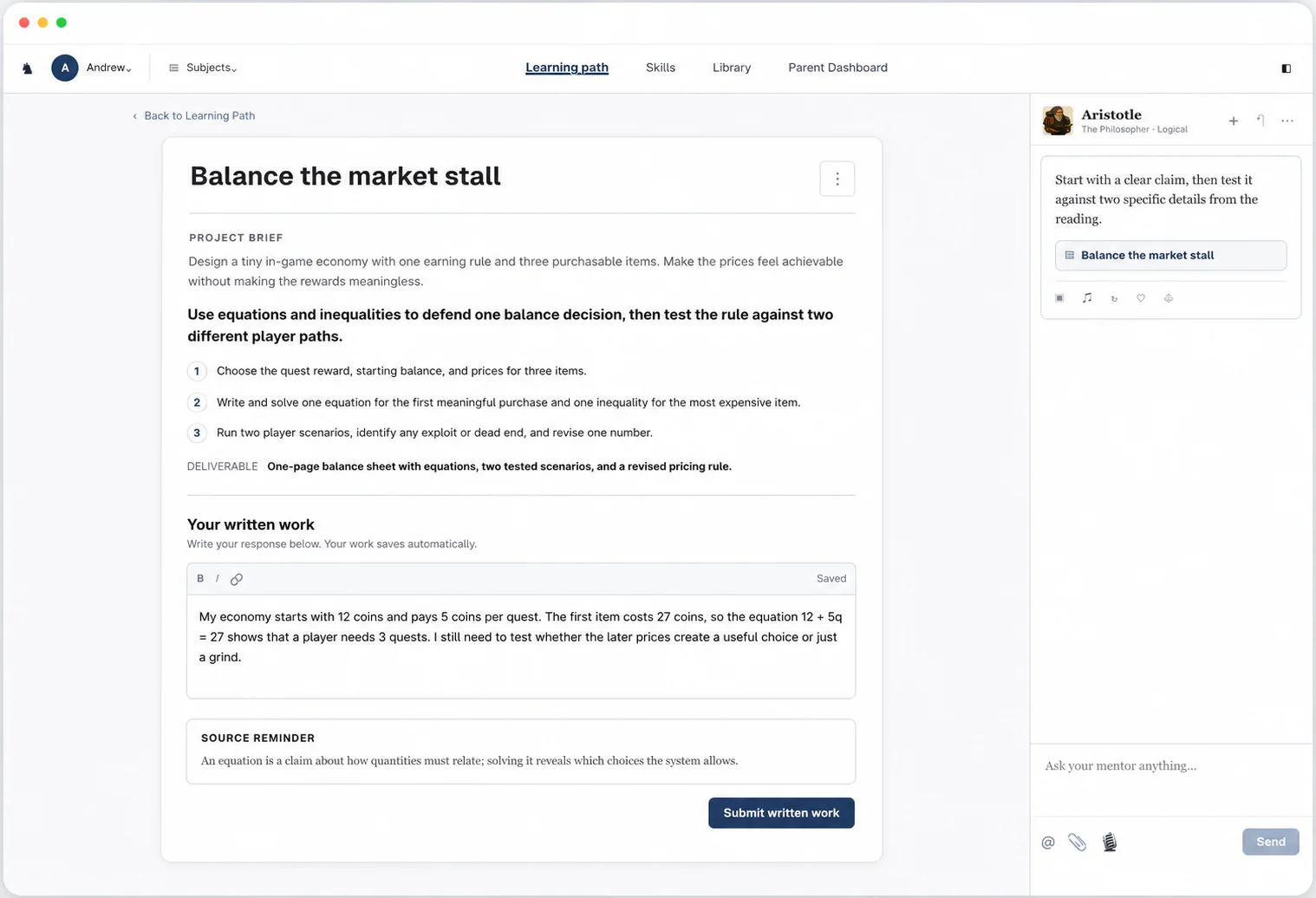
Design a tiny in-game economy with one earning rule and three purchasable items. Make the prices feel achievable without making the rewards meaningless.
- Task
- Use equations and inequalities to defend one balance decision, then test the rule against two different player paths
- Hand in
- One-page balance sheet with equations, two tested scenarios, and a revised pricing rule
Your parent dashboard
- Today
- Each subject's lesson, and whether it's done
- Grades
- Every submission graded instantly, with written feedback, so you never grade
- Records
- Attendance log and learning summary, ready to export

Units and skills by grade
Grade 37 units · 40 skills
Place value to 100,0006 skills
- Compose a number to 100,000 using place value
- Write a number to 100,000 in expanded notation
- Compare two numbers to 100,000 using symbols
- Round a whole number to the nearest ten
- Round a whole number to the nearest hundred
- Locate a whole number on an open number line
Fractions as numbers6 skills
- Name a fraction from equal parts of a whole
- Place a unit fraction on a number line
- Explain that a whole is the sum of its unit fractions
- Find an equivalent fraction with a picture
- Compare two fractions with the same numerator
- Compare two fractions with the same denominator
Multiplication and division6 skills
- Model a multiplication fact with an array
- Use equal groups to write a multiplication sentence
- Recall multiplication facts through ten by ten
- Use a related multiplication fact to divide
- Divide a set into equal groups to find the size of each group
- Divide a set into equal groups to find the number of groups
Problem solving and patterns6 skills
- Solve a one-step multiplication problem in context
- Solve a two-step problem with addition and subtraction
- Represent a problem with a strip diagram
- Write an equation with an unknown for a story problem
- Complete an input-output table from a rule
- Describe the rule of a number pattern
Geometry and measurement7 skills
- Classify a two-dimensional figure by its attributes
- Identify a quadrilateral by its sides and angles
- Find the area of a rectangle by tiling with unit squares
- Find the perimeter of a figure with given side lengths
- Tell time to the nearest minute
- Measure liquid volume with a marked container
- Measure weight with a balance and standard units
Data analysis5 skills
- Build a frequency table from a set of observations
- Read a dot plot to answer a question
- Read a pictograph with a scaled key
- Read a bar graph with a scaled interval
- Solve a one-step problem using data from a graph
Personal financial literacy4 skills
- Explain the difference between income and a gift
- Sort expenses as planned or unplanned
- Explain why a person saves for a goal
- Compare the cost of two choices
Grade 47 units · 41 skills
Place value to 1,000,0006 skills
- Interpret the value of each place to the millions
- Write a number to 1,000,000 in expanded notation
- Compare two whole numbers to 1,000,000
- Round a whole number to a given place value
- Represent a decimal to the tenths with a model
- Represent a decimal to the hundredths with a model
Decimals5 skills
- Relate a decimal to the hundredths to its fraction
- Locate a decimal on a number line
- Compare two decimals to the hundredths
- Add two decimals to the hundredths
- Subtract two decimals to the hundredths
Multiplication and division6 skills
- Multiply a four-digit number by a one-digit number
- Multiply a two-digit number by a two-digit number
- Divide a four-digit number by a one-digit number
- Interpret a remainder in a division situation
- Estimate a product to check reasonableness
- Use the distributive property to multiply
Fraction operations6 skills
- Add fractions with equal denominators
- Subtract fractions with equal denominators
- Decompose a fraction into a sum of fractions
- Find an equivalent fraction using multiplication
- Compare two fractions with unlike denominators using benchmarks
- Relate a fraction greater than one to a mixed number
Geometry and angles6 skills
- Identify points, lines, rays, and line segments
- Identify parallel and perpendicular lines
- Classify a triangle by its angles
- Measure an angle with a protractor
- Draw an angle of a given measure
- Find an unknown angle in a decomposed figure
Measurement5 skills
- Use the perimeter formula for a rectangle
- Use the area formula for a rectangle
- Convert measurements within the customary system
- Convert measurements within the metric system
- Solve an elapsed time problem
Data and financial literacy7 skills
- Represent data on a frequency table
- Represent data on a dot plot
- Represent data on a stem-and-leaf plot
- Solve a one-step problem from a data representation
- Distinguish a fixed expense from a variable expense
- Calculate profit in a simple situation
- Describe how income is earned through work
Grade 57 units · 38 skills
Decimals to thousandths5 skills
- Represent a decimal to the thousandths with a model
- Compare two decimals to the thousandths
- Round a decimal to the nearest tenth
- Round a decimal to the nearest hundredth
- Add and subtract decimals to the thousandths
Whole number and decimal operations6 skills
- Multiply a three-digit number by a two-digit number
- Divide a four-digit number by a two-digit number
- Multiply a decimal by a whole number
- Multiply a decimal by a decimal to the hundredths
- Divide a decimal by a whole number
- Estimate to check a decimal computation
Fraction operations6 skills
- Add fractions with unlike denominators
- Subtract fractions with unlike denominators
- Multiply a whole number by a fraction
- Divide a unit fraction by a whole number
- Divide a whole number by a unit fraction
- Solve a fraction problem in context
Expressions and patterns5 skills
- Use order of operations without exponents
- Write a numerical expression from a verbal description
- Simplify a numerical expression with grouping symbols
- Generate a numerical pattern from a given rule
- Identify the relationship between two numerical patterns
Coordinate plane4 skills
- Identify the parts of the coordinate plane
- Graph an ordered pair in the first quadrant
- Name the ordered pair for a plotted point
- Graph a pattern as ordered pairs
Geometry and volume5 skills
- Classify two-dimensional figures in a hierarchy
- Find the volume of a rectangular prism by counting unit cubes
- Use a volume formula for a rectangular prism
- Distinguish perimeter, area, and volume in a problem
- Solve a problem involving the area of a composite figure
Data and financial literacy7 skills
- Represent categorical data on a bar graph
- Represent numerical data on a dot plot
- Represent paired data on a scatterplot
- Solve a problem using data from a representation
- Explain the difference between gross income and net income
- Describe the purpose of taxes
- Balance a simple budget
Grade 612 units · 54 skills
Ratios, rates, and percents6 skills
- Write a ratio from a real comparison
- Build an equivalent ratio table
- Find a unit rate in a shopping context
- Use a double number line for a ratio situation
- Solve a percent-of-quantity problem
- Explain a rate conversion using units
Fraction and decimal operations5 skills
- Divide fractions with a visual model
- Multiply decimals in a measurement problem
- Use common denominators to compare fractions
- Convert between fractions, decimals, and percents
- Estimate before computing with rational numbers
Integers and coordinate plane4 skills
- Order positive and negative numbers on a number line
- Interpret absolute value as distance
- Plot ordered pairs in all four quadrants
- Use coordinates to describe a real location
Expressions and one-variable equations5 skills
- Evaluate an expression with exponents and variables
- Write an expression from a verbal phrase
- Use the distributive property to rewrite an expression
- Solve a one-step equation with rational numbers
- Write an inequality for a real constraint
Area, surface area, and volume5 skills
- Find area of triangles and parallelograms
- Decompose a polygon into simpler shapes
- Use nets to find surface area
- Find volume of a rectangular prism with fractional edges
- Explain which measurement formula fits a figure
Statistical questions and displays4 skills
- Distinguish statistical from nonstatistical questions
- Make a dot plot from a small data set
- Find mean and median from a data display
- Describe variability using range and clusters
Mathematical reasoning4 skills
- Choose a strategy for a multi-step word problem
- Explain why an estimate is reasonable
- Check an answer using inverse operations
- Compare exact and approximate answers
Scale drawings and maps4 skills
- Read a map scale in a distance problem
- Find a missing length in a scale drawing
- Explain how scale changes perimeter
- Compare original and scaled measurements
Everyday financial math4 skills
- Compute a discount from a percent
- Find sales tax on a purchase
- Compare two unit-price offers
- Explain a simple budget tradeoff
Numeric patterns4 skills
- Extend a pattern from a table
- Describe a rule in words and symbols
- Compare additive and multiplicative patterns
- Use a table to predict a later value
Measurement data project4 skills
- Collect consistent measurement data
- Choose a graph for measurement results
- Write a claim about a class data set
- Revise a claim after checking an outlier
Math capstone5 skills
- Solve a ratio and measurement design problem
- Defend a multi-step calculation with units
- Use a data display to support a decision
- Explain an error in a fraction or percent solution
- Present a complete Grade 6 math argument
Grade 712 units · 54 skills
Proportional relationships6 skills
- Identify a proportional relationship from a table
- Find the constant of proportionality
- Write a proportional equation from a context
- Graph a proportional relationship through the origin
- Use slope as a unit rate
- Compare proportional relationships across forms
Rational number operations5 skills
- Add rational numbers with opposite signs
- Subtract rational numbers using distance
- Multiply signed fractions in a context
- Divide signed rational numbers
- Explain why signs change in multiplication and division
Linear equations and inequalities5 skills
- Solve a two-step equation with rational coefficients
- Solve an equation with variables on both sides
- Write an inequality from a constraint
- Graph a one-variable inequality
- Check a solution against the original context
Percents and financial reasoning4 skills
- Solve a percent increase problem
- Solve a percent decrease problem
- Find simple interest over time
- Compare markup, discount, tax, and tip situations
Angles, circles, and scale5 skills
- Use angle relationships to find an unknown measure
- Find circumference from diameter
- Find area of a circle
- Use scale factor to compare side lengths
- Solve a composite-area problem with circles and polygons
Probability models4 skills
- Find theoretical probability from equally likely outcomes
- Estimate probability from repeated trials
- Use a tree diagram for compound events
- Compare experimental and theoretical probability
Sampling and inference4 skills
- Use a random sample to estimate a population value
- Compare two data distributions by center and spread
- Identify a biased sampling method
- Write a cautious inference from sample data
Linear model introduction4 skills
- Find slope from two points
- Interpret y-intercept in a context
- Write a line from a table
- Compare linear and nonlinear patterns
Mathematical reasoning4 skills
- Break a percent problem into smaller steps
- Use units to catch a wrong answer
- Explain why two proportional methods agree
- Choose a graph that matches a situation
Equation and geometry transfer4 skills
- Write an equation for an angle relationship
- Use an equation to find a scale length
- Model perimeter with a linear expression
- Connect circle formulas to proportional reasoning
Data project4 skills
- Design a sampling question
- Collect and display sample data
- Compare two groups using medians
- Defend a conclusion with sampling limits
Math capstone5 skills
- Solve a proportional finance problem
- Build and interpret a probability model
- Defend a geometry solution with equations
- Critique a statistical claim from a sample
- Present a connected Grade 7 math solution
Grade 812 units · 54 skills
Linear functions and slope6 skills
- Find slope from a graph
- Find slope from two points
- Write a linear equation from a table
- Interpret rate of change and initial value
- Compare two linear functions in different forms
- Explain why a relationship is not linear
Systems of linear equations5 skills
- Solve a system by graphing
- Solve a system by substitution
- Solve a system by elimination
- Interpret intersection as a shared solution
- Classify systems with no solution or many solutions
Exponents and scientific notation5 skills
- Apply exponent product and quotient rules
- Use zero and negative exponents
- Convert between standard and scientific notation
- Compute with numbers in scientific notation
- Compare quantities written in scientific notation
Irrational numbers and roots4 skills
- Approximate a square root on a number line
- Distinguish rational and irrational numbers
- Use cube roots in volume contexts
- Compare decimal expansions of real numbers
Pythagorean theorem5 skills
- Use the Pythagorean theorem to find a missing side
- Use the converse to classify a triangle
- Find distance between two coordinate points
- Solve a real-world diagonal-distance problem
- Explain why the theorem fits right triangles
Transformations and congruence4 skills
- Describe a translation using coordinates
- Describe a reflection across an axis
- Describe a rotation about the origin
- Use transformations to show congruence
Similarity, volume, and scale4 skills
- Use dilations to explain similarity
- Find a missing side in similar figures
- Find volume of cylinders, cones, or spheres
- Explain how scale affects volume
Scatter plots and association4 skills
- Make a scatter plot from paired data
- Describe positive, negative, or no association
- Draw an informal line of fit
- Use a line of fit to make a prediction
Function modeling4 skills
- Decide whether a table defines a function
- Compare linear, quadratic, and exponential growth patterns
- Interpret function notation in a context
- Use a function rule to solve a problem
Mathematical reasoning4 skills
- Write a multi-step justification for a system solution
- Explain when an estimate is enough
- Check reasonableness using graph and equation forms
- Identify a hidden assumption in a model
High school math readiness4 skills
- Connect slope to Algebra I linear functions
- Connect Pythagorean distance to coordinate geometry
- Use exponent rules in scientific contexts
- Organize a solution for a high-school-style problem
Math capstone5 skills
- Model a real situation with a linear function
- Use a system to compare two plans
- Apply exponent notation to a science quantity
- Defend a geometry solution with a diagram
- Present a Grade 8 math argument with multiple formats
Grade 913 units · 59 skills
Algebra 1: linear equations6 skills
- Solve a linear equation with variables on both sides
- Rewrite a formula for a chosen variable
- Graph a line from slope-intercept form
- Write a line from two points
- Interpret slope and intercept in a model
- Solve a linear inequality and graph the solution set
Systems and linear modeling5 skills
- Solve a system by substitution
- Solve a system by elimination
- Model break-even with a linear system
- Interpret a system solution in context
- Classify a system by number of solutions
Functions and function notation5 skills
- Identify domain and range from a graph
- Evaluate a function from notation
- Compare functions across table, graph, and equation
- Find average rate of change from a table
- Interpret zeros and intercepts in context
Exponents and radicals5 skills
- Simplify a radical expression
- Use rational exponents
- Apply exponent rules to algebraic expressions
- Rewrite an expression using structure
- Classify rational and irrational numbers
Polynomials and factoring5 skills
- Add and multiply polynomial expressions
- Factor a greatest common factor
- Factor a trinomial with leading coefficient one
- Factor a difference of squares
- Use factoring to solve a quadratic equation
Quadratic functions4 skills
- Graph a quadratic from vertex form
- Find zeros from a factored quadratic
- Complete the square for a simple quadratic
- Compare linear and quadratic growth
Exponential functions4 skills
- Write an exponential growth function
- Write an exponential decay function
- Compare exponential and linear change
- Interpret an exponential parameter in context
Statistics and residuals4 skills
- Fit a linear model to bivariate data
- Interpret correlation without claiming causation
- Use residuals to judge model fit
- Choose a model from a scatter plot
Sequences4 skills
- Write an arithmetic sequence rule
- Write a geometric sequence rule
- Compare recursive and explicit sequence forms
- Use a sequence to model repeated change
Mathematical reasoning4 skills
- Justify each step in an algebraic solution
- Find an error in a function model
- Explain why a factored form reveals zeros
- Compare two valid solution paths
Algebra 1 modeling project4 skills
- Select variables for a real-world model
- Build a linear or quadratic model from data
- State model limits and assumptions
- Use a model to recommend a decision
AP exam readiness4 skills
- Solve an Algebra I mixed function item with graph, table, and equation evidence
- Choose the best method for a timed linear, quadratic, or exponential item
- Explain why an Algebra I distractor answer fails
- Write a concise justification for a grade 9 modeling item
Math capstone5 skills
- Solve a multi-representation function problem
- Defend a system model with context
- Use factoring and graphing to analyze a quadratic
- Explain model limitations in writing
- Present a complete Algebra I argument
Grade 1013 units · 58 skills
Geometry: logic and proof6 skills
- Write a conditional statement and converse
- Use definitions in a geometric proof
- Apply properties of equality in a proof
- Prove a line-angle relationship
- Explain why a diagram alone is insufficient
- Organize a two-column or paragraph proof
Transformations and congruence5 skills
- Use rigid motions to prove congruence
- Apply triangle congruence criteria
- Prove corresponding parts after congruent triangles
- Construct a congruent triangle from given data
- Explain a congruence proof in words
Similarity and dilations5 skills
- Use dilations to prove similarity
- Apply triangle similarity criteria
- Find missing side lengths in similar figures
- Prove slope criteria for parallel lines
- Use similarity in an indirect measurement problem
Right triangles and trigonometry4 skills
- Use the Pythagorean theorem in coordinate geometry
- Apply sine, cosine, and tangent ratios
- Solve a right-triangle modeling problem
- Use special right-triangle relationships
Circle theorems5 skills
- Find arc measures from central angles
- Use inscribed angle relationships
- Apply tangent and secant relationships
- Write the equation of a circle
- Solve a circle proof problem
Coordinate geometry4 skills
- Find distance and midpoint from coordinates
- Use slope to prove parallel or perpendicular lines
- Partition a segment by ratio
- Use coordinates to prove a quadrilateral property
Area, volume, and density4 skills
- Find area of composite figures
- Find volume of prisms, cylinders, pyramids, cones, and spheres
- Compare surface area and volume under scaling
- Solve a density or packing problem
Constructions and loci4 skills
- Construct a perpendicular bisector
- Construct an angle bisector
- Construct parallel and perpendicular lines
- Describe a locus of points from constraints
Geometric modeling4 skills
- Choose a geometric model for a physical object
- Estimate measurement error in a geometric calculation
- Use scale drawings in design
- Defend a modeling assumption
Probability with geometry4 skills
- Find geometric probability from area
- Use a two-way table with a spatial context
- Compare independent and dependent events in a model
- Explain probability limits in a diagram
Mathematical reasoning4 skills
- Write a proof plan before solving
- Identify an unstated geometric assumption
- Compare algebraic and geometric solutions
- Revise a proof after a counterexample
AP exam readiness4 skills
- Solve a Geometry mixed proof item with diagram and coordinate evidence
- Choose the best method for a timed congruence, similarity, or circle item
- Explain why a Geometry distractor answer fails
- Write a concise justification for a grade 10 proof or measurement item
Math capstone5 skills
- Prove a geometric claim using transformations
- Solve a trigonometry design problem
- Use coordinate geometry in a proof
- Evaluate measurement error in a model
- Present a complete Geometry argument
Grade 1113 units · 60 skills
Polynomials6 skills
- Add polynomial expressions
- Multiply binomials
- Factor a quadratic with leading coefficient 1
- Factor a quadratic with leading coefficient greater than 1
- Divide polynomials using long division
- Use the remainder theorem
Rational expressions5 skills
- Simplify a rational expression
- Find excluded values of a rational expression
- Multiply rational expressions
- Solve a rational equation with extraneous-solution check
- Interpret a rational function asymptote
Function analysis5 skills
- Justify a function-domain restriction
- Find inverse functions on a restricted domain
- Analyze transformations of parent functions
- Compare polynomial, rational, exponential, and logarithmic behavior
- Use composition of functions in a context
Exponential and logarithmic functions5 skills
- Solve an exponential equation by taking logarithms
- Use logarithm properties to rewrite expressions
- Model compound growth with an exponential function
- Interpret logarithmic scale in data
- Compare exponential and logistic-looking data cautiously
Trigonometry5 skills
- Use radians to measure angle rotation
- Graph sine and cosine functions
- Solve a trigonometric equation on a restricted interval
- Use identities to rewrite a trigonometric expression
- Model periodic behavior with amplitude and period
Complex numbers4 skills
- Add and multiply complex numbers
- Use complex conjugates to simplify a quotient
- Solve a quadratic with complex roots
- Interpret complex roots of a polynomial
Sequences and series4 skills
- Write arithmetic and geometric sequence formulas
- Find a finite geometric series sum
- Use recursive definitions for sequences
- Compare sequence growth rates
Inference and modeling5 skills
- Design a survey with reduced bias
- Interpret standard deviation in context
- Use normal distributions for approximate probabilities
- Compare confidence and certainty in a data claim
- Critique a regression model using residuals
Conics and parametric models4 skills
- Identify a parabola from an equation
- Use the distance formula to derive a circle equation
- Interpret parametric equations as motion
- Compare explicit and parametric forms
Systems and matrices4 skills
- Represent a linear system with a matrix
- Use row operations to solve a small system
- Interpret a matrix transformation geometrically
- Use a system to model constraints
Mathematical reasoning4 skills
- Explain why a domain restriction is necessary
- Compare symbolic and graphical evidence for a function claim
- Find a hidden assumption in a data model
- Defend an algebraic transformation step
AP exam readiness4 skills
- Solve an Algebra II mixed function item with symbolic and graphical evidence
- Choose the best method for a timed polynomial, rational, logarithmic, or trigonometric item
- Explain why an Algebra II distractor answer fails
- Write a concise justification for a grade 11 function-model item
Math capstone5 skills
- Build a function model from messy data
- Defend a polynomial or rational model choice
- Use logarithms or trigonometry in a real application
- Critique a statistical argument
- Present an advanced Algebra II argument
Grade 1213 units · 58 skills
Limits and rates of change6 skills
- Estimate a limit from a table
- Estimate a limit from a graph
- Interpret average and instantaneous rate of change
- Explain when a limit does not exist
- Connect secant and tangent slope ideas
- Use limit language in a context
Derivative models5 skills
- Use a derivative to describe increasing and decreasing behavior
- Interpret derivative units in a context
- Find extrema from a derivative graph
- Compare position, velocity, and acceleration graphs
- Use a tangent-line approximation
Accumulation and integrals4 skills
- Estimate area under a curve with rectangles
- Interpret an integral as accumulated change
- Connect rate graphs to total change
- Compare left, right, and midpoint estimates
Statistical inference5 skills
- Interpret a confidence interval
- Explain a hypothesis test conclusion
- Distinguish statistical significance from practical importance
- Critique sampling and experimental design
- Use simulation to estimate probability
Probability models4 skills
- Use conditional probability in a two-way table
- Apply expected value to a decision
- Model repeated trials with a binomial setting
- Compare independent and dependent events
Vectors and parametric motion4 skills
- Represent a vector by components
- Add vectors graphically and algebraically
- Model two-dimensional motion parametrically
- Interpret speed from a parametric path
Discrete mathematics4 skills
- Use recursion to define a sequence
- Count arrangements with restrictions
- Represent a network with vertices and edges
- Optimize a path in a small network
Financial and decision models4 skills
- Model compound interest with regular contributions
- Compare loan repayment scenarios
- Use sensitivity analysis on a financial model
- Explain model assumptions and risk
Proof and mathematical structure4 skills
- Write a direct proof of a number property
- Use a counterexample to disprove a claim
- Compare inductive and deductive reasoning
- State conditions needed for a theorem
Advanced function connections4 skills
- Analyze a piecewise function at boundaries
- Compare polynomial, exponential, logarithmic, and trigonometric models
- Use transformations to build a complex model
- Justify a modeling choice in writing
Mathematical research modeling4 skills
- Turn a real question into variables and constraints
- Choose data needed for a model
- Validate a model against evidence
- Revise a model after residual or error analysis
AP exam readiness4 skills
- Solve an advanced math mixed item with calculus, statistics, or modeling evidence
- Choose the best method for a timed limit, inference, vector, or decision-model item
- Explain why a grade 12 distractor answer fails
- Write a concise justification for an advanced modeling or inference item
Math capstone6 skills
- Build an original mathematical model
- Defend a calculus or statistics method choice
- Quantify uncertainty in a conclusion
- Critique an alternative model
- Present a college-ready mathematical argument
- Reflect on limits of the chosen model
Questions parents ask
Where does my child start in Math?
- Placement checks your child's current Math skills and sets the first lesson from that result, not from their grade.
How much of the teaching do I do?
- None of it. The course explains each new idea and checks how your child uses it, while the mentor answers questions as they work. Every submission is graded as soon as it comes in, so you never grade it yourself.
Can I use the record for high-school planning?
- Yes. The subject record holds every graded assignment with its written feedback, ready to export. We generate a transcript from the course records, ready for you to sign.
Math, taught around your child
A Math path that makes the next skill and the eventual move into Algebra easier to see.
$49/month after the trial.