Advanced Microeconomics homeschool curriculum.
Your student uses supply, demand, costs, and incentives to explain decisions in different markets.
A personalized lesson from the course
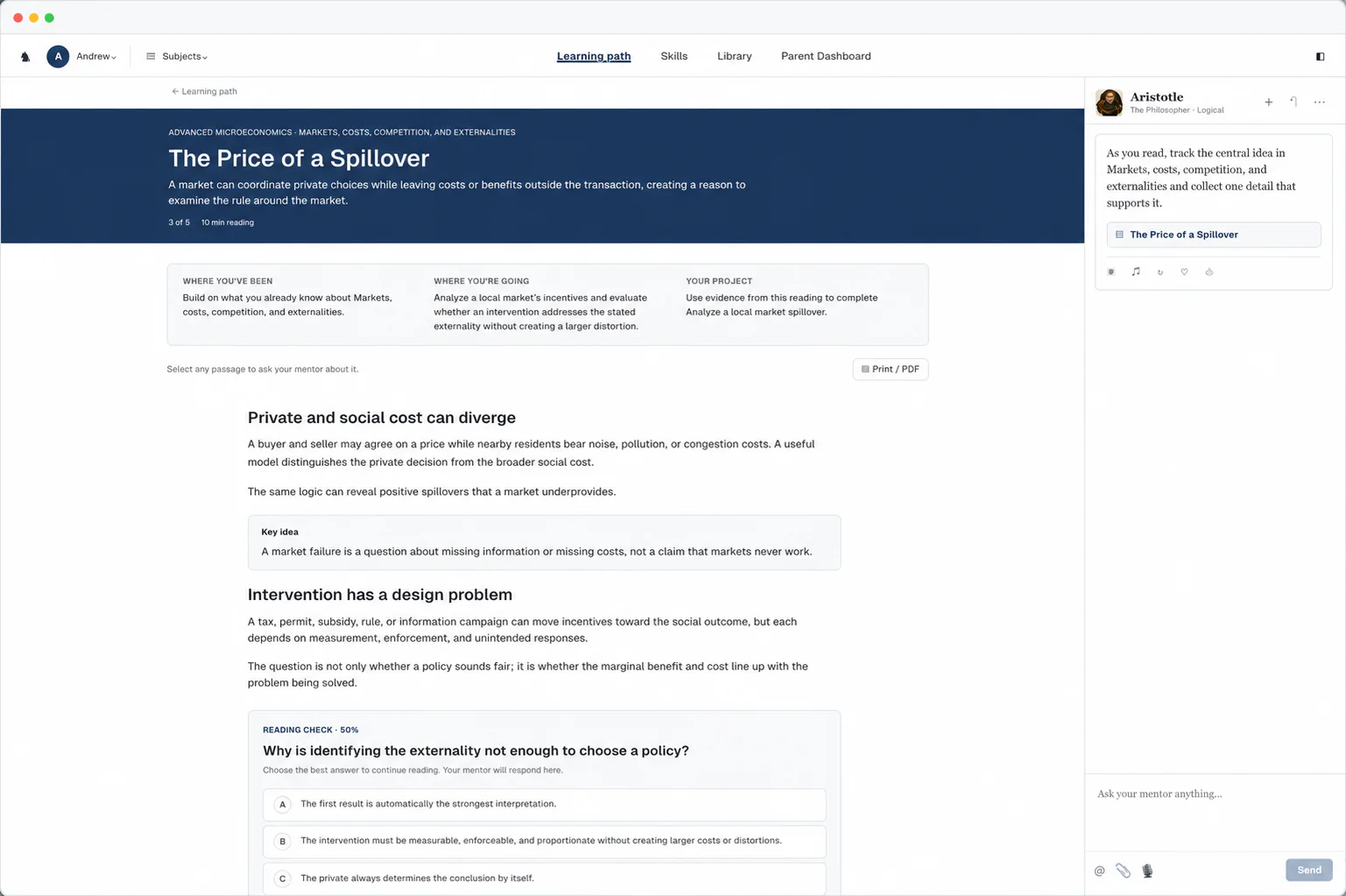
A market can coordinate private choices while leaving costs or benefits outside the transaction, creating a reason to examine the rule around the market.
- Lesson
- The Price of a Spillover
- Goal
- Analyze a local market's incentives and evaluate whether an intervention addresses the stated externality without creating a larger distortion.
How a lesson works
A 10-minute reading
This example lesson comes from the unit on markets, costs, competition, and externalities. It moves from “Private and social cost can diverge” to “Intervention has a design problem” and builds to one idea: a market failure is a question about missing information or missing costs, not a claim that markets never work.
Help inside the reading
Our Always-On Mentor stays beside “The Price of a Spillover” the whole way through, answering questions about any highlighted line and, during the Reading Check, clarifying a question without giving the answer away.
A check halfway through
Your child answers “Why is identifying the externality not enough to choose a policy?” before reading on, and the Reading Check at the end asks new questions.
A project your child hands in
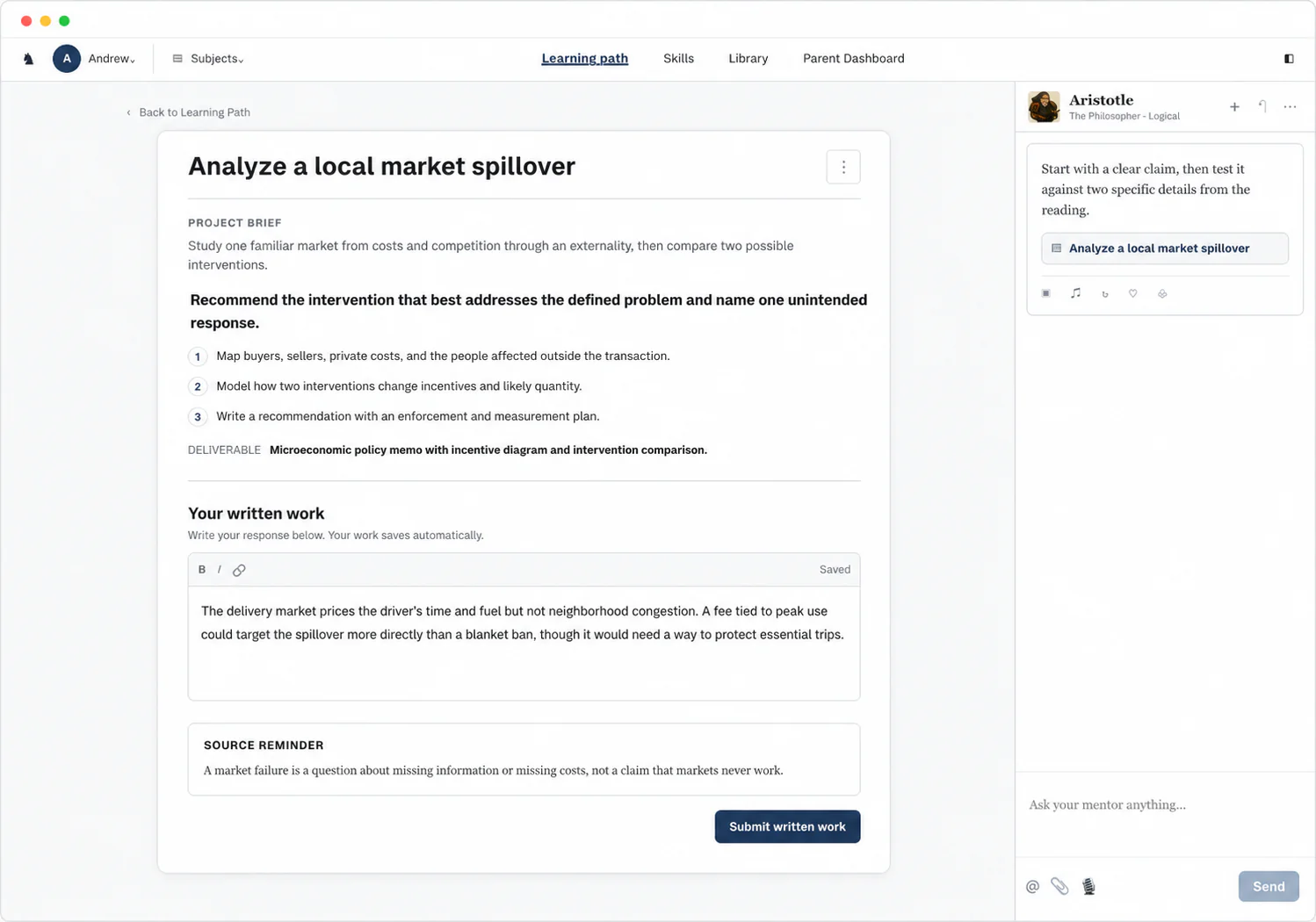
Study one familiar market from costs and competition through an externality, then compare two possible interventions.
- Task
- Recommend the intervention that best addresses the defined problem and name one unintended response
- Hand in
- Microeconomic policy memo with incentive diagram and intervention comparison
Arguments backed by evidence
Students build and explain one model, solve a focused problem set, examine a real case, and correct errors visibly. Advanced Microeconomics runs through 20 units and 80 skills, starting with basic economic concepts; supply and demand; and production, cost, and the perfect competition model.
- Labeled graphs with written causal reasoning
- Firm and market calculation sets
- Evidence-based analysis of a real market
Units and skills
Advanced Microeconomics20 units · 80 skills
Basic economic concepts4 skills
- Define and apply economic principles and models in Basic economic concepts
- Interpret economic outcomes and evidence in Basic economic concepts
- Determine the effects of changes to conditions in Basic economic concepts
- Create and analyze economic graphs for Basic economic concepts
Supply and demand4 skills
- Define and apply economic principles and models in Supply and demand
- Interpret economic outcomes and evidence in Supply and demand
- Determine the effects of changes to conditions in Supply and demand
- Create and analyze economic graphs for Supply and demand
Production, cost, and the perfect competition model4 skills
- Define and apply economic principles and models in Production, cost, and the perfect competition model
- Interpret economic outcomes and evidence in Production, cost, and the perfect competition model
- Determine the effects of changes to conditions in Production, cost, and the perfect competition model
- Create and analyze economic graphs for Production, cost, and the perfect competition model
Imperfect competition4 skills
- Define and apply economic principles and models in Imperfect competition
- Interpret economic outcomes and evidence in Imperfect competition
- Determine the effects of changes to conditions in Imperfect competition
- Create and analyze economic graphs for Imperfect competition
Factor markets4 skills
- Define and apply economic principles and models in Factor markets
- Interpret economic outcomes and evidence in Factor markets
- Determine the effects of changes to conditions in Factor markets
- Create and analyze economic graphs for Factor markets
Market failure and government4 skills
- Define and apply economic principles and models in Market failure and government
- Interpret economic outcomes and evidence in Market failure and government
- Determine the effects of changes to conditions in Market failure and government
- Create and analyze economic graphs for Market failure and government
Elasticity4 skills
- Define and apply economic principles and models in Elasticity
- Interpret economic outcomes and evidence in Elasticity
- Determine the effects of changes to conditions in Elasticity
- Create and analyze economic graphs for Elasticity
Consumer and producer surplus4 skills
- Define and apply economic principles and models in Consumer and producer surplus
- Interpret economic outcomes and evidence in Consumer and producer surplus
- Determine the effects of changes to conditions in Consumer and producer surplus
- Create and analyze economic graphs for Consumer and producer surplus
Firm decision making4 skills
- Define and apply economic principles and models in Firm decision making
- Interpret economic outcomes and evidence in Firm decision making
- Determine the effects of changes to conditions in Firm decision making
- Create and analyze economic graphs for Firm decision making
Game theory and strategy4 skills
- Define and apply economic principles and models in Game theory and strategy
- Interpret economic outcomes and evidence in Game theory and strategy
- Determine the effects of changes to conditions in Game theory and strategy
- Create and analyze economic graphs for Game theory and strategy
Economic graphs4 skills
- Define and apply economic principles and models in Economic graphs
- Interpret economic outcomes and evidence in Economic graphs
- Determine the effects of changes to conditions in Economic graphs
- Create and analyze economic graphs for Economic graphs
Cumulative market analysis4 skills
- Define and apply economic principles and models in Cumulative market analysis
- Interpret economic outcomes and evidence in Cumulative market analysis
- Determine the effects of changes to conditions in Cumulative market analysis
- Create and analyze economic graphs for Cumulative market analysis
Multiple quantitative representations4 skills
- Define and apply economic principles and models in Multiple quantitative representations
- Interpret economic outcomes and evidence in Multiple quantitative representations
- Determine the effects of changes to conditions in Multiple quantitative representations
- Create and analyze economic graphs for Multiple quantitative representations
Graph construction and interpretation4 skills
- Define and apply economic principles and models in Graph construction and interpretation
- Interpret economic outcomes and evidence in Graph construction and interpretation
- Determine the effects of changes to conditions in Graph construction and interpretation
- Create and analyze economic graphs for Graph construction and interpretation
Written mathematical justification4 skills
- Define and apply economic principles and models in Written mathematical justification
- Interpret economic outcomes and evidence in Written mathematical justification
- Determine the effects of changes to conditions in Written mathematical justification
- Create and analyze economic graphs for Written mathematical justification
Dated evidence and changing conditions4 skills
- Define and apply economic principles and models in Dated evidence and changing conditions
- Interpret economic outcomes and evidence in Dated evidence and changing conditions
- Determine the effects of changes to conditions in Dated evidence and changing conditions
- Create and analyze economic graphs for Dated evidence and changing conditions
Competing contemporary perspectives4 skills
- Define and apply economic principles and models in Competing contemporary perspectives
- Interpret economic outcomes and evidence in Competing contemporary perspectives
- Determine the effects of changes to conditions in Competing contemporary perspectives
- Create and analyze economic graphs for Competing contemporary perspectives
Advanced Microeconomics cumulative assessment4 skills
- Define and apply economic principles and models in Advanced Microeconomics cumulative assessment
- Interpret economic outcomes and evidence in Advanced Microeconomics cumulative assessment
- Determine the effects of changes to conditions in Advanced Microeconomics cumulative assessment
- Create and analyze economic graphs for Advanced Microeconomics cumulative assessment
Advanced Microeconomics exam-mode practice4 skills
- Define and apply economic principles and models in Advanced Microeconomics exam-mode practice
- Interpret economic outcomes and evidence in Advanced Microeconomics exam-mode practice
- Determine the effects of changes to conditions in Advanced Microeconomics exam-mode practice
- Create and analyze economic graphs for Advanced Microeconomics exam-mode practice
Advanced Microeconomics reflection and transfer4 skills
- Define and apply economic principles and models in Advanced Microeconomics reflection and transfer
- Interpret economic outcomes and evidence in Advanced Microeconomics reflection and transfer
- Determine the effects of changes to conditions in Advanced Microeconomics reflection and transfer
- Create and analyze economic graphs for Advanced Microeconomics reflection and transfer
Questions parents ask
How does Advanced Microeconomics prepare my student for AP Microeconomics?
- Advanced Microeconomics follows the AP Microeconomics framework unit by unit, as its skill tree shows. Your teen explains and applies the ideas in written responses and projects, so the work shows which skills are secure and which need more practice.
How does a homeschooler register for an AP exam?
- An AP coordinator at an AP-authorized local school arranges registration. Use College Board’s homeschool exam guidance to find a host school. That school sets its deadlines and outside-student policies; its coordinator orders the exam, collects fees, and tells your child where and when to test.
Which course title goes on a homeschool transcript?
- Advanced Microeconomics, not AP Microeconomics. The AP designation requires College Board Course Audit authorization of the course, which framework alignment does not give. We generate the transcript with that title, ready for you to sign as homeschool administrator.
How can AP scores earn college credit?
- Colleges award credit under their own AP score policies. College Board reports scores on a 1–5 scale, separately from our coursework grades; check the college’s required score and whether it grants credit, placement, or both.
Advanced Microeconomics, with the teaching and records handled
$49/month after the trial.