Economics for your homeschool
Your teen uses incentives, tradeoffs, and evidence to examine a market or policy question they care about.
A lesson built around your child
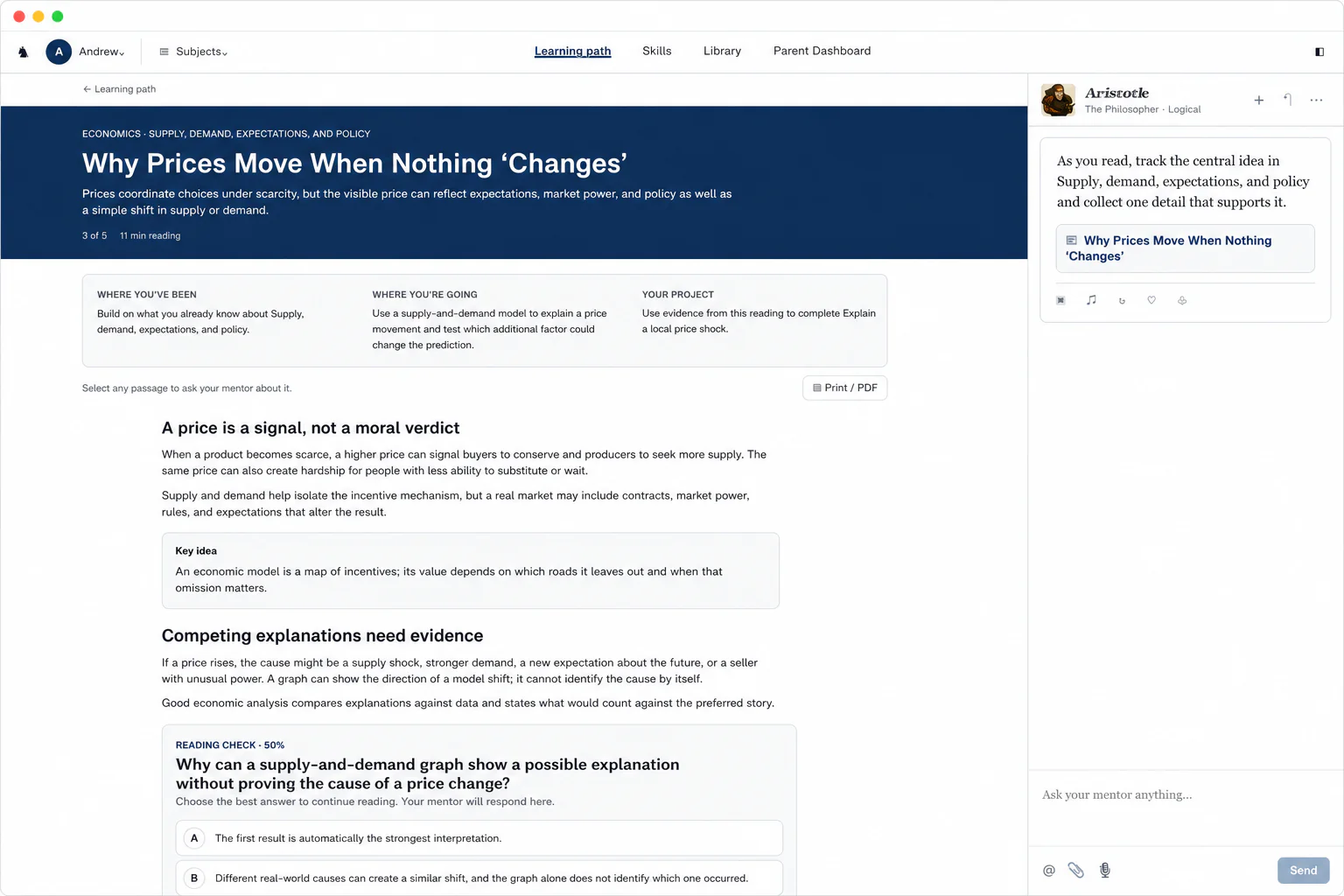
Prices coordinate choices under scarcity, but the visible price can reflect expectations, market power, and policy as well as a simple shift in supply or demand.
- Lesson
- Why Prices Move When Nothing 'Changes'
- Goal
- Use a supply-and-demand model to explain a price movement and test which additional factor could change the prediction.
How a lesson works
An 11-minute reading
This example lesson comes from the unit on supply, demand, expectations, and policy. It moves from “A price is a signal, not a moral verdict” to “Competing explanations need evidence” and builds to one idea: an economic model is a map of incentives; its value depends on which roads it leaves out and when that omission matters.
Help inside the reading
When a market or policy claim skips a cost or tradeoff, our Always-On Mentor can help your teen identify the assumption and check the evidence. Your child can also highlight any line of “Why Prices Move When Nothing ‘Changes’” to ask about it or ask for a visual, and the mentor offers help on its own when they seem stuck.
A check halfway through
Your child answers “Why can a supply-and-demand graph show a possible explanation without proving the cause of a price change?” before reading on, and the Reading Check at the end asks new questions.
A project your child hands in
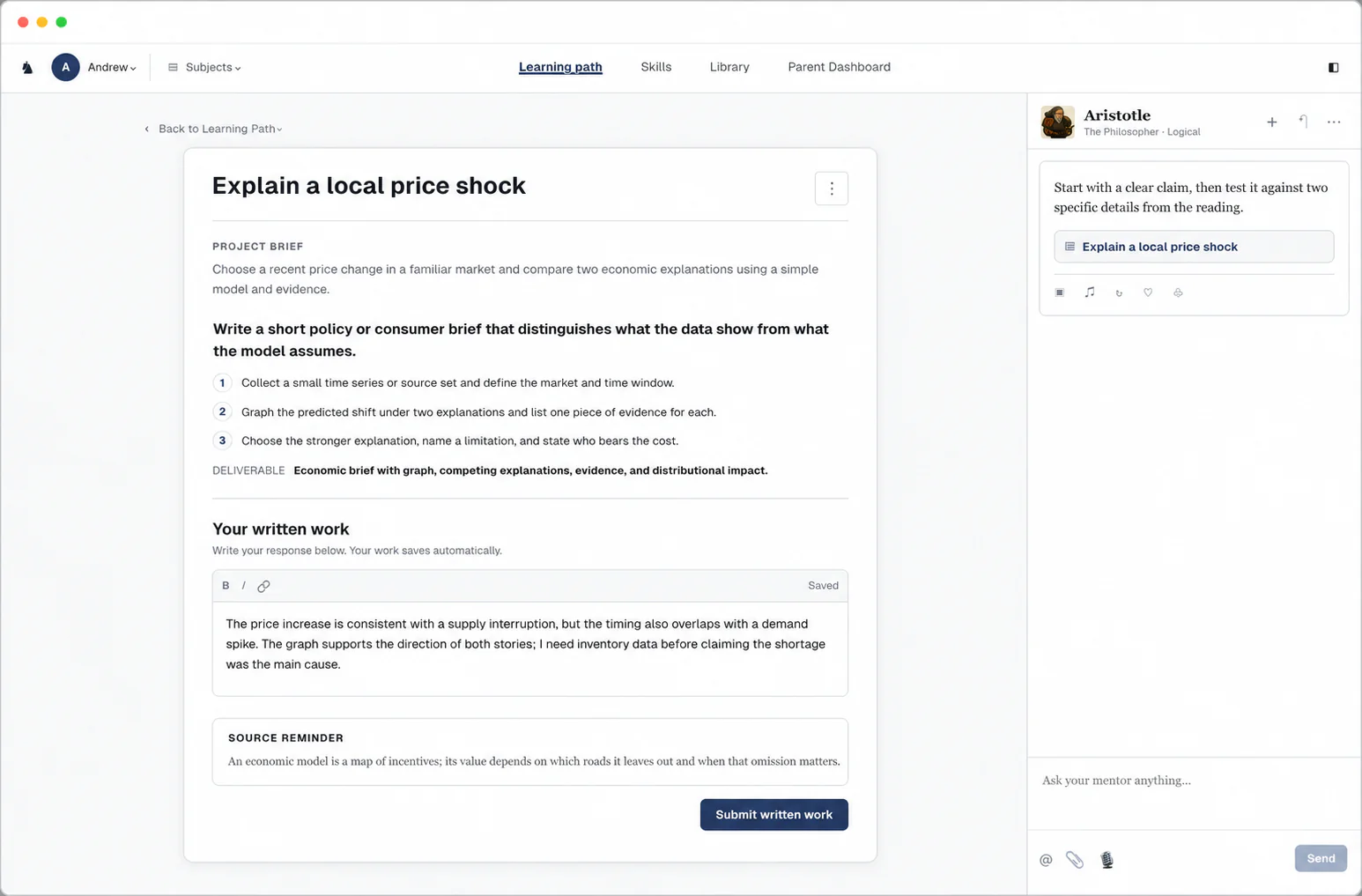
Choose a recent price change in a familiar market and compare two economic explanations using a simple model and evidence.
- Task
- Write a short policy or consumer brief that distinguishes what the data show from what the model assumes
- Hand in
- Economic brief with graph, competing explanations, evidence, and distributional impact
Your parent dashboard
- Today
- Each subject's lesson, and whether it's done
- Grades
- Every submission graded instantly, with written feedback, so you never grade
- Records
- Attendance log and learning summary, ready to export

Units and skills
The course teaches economic reasoning, from scarcity and incentives through markets, firms, the whole economy, policy, trade, and arguments backed by data. Economics is one skill tree for every grade with 12 units, from scarcity, choice, and opportunity cost to economic research and policy memo, and your child's grade sets how deep each unit goes.
Economics12 units · 60 skills
Scarcity, choice, and opportunity cost5 skills
- Define the vocabulary, boundaries, and common misconceptions of Scarcity, choice, and opportunity cost
- Explain the main actors, mechanisms, sequence, and constraints in Scarcity, choice, and opportunity cost
- Interpret evidence, data, cases, or examples connected to Scarcity, choice, and opportunity cost
- Apply Scarcity, choice, and opportunity cost to a realistic market or policy scenario
- Create a economic analysis memo that justifies decisions about Scarcity, choice, and opportunity cost
Supply, demand, and price formation5 skills
- Define the vocabulary, boundaries, and common misconceptions of Supply, demand, and price formation
- Explain the main actors, mechanisms, sequence, and constraints in Supply, demand, and price formation
- Interpret evidence, data, cases, or examples connected to Supply, demand, and price formation
- Apply Supply, demand, and price formation to a realistic market or policy scenario
- Create a economic analysis memo that justifies decisions about Supply, demand, and price formation
Markets, incentives, and failures5 skills
- Define the vocabulary, boundaries, and common misconceptions of Markets, incentives, and failures
- Explain the main actors, mechanisms, sequence, and constraints in Markets, incentives, and failures
- Interpret evidence, data, cases, or examples connected to Markets, incentives, and failures
- Apply Markets, incentives, and failures to a realistic market or policy scenario
- Create a economic analysis memo that justifies decisions about Markets, incentives, and failures
Households, firms, and production5 skills
- Define the vocabulary, boundaries, and common misconceptions of Households, firms, and production
- Explain the main actors, mechanisms, sequence, and constraints in Households, firms, and production
- Interpret evidence, data, cases, or examples connected to Households, firms, and production
- Apply Households, firms, and production to a realistic market or policy scenario
- Create a economic analysis memo that justifies decisions about Households, firms, and production
Competition, monopoly, and regulation5 skills
- Define the vocabulary, boundaries, and common misconceptions of Competition, monopoly, and regulation
- Explain the main actors, mechanisms, sequence, and constraints in Competition, monopoly, and regulation
- Interpret evidence, data, cases, or examples connected to Competition, monopoly, and regulation
- Apply Competition, monopoly, and regulation to a realistic market or policy scenario
- Create a economic analysis memo that justifies decisions about Competition, monopoly, and regulation
Labor markets and human capital5 skills
- Define the vocabulary, boundaries, and common misconceptions of Labor markets and human capital
- Explain the main actors, mechanisms, sequence, and constraints in Labor markets and human capital
- Interpret evidence, data, cases, or examples connected to Labor markets and human capital
- Apply Labor markets and human capital to a realistic market or policy scenario
- Create a economic analysis memo that justifies decisions about Labor markets and human capital
Money, banking, and inflation5 skills
- Define the vocabulary, boundaries, and common misconceptions of Money, banking, and inflation
- Explain the main actors, mechanisms, sequence, and constraints in Money, banking, and inflation
- Interpret evidence, data, cases, or examples connected to Money, banking, and inflation
- Apply Money, banking, and inflation to a realistic market or policy scenario
- Create a economic analysis memo that justifies decisions about Money, banking, and inflation
Macroeconomic indicators and cycles5 skills
- Define the vocabulary, boundaries, and common misconceptions of Macroeconomic indicators and cycles
- Explain the main actors, mechanisms, sequence, and constraints in Macroeconomic indicators and cycles
- Interpret evidence, data, cases, or examples connected to Macroeconomic indicators and cycles
- Apply Macroeconomic indicators and cycles to a realistic market or policy scenario
- Create a economic analysis memo that justifies decisions about Macroeconomic indicators and cycles
Trade, comparative advantage, and exchange rates5 skills
- Define the vocabulary, boundaries, and common misconceptions of Trade, comparative advantage, and exchange rates
- Explain the main actors, mechanisms, sequence, and constraints in Trade, comparative advantage, and exchange rates
- Interpret evidence, data, cases, or examples connected to Trade, comparative advantage, and exchange rates
- Apply Trade, comparative advantage, and exchange rates to a realistic market or policy scenario
- Create a economic analysis memo that justifies decisions about Trade, comparative advantage, and exchange rates
Public finance, taxes, and policy5 skills
- Define the vocabulary, boundaries, and common misconceptions of Public finance, taxes, and policy
- Explain the main actors, mechanisms, sequence, and constraints in Public finance, taxes, and policy
- Interpret evidence, data, cases, or examples connected to Public finance, taxes, and policy
- Apply Public finance, taxes, and policy to a realistic market or policy scenario
- Create a economic analysis memo that justifies decisions about Public finance, taxes, and policy
Inequality, growth, and development5 skills
- Define the vocabulary, boundaries, and common misconceptions of Inequality, growth, and development
- Explain the main actors, mechanisms, sequence, and constraints in Inequality, growth, and development
- Interpret evidence, data, cases, or examples connected to Inequality, growth, and development
- Apply Inequality, growth, and development to a realistic market or policy scenario
- Create a economic analysis memo that justifies decisions about Inequality, growth, and development
Economic research and policy memo5 skills
- Define the vocabulary, boundaries, and common misconceptions of Economic research and policy memo
- Explain the main actors, mechanisms, sequence, and constraints in Economic research and policy memo
- Interpret evidence, data, cases, or examples connected to Economic research and policy memo
- Apply Economic research and policy memo to a realistic market or policy scenario
- Create a economic analysis memo that justifies decisions about Economic research and policy memo
Questions parents ask
Which grades can use this Economics curriculum?
- One Economics skill tree serves grades 3 to 12, with course pages for 9th grade, 10th grade, 11th grade, and high school. Placement checks your child's current skills, so the first lesson can sit before or after their grade.
What should my child know before starting?
- Starting skills include basic arithmetic, interest in money and decisions, and curiosity about how things work. If placement finds a gap, the course starts with those skills.
How much of the teaching do I do?
- None of it. The course explains each new idea and checks how your child uses it, while the mentor answers questions as they work. Every submission is graded as soon as it comes in, so you never grade it yourself.
Can I use the record for high-school planning?
- Yes. The subject record holds every graded assignment with its written feedback, ready to export. We generate a transcript from the course records, ready for you to sign.
Economics, taught around your child
Economic judgment your learner can use long after the final exam.
$49/month after the trial.