Entrepreneurship for your homeschool
Your teen tests a small business idea, listens to what the results show, and decides what to change next.
A lesson built around your child
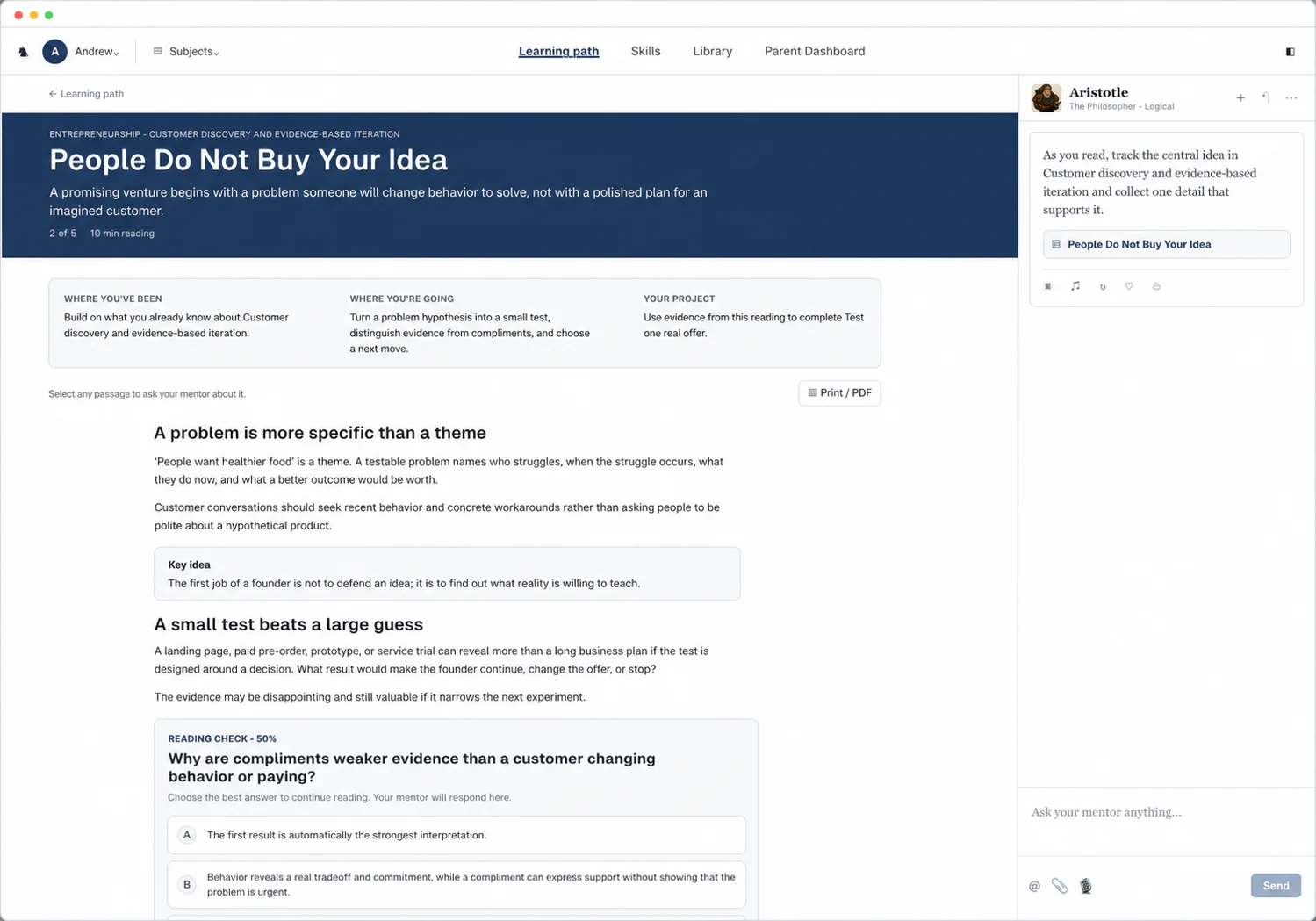
A promising venture begins with a problem someone will change behavior to solve, not with a polished plan for an imagined customer.
- Lesson
- People Do Not Buy Your Idea
- Goal
- Turn a problem hypothesis into a small test, distinguish evidence from compliments, and choose a next move.
How a lesson works
A 10-minute reading
This example lesson comes from the unit on customer discovery and evidence-based iteration. It moves from “A problem is more specific than a theme” to “A small test beats a large guess” and builds to one idea: the first job of a founder is not to defend an idea; it is to find out what reality is willing to teach.
Help inside the reading
If people do not respond to a business idea, our Always-On Mentor can help your teen check the question, costs, and what to try next. A class project does not have to become a company. Your child can also highlight any line of “People Do Not Buy Your Idea” to ask about it or ask for a visual, and the mentor offers help on its own when they seem stuck.
A check halfway through
Your child answers “Why are compliments weaker evidence than a customer changing behavior or paying?” before reading on, and the Reading Check at the end asks new questions.
A project your child hands in
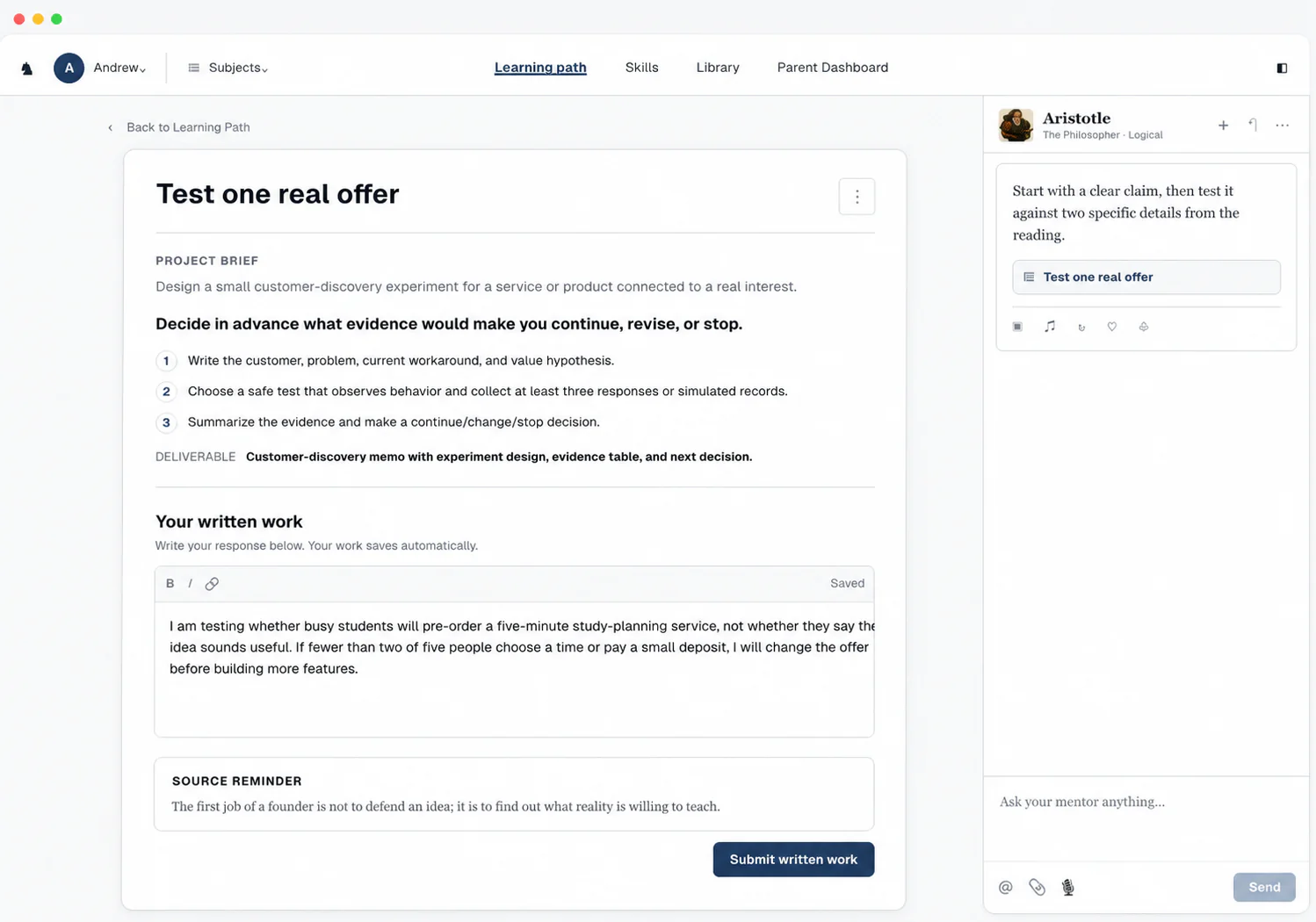
Design a small customer-discovery experiment for a service or product connected to a real interest.
- Task
- Decide in advance what evidence would make you continue, revise, or stop
- Hand in
- Customer-discovery memo with experiment design, evidence table, and next decision
Your parent dashboard
- Today
- Each subject's lesson, and whether it's done
- Grades
- Every submission graded instantly, with written feedback, so you never grade
- Records
- Attendance log and learning summary, ready to export

Units and skills
Turns your child's interests into disciplined venture thinking built on evidence, iteration, and responsible risk; starting a company is optional. Entrepreneurship is one skill tree for every grade with 12 units, from customer problems and market discovery to startup launch capstone, and your child's grade sets how deep each unit goes.
Entrepreneurship12 units · 60 skills
Customer problems and market discovery5 skills
- Define the vocabulary, boundaries, and common misconceptions of Customer problems and market discovery
- Explain the main actors, mechanisms, sequence, and constraints in Customer problems and market discovery
- Interpret evidence, data, cases, or examples connected to Customer problems and market discovery
- Apply Customer problems and market discovery to a realistic startup or customer-discovery problem
- Create a venture memo that justifies decisions about Customer problems and market discovery
Value proposition and positioning5 skills
- Define the vocabulary, boundaries, and common misconceptions of Value proposition and positioning
- Explain the main actors, mechanisms, sequence, and constraints in Value proposition and positioning
- Interpret evidence, data, cases, or examples connected to Value proposition and positioning
- Apply Value proposition and positioning to a realistic startup or customer-discovery problem
- Create a venture memo that justifies decisions about Value proposition and positioning
Business models and unit economics5 skills
- Define the vocabulary, boundaries, and common misconceptions of Business models and unit economics
- Explain the main actors, mechanisms, sequence, and constraints in Business models and unit economics
- Interpret evidence, data, cases, or examples connected to Business models and unit economics
- Apply Business models and unit economics to a realistic startup or customer-discovery problem
- Create a venture memo that justifies decisions about Business models and unit economics
Market sizing and competitor analysis5 skills
- Define the vocabulary, boundaries, and common misconceptions of Market sizing and competitor analysis
- Explain the main actors, mechanisms, sequence, and constraints in Market sizing and competitor analysis
- Interpret evidence, data, cases, or examples connected to Market sizing and competitor analysis
- Apply Market sizing and competitor analysis to a realistic startup or customer-discovery problem
- Create a venture memo that justifies decisions about Market sizing and competitor analysis
Lean experiments and validation5 skills
- Define the vocabulary, boundaries, and common misconceptions of Lean experiments and validation
- Explain the main actors, mechanisms, sequence, and constraints in Lean experiments and validation
- Interpret evidence, data, cases, or examples connected to Lean experiments and validation
- Apply Lean experiments and validation to a realistic startup or customer-discovery problem
- Create a venture memo that justifies decisions about Lean experiments and validation
Product design and MVP scope5 skills
- Define the vocabulary, boundaries, and common misconceptions of Product design and MVP scope
- Explain the main actors, mechanisms, sequence, and constraints in Product design and MVP scope
- Interpret evidence, data, cases, or examples connected to Product design and MVP scope
- Apply Product design and MVP scope to a realistic startup or customer-discovery problem
- Create a venture memo that justifies decisions about Product design and MVP scope
Pricing, sales channels, and acquisition5 skills
- Define the vocabulary, boundaries, and common misconceptions of Pricing, sales channels, and acquisition
- Explain the main actors, mechanisms, sequence, and constraints in Pricing, sales channels, and acquisition
- Interpret evidence, data, cases, or examples connected to Pricing, sales channels, and acquisition
- Apply Pricing, sales channels, and acquisition to a realistic startup or customer-discovery problem
- Create a venture memo that justifies decisions about Pricing, sales channels, and acquisition
Operations, suppliers, and fulfillment5 skills
- Define the vocabulary, boundaries, and common misconceptions of Operations, suppliers, and fulfillment
- Explain the main actors, mechanisms, sequence, and constraints in Operations, suppliers, and fulfillment
- Interpret evidence, data, cases, or examples connected to Operations, suppliers, and fulfillment
- Apply Operations, suppliers, and fulfillment to a realistic startup or customer-discovery problem
- Create a venture memo that justifies decisions about Operations, suppliers, and fulfillment
Finance, cash flow, and fundraising5 skills
- Define the vocabulary, boundaries, and common misconceptions of Finance, cash flow, and fundraising
- Explain the main actors, mechanisms, sequence, and constraints in Finance, cash flow, and fundraising
- Interpret evidence, data, cases, or examples connected to Finance, cash flow, and fundraising
- Apply Finance, cash flow, and fundraising to a realistic startup or customer-discovery problem
- Create a venture memo that justifies decisions about Finance, cash flow, and fundraising
Legal basics, risk, and ethics5 skills
- Define the vocabulary, boundaries, and common misconceptions of Legal basics, risk, and ethics
- Explain the main actors, mechanisms, sequence, and constraints in Legal basics, risk, and ethics
- Interpret evidence, data, cases, or examples connected to Legal basics, risk, and ethics
- Apply Legal basics, risk, and ethics to a realistic startup or customer-discovery problem
- Create a venture memo that justifies decisions about Legal basics, risk, and ethics
Pitching, storytelling, and metrics5 skills
- Define the vocabulary, boundaries, and common misconceptions of Pitching, storytelling, and metrics
- Explain the main actors, mechanisms, sequence, and constraints in Pitching, storytelling, and metrics
- Interpret evidence, data, cases, or examples connected to Pitching, storytelling, and metrics
- Apply Pitching, storytelling, and metrics to a realistic startup or customer-discovery problem
- Create a venture memo that justifies decisions about Pitching, storytelling, and metrics
Startup launch capstone5 skills
- Define the vocabulary, boundaries, and common misconceptions of Startup launch capstone
- Explain the main actors, mechanisms, sequence, and constraints in Startup launch capstone
- Interpret evidence, data, cases, or examples connected to Startup launch capstone
- Apply Startup launch capstone to a realistic startup or customer-discovery problem
- Create a venture memo that justifies decisions about Startup launch capstone
Questions parents ask
Which grades can use this Entrepreneurship curriculum?
- One Entrepreneurship skill tree serves grades 3 to 12, with course pages for 9th grade and high school. Placement checks your child's current skills, so the first lesson can sit before or after their grade.
What should my child know before starting?
- Starting skills include willingness to try things, comfort with uncertainty, and basic communication skills. If placement finds a gap, the course starts with those skills.
How much of the teaching do I do?
- None of it. The course explains each new idea and checks how your child uses it, while the mentor answers questions as they work. Every submission is graded as soon as it comes in, so you never grade it yourself.
Can I use the record for high-school planning?
- Yes. The subject record holds every graded assignment with its written feedback, ready to export. We generate a transcript from the course records, ready for you to sign.
Entrepreneurship, taught around your child
Entrepreneurial judgment built through evidence, revision, and responsible experiments.
$49/month after the trial.