Political Science for your homeschool
Your teen examines institutions, incentives, and competing accounts before taking a position on a political question.
A lesson built around your child
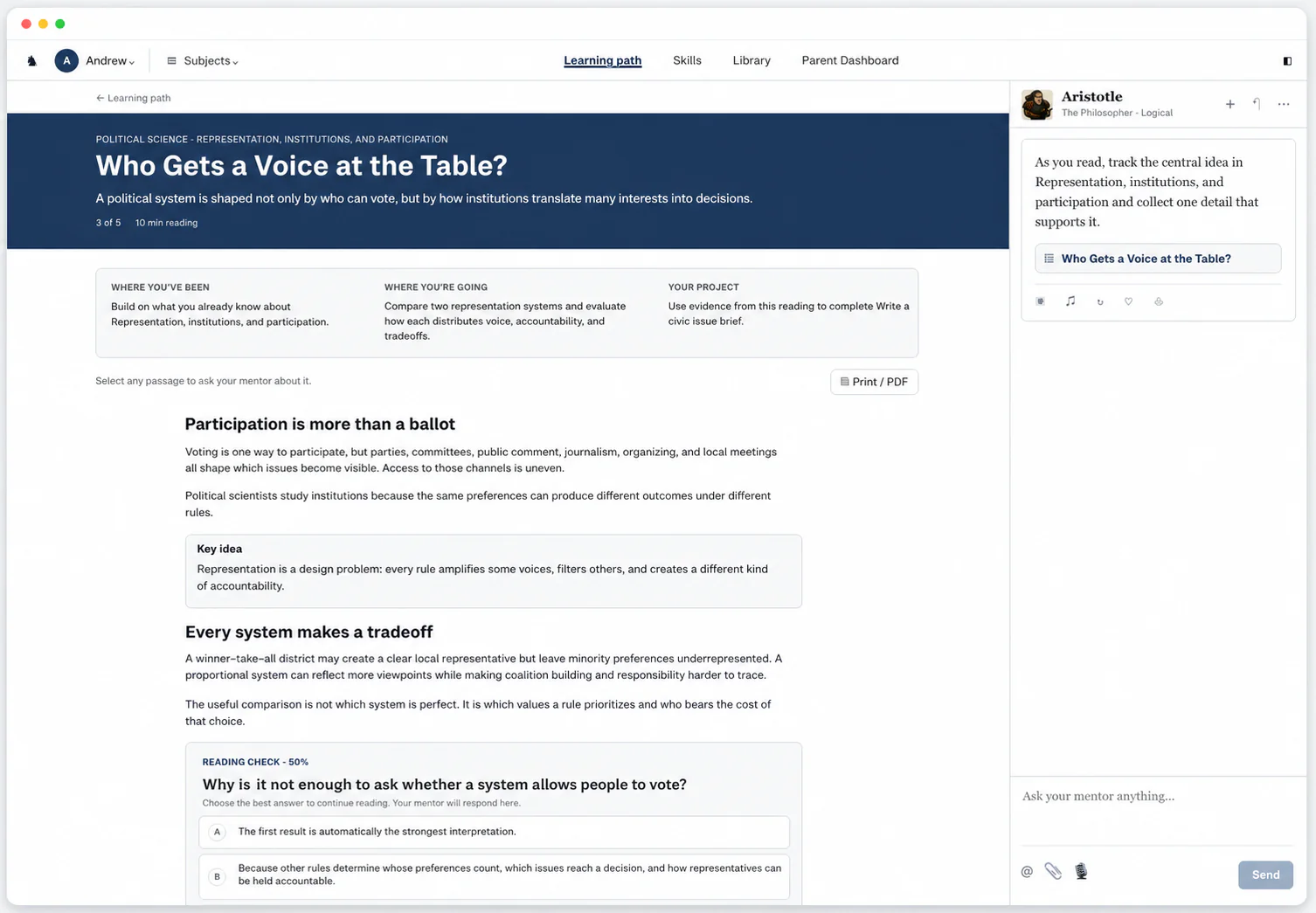
A political system is shaped not only by who can vote, but by how institutions translate many interests into decisions.
- Lesson
- Who Gets a Voice at the Table?
- Goal
- Compare two representation systems and evaluate how each distributes voice, accountability, and tradeoffs.
How a lesson works
A 10-minute reading
This example lesson comes from the unit on representation, institutions, and participation. It moves from “Participation is more than a ballot” to “Every system makes a tradeoff” and builds to one idea: representation is a design problem: every rule amplifies some voices, filters others, and creates a different kind of accountability.
Help inside the reading
If a policy argument uses one source, our Always-On Mentor can ask what evidence supports it and what a thoughtful counterargument would say, without choosing a political side. Your child can also highlight any line of “Who Gets a Voice at the Table?” to ask about it or ask for a visual, and the mentor offers help on its own when they seem stuck.
A check halfway through
Your child answers “Why is it not enough to ask whether a system allows people to vote?” before reading on, and the Reading Check at the end asks new questions.
A project your child hands in
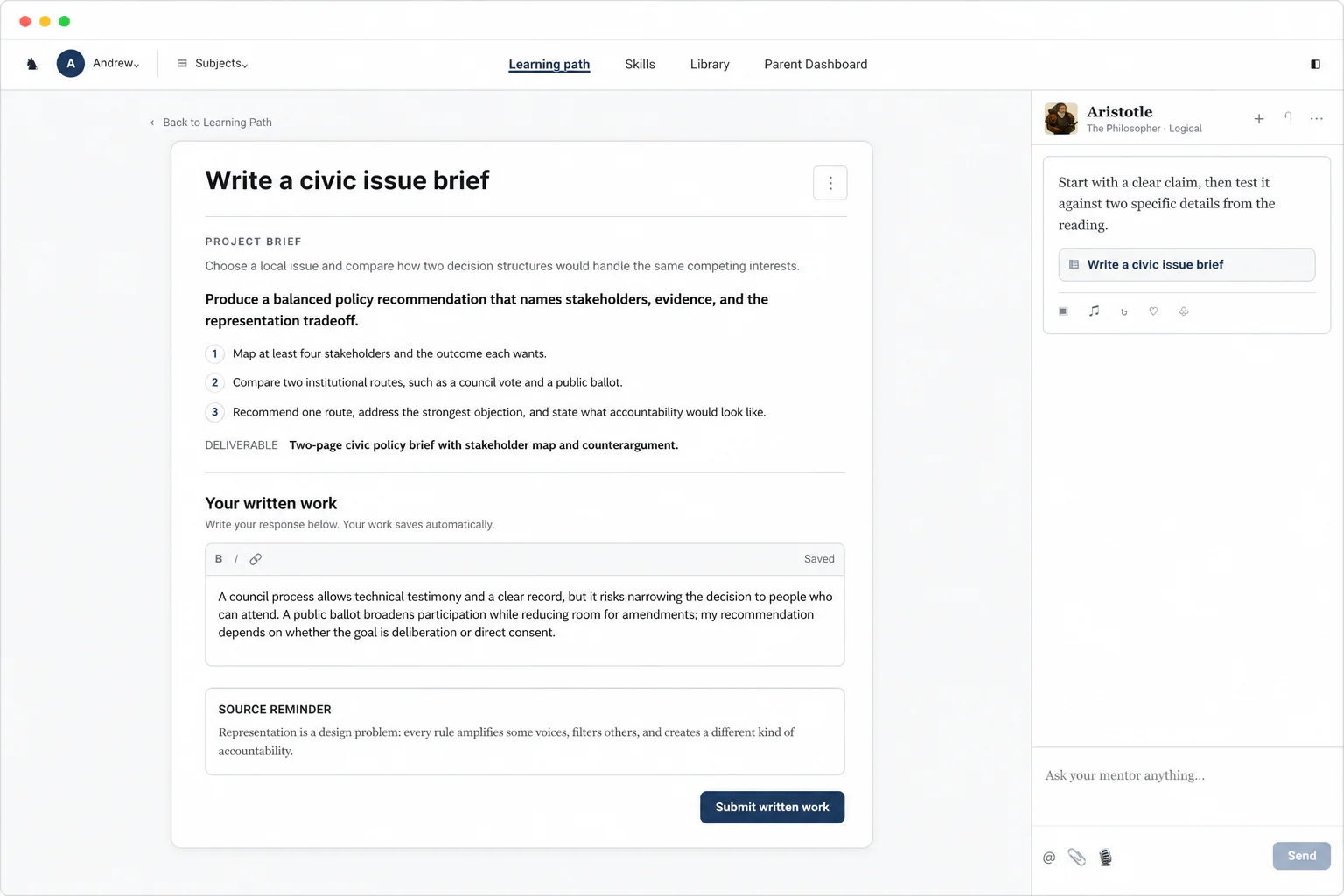
Choose a local issue and compare how two decision structures would handle the same competing interests.
- Task
- Produce a balanced policy recommendation that names stakeholders, evidence, and the representation tradeoff
- Hand in
- Two-page civic policy brief with stakeholder map and counterargument
Your parent dashboard
- Today
- Each subject's lesson, and whether it's done
- Grades
- Every submission graded instantly, with written feedback, so you never grade
- Records
- Attendance log and learning summary, ready to export

Units and skills
The course teaches how politics works through institutions, incentives, public opinion, rights, policy tradeoffs, other countries' systems, and arguments backed by evidence. Political Science is one skill tree for every grade with 12 units, from power, authority, legitimacy, and accountability to policy memo and democratic strategy capstone, and your child's grade sets how deep each unit goes.
Political Science12 units · 60 skills
Power, authority, legitimacy, and accountability5 skills
- Define the vocabulary, boundaries, and common misconceptions of Power, authority, legitimacy, and accountability
- Explain the main actors, mechanisms, sequence, and constraints in Power, authority, legitimacy, and accountability
- Interpret evidence, data, cases, or examples connected to Power, authority, legitimacy, and accountability
- Apply Power, authority, legitimacy, and accountability to a realistic political institution or policy dispute
- Create a policy memo that justifies decisions about Power, authority, legitimacy, and accountability
Political institutions and jurisdiction5 skills
- Define the vocabulary, boundaries, and common misconceptions of Political institutions and jurisdiction
- Explain the main actors, mechanisms, sequence, and constraints in Political institutions and jurisdiction
- Interpret evidence, data, cases, or examples connected to Political institutions and jurisdiction
- Apply Political institutions and jurisdiction to a realistic political institution or policy dispute
- Create a policy memo that justifies decisions about Political institutions and jurisdiction
Constitutions, federalism, and rule design5 skills
- Define the vocabulary, boundaries, and common misconceptions of Constitutions, federalism, and rule design
- Explain the main actors, mechanisms, sequence, and constraints in Constitutions, federalism, and rule design
- Interpret evidence, data, cases, or examples connected to Constitutions, federalism, and rule design
- Apply Constitutions, federalism, and rule design to a realistic political institution or policy dispute
- Create a policy memo that justifies decisions about Constitutions, federalism, and rule design
Rights, liberties, and equal protection5 skills
- Define the vocabulary, boundaries, and common misconceptions of Rights, liberties, and equal protection
- Explain the main actors, mechanisms, sequence, and constraints in Rights, liberties, and equal protection
- Interpret evidence, data, cases, or examples connected to Rights, liberties, and equal protection
- Apply Rights, liberties, and equal protection to a realistic political institution or policy dispute
- Create a policy memo that justifies decisions about Rights, liberties, and equal protection
Representation, parties, and electoral systems5 skills
- Define the vocabulary, boundaries, and common misconceptions of Representation, parties, and electoral systems
- Explain the main actors, mechanisms, sequence, and constraints in Representation, parties, and electoral systems
- Interpret evidence, data, cases, or examples connected to Representation, parties, and electoral systems
- Apply Representation, parties, and electoral systems to a realistic political institution or policy dispute
- Create a policy memo that justifies decisions about Representation, parties, and electoral systems
Campaigns, public opinion, and media incentives5 skills
- Define the vocabulary, boundaries, and common misconceptions of Campaigns, public opinion, and media incentives
- Explain the main actors, mechanisms, sequence, and constraints in Campaigns, public opinion, and media incentives
- Interpret evidence, data, cases, or examples connected to Campaigns, public opinion, and media incentives
- Apply Campaigns, public opinion, and media incentives to a realistic political institution or policy dispute
- Create a policy memo that justifies decisions about Campaigns, public opinion, and media incentives
Interest groups and collective action5 skills
- Define the vocabulary, boundaries, and common misconceptions of Interest groups and collective action
- Explain the main actors, mechanisms, sequence, and constraints in Interest groups and collective action
- Interpret evidence, data, cases, or examples connected to Interest groups and collective action
- Apply Interest groups and collective action to a realistic political institution or policy dispute
- Create a policy memo that justifies decisions about Interest groups and collective action
Policy analysis and implementation5 skills
- Define the vocabulary, boundaries, and common misconceptions of Policy analysis and implementation
- Explain the main actors, mechanisms, sequence, and constraints in Policy analysis and implementation
- Interpret evidence, data, cases, or examples connected to Policy analysis and implementation
- Apply Policy analysis and implementation to a realistic political institution or policy dispute
- Create a policy memo that justifies decisions about Policy analysis and implementation
Comparative political systems5 skills
- Define the vocabulary, boundaries, and common misconceptions of Comparative political systems
- Explain the main actors, mechanisms, sequence, and constraints in Comparative political systems
- Interpret evidence, data, cases, or examples connected to Comparative political systems
- Apply Comparative political systems to a realistic political institution or policy dispute
- Create a policy memo that justifies decisions about Comparative political systems
International relations and security5 skills
- Define the vocabulary, boundaries, and common misconceptions of International relations and security
- Explain the main actors, mechanisms, sequence, and constraints in International relations and security
- Interpret evidence, data, cases, or examples connected to International relations and security
- Apply International relations and security to a realistic political institution or policy dispute
- Create a policy memo that justifies decisions about International relations and security
Political research methods and polling5 skills
- Define the vocabulary, boundaries, and common misconceptions of Political research methods and polling
- Explain the main actors, mechanisms, sequence, and constraints in Political research methods and polling
- Interpret evidence, data, cases, or examples connected to Political research methods and polling
- Apply Political research methods and polling to a realistic political institution or policy dispute
- Create a policy memo that justifies decisions about Political research methods and polling
Policy memo and democratic strategy capstone5 skills
- Define the vocabulary, boundaries, and common misconceptions of Policy memo and democratic strategy capstone
- Explain the main actors, mechanisms, sequence, and constraints in Policy memo and democratic strategy capstone
- Interpret evidence, data, cases, or examples connected to Policy memo and democratic strategy capstone
- Apply Policy memo and democratic strategy capstone to a realistic political institution or policy dispute
- Create a policy memo that justifies decisions about Policy memo and democratic strategy capstone
Questions parents ask
Which grades can use this Political Science curriculum?
- One Political Science skill tree serves grades 3 to 12, with course pages for 9th grade and high school. Placement checks your child's current skills, so the first lesson can sit before or after their grade.
What should my child know before starting?
- Starting skills include basic reading comprehension, interest in current events, and willingness to consider multiple views. If placement finds a gap, the course starts with those skills.
How much of the teaching do I do?
- None of it. The course explains each new idea and checks how your child uses it, while the mentor answers questions as they work. Every submission is graded as soon as it comes in, so you never grade it yourself.
Can I use the record for high-school planning?
- Yes. The subject record holds every graded assignment with its written feedback, ready to export. We generate a transcript from the course records, ready for you to sign.
Political Science, taught around your child
Political reasoning that can handle disagreement and evidence at the same time.
$49/month after the trial.