Electrical Engineering for your homeschool
Your child connects a circuit diagram to calculations and measurements, then uses them to find and explain a fault.
A lesson built around your child
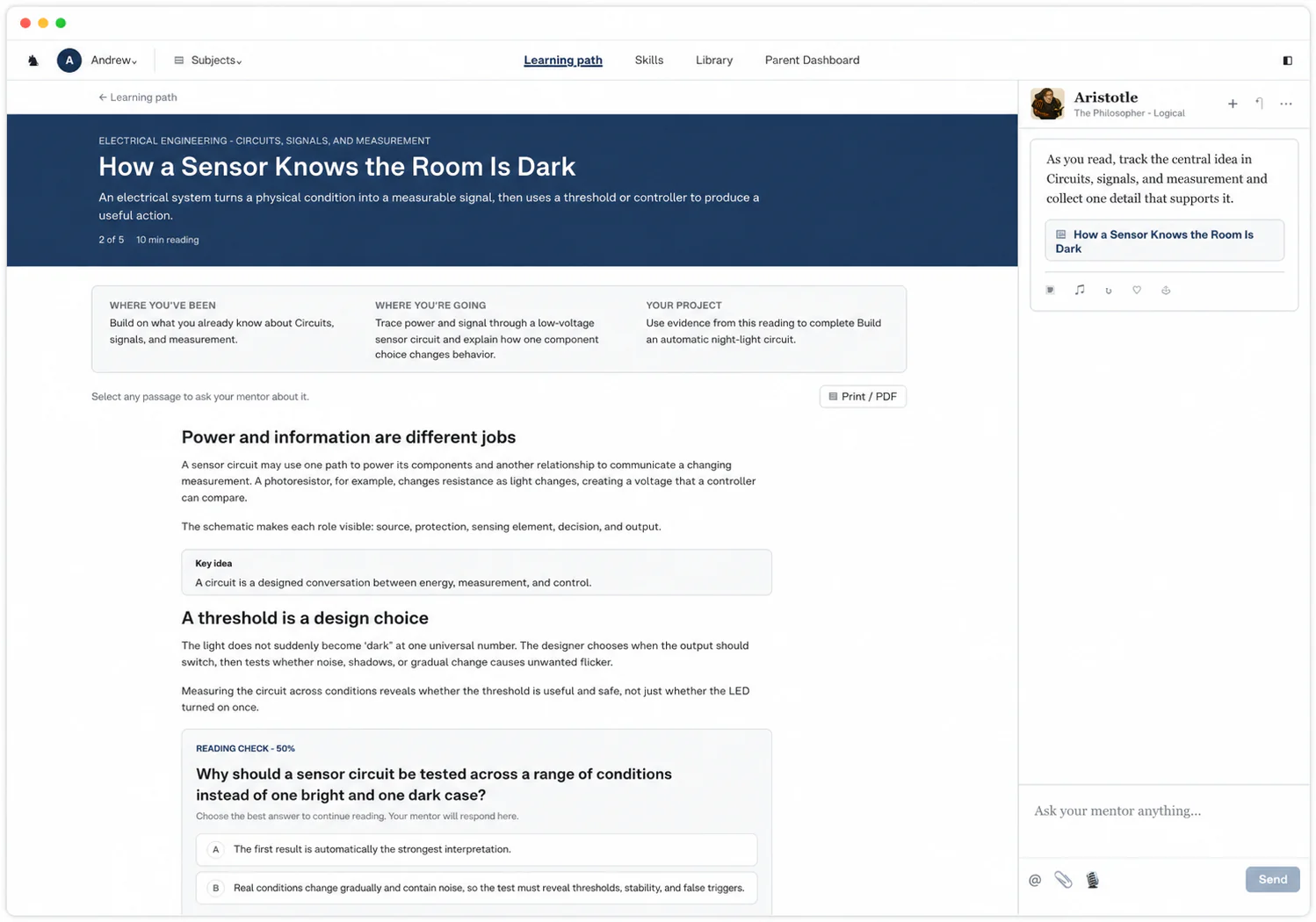
An electrical system turns a physical condition into a measurable signal, then uses a threshold or controller to produce a useful action.
- Lesson
- How a Sensor Knows the Room Is Dark
- Goal
- Trace power and signal through a low-voltage sensor circuit and explain how one component choice changes behavior.
How a lesson works
A 10-minute reading
This example lesson comes from the unit on circuits, signals, and measurement. It moves from “Power and information are different jobs” to “A threshold is a design choice” and builds to one idea: a circuit is a designed conversation between energy, measurement, and control.
Help inside the reading
If a circuit does not work, our Always-On Mentor can help your child check one connection or measurement at a time instead of handing over a new diagram. Your child can also highlight any line of “How a Sensor Knows the Room Is Dark” to ask about it or ask for a visual, and the mentor offers help on its own when they seem stuck.
A check halfway through
Your child answers “Why should a sensor circuit be tested across a range of conditions instead of one bright and one dark case?” before reading on, and the Reading Check at the end asks new questions.
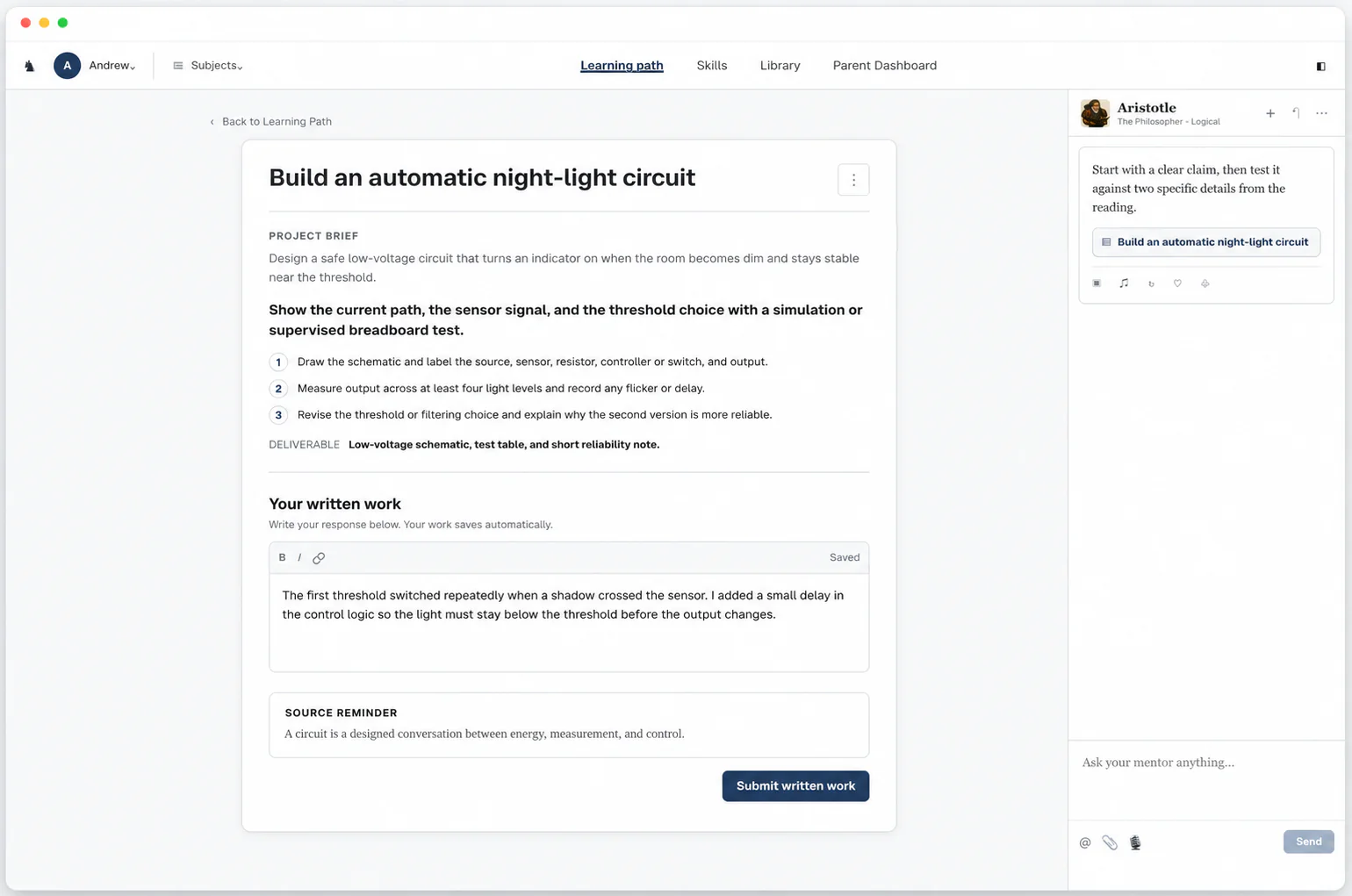
A project your child hands in
Design a safe low-voltage circuit that turns an indicator on when the room becomes dim and stays stable near the threshold.
- Task
- Show the current path, the sensor signal, and the threshold choice with a simulation or supervised breadboard test
- Hand in
- Low-voltage schematic, test table, and short reliability note
Your parent dashboard
- Today
- Each subject's lesson, and whether it's done
- Grades
- Every submission graded instantly, with written feedback, so you never grade
- Records
- Attendance log and learning summary, ready to export

Units and skills
Builds the conceptual and practical foundation for electronics, robotics, and energy systems without requiring advanced calculus. Electrical Engineering is one skill tree for every grade with 12 units, from charge, current, voltage, and resistance to electronics design capstone, and your child's grade sets how deep each unit goes.
Electrical Engineering12 units · 60 skills
Charge, current, voltage, and resistance5 skills
- Define the vocabulary, boundaries, and common misconceptions of Charge, current, voltage, and resistance
- Explain the main actors, mechanisms, sequence, and constraints in Charge, current, voltage, and resistance
- Interpret evidence, data, cases, or examples connected to Charge, current, voltage, and resistance
- Apply Charge, current, voltage, and resistance to a realistic circuit or signal-design problem
- Create a tested electronics design note that justifies decisions about Charge, current, voltage, and resistance
Circuit diagrams and measurement5 skills
- Define the vocabulary, boundaries, and common misconceptions of Circuit diagrams and measurement
- Explain the main actors, mechanisms, sequence, and constraints in Circuit diagrams and measurement
- Interpret evidence, data, cases, or examples connected to Circuit diagrams and measurement
- Apply Circuit diagrams and measurement to a realistic circuit or signal-design problem
- Create a tested electronics design note that justifies decisions about Circuit diagrams and measurement
Series, parallel, and equivalent circuits5 skills
- Define the vocabulary, boundaries, and common misconceptions of Series, parallel, and equivalent circuits
- Explain the main actors, mechanisms, sequence, and constraints in Series, parallel, and equivalent circuits
- Interpret evidence, data, cases, or examples connected to Series, parallel, and equivalent circuits
- Apply Series, parallel, and equivalent circuits to a realistic circuit or signal-design problem
- Create a tested electronics design note that justifies decisions about Series, parallel, and equivalent circuits
Capacitors, inductors, and transient behavior5 skills
- Define the vocabulary, boundaries, and common misconceptions of Capacitors, inductors, and transient behavior
- Explain the main actors, mechanisms, sequence, and constraints in Capacitors, inductors, and transient behavior
- Interpret evidence, data, cases, or examples connected to Capacitors, inductors, and transient behavior
- Apply Capacitors, inductors, and transient behavior to a realistic circuit or signal-design problem
- Create a tested electronics design note that justifies decisions about Capacitors, inductors, and transient behavior
AC signals, frequency, and impedance5 skills
- Define the vocabulary, boundaries, and common misconceptions of AC signals, frequency, and impedance
- Explain the main actors, mechanisms, sequence, and constraints in AC signals, frequency, and impedance
- Interpret evidence, data, cases, or examples connected to AC signals, frequency, and impedance
- Apply AC signals, frequency, and impedance to a realistic circuit or signal-design problem
- Create a tested electronics design note that justifies decisions about AC signals, frequency, and impedance
Semiconductors, diodes, and transistors5 skills
- Define the vocabulary, boundaries, and common misconceptions of Semiconductors, diodes, and transistors
- Explain the main actors, mechanisms, sequence, and constraints in Semiconductors, diodes, and transistors
- Interpret evidence, data, cases, or examples connected to Semiconductors, diodes, and transistors
- Apply Semiconductors, diodes, and transistors to a realistic circuit or signal-design problem
- Create a tested electronics design note that justifies decisions about Semiconductors, diodes, and transistors
Digital logic and microcontrollers5 skills
- Define the vocabulary, boundaries, and common misconceptions of Digital logic and microcontrollers
- Explain the main actors, mechanisms, sequence, and constraints in Digital logic and microcontrollers
- Interpret evidence, data, cases, or examples connected to Digital logic and microcontrollers
- Apply Digital logic and microcontrollers to a realistic circuit or signal-design problem
- Create a tested electronics design note that justifies decisions about Digital logic and microcontrollers
Sensors, actuators, and signal conditioning5 skills
- Define the vocabulary, boundaries, and common misconceptions of Sensors, actuators, and signal conditioning
- Explain the main actors, mechanisms, sequence, and constraints in Sensors, actuators, and signal conditioning
- Interpret evidence, data, cases, or examples connected to Sensors, actuators, and signal conditioning
- Apply Sensors, actuators, and signal conditioning to a realistic circuit or signal-design problem
- Create a tested electronics design note that justifies decisions about Sensors, actuators, and signal conditioning
Power, safety, and grounding5 skills
- Define the vocabulary, boundaries, and common misconceptions of Power, safety, and grounding
- Explain the main actors, mechanisms, sequence, and constraints in Power, safety, and grounding
- Interpret evidence, data, cases, or examples connected to Power, safety, and grounding
- Apply Power, safety, and grounding to a realistic circuit or signal-design problem
- Create a tested electronics design note that justifies decisions about Power, safety, and grounding
Communication signals and noise5 skills
- Define the vocabulary, boundaries, and common misconceptions of Communication signals and noise
- Explain the main actors, mechanisms, sequence, and constraints in Communication signals and noise
- Interpret evidence, data, cases, or examples connected to Communication signals and noise
- Apply Communication signals and noise to a realistic circuit or signal-design problem
- Create a tested electronics design note that justifies decisions about Communication signals and noise
PCB layout and design verification5 skills
- Define the vocabulary, boundaries, and common misconceptions of PCB layout and design verification
- Explain the main actors, mechanisms, sequence, and constraints in PCB layout and design verification
- Interpret evidence, data, cases, or examples connected to PCB layout and design verification
- Apply PCB layout and design verification to a realistic circuit or signal-design problem
- Create a tested electronics design note that justifies decisions about PCB layout and design verification
Electronics design capstone5 skills
- Define the vocabulary, boundaries, and common misconceptions of Electronics design capstone
- Explain the main actors, mechanisms, sequence, and constraints in Electronics design capstone
- Interpret evidence, data, cases, or examples connected to Electronics design capstone
- Apply Electronics design capstone to a realistic circuit or signal-design problem
- Create a tested electronics design note that justifies decisions about Electronics design capstone
Questions parents ask
Which grades can use this Electrical Engineering curriculum?
- One Electrical Engineering skill tree serves grades 3 to 12, with course pages for 9th grade and high school. Placement checks your child's current skills, so the first lesson can sit before or after their grade.
What should my child know before starting?
- Starting skills include basic math skills, interest in electronics, and willingness to troubleshoot. If placement finds a gap, the course starts with those skills.
How much of the teaching do I do?
- None of it. The course explains each new idea and checks how your child uses it, while the mentor answers questions as they work. Every submission is graded as soon as it comes in, so you never grade it yourself.
Can I use the record for high-school planning?
- Yes. The subject record holds every graded assignment with its written feedback, ready to export. We generate a transcript from the course records, ready for you to sign.
Electrical Engineering, taught around your child
Electrical systems the learner can predict and debug, not only assemble.
$49/month after the trial.