Advanced Macroeconomics homeschool curriculum.
Your student studies economic indicators, builds macroeconomic models, and evaluates policy with current data.
A personalized lesson from the course
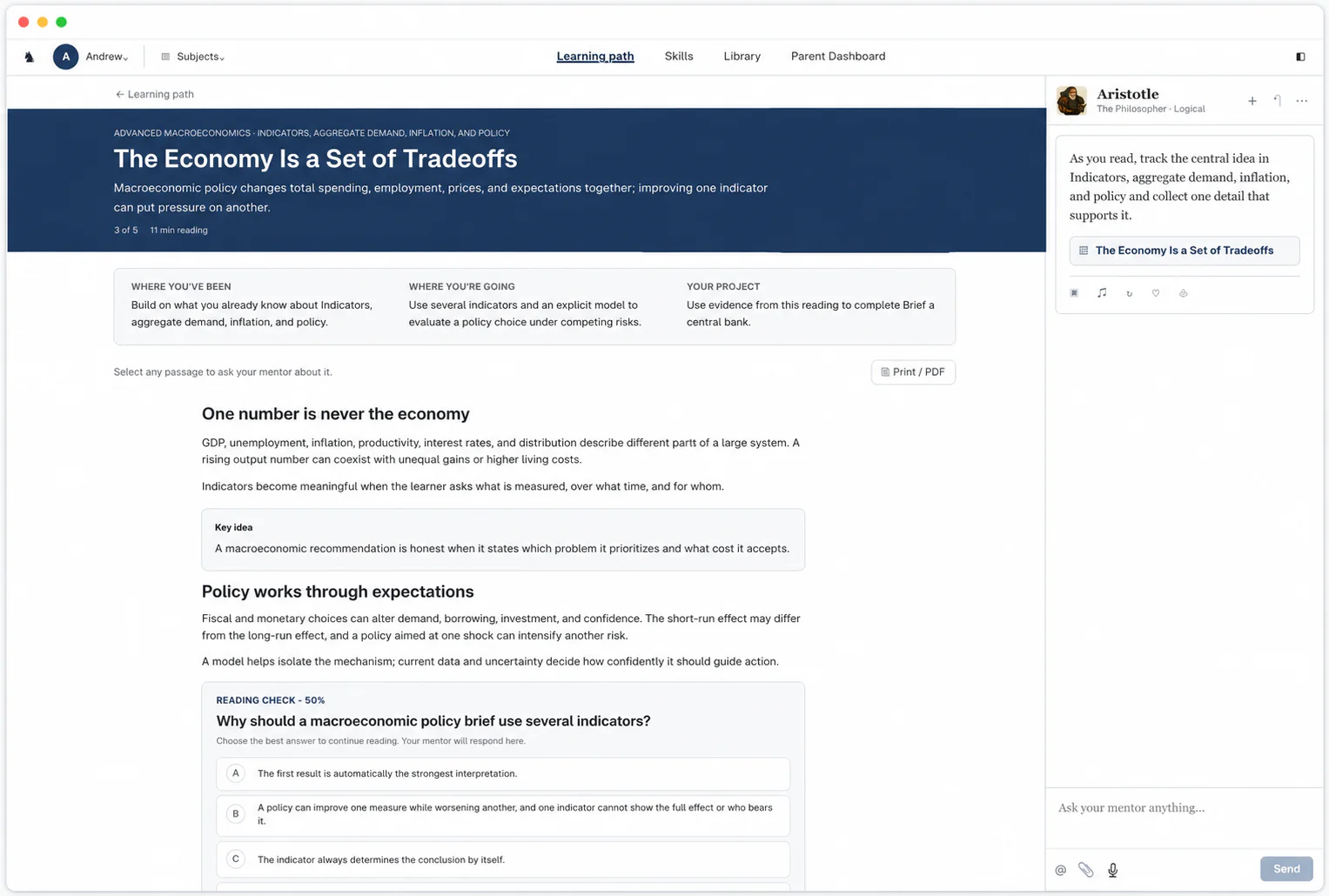
Macroeconomic policy changes total spending, employment, prices, and expectations together; improving one indicator can put pressure on another.
- Lesson
- The Economy Is a Set of Tradeoffs
- Goal
- Use several indicators and an explicit model to evaluate a policy choice under competing risks.
How a lesson works
An 11-minute reading
This example lesson comes from the unit on indicators, aggregate demand, inflation, and policy. It moves from “One number is never the economy” to “Policy works through expectations” and builds to one idea: a macroeconomic recommendation is honest when it states which problem it prioritizes and what cost it accepts.
Help inside the reading
Any line of “The Economy Is a Set of Tradeoffs” can go to our Always-On Mentor: your child highlights it to ask a question, and the mentor can draw the idea step by step on its board or, after a missed answer, explain it another way.
A check halfway through
Your child answers “Why should a macroeconomic policy brief use several indicators?” before reading on, and the Reading Check at the end asks new questions.
A project your child hands in
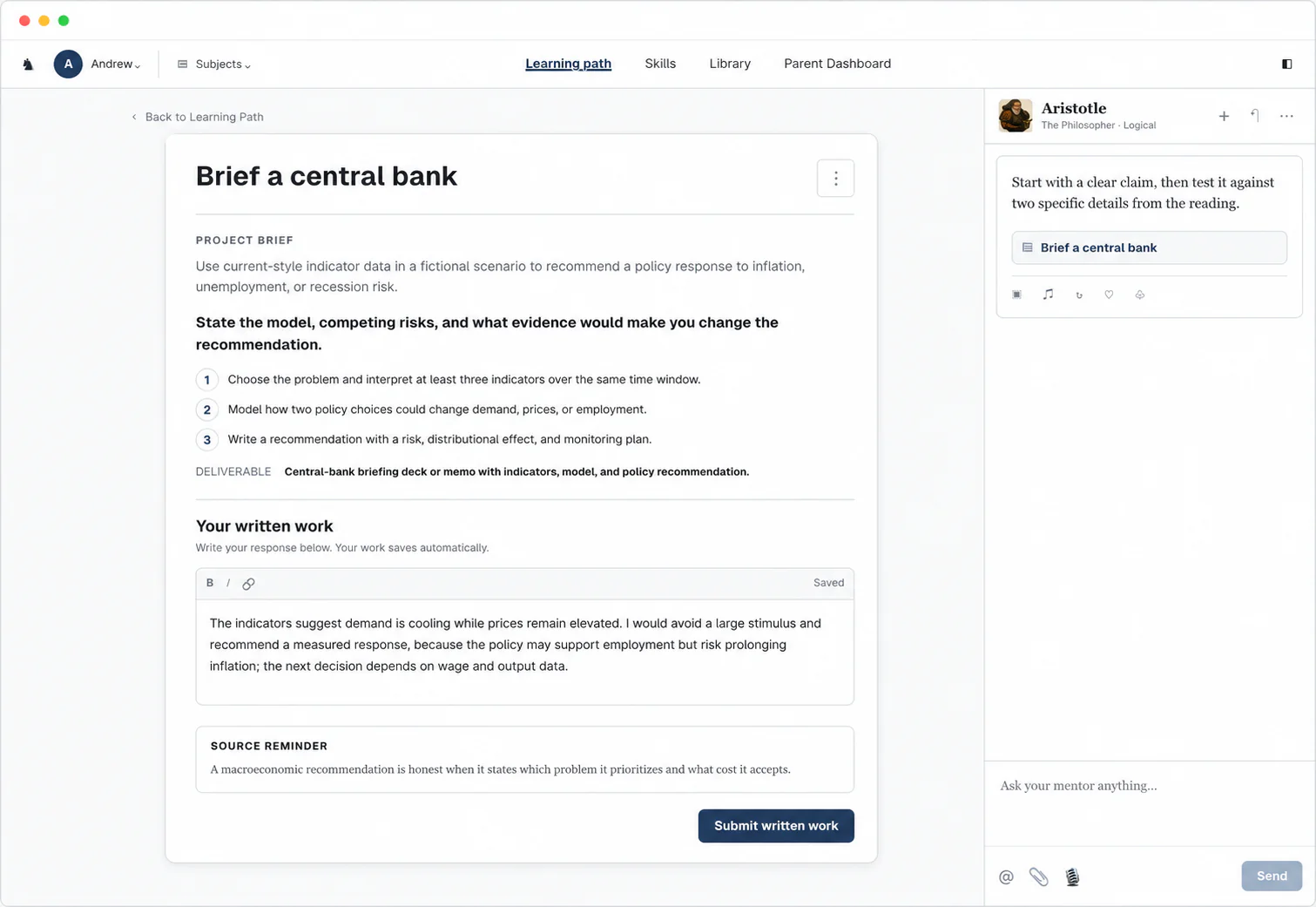
Use current-style indicator data in a fictional scenario to recommend a policy response to inflation, unemployment, or recession risk.
- Task
- State the model, competing risks, and what evidence would make you change the recommendation
- Hand in
- Central-bank briefing deck or memo with indicators, model, and policy recommendation
Arguments backed by evidence
Students connect economic definitions and models with calculations, current data, and policy choices. Advanced Macroeconomics runs through 20 units and 80 skills, starting with basic economic concepts, economic indicators and the business cycle, and national income and price determination.
- Correctly labeled economic models
- Calculation and policy-analysis sets
- Current-data explanations tied to a model
Units and skills
Advanced Macroeconomics20 units · 80 skills
Basic economic concepts4 skills
- Define and apply economic principles and models in Basic economic concepts
- Interpret economic outcomes and evidence in Basic economic concepts
- Determine the effects of changes to conditions in Basic economic concepts
- Create and analyze economic graphs for Basic economic concepts
Economic indicators and the business cycle4 skills
- Define and apply economic principles and models in Economic indicators and the business cycle
- Interpret economic outcomes and evidence in Economic indicators and the business cycle
- Determine the effects of changes to conditions in Economic indicators and the business cycle
- Create and analyze economic graphs for Economic indicators and the business cycle
National income and price determination4 skills
- Define and apply economic principles and models in National income and price determination
- Interpret economic outcomes and evidence in National income and price determination
- Determine the effects of changes to conditions in National income and price determination
- Create and analyze economic graphs for National income and price determination
Financial sector4 skills
- Define and apply economic principles and models in Financial sector
- Interpret economic outcomes and evidence in Financial sector
- Determine the effects of changes to conditions in Financial sector
- Create and analyze economic graphs for Financial sector
Long-run consequences of stabilization policies4 skills
- Define and apply economic principles and models in Long-run consequences of stabilization policies
- Interpret economic outcomes and evidence in Long-run consequences of stabilization policies
- Determine the effects of changes to conditions in Long-run consequences of stabilization policies
- Create and analyze economic graphs for Long-run consequences of stabilization policies
Open economy4 skills
- Define and apply economic principles and models in Open economy
- Interpret economic outcomes and evidence in Open economy
- Determine the effects of changes to conditions in Open economy
- Create and analyze economic graphs for Open economy
Aggregate demand and supply4 skills
- Define and apply economic principles and models in Aggregate demand and supply
- Interpret economic outcomes and evidence in Aggregate demand and supply
- Determine the effects of changes to conditions in Aggregate demand and supply
- Create and analyze economic graphs for Aggregate demand and supply
Fiscal policy4 skills
- Define and apply economic principles and models in Fiscal policy
- Interpret economic outcomes and evidence in Fiscal policy
- Determine the effects of changes to conditions in Fiscal policy
- Create and analyze economic graphs for Fiscal policy
Monetary policy4 skills
- Define and apply economic principles and models in Monetary policy
- Interpret economic outcomes and evidence in Monetary policy
- Determine the effects of changes to conditions in Monetary policy
- Create and analyze economic graphs for Monetary policy
Foreign exchange4 skills
- Define and apply economic principles and models in Foreign exchange
- Interpret economic outcomes and evidence in Foreign exchange
- Determine the effects of changes to conditions in Foreign exchange
- Create and analyze economic graphs for Foreign exchange
Economic graphs4 skills
- Define and apply economic principles and models in Economic graphs
- Interpret economic outcomes and evidence in Economic graphs
- Determine the effects of changes to conditions in Economic graphs
- Create and analyze economic graphs for Economic graphs
Cumulative policy analysis4 skills
- Define and apply economic principles and models in Cumulative policy analysis
- Interpret economic outcomes and evidence in Cumulative policy analysis
- Determine the effects of changes to conditions in Cumulative policy analysis
- Create and analyze economic graphs for Cumulative policy analysis
Multiple quantitative representations4 skills
- Define and apply economic principles and models in Multiple quantitative representations
- Interpret economic outcomes and evidence in Multiple quantitative representations
- Determine the effects of changes to conditions in Multiple quantitative representations
- Create and analyze economic graphs for Multiple quantitative representations
Graph construction and interpretation4 skills
- Define and apply economic principles and models in Graph construction and interpretation
- Interpret economic outcomes and evidence in Graph construction and interpretation
- Determine the effects of changes to conditions in Graph construction and interpretation
- Create and analyze economic graphs for Graph construction and interpretation
Written mathematical justification4 skills
- Define and apply economic principles and models in Written mathematical justification
- Interpret economic outcomes and evidence in Written mathematical justification
- Determine the effects of changes to conditions in Written mathematical justification
- Create and analyze economic graphs for Written mathematical justification
Dated evidence and changing conditions4 skills
- Define and apply economic principles and models in Dated evidence and changing conditions
- Interpret economic outcomes and evidence in Dated evidence and changing conditions
- Determine the effects of changes to conditions in Dated evidence and changing conditions
- Create and analyze economic graphs for Dated evidence and changing conditions
Competing contemporary perspectives4 skills
- Define and apply economic principles and models in Competing contemporary perspectives
- Interpret economic outcomes and evidence in Competing contemporary perspectives
- Determine the effects of changes to conditions in Competing contemporary perspectives
- Create and analyze economic graphs for Competing contemporary perspectives
Advanced Macroeconomics cumulative assessment4 skills
- Define and apply economic principles and models in Advanced Macroeconomics cumulative assessment
- Interpret economic outcomes and evidence in Advanced Macroeconomics cumulative assessment
- Determine the effects of changes to conditions in Advanced Macroeconomics cumulative assessment
- Create and analyze economic graphs for Advanced Macroeconomics cumulative assessment
Advanced Macroeconomics exam-mode practice4 skills
- Define and apply economic principles and models in Advanced Macroeconomics exam-mode practice
- Interpret economic outcomes and evidence in Advanced Macroeconomics exam-mode practice
- Determine the effects of changes to conditions in Advanced Macroeconomics exam-mode practice
- Create and analyze economic graphs for Advanced Macroeconomics exam-mode practice
Advanced Macroeconomics reflection and transfer4 skills
- Define and apply economic principles and models in Advanced Macroeconomics reflection and transfer
- Interpret economic outcomes and evidence in Advanced Macroeconomics reflection and transfer
- Determine the effects of changes to conditions in Advanced Macroeconomics reflection and transfer
- Create and analyze economic graphs for Advanced Macroeconomics reflection and transfer
Questions parents ask
How does Advanced Macroeconomics prepare my student for AP Macroeconomics?
- Advanced Macroeconomics follows the AP Macroeconomics framework unit by unit, as its skill tree shows. Your teen explains and applies the ideas in written responses and projects, so the work shows which skills are secure and which need more practice.
How does a homeschooler register for an AP exam?
- An AP coordinator at an AP-authorized local school arranges registration. Use College Board’s homeschool exam guidance to find a host school. That school sets its deadlines and outside-student policies; its coordinator orders the exam, collects fees, and tells your child where and when to test.
Which course title goes on a homeschool transcript?
- Advanced Macroeconomics, not AP Macroeconomics. The AP designation requires College Board Course Audit authorization of the course, which framework alignment does not give. We generate the transcript with that title, ready for you to sign as homeschool administrator.
How can AP scores earn college credit?
- Colleges award credit under their own AP score policies. College Board reports scores on a 1–5 scale, separately from our coursework grades; check the college’s required score and whether it grants credit, placement, or both.
Advanced Macroeconomics, with the teaching and records handled
$49/month after the trial.