Advanced German Language and Culture homeschool curriculum.
Your student builds German listening and speaking fluency and writes arguments from German-language sources.
A personalized lesson from the course
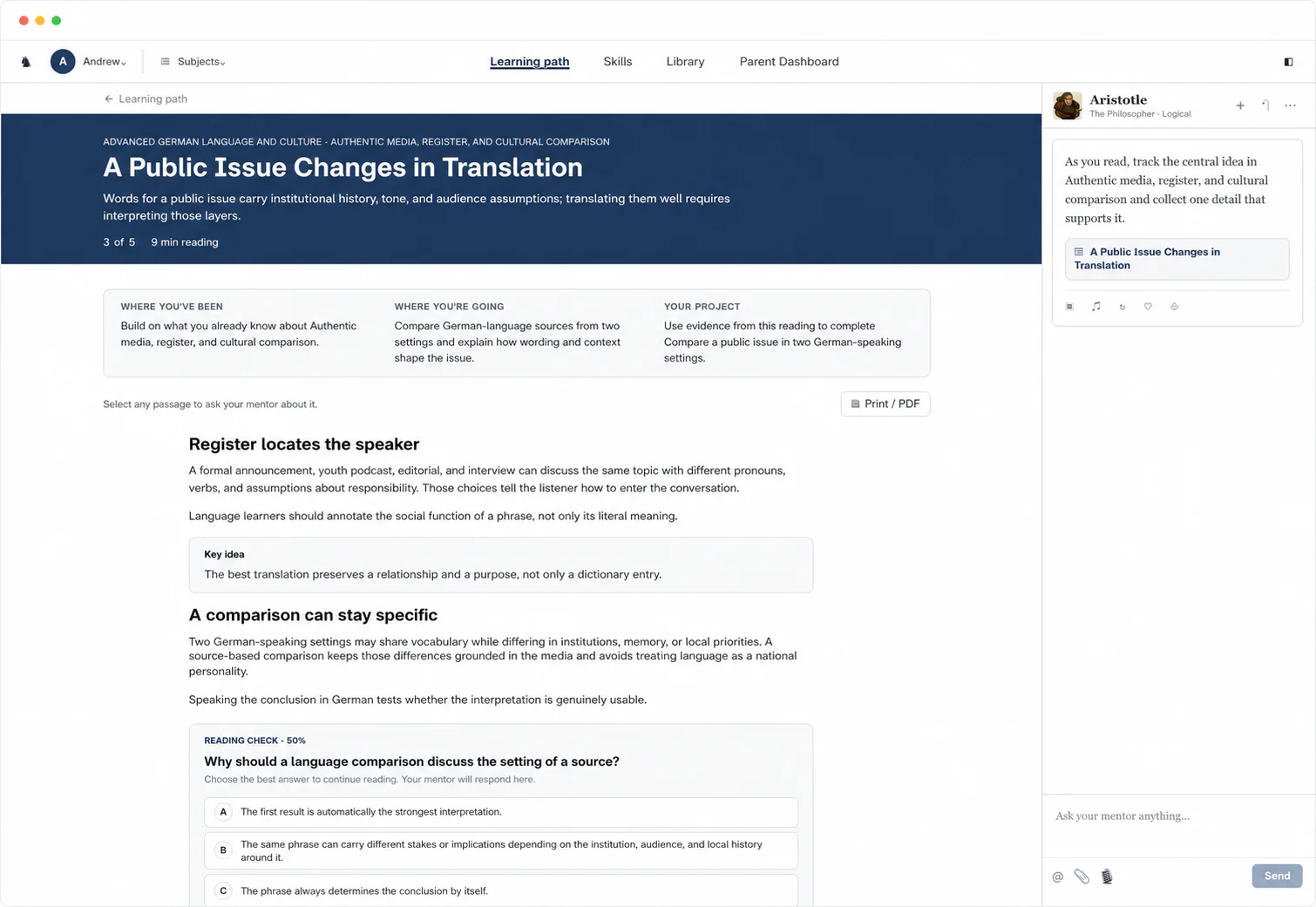
Words for a public issue carry institutional history, tone, and audience assumptions; translating them well requires interpreting those layers.
- Lesson
- A Public Issue Changes in Translation
- Goal
- Compare German-language sources from two settings and explain how wording and context shape the issue.
How a lesson works
A 9-minute reading
This example lesson comes from the unit on authentic media, register, and cultural comparison. It moves from “Register locates the speaker” to “A comparison can stay specific” and builds to one idea: the best translation preserves a relationship and a purpose, not only a dictionary entry.
Help inside the reading
Your child can highlight any line of “A Public Issue Changes in Translation” and ask our Always-On Mentor about it or ask for a visual, and it offers help on its own whenever they seem stuck.
A check halfway through
Your child answers “Why should a language comparison discuss the setting of a source?” before reading on, and the Reading Check at the end asks new questions.
A project your child hands in
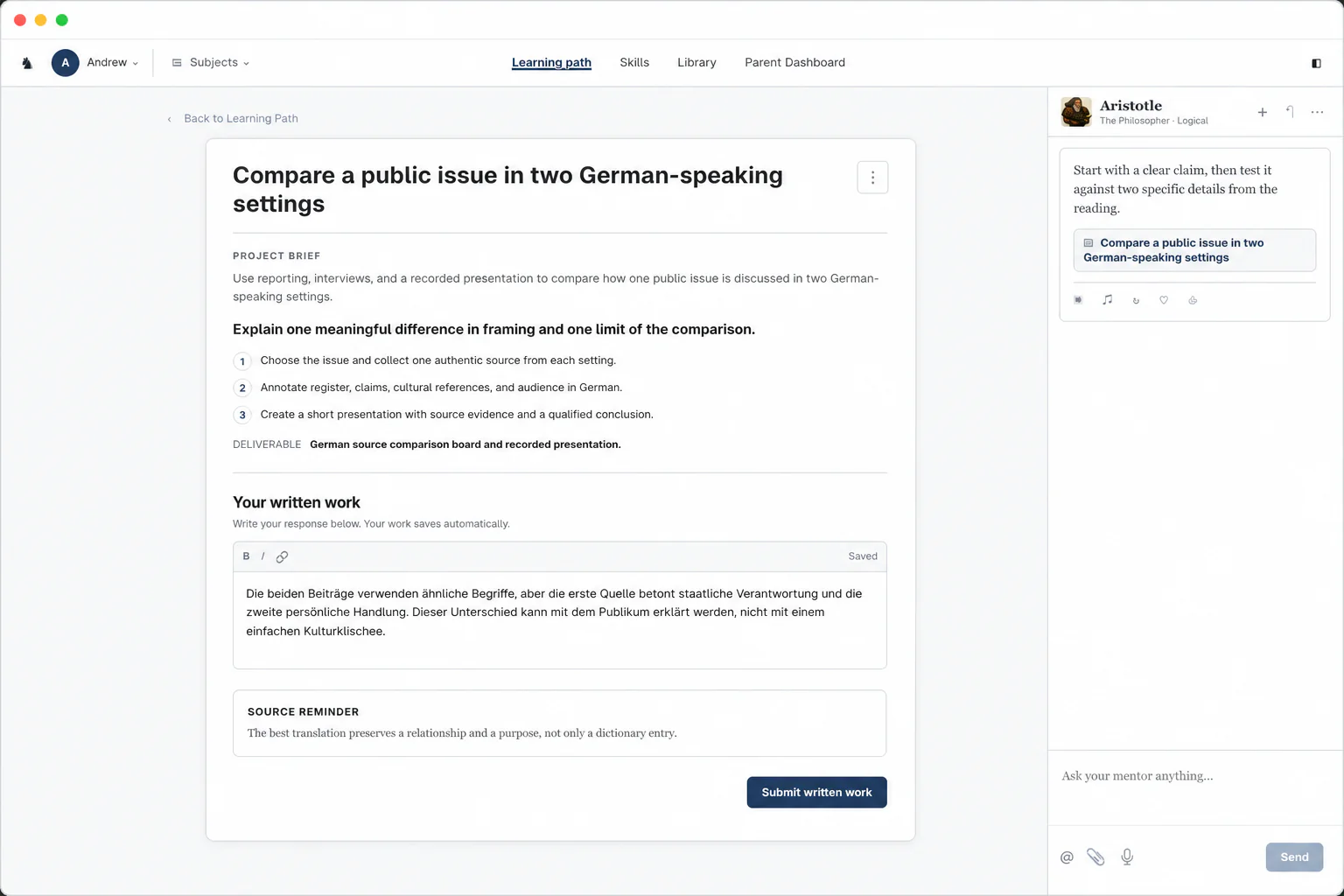
Use reporting, interviews, and a recorded presentation to compare how one public issue is discussed in two German-speaking settings.
- Task
- Explain one meaningful difference in framing and one limit of the comparison
- Hand in
- German source comparison board and recorded presentation
Use the language, keep the evidence
Students listen to authentic German, respond in conversation, and support an argument with a German-language source. Each recording and written response is graded with feedback as soon as it is submitted. Advanced German Language and Culture runs through 22 units and 110 skills, starting with families and communities, personal and public identities, and beauty and aesthetics.
- Recorded spoken exchanges
- Timed reading and listening analyses
- Presentational writing and speech grounded in sources
Units and skills
Advanced German Language and Culture22 units · 110 skills
Families and communities5 skills
- Interpret authentic written, audio, or audiovisual material about Families and communities
- Sustain an appropriate interpersonal exchange about Families and communities
- Present organized spoken or written communication about Families and communities
- Compare products, practices, and perspectives connected to Families and communities
- Use course-level vocabulary and language control in Families and communities
Personal and public identities5 skills
- Interpret authentic written, audio, or audiovisual material about Personal and public identities
- Sustain an appropriate interpersonal exchange about Personal and public identities
- Present organized spoken or written communication about Personal and public identities
- Compare products, practices, and perspectives connected to Personal and public identities
- Use course-level vocabulary and language control in Personal and public identities
Beauty and aesthetics5 skills
- Interpret authentic written, audio, or audiovisual material about Beauty and aesthetics
- Sustain an appropriate interpersonal exchange about Beauty and aesthetics
- Present organized spoken or written communication about Beauty and aesthetics
- Compare products, practices, and perspectives connected to Beauty and aesthetics
- Use course-level vocabulary and language control in Beauty and aesthetics
Science and technology5 skills
- Interpret authentic written, audio, or audiovisual material about Science and technology
- Sustain an appropriate interpersonal exchange about Science and technology
- Present organized spoken or written communication about Science and technology
- Compare products, practices, and perspectives connected to Science and technology
- Use course-level vocabulary and language control in Science and technology
Contemporary life5 skills
- Interpret authentic written, audio, or audiovisual material about Contemporary life
- Sustain an appropriate interpersonal exchange about Contemporary life
- Present organized spoken or written communication about Contemporary life
- Compare products, practices, and perspectives connected to Contemporary life
- Use course-level vocabulary and language control in Contemporary life
Global challenges5 skills
- Interpret authentic written, audio, or audiovisual material about Global challenges
- Sustain an appropriate interpersonal exchange about Global challenges
- Present organized spoken or written communication about Global challenges
- Compare products, practices, and perspectives connected to Global challenges
- Use course-level vocabulary and language control in Global challenges
Interpretive reading5 skills
- Interpret authentic written, audio, or audiovisual material about Interpretive reading
- Sustain an appropriate interpersonal exchange about Interpretive reading
- Present organized spoken or written communication about Interpretive reading
- Compare products, practices, and perspectives connected to Interpretive reading
- Use course-level vocabulary and language control in Interpretive reading
Interpretive listening5 skills
- Interpret authentic written, audio, or audiovisual material about Interpretive listening
- Sustain an appropriate interpersonal exchange about Interpretive listening
- Present organized spoken or written communication about Interpretive listening
- Compare products, practices, and perspectives connected to Interpretive listening
- Use course-level vocabulary and language control in Interpretive listening
Interpersonal writing5 skills
- Interpret authentic written, audio, or audiovisual material about Interpersonal writing
- Sustain an appropriate interpersonal exchange about Interpersonal writing
- Present organized spoken or written communication about Interpersonal writing
- Compare products, practices, and perspectives connected to Interpersonal writing
- Use course-level vocabulary and language control in Interpersonal writing
Interpersonal speaking5 skills
- Interpret authentic written, audio, or audiovisual material about Interpersonal speaking
- Sustain an appropriate interpersonal exchange about Interpersonal speaking
- Present organized spoken or written communication about Interpersonal speaking
- Compare products, practices, and perspectives connected to Interpersonal speaking
- Use course-level vocabulary and language control in Interpersonal speaking
Presentational writing5 skills
- Interpret authentic written, audio, or audiovisual material about Presentational writing
- Sustain an appropriate interpersonal exchange about Presentational writing
- Present organized spoken or written communication about Presentational writing
- Compare products, practices, and perspectives connected to Presentational writing
- Use course-level vocabulary and language control in Presentational writing
Presentational speaking5 skills
- Interpret authentic written, audio, or audiovisual material about Presentational speaking
- Sustain an appropriate interpersonal exchange about Presentational speaking
- Present organized spoken or written communication about Presentational speaking
- Compare products, practices, and perspectives connected to Presentational speaking
- Use course-level vocabulary and language control in Presentational speaking
Interpretive communication5 skills
- Interpret authentic written, audio, or audiovisual material about Interpretive communication
- Sustain an appropriate interpersonal exchange about Interpretive communication
- Present organized spoken or written communication about Interpretive communication
- Compare products, practices, and perspectives connected to Interpretive communication
- Use course-level vocabulary and language control in Interpretive communication
Interpersonal communication5 skills
- Interpret authentic written, audio, or audiovisual material about Interpersonal communication
- Sustain an appropriate interpersonal exchange about Interpersonal communication
- Present organized spoken or written communication about Interpersonal communication
- Compare products, practices, and perspectives connected to Interpersonal communication
- Use course-level vocabulary and language control in Interpersonal communication
Presentational communication5 skills
- Interpret authentic written, audio, or audiovisual material about Presentational communication
- Sustain an appropriate interpersonal exchange about Presentational communication
- Present organized spoken or written communication about Presentational communication
- Compare products, practices, and perspectives connected to Presentational communication
- Use course-level vocabulary and language control in Presentational communication
Cultural comparison5 skills
- Interpret authentic written, audio, or audiovisual material about Cultural comparison
- Sustain an appropriate interpersonal exchange about Cultural comparison
- Present organized spoken or written communication about Cultural comparison
- Compare products, practices, and perspectives connected to Cultural comparison
- Use course-level vocabulary and language control in Cultural comparison
Authentic source interpretation5 skills
- Interpret authentic written, audio, or audiovisual material about Authentic source interpretation
- Sustain an appropriate interpersonal exchange about Authentic source interpretation
- Present organized spoken or written communication about Authentic source interpretation
- Compare products, practices, and perspectives connected to Authentic source interpretation
- Use course-level vocabulary and language control in Authentic source interpretation
Controlled performance-task planning5 skills
- Interpret authentic written, audio, or audiovisual material about Controlled performance-task planning
- Sustain an appropriate interpersonal exchange about Controlled performance-task planning
- Present organized spoken or written communication about Controlled performance-task planning
- Compare products, practices, and perspectives connected to Controlled performance-task planning
- Use course-level vocabulary and language control in Controlled performance-task planning
Final artifact integrity and attestation5 skills
- Interpret authentic written, audio, or audiovisual material about Final artifact integrity and attestation
- Sustain an appropriate interpersonal exchange about Final artifact integrity and attestation
- Present organized spoken or written communication about Final artifact integrity and attestation
- Compare products, practices, and perspectives connected to Final artifact integrity and attestation
- Use course-level vocabulary and language control in Final artifact integrity and attestation
Advanced German Language and Culture cumulative assessment5 skills
- Interpret authentic written, audio, or audiovisual material about Advanced German Language and Culture cumulative assessment
- Sustain an appropriate interpersonal exchange about Advanced German Language and Culture cumulative assessment
- Present organized spoken or written communication about Advanced German Language and Culture cumulative assessment
- Compare products, practices, and perspectives connected to Advanced German Language and Culture cumulative assessment
- Use course-level vocabulary and language control in Advanced German Language and Culture cumulative assessment
Advanced German Language and Culture exam-mode practice5 skills
- Interpret authentic written, audio, or audiovisual material about Advanced German Language and Culture exam-mode practice
- Sustain an appropriate interpersonal exchange about Advanced German Language and Culture exam-mode practice
- Present organized spoken or written communication about Advanced German Language and Culture exam-mode practice
- Compare products, practices, and perspectives connected to Advanced German Language and Culture exam-mode practice
- Use course-level vocabulary and language control in Advanced German Language and Culture exam-mode practice
Advanced German Language and Culture reflection and transfer5 skills
- Interpret authentic written, audio, or audiovisual material about Advanced German Language and Culture reflection and transfer
- Sustain an appropriate interpersonal exchange about Advanced German Language and Culture reflection and transfer
- Present organized spoken or written communication about Advanced German Language and Culture reflection and transfer
- Compare products, practices, and perspectives connected to Advanced German Language and Culture reflection and transfer
- Use course-level vocabulary and language control in Advanced German Language and Culture reflection and transfer
Questions parents ask
How does Advanced German Language and Culture prepare my student for AP German Language and Culture?
- Advanced German Language and Culture follows the AP German Language and Culture framework unit by unit, as its skill tree shows. Your teen explains and applies the ideas in written responses and projects, so the work shows which skills are secure and which need more practice.
How does a homeschooler register for an AP exam?
- An AP coordinator at an AP-authorized local school arranges registration. Use College Board’s homeschool exam guidance to find a host school. That school sets its deadlines and outside-student policies; its coordinator orders the exam, collects fees, and tells your child where and when to test.
Which course title goes on a homeschool transcript?
- Advanced German Language and Culture, not AP German Language and Culture. The AP designation requires College Board Course Audit authorization of the course, which framework alignment does not give. We generate the transcript with that title, ready for you to sign as homeschool administrator.
How can AP scores earn college credit?
- Colleges award credit under their own AP score policies. College Board reports scores on a 1–5 scale, separately from our coursework grades; check the college’s required score and whether it grants credit, placement, or both.
Advanced German Language and Culture, with the teaching and records handled
$49/month after the trial.