Algebra for your homeschool
A different explanation can help more than another page of the same equations. We find the missing step and teach from there.
A lesson built around your child
A variable is not a letter to memorize; it is a changing quantity that lets you test whether a system is fair.
- Lesson
- The Equation Behind a Fair Game Economy
- Goal
- Translate a real constraint into an equation, solve for an unknown, and explain what the result means in context.

How a lesson works
A 10-minute reading
This example lesson comes from the unit on variables, equations, and constraints. It moves from “Start with the rule, not the symbol” to “A solution is a design decision” and builds to one idea: an equation is a claim about how quantities must relate; solving it reveals which choices the system allows.
Help inside the reading
When a fraction mistake throws off an equation, our Always-On Mentor can help your child work through that step and try a new problem. Your child can also highlight any line of “The Equation Behind a Fair Game Economy” to ask about it or ask for a visual, and the mentor offers help on its own when they seem stuck.
A check halfway through
Your child answers “Why should a solution be checked against the original situation instead of accepted immediately?” before reading on, and the Reading Check at the end asks new questions.
A project your child hands in
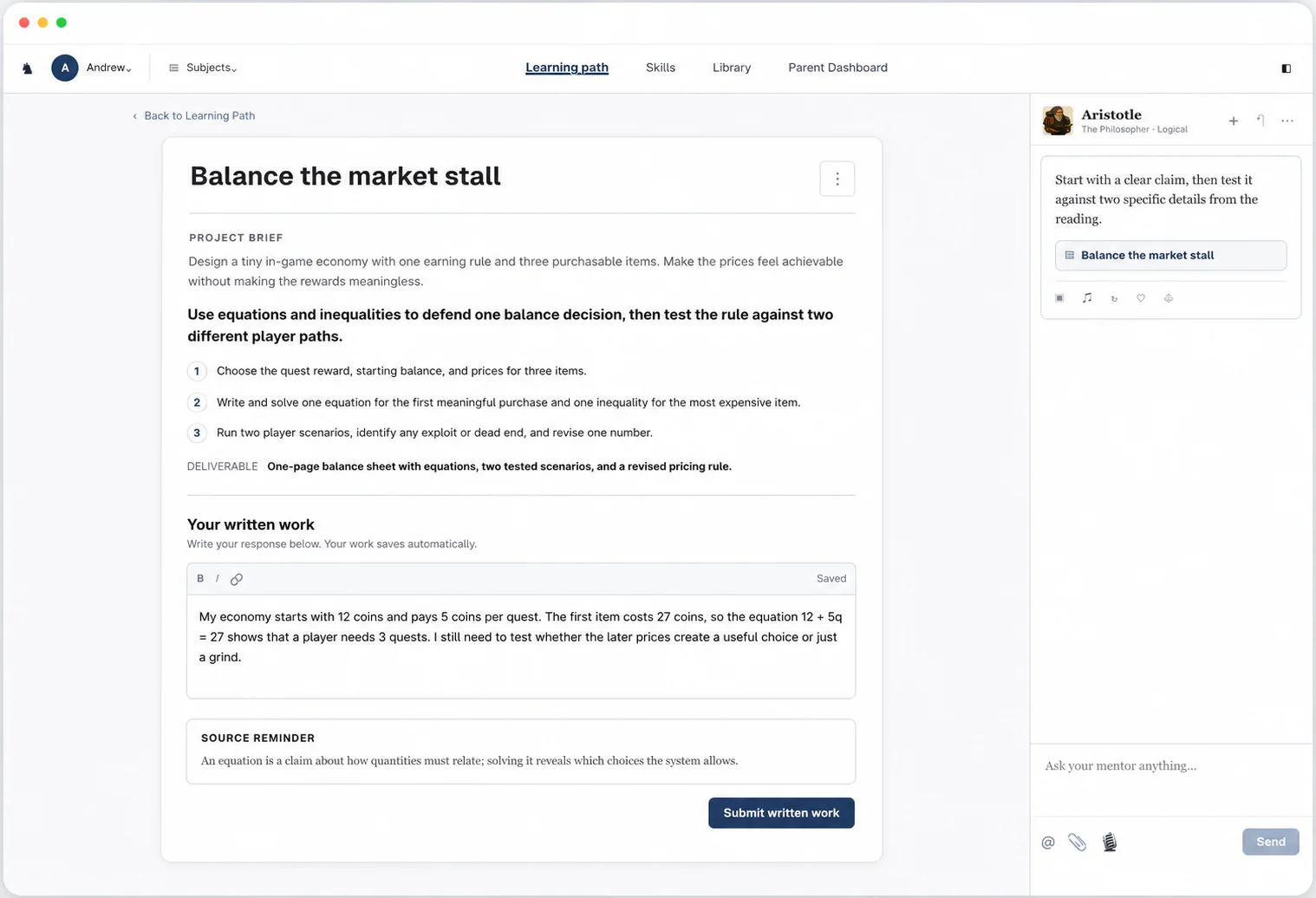
Design a tiny in-game economy with one earning rule and three purchasable items. Make the prices feel achievable without making the rewards meaningless.
- Task
- Use equations and inequalities to defend one balance decision, then test the rule against two different player paths
- Hand in
- One-page balance sheet with equations, two tested scenarios, and a revised pricing rule
Your parent dashboard
- Today
- Each subject's lesson, and whether it's done
- Grades
- Every submission graded instantly, with written feedback, so you never grade
- Records
- Attendance log and learning summary, ready to export

Units and skills by grade
Grades 3 to 5 each have their own algebra units. From grade 6 through grade 12, algebra is one full course: the same 6 units at every grade. Each grade adds a few skills of its own, and your child's grade sets how deep each unit goes.
Grade 33 units · 9 skills
Multiplication equations, division equations, properties of operations3 skills
- Multiplication Equations
- Division Equations
- Properties of Operations
Missing factor problems, equivalent expressions, patterns in tables3 skills
- Missing Factor Problems
- Equivalent Expressions
- Patterns in Tables
Fraction comparison equations, area as multiplication3 skills
- Fraction Comparison Equations
- Area as Multiplication
- Operation Strategy Project
Grade 43 units · 9 skills
Multi-step whole-number equations, factor pairs and multiples3 skills
- Multi-step Whole-number Equations
- Factor Pairs and Multiples
- Variable Expressions
Equivalent fraction equations, decimal comparison equations3 skills
- Equivalent Fraction Equations
- Decimal Comparison Equations
- Coordinate Pattern Rules
Multiplicative comparison equations, measurement formula reasoning3 skills
- Multiplicative Comparison Equations
- Measurement Formula Reasoning
- Expression Modeling Project
Grade 53 units · 9 skills
Order of operations, numerical expressions, decimal equations3 skills
- Order of Operations
- Numerical Expressions
- Decimal Equations
Fraction equations, coordinate graph patterns, volume formulas3 skills
- Fraction Equations
- Coordinate Graph Patterns
- Volume Formulas
Two-variable patterns, rate table foundations, algebraic modeling project3 skills
- Two-variable Patterns
- Rate Table Foundations
- Algebraic Modeling Project
Grades 6 to 126 units · 60 skills
Linear equations10 skills
- Solve a one-step linear equation
- Solve a two-step linear equation
- Solve a linear equation with variables on both sides
- Solve a literal equation for a specified variable
- Solve a linear equation with parentheses
- Solve a linear equation with fractions
- Identify no-solution and infinitely-many-solution cases
- Write an equation from a tape diagram
- Solve an equation with rational coefficients
- Solve a system of linear equations by inspection
Inequalities8 skills
- Solve a one-variable inequality
- Graph an inequality on a number line
- Solve a compound inequality
- Represent a two-variable inequality on a coordinate plane
- Solve an inequality with a negative coefficient
- Write an inequality from a context
- Check whether a value satisfies an inequality
- Solve a two-step inequality from a context
Systems and modeling7 skills
- Solve a linear system by graphing
- Solve a linear system by substitution
- Solve a linear system by elimination
- Interpret a system solution in context
- Write a linear system from a context
- Classify a linear system as consistent or inconsistent
- Compare substitution and elimination for a system
Functions13 skills
- Evaluate a function from notation
- Find the domain from a table
- Find the range from a graph
- Identify linear rate of change
- Write a linear function from two points
- Identify a function from ordered pairs
- Identify a function from a graph
- Find an input from a function output
- Read input-output rules from a table
- Compare two linear functions in different representations
- Write a recursive rule for an arithmetic sequence
- Combine functions by addition, subtraction, multiplication, or division
- Analyze end behavior of a rational function
Quadratics11 skills
- Factor a quadratic with leading coefficient 1
- Factor a quadratic with leading coefficient greater than 1
- Solve a quadratic by square roots
- Solve a quadratic by factoring
- Identify vertex from vertex form
- Graph a quadratic from intercepts
- Solve a quadratic by completing the square
- Solve a quadratic using the quadratic formula
- Identify zeros from standard form by factoring
- Use the discriminant to classify roots
- Use quadratic models to optimize a contextual quantity
Exponents and radicals11 skills
- Apply the product rule for exponents
- Apply the quotient rule for exponents
- Apply a power of a power rule
- Simplify a square root radical
- Solve a simple radical equation
- Convert between radical and rational exponent notation
- Simplify a cube root
- Use exponent rules with negative exponents
- Evaluate a zero-exponent expression
- Simplify expressions with complex numbers
- Solve an equation with rational exponents
Questions parents ask
Which grades can use this Algebra curriculum?
- Grades 3 to 12. The skill trees on this page show the units and skills by grade. Placement checks your child's current skills, so the first lesson can sit before or after their grade.
What should my child know before starting?
- Starting skills include fluency with multiplication and division facts, comfort with fractions and decimals, and solving simple word problems. If placement finds a gap, the course starts with those skills.
How much of the teaching do I do?
- None of it. The course explains each new idea and checks how your child uses it, while the mentor answers questions as they work. Every submission is graded as soon as it comes in, so you never grade it yourself.
Can I use the record for high-school planning?
- Yes. The subject record holds every graded assignment with its written feedback, ready to export. We generate a transcript from the course records, ready for you to sign.
Algebra, taught around your child
A path that keeps strong skills moving and repairs the exact step that is missing.
$49/month after the trial.