Psychology for your homeschool
Your teen examines how a study was designed and what else could explain its findings before accepting a claim about behavior.
A lesson built around your child
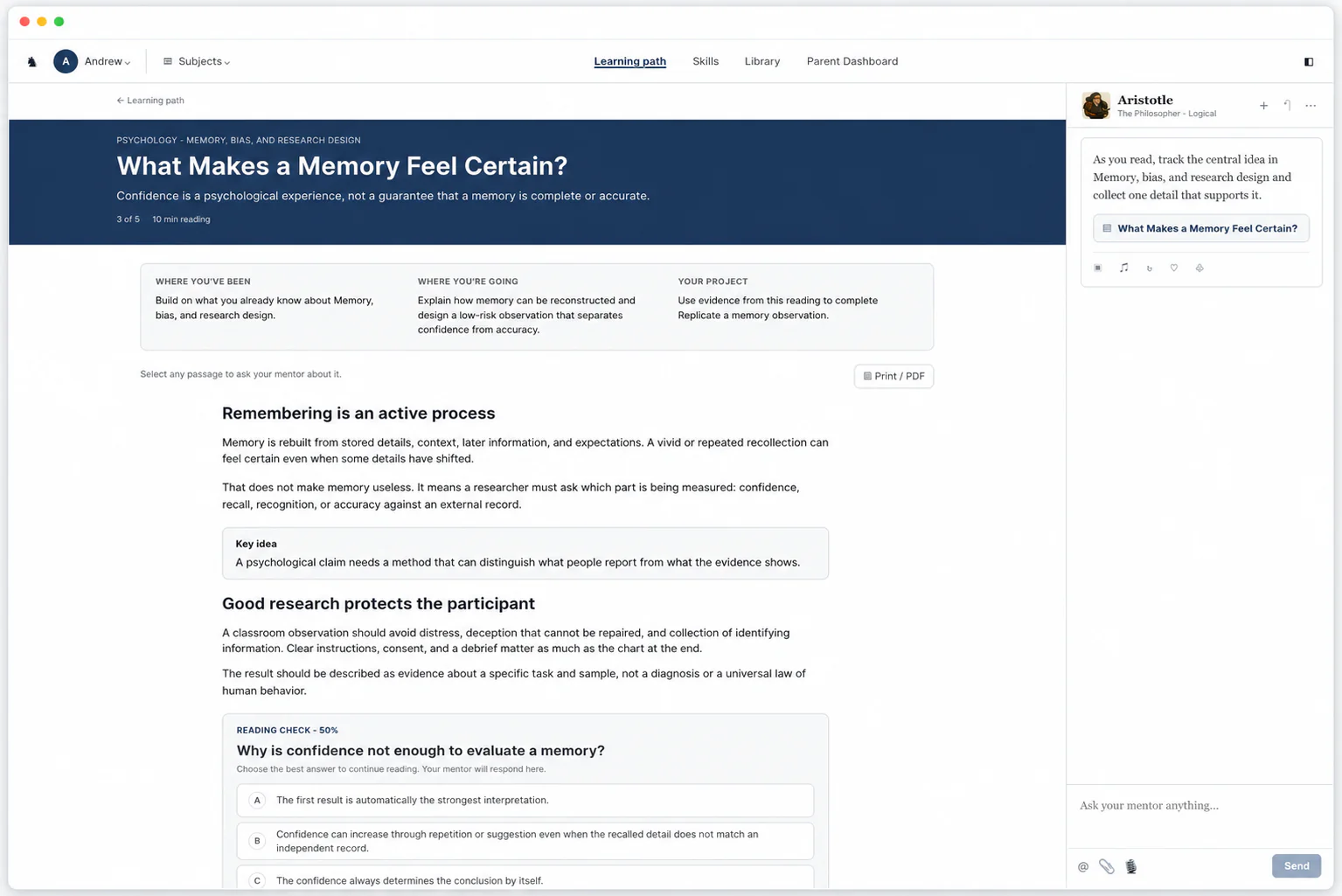
Confidence is a psychological experience, not a guarantee that a memory is complete or accurate.
- Lesson
- What Makes a Memory Feel Certain?
- Goal
- Explain how memory can be reconstructed and design a low-risk observation that separates confidence from accuracy.
How a lesson works
A 10-minute reading
This example lesson comes from the unit on memory, bias, and research design. It moves from “Remembering is an active process” to “Good research protects the participant” and builds to one idea: a psychological claim needs a method that can distinguish what people report from what the evidence shows.
Help inside the reading
If a study finds two things together, our Always-On Mentor can help your teen check whether it shows that one caused the other. Course discussion is not diagnosis or therapy. Your child can also highlight any line of “What Makes a Memory Feel Certain?” to ask about it or ask for a visual, and the mentor offers help on its own when they seem stuck.
A check halfway through
Your child answers “Why is confidence not enough to evaluate a memory?” before reading on, and the Reading Check at the end asks new questions.
A project your child hands in
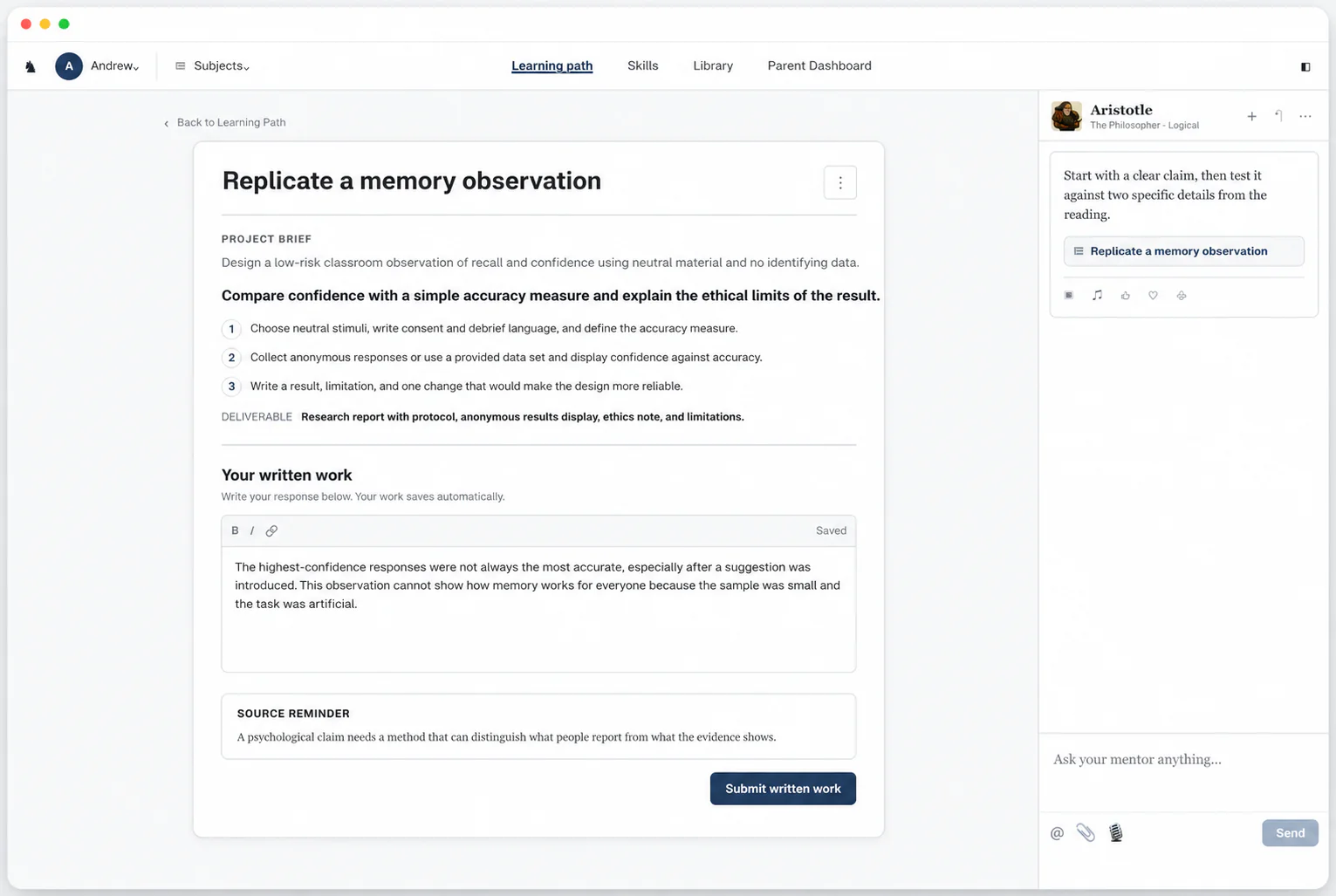
Design a low-risk classroom observation of recall and confidence using neutral material and no identifying data.
- Task
- Compare confidence with a simple accuracy measure and explain the ethical limits of the result
- Hand in
- Research report with protocol, anonymous results display, ethics note, and limitations
Your parent dashboard
- Today
- Each subject's lesson, and whether it's done
- Grades
- Every submission graded instantly, with written feedback, so you never grade
- Records
- Attendance log and learning summary, ready to export

Units and skills
The course teaches psychology through behavior, the brain, development, learning, memory, emotion, social influence, personality, mental health and treatment, and research methods. Psychology is one skill tree for every grade with 12 units, from psychology as a science to psychology case analysis capstone, and your child's grade sets how deep each unit goes.
Psychology12 units · 60 skills
Psychology as a science5 skills
- Define the vocabulary, boundaries, and common misconceptions of Psychology as a science
- Explain the main actors, mechanisms, sequence, and constraints in Psychology as a science
- Interpret evidence, data, cases, or examples connected to Psychology as a science
- Apply Psychology as a science to a realistic behavioral case or research claim
- Create a psychology case analysis that justifies decisions about Psychology as a science
Brain, nervous system, and behavior5 skills
- Define the vocabulary, boundaries, and common misconceptions of Brain, nervous system, and behavior
- Explain the main actors, mechanisms, sequence, and constraints in Brain, nervous system, and behavior
- Interpret evidence, data, cases, or examples connected to Brain, nervous system, and behavior
- Apply Brain, nervous system, and behavior to a realistic behavioral case or research claim
- Create a psychology case analysis that justifies decisions about Brain, nervous system, and behavior
Sensation, perception, and attention5 skills
- Define the vocabulary, boundaries, and common misconceptions of Sensation, perception, and attention
- Explain the main actors, mechanisms, sequence, and constraints in Sensation, perception, and attention
- Interpret evidence, data, cases, or examples connected to Sensation, perception, and attention
- Apply Sensation, perception, and attention to a realistic behavioral case or research claim
- Create a psychology case analysis that justifies decisions about Sensation, perception, and attention
Learning, memory, and cognition5 skills
- Define the vocabulary, boundaries, and common misconceptions of Learning, memory, and cognition
- Explain the main actors, mechanisms, sequence, and constraints in Learning, memory, and cognition
- Interpret evidence, data, cases, or examples connected to Learning, memory, and cognition
- Apply Learning, memory, and cognition to a realistic behavioral case or research claim
- Create a psychology case analysis that justifies decisions about Learning, memory, and cognition
Development across the lifespan5 skills
- Define the vocabulary, boundaries, and common misconceptions of Development across the lifespan
- Explain the main actors, mechanisms, sequence, and constraints in Development across the lifespan
- Interpret evidence, data, cases, or examples connected to Development across the lifespan
- Apply Development across the lifespan to a realistic behavioral case or research claim
- Create a psychology case analysis that justifies decisions about Development across the lifespan
Motivation, emotion, and stress5 skills
- Define the vocabulary, boundaries, and common misconceptions of Motivation, emotion, and stress
- Explain the main actors, mechanisms, sequence, and constraints in Motivation, emotion, and stress
- Interpret evidence, data, cases, or examples connected to Motivation, emotion, and stress
- Apply Motivation, emotion, and stress to a realistic behavioral case or research claim
- Create a psychology case analysis that justifies decisions about Motivation, emotion, and stress
Personality and individual differences5 skills
- Define the vocabulary, boundaries, and common misconceptions of Personality and individual differences
- Explain the main actors, mechanisms, sequence, and constraints in Personality and individual differences
- Interpret evidence, data, cases, or examples connected to Personality and individual differences
- Apply Personality and individual differences to a realistic behavioral case or research claim
- Create a psychology case analysis that justifies decisions about Personality and individual differences
Social psychology and group behavior5 skills
- Define the vocabulary, boundaries, and common misconceptions of Social psychology and group behavior
- Explain the main actors, mechanisms, sequence, and constraints in Social psychology and group behavior
- Interpret evidence, data, cases, or examples connected to Social psychology and group behavior
- Apply Social psychology and group behavior to a realistic behavioral case or research claim
- Create a psychology case analysis that justifies decisions about Social psychology and group behavior
Psychological disorders and mental health5 skills
- Define the vocabulary, boundaries, and common misconceptions of Psychological disorders and mental health
- Explain the main actors, mechanisms, sequence, and constraints in Psychological disorders and mental health
- Interpret evidence, data, cases, or examples connected to Psychological disorders and mental health
- Apply Psychological disorders and mental health to a realistic behavioral case or research claim
- Create a psychology case analysis that justifies decisions about Psychological disorders and mental health
Therapy, prevention, and wellbeing5 skills
- Define the vocabulary, boundaries, and common misconceptions of Therapy, prevention, and wellbeing
- Explain the main actors, mechanisms, sequence, and constraints in Therapy, prevention, and wellbeing
- Interpret evidence, data, cases, or examples connected to Therapy, prevention, and wellbeing
- Apply Therapy, prevention, and wellbeing to a realistic behavioral case or research claim
- Create a psychology case analysis that justifies decisions about Therapy, prevention, and wellbeing
Research design, statistics, and ethics5 skills
- Define the vocabulary, boundaries, and common misconceptions of Research design, statistics, and ethics
- Explain the main actors, mechanisms, sequence, and constraints in Research design, statistics, and ethics
- Interpret evidence, data, cases, or examples connected to Research design, statistics, and ethics
- Apply Research design, statistics, and ethics to a realistic behavioral case or research claim
- Create a psychology case analysis that justifies decisions about Research design, statistics, and ethics
Psychology case analysis capstone5 skills
- Define the vocabulary, boundaries, and common misconceptions of Psychology case analysis capstone
- Explain the main actors, mechanisms, sequence, and constraints in Psychology case analysis capstone
- Interpret evidence, data, cases, or examples connected to Psychology case analysis capstone
- Apply Psychology case analysis capstone to a realistic behavioral case or research claim
- Create a psychology case analysis that justifies decisions about Psychology case analysis capstone
Questions parents ask
Which grades can use this Psychology curriculum?
- One Psychology skill tree serves grades 3 to 12, with course pages for 9th grade and high school. Placement checks your child's current skills, so the first lesson can sit before or after their grade.
What should my child know before starting?
- Starting skills include interest in understanding people, basic science literacy, and willingness to question intuitions. If placement finds a gap, the course starts with those skills.
How much of the teaching do I do?
- None of it. The course explains each new idea and checks how your child uses it, while the mentor answers questions as they work. Every submission is graded as soon as it comes in, so you never grade it yourself.
Can I use the record for high-school planning?
- Yes. The subject record holds every graded assignment with its written feedback, ready to export. We generate a transcript from the course records, ready for you to sign.
Psychology, taught around your child
Psychological reasoning that is curious, evidence-based, and careful about its limits.
$49/month after the trial.