U.S. Citizenship and Civics for your homeschool
Your child learns how rights, elections, and public institutions work, then applies that knowledge to a civic question.
A lesson built around your child
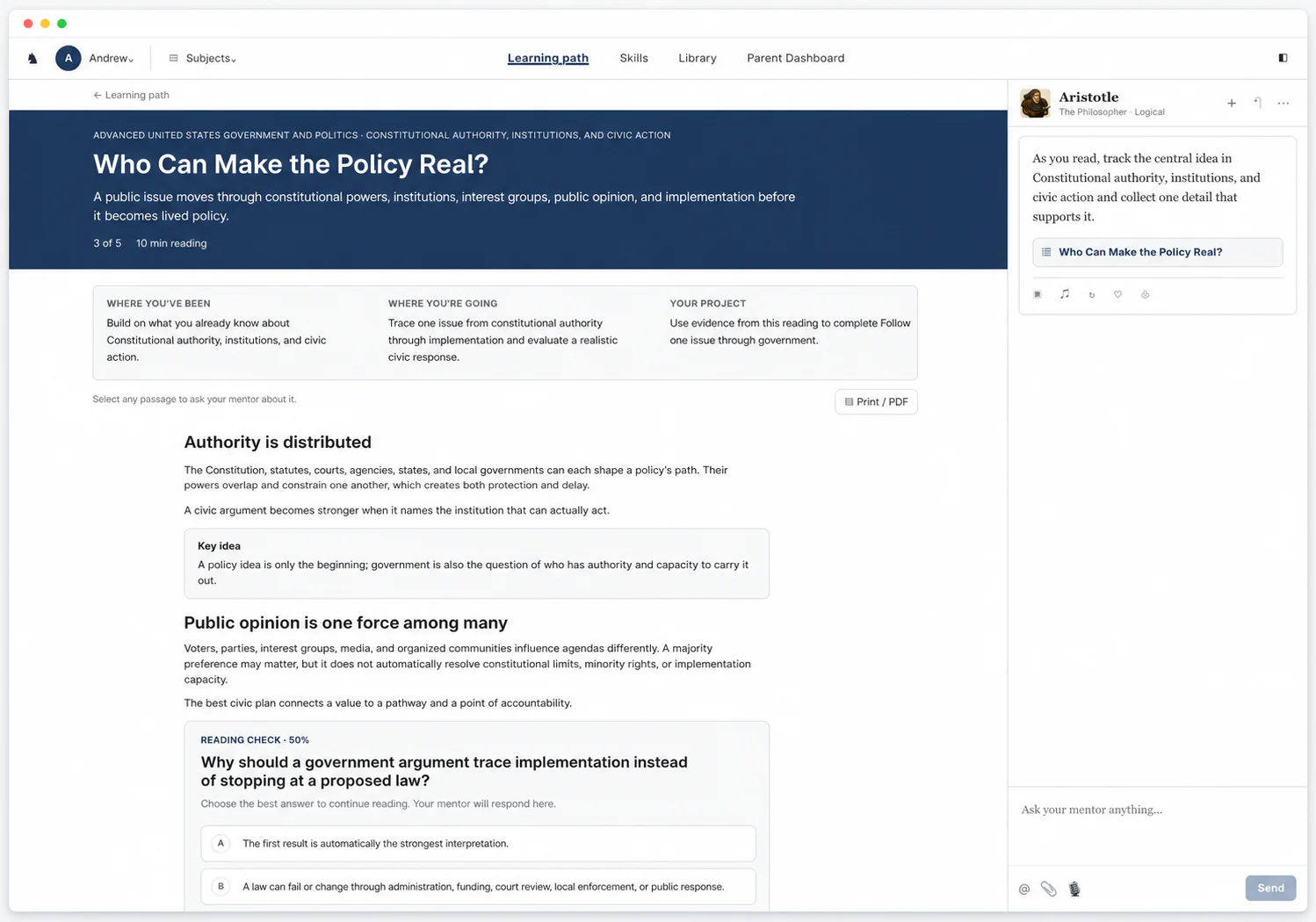
A public issue moves through constitutional powers, institutions, interest groups, public opinion, and implementation before it becomes lived policy.
- Lesson
- Who Can Make the Policy Real?
- Goal
- Trace one issue from constitutional authority through implementation and evaluate a realistic civic response.
How a lesson works
A 10-minute reading
This example lesson comes from the unit on constitutional authority, institutions, and civic action. It moves from “Authority is distributed” to “Public opinion is one force among many” and builds to one idea: a policy idea is only the beginning; government is also the question of who has authority and capacity to carry it out.
Help inside the reading
If a civic proposal relies on a shaky source or ignores who has authority, our Always-On Mentor can help your child check both without pushing a political viewpoint. Your child can also highlight any line of “Who Can Make the Policy Real?” to ask about it or ask for a visual, and the mentor offers help on its own when they seem stuck.
A check halfway through
Your child answers “Why should a government argument trace implementation instead of stopping at a proposed law?” before reading on, and the Reading Check at the end asks new questions.
A project your child hands in
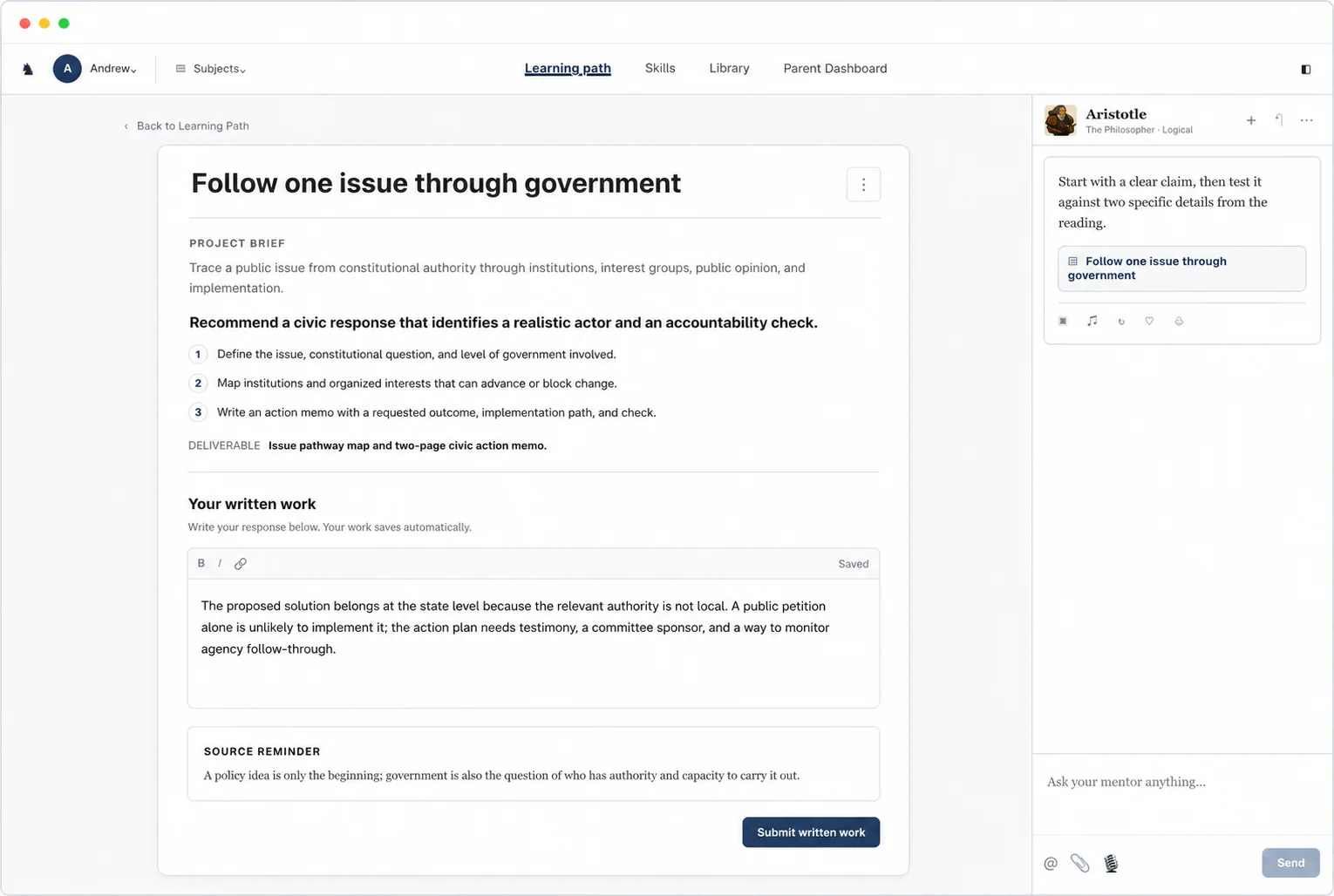
Trace a public issue from constitutional authority through institutions, interest groups, public opinion, and implementation.
- Task
- Recommend a civic response that identifies a realistic actor and an accountability check
- Hand in
- Issue pathway map and two-page civic action memo
Your parent dashboard
- Today
- Each subject's lesson, and whether it's done
- Grades
- Every submission graded instantly, with written feedback, so you never grade
- Records
- Attendance log and learning summary, ready to export

Units and skills
Builds politically neutral civic literacy through constitutional structure, public institutions, rights and responsibilities, source judgment, naturalization knowledge, and practical participation. U.S. Citizenship and Civics is one skill tree for every grade with 12 units, from constitutional foundations and the rule of law to civic portfolio and oral defense capstone, and your child's grade sets how deep each unit goes.
U.S. Citizenship and Civics12 units · 60 skills
Constitutional foundations and the rule of law5 skills
- Define the core ideas and boundaries of Constitutional foundations and the rule of law
- Explain how institutions, rules, and responsibilities operate in Constitutional foundations and the rule of law
- Apply the relevant civic process or constitutional principle to Constitutional foundations and the rule of law
- Evaluate evidence, competing claims, and practical limits within Constitutional foundations and the rule of law
- Create and defend an evidence-based civic product for Constitutional foundations and the rule of law
Branches, checks and balances, and federalism5 skills
- Define the core ideas and boundaries of Branches, checks and balances, and federalism
- Explain how institutions, rules, and responsibilities operate in Branches, checks and balances, and federalism
- Apply the relevant civic process or constitutional principle to Branches, checks and balances, and federalism
- Evaluate evidence, competing claims, and practical limits within Branches, checks and balances, and federalism
- Create and defend an evidence-based civic product for Branches, checks and balances, and federalism
Rights, civil liberties, and equal protection5 skills
- Define the core ideas and boundaries of Rights, civil liberties, and equal protection
- Explain how institutions, rules, and responsibilities operate in Rights, civil liberties, and equal protection
- Apply the relevant civic process or constitutional principle to Rights, civil liberties, and equal protection
- Evaluate evidence, competing claims, and practical limits within Rights, civil liberties, and equal protection
- Create and defend an evidence-based civic product for Rights, civil liberties, and equal protection
Citizenship, responsibilities, and civic identity5 skills
- Define the core ideas and boundaries of Citizenship, responsibilities, and civic identity
- Explain how institutions, rules, and responsibilities operate in Citizenship, responsibilities, and civic identity
- Apply the relevant civic process or constitutional principle to Citizenship, responsibilities, and civic identity
- Evaluate evidence, competing claims, and practical limits within Citizenship, responsibilities, and civic identity
- Create and defend an evidence-based civic product for Citizenship, responsibilities, and civic identity
Elections, representation, and public accountability5 skills
- Define the core ideas and boundaries of Elections, representation, and public accountability
- Explain how institutions, rules, and responsibilities operate in Elections, representation, and public accountability
- Apply the relevant civic process or constitutional principle to Elections, representation, and public accountability
- Evaluate evidence, competing claims, and practical limits within Elections, representation, and public accountability
- Create and defend an evidence-based civic product for Elections, representation, and public accountability
Courts, law, and due process5 skills
- Define the core ideas and boundaries of Courts, law, and due process
- Explain how institutions, rules, and responsibilities operate in Courts, law, and due process
- Apply the relevant civic process or constitutional principle to Courts, law, and due process
- Evaluate evidence, competing claims, and practical limits within Courts, law, and due process
- Create and defend an evidence-based civic product for Courts, law, and due process
State, local, and tribal government5 skills
- Define the core ideas and boundaries of State, local, and tribal government
- Explain how institutions, rules, and responsibilities operate in State, local, and tribal government
- Apply the relevant civic process or constitutional principle to State, local, and tribal government
- Evaluate evidence, competing claims, and practical limits within State, local, and tribal government
- Create and defend an evidence-based civic product for State, local, and tribal government
Civic information, media, and source judgment5 skills
- Define the core ideas and boundaries of Civic information, media, and source judgment
- Explain how institutions, rules, and responsibilities operate in Civic information, media, and source judgment
- Apply the relevant civic process or constitutional principle to Civic information, media, and source judgment
- Evaluate evidence, competing claims, and practical limits within Civic information, media, and source judgment
- Create and defend an evidence-based civic product for Civic information, media, and source judgment
Civic disagreement, deliberation, and compromise5 skills
- Define the core ideas and boundaries of Civic disagreement, deliberation, and compromise
- Explain how institutions, rules, and responsibilities operate in Civic disagreement, deliberation, and compromise
- Apply the relevant civic process or constitutional principle to Civic disagreement, deliberation, and compromise
- Evaluate evidence, competing claims, and practical limits within Civic disagreement, deliberation, and compromise
- Create and defend an evidence-based civic product for Civic disagreement, deliberation, and compromise
Naturalization knowledge and practical civic processes5 skills
- Define the core ideas and boundaries of Naturalization knowledge and practical civic processes
- Explain how institutions, rules, and responsibilities operate in Naturalization knowledge and practical civic processes
- Apply the relevant civic process or constitutional principle to Naturalization knowledge and practical civic processes
- Evaluate evidence, competing claims, and practical limits within Naturalization knowledge and practical civic processes
- Create and defend an evidence-based civic product for Naturalization knowledge and practical civic processes
Community action brief5 skills
- Define the core ideas and boundaries of Community action brief
- Explain how institutions, rules, and responsibilities operate in Community action brief
- Apply the relevant civic process or constitutional principle to Community action brief
- Evaluate evidence, competing claims, and practical limits within Community action brief
- Create and defend an evidence-based civic product for Community action brief
Civic portfolio and oral defense capstone5 skills
- Define the core ideas and boundaries of Civic portfolio and oral defense capstone
- Explain how institutions, rules, and responsibilities operate in Civic portfolio and oral defense capstone
- Apply the relevant civic process or constitutional principle to Civic portfolio and oral defense capstone
- Evaluate evidence, competing claims, and practical limits within Civic portfolio and oral defense capstone
- Create and defend an evidence-based civic product for Civic portfolio and oral defense capstone
Questions parents ask
Where does my child start in U.S. Citizenship and Civics?
- Placement checks your child's current U.S. Citizenship and Civics skills and sets the first lesson from that result, not from their grade.
How much of the teaching do I do?
- None of it. The course explains each new idea and checks how your child uses it, while the mentor answers questions as they work. Every submission is graded as soon as it comes in, so you never grade it yourself.
Can I use the record for high-school planning?
- Yes. The subject record holds every graded assignment with its written feedback, ready to export. We generate a transcript from the course records, ready for you to sign.
U.S. Citizenship and Civics, taught around your child
Practical civic knowledge grounded in institutions, evidence, rights, responsibilities, and respectful participation.
$49/month after the trial.