Cultural Studies for your homeschool
Your teen compares accounts from different perspectives and checks their own assumptions about a cultural question.
A lesson built around your child
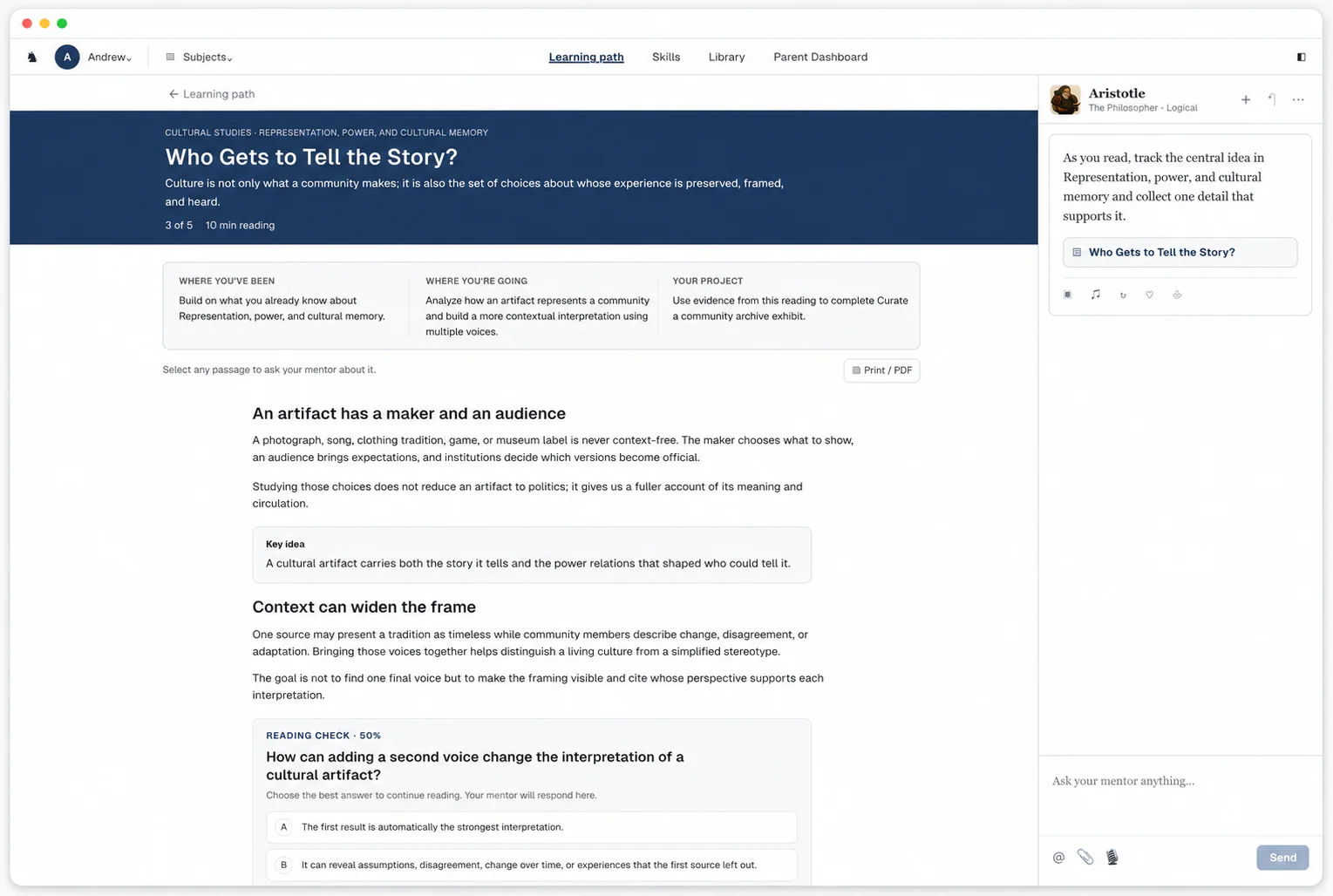
Culture is not only what a community makes; it is also the set of choices about whose experience is preserved, framed, and heard.
- Lesson
- Who Gets to Tell the Story?
- Goal
- Analyze how an artifact represents a community and build a more contextual interpretation using multiple voices.
How a lesson works
A 10-minute reading
This example lesson comes from the unit on representation, power, and cultural memory. It moves from “An artifact has a maker and an audience” to “Context can widen the frame” and builds to one idea: a cultural artifact carries both the story it tells and the power relations that shaped who could tell it.
Help inside the reading
If a cultural account sounds one-sided, our Always-On Mentor can ask whose perspective is missing and what evidence might change the picture. Your child can also highlight any line of “Who Gets to Tell the Story?” to ask about it or ask for a visual, and the mentor offers help on its own when they seem stuck.
A check halfway through
Your child answers “How can adding a second voice change the interpretation of a cultural artifact?” before reading on, and the Reading Check at the end asks new questions.
A project your child hands in
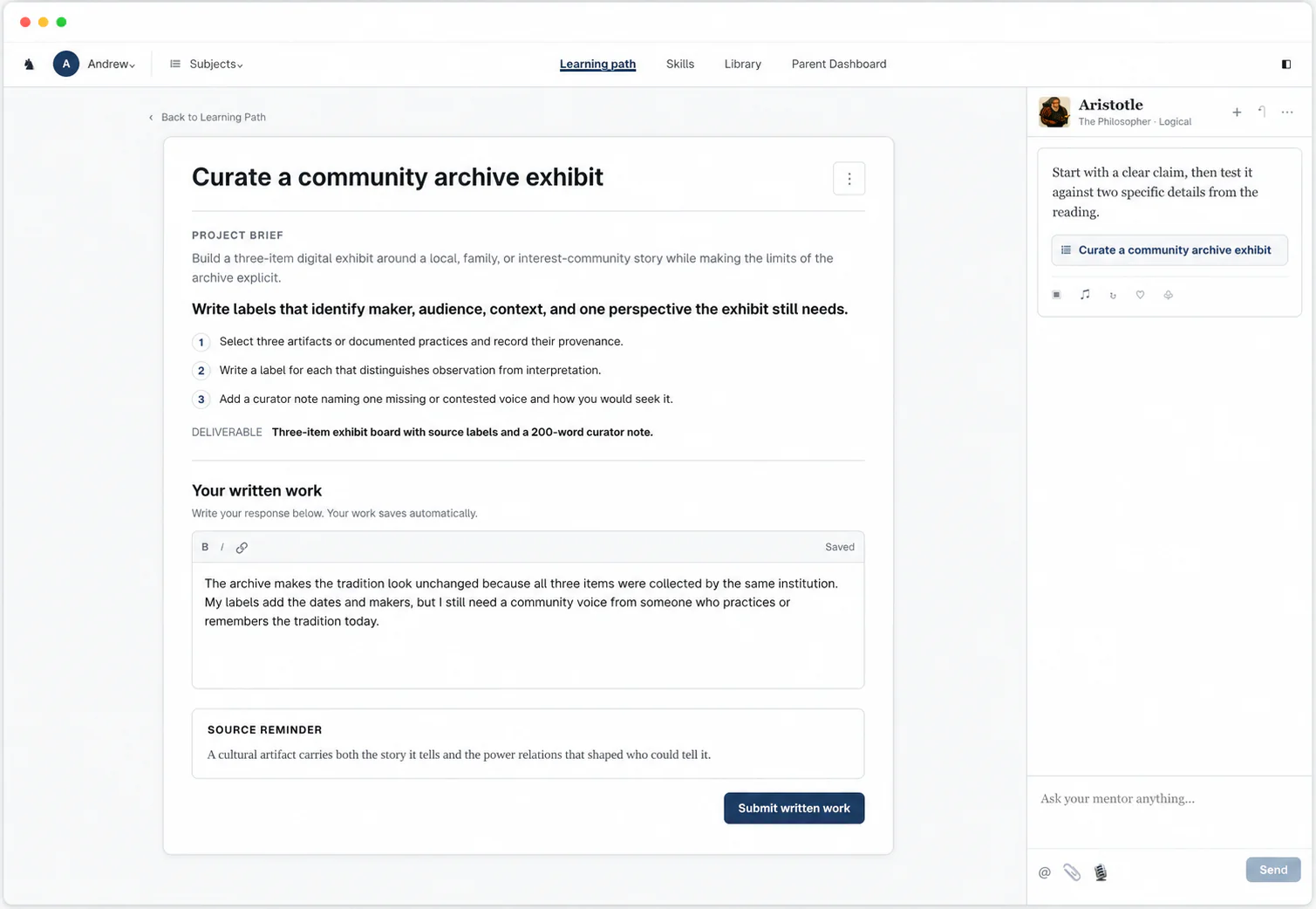
Build a three-item digital exhibit around a local, family, or interest-community story while making the limits of the archive explicit.
- Task
- Write labels that identify maker, audience, context, and one perspective the exhibit still needs
- Hand in
- Three-item exhibit board with source labels and a 200-word curator note
Your parent dashboard
- Today
- Each subject's lesson, and whether it's done
- Grades
- Every submission graded instantly, with written feedback, so you never grade
- Records
- Attendance log and learning summary, ready to export

Units and skills
The course teaches how cultures make meaning through symbols, identity, media, power, institutions, popular culture, memory, globalization, and research ethics. Cultural Studies is one skill tree for every grade with 12 units, from culture, identity, and meaning to cultural analysis capstone, and your child's grade sets how deep each unit goes.
Cultural Studies12 units · 60 skills
Culture, identity, and meaning5 skills
- Define the vocabulary, boundaries, and common misconceptions of Culture, identity, and meaning
- Explain the main actors, mechanisms, sequence, and constraints in Culture, identity, and meaning
- Interpret evidence, data, cases, or examples connected to Culture, identity, and meaning
- Apply Culture, identity, and meaning to a realistic cultural case or community pattern
- Create a cultural analysis memo that justifies decisions about Culture, identity, and meaning
Language, symbols, and representation5 skills
- Define the vocabulary, boundaries, and common misconceptions of Language, symbols, and representation
- Explain the main actors, mechanisms, sequence, and constraints in Language, symbols, and representation
- Interpret evidence, data, cases, or examples connected to Language, symbols, and representation
- Apply Language, symbols, and representation to a realistic cultural case or community pattern
- Create a cultural analysis memo that justifies decisions about Language, symbols, and representation
Ritual, religion, and belief systems5 skills
- Define the vocabulary, boundaries, and common misconceptions of Ritual, religion, and belief systems
- Explain the main actors, mechanisms, sequence, and constraints in Ritual, religion, and belief systems
- Interpret evidence, data, cases, or examples connected to Ritual, religion, and belief systems
- Apply Ritual, religion, and belief systems to a realistic cultural case or community pattern
- Create a cultural analysis memo that justifies decisions about Ritual, religion, and belief systems
Family, kinship, and social roles5 skills
- Define the vocabulary, boundaries, and common misconceptions of Family, kinship, and social roles
- Explain the main actors, mechanisms, sequence, and constraints in Family, kinship, and social roles
- Interpret evidence, data, cases, or examples connected to Family, kinship, and social roles
- Apply Family, kinship, and social roles to a realistic cultural case or community pattern
- Create a cultural analysis memo that justifies decisions about Family, kinship, and social roles
Class, race, gender, and power5 skills
- Define the vocabulary, boundaries, and common misconceptions of Class, race, gender, and power
- Explain the main actors, mechanisms, sequence, and constraints in Class, race, gender, and power
- Interpret evidence, data, cases, or examples connected to Class, race, gender, and power
- Apply Class, race, gender, and power to a realistic cultural case or community pattern
- Create a cultural analysis memo that justifies decisions about Class, race, gender, and power
Media, popular culture, and consumption5 skills
- Define the vocabulary, boundaries, and common misconceptions of Media, popular culture, and consumption
- Explain the main actors, mechanisms, sequence, and constraints in Media, popular culture, and consumption
- Interpret evidence, data, cases, or examples connected to Media, popular culture, and consumption
- Apply Media, popular culture, and consumption to a realistic cultural case or community pattern
- Create a cultural analysis memo that justifies decisions about Media, popular culture, and consumption
Migration, diaspora, and hybridity5 skills
- Define the vocabulary, boundaries, and common misconceptions of Migration, diaspora, and hybridity
- Explain the main actors, mechanisms, sequence, and constraints in Migration, diaspora, and hybridity
- Interpret evidence, data, cases, or examples connected to Migration, diaspora, and hybridity
- Apply Migration, diaspora, and hybridity to a realistic cultural case or community pattern
- Create a cultural analysis memo that justifies decisions about Migration, diaspora, and hybridity
Colonialism, nation, and memory5 skills
- Define the vocabulary, boundaries, and common misconceptions of Colonialism, nation, and memory
- Explain the main actors, mechanisms, sequence, and constraints in Colonialism, nation, and memory
- Interpret evidence, data, cases, or examples connected to Colonialism, nation, and memory
- Apply Colonialism, nation, and memory to a realistic cultural case or community pattern
- Create a cultural analysis memo that justifies decisions about Colonialism, nation, and memory
Institutions and cultural change5 skills
- Define the vocabulary, boundaries, and common misconceptions of Institutions and cultural change
- Explain the main actors, mechanisms, sequence, and constraints in Institutions and cultural change
- Interpret evidence, data, cases, or examples connected to Institutions and cultural change
- Apply Institutions and cultural change to a realistic cultural case or community pattern
- Create a cultural analysis memo that justifies decisions about Institutions and cultural change
Ethnographic observation and ethics5 skills
- Define the vocabulary, boundaries, and common misconceptions of Ethnographic observation and ethics
- Explain the main actors, mechanisms, sequence, and constraints in Ethnographic observation and ethics
- Interpret evidence, data, cases, or examples connected to Ethnographic observation and ethics
- Apply Ethnographic observation and ethics to a realistic cultural case or community pattern
- Create a cultural analysis memo that justifies decisions about Ethnographic observation and ethics
Cultural comparison and interpretation5 skills
- Define the vocabulary, boundaries, and common misconceptions of Cultural comparison and interpretation
- Explain the main actors, mechanisms, sequence, and constraints in Cultural comparison and interpretation
- Interpret evidence, data, cases, or examples connected to Cultural comparison and interpretation
- Apply Cultural comparison and interpretation to a realistic cultural case or community pattern
- Create a cultural analysis memo that justifies decisions about Cultural comparison and interpretation
Cultural analysis capstone5 skills
- Define the vocabulary, boundaries, and common misconceptions of Cultural analysis capstone
- Explain the main actors, mechanisms, sequence, and constraints in Cultural analysis capstone
- Interpret evidence, data, cases, or examples connected to Cultural analysis capstone
- Apply Cultural analysis capstone to a realistic cultural case or community pattern
- Create a cultural analysis memo that justifies decisions about Cultural analysis capstone
Questions parents ask
Which grades can use this Cultural Studies curriculum?
- One Cultural Studies skill tree serves grades 3 to 12, with course pages for 9th grade and high school. Placement checks your child's current skills, so the first lesson can sit before or after their grade.
What should my child know before starting?
- Starting skills include curiosity about others, willingness to suspend judgment, and basic reading skills. If placement finds a gap, the course starts with those skills.
How much of the teaching do I do?
- None of it. The course explains each new idea and checks how your child uses it, while the mentor answers questions as they work. Every submission is graded as soon as it comes in, so you never grade it yourself.
Can I use the record for high-school planning?
- Yes. The subject record holds every graded assignment with its written feedback, ready to export. We generate a transcript from the course records, ready for you to sign.
Cultural Studies, taught around your child
Cultural understanding that becomes more precise when the evidence gets complicated.
$49/month after the trial.