12th grade homeschool curriculum
A full curriculum, starting at your child's level, with lessons connected to their interests and progress you can see.
See the work in 12th grade
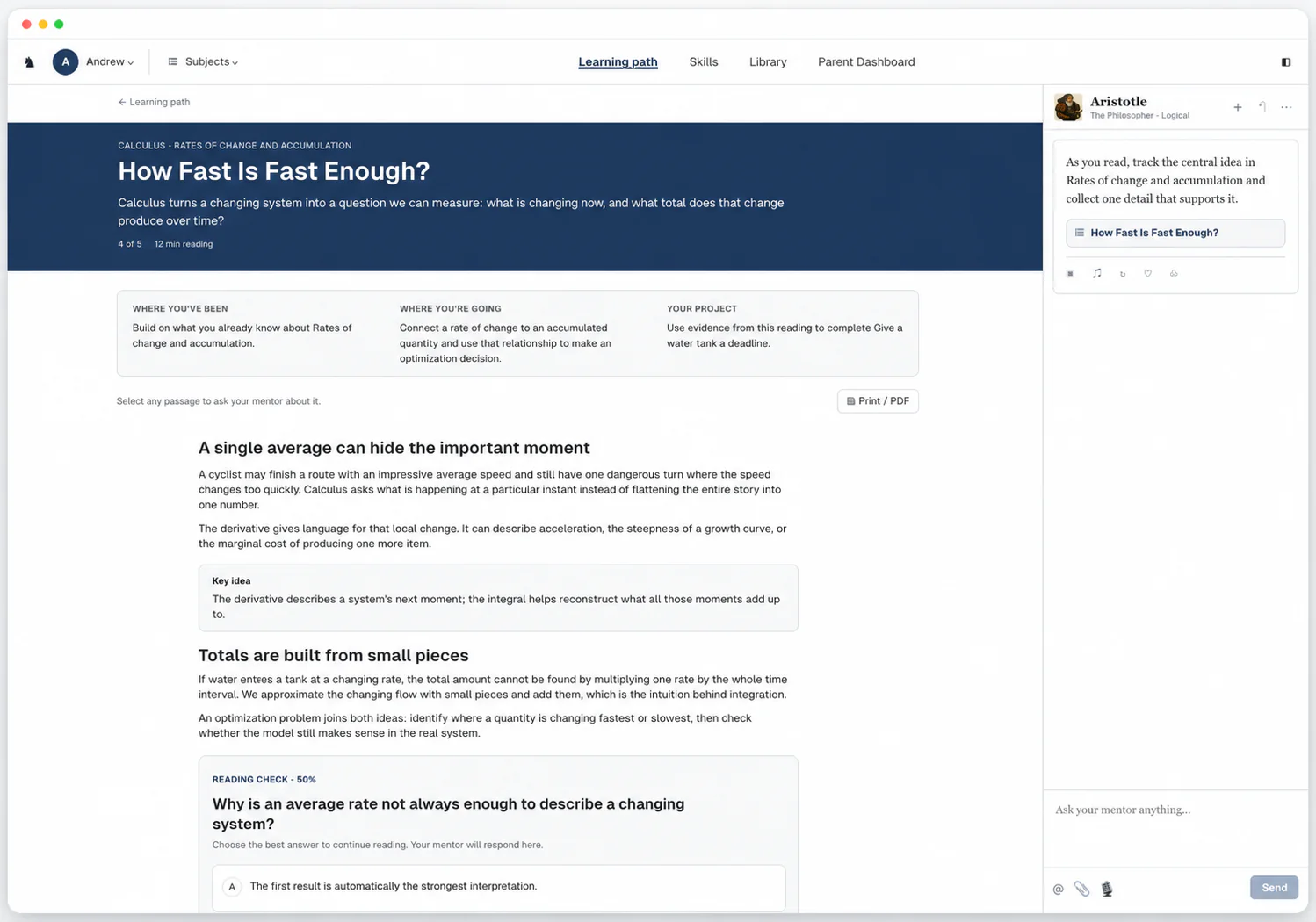
Calculus turns a changing system into a question we can measure: what is changing now, and what total does that change produce over time?
- Lesson
- How Fast Is Fast Enough?
- Goal
- Connect a rate of change to an accumulated quantity and use that relationship to make an optimization decision.
- Project
- Give a water tank a deadline
Your parent dashboard
- Today
- Each subject's lesson, and whether it's done
- Grades
- Every submission graded instantly, with written feedback, so you never grade
- Records
- Attendance log and learning summary, ready to export
- Documents
- Transcripts and state-aware compliance drafts, written for you and ready to sign

12th grade scope and sequence
Math13 units · 58 skills
Limits and rates of change6 skills
- Estimate a limit from a table
- Estimate a limit from a graph
- Interpret average and instantaneous rate of change
- Explain when a limit does not exist
- Connect secant and tangent slope ideas
- Use limit language in a context
Derivative models5 skills
- Use a derivative to describe increasing and decreasing behavior
- Interpret derivative units in a context
- Find extrema from a derivative graph
- Compare position, velocity, and acceleration graphs
- Use a tangent-line approximation
Accumulation and integrals4 skills
- Estimate area under a curve with rectangles
- Interpret an integral as accumulated change
- Connect rate graphs to total change
- Compare left, right, and midpoint estimates
Statistical inference5 skills
- Interpret a confidence interval
- Explain a hypothesis test conclusion
- Distinguish statistical significance from practical importance
- Critique sampling and experimental design
- Use simulation to estimate probability
Probability models4 skills
- Use conditional probability in a two-way table
- Apply expected value to a decision
- Model repeated trials with a binomial setting
- Compare independent and dependent events
Vectors and parametric motion4 skills
- Represent a vector by components
- Add vectors graphically and algebraically
- Model two-dimensional motion parametrically
- Interpret speed from a parametric path
Discrete mathematics4 skills
- Use recursion to define a sequence
- Count arrangements with restrictions
- Represent a network with vertices and edges
- Optimize a path in a small network
Financial and decision models4 skills
- Model compound interest with regular contributions
- Compare loan repayment scenarios
- Use sensitivity analysis on a financial model
- Explain model assumptions and risk
Proof and mathematical structure4 skills
- Write a direct proof of a number property
- Use a counterexample to disprove a claim
- Compare inductive and deductive reasoning
- State conditions needed for a theorem
Advanced function connections4 skills
- Analyze a piecewise function at boundaries
- Compare polynomial, exponential, logarithmic, and trigonometric models
- Use transformations to build a complex model
- Justify a modeling choice in writing
Mathematical research modeling4 skills
- Turn a real question into variables and constraints
- Choose data needed for a model
- Validate a model against evidence
- Revise a model after residual or error analysis
AP exam readiness4 skills
- Solve an advanced math mixed item with calculus, statistics, or modeling evidence
- Choose the best method for a timed limit, inference, vector, or decision-model item
- Explain why a grade 12 distractor answer fails
- Write a concise justification for an advanced modeling or inference item
Math capstone6 skills
- Build an original mathematical model
- Defend a calculus or statistics method choice
- Quantify uncertainty in a conclusion
- Critique an alternative model
- Present a college-ready mathematical argument
- Reflect on limits of the chosen model
Reading6 units · 50 skills
Literary reading9 skills
- Identify theme from repeated details
- Explain character motivation
- Analyze how setting shapes conflict
- Interpret figurative language in context
- Compare narrator perspective
- Analyze symbolism
- Trace conflict development
- Compare character arcs
- Compare critical interpretations
Informational reading9 skills
- Identify central idea
- Trace an author's claim
- Distinguish evidence from commentary
- Summarize a section objectively
- Evaluate source credibility
- Identify text structure
- Evaluate evidence relevance
- Analyze author's assumptions
- Evaluate methodological claims in nonfiction
Media and multimodal reading7 skills
- Interpret a chart embedded in an article
- Connect image evidence to a text claim
- Evaluate a caption's relationship to an image
- Compare video and print accounts of an event
- Evaluate scale in an infographic
- Interpret a timeline embedded in text
- Compare headline and article evidence
Vocabulary8 skills
- Use context clues for an unfamiliar word
- Identify connotation
- Distinguish denotation from connotation
- Use word parts to infer meaning
- Infer meaning from analogy
- Use roots and affixes
- Identify figurative versus literal meaning
- Analyze discipline-specific language
Evidence8 skills
- Quote textual evidence accurately
- Paraphrase evidence without changing meaning
- Connect evidence to an inference
- Compare evidence across two texts
- Rank evidence by strength
- Explain why evidence is relevant
- Integrate evidence across genres
- Build an interpretation from scholarly sources
Fluency and text complexity9 skills
- Read grade-level prose with appropriate pacing
- Use punctuation to guide oral phrasing
- Identify sentence complexity in a passage
- Use background knowledge to prepare for a difficult text
- Use paragraph structure to plan reading pace
- Identify unfamiliar syntax before rereading
- Use repeated reading to improve accuracy
- Evaluate text complexity for an independent reading choice
- Use syntax density to explain reading difficulty
English language arts13 units · 60 skills
College-level literature6 skills
- Analyze a complex text through form, context, and ambiguity
- Compare literary movements or traditions
- Evaluate competing interpretations of a text
- Explain intertextual allusion and echo
- Use close reading to support an original interpretation
- Recognize limits of a single interpretive lens
Interpretive lenses4 skills
- Apply a historical lens to a literary passage
- Apply a formal lens to language and structure
- Compare ethical, psychological, or social readings of a text
- Explain what an interpretive lens reveals and hides
Advanced nonfiction and ideas5 skills
- Analyze a philosophical or critical essay for claims and warrants
- Compare two complex arguments about the same issue
- Evaluate how definitions shape argument
- Trace nuance, qualification, and concession in nonfiction
- Summarize a difficult argument accurately
College composition5 skills
- Develop a thesis with stakes and qualification
- Organize a long essay by conceptual movement
- Use evidence from primary and secondary sources
- Write introductions that frame a problem
- Revise paragraphs for cohesion and emphasis
Research argument5 skills
- Design a research question with scholarly stakes
- Build a literature review paragraph
- Integrate source disagreement into an argument
- Use citation to show source relationships
- Revise a claim after evaluating stronger evidence
Creative and rhetorical craft4 skills
- Imitate a mentor text for structure or style
- Use voice deliberately for audience and purpose
- Revise imagery, pacing, and syntax for effect
- Write a reflective commentary on craft choices
Language precision and editing4 skills
- Edit a long essay for style consistency
- Use punctuation for complex academic sentences
- Revise nominalizations and passive constructions deliberately
- Control diction for disciplinary audience
College seminar5 skills
- Lead a seminar using prepared textual evidence
- Ask a question that opens an interpretive problem
- Respond to critique by refining a claim
- Connect multiple speakers' ideas into a shared issue
- Evaluate discussion through evidence and reasoning
Publication and multimodal communication4 skills
- Adapt an argument for a public audience
- Design a multimodal presentation with citation
- Evaluate digital publication credibility and accessibility
- Explain how medium changes audience responsibility
Portfolio revision4 skills
- Select portfolio pieces by evidence of growth
- Write a reflective introduction to a portfolio
- Revise a piece for college-level clarity
- Edit a final portfolio reflection
College reading and writing readiness4 skills
- Annotate a scholarly essay for structure and assumptions
- Write a timed analytical response
- Prepare a conference-style explanation of a paper
- Create a plan for independent reading beyond the course
AP exam readiness4 skills
- Analyze a college-level literature or nonfiction passage under time limits
- Plan a defensible thesis for a senior research or interpretation prompt
- Select textual evidence that best supports a grade 12 line of reasoning
- Revise a senior short response for clarity, precision, and evidence use
ELA capstone6 skills
- Write a college-level literary or nonfiction analysis
- Write a research argument with source conversation
- Present a polished seminar or public talk
- Revise a portfolio for audience and purpose
- Defend an original interpretation under questioning
- Reflect on growth as an independent reader and writer
Science13 units · 57 skills
Advanced scientific research design6 skills
- Turn a broad science question into a testable research design
- Choose variables, controls, and comparison groups
- Plan measurement precision and replication
- Anticipate confounding variables and bias
- Pre-register a claim, method, and analysis plan
- Revise a design after feasibility review
Advanced systems modeling5 skills
- Build a stock-and-flow model for a science system
- Identify feedback loops and delays
- Compare model predictions with data
- Explain assumptions and boundary conditions
- Use sensitivity analysis to test a model
Climate and environmental systems4 skills
- Analyze climate forcing and feedback evidence
- Interpret ocean, atmosphere, and ice data together
- Evaluate land-use and biodiversity tradeoffs
- Compare mitigation and adaptation strategies
Space and planetary science4 skills
- Interpret stellar spectra for composition or motion
- Compare planetary atmospheres and habitability factors
- Use orbital evidence to explain exoplanet detection
- Evaluate claims about space exploration with evidence
Molecular biology and biotechnology4 skills
- Analyze gene regulation at a conceptual level
- Interpret sequencing or protein evidence in a case
- Compare gene therapy, CRISPR, and synthetic biology applications
- Evaluate biosecurity and privacy tradeoffs
Advanced chemistry and materials4 skills
- Connect molecular structure to material properties
- Analyze battery or fuel-cell chemistry evidence
- Compare catalysts by mechanism and performance
- Evaluate a material life-cycle claim
Advanced physics and technology4 skills
- Explain semiconductor behavior conceptually
- Compare sensor technologies by signal and noise
- Analyze energy conversion in a modern device
- Evaluate limits of a physical technology model
Field and community science methods4 skills
- Design a field sampling protocol
- Use geospatial or sensor data responsibly
- Compare citizen-science and controlled-lab evidence
- Explain ethical duties in community data collection
Scientific data analysis4 skills
- Use statistical uncertainty in a science claim
- Compare competing models with residuals or error metrics
- Detect misleading graph choices
- Explain reproducibility and replication limits
Research engineering design4 skills
- Translate research evidence into design criteria
- Prototype a solution under scientific constraints
- Test reliability and failure modes
- Revise a design using quantitative evidence
Science, ethics, and policy4 skills
- Separate scientific claim, value judgment, and policy choice
- Evaluate risk and benefit for affected groups
- Use uncertainty honestly in a recommendation
- Critique a science communication artifact
AP exam readiness4 skills
- Analyze an advanced science research stimulus with method and uncertainty
- Interpret climate, molecular, materials, field, or systems data under time limits
- Choose evidence that supports or weakens an interdisciplinary science claim
- Write a concise advanced science claim-evidence-reasoning response
Science capstone6 skills
- Design an original science investigation or engineering study
- Analyze evidence across at least two scientific domains
- Defend assumptions and uncertainty in a research claim
- Evaluate ethical and societal implications
- Present a college-ready science argument
- Revise the final claim after critique
History12 units · 59 skills
Historical research design6 skills
- Turn a broad historical interest into a researchable question with scope, stakes, and evidence plan
- Build an annotated source base using archives, scholarly books, articles, data, and primary sources
- Distinguish primary evidence, secondary interpretation, historiography, theory, and public memory
- Evaluate source gaps, selection bias, archive power, translation limits, and ethical constraints
- Defend a Grade 12 historical claim about historical research design using conflicting evidence
- Design an annotated bibliography that separates primary sources, scholarly monographs, articles, and reference works
Historiography and interpretive schools5 skills
- Build a historiographical comparison
- Compare political, social, cultural, economic, intellectual, environmental, and microhistorical approaches
- Analyze how historians revise interpretations when evidence, questions, or values change
- Write a literature-review paragraph that identifies debate, evidence base, and intervention
- Compare consensus, Marxist, Annales, postcolonial, feminist, and microhistorical interpretations
Comparative revolutions and state power5 skills
- Compare revolutions with specific evidence across ideology, social base, violence, state collapse, and outcomes
- Analyze American, French, Haitian, Russian, Chinese, Iranian, or anti-colonial revolutions as cases
- Evaluate whether revolutions expand freedom, build stronger states, or produce new exclusions
- Use comparison without flattening local context, chronology, or actor agency
- Defend a Grade 12 historical claim about comparative revolutions and state power using conflicting evidence
Empire, settler colonialism, and decolonization5 skills
- Analyze settler colonialism, extraction empire, indirect rule, law, race, labor, and resistance
- Compare Indigenous sovereignty, land policy, removal, assimilation, and treaty history across cases
- Explain decolonization through nationalism, war, diplomacy, economic dependency, and Cold War pressure
- Evaluate postcolonial memory and reparations debates through evidence and historical responsibility
- Evaluate settler colonialism through land law, migration, labor systems, violence, and memory politics
Political economy and inequality5 skills
- Analyze capitalism, labor, slavery, industrialization, welfare states, neoliberalism, and inequality historically
- Compare taxation, central banking, regulation, public goods, and social insurance as historical choices
- Use economic data carefully by checking measurement, categories, missing people, and interpretive frame
- Explain how political economy links household life, state power, business, empire, and ideology
- Defend a Grade 12 historical claim about political economy and inequality using conflicting evidence
War, genocide, and mass violence4 skills
- Compare total war, civil war, genocide, ethnic cleansing, terrorism, and state repression precisely
- Analyze perpetrator, victim, bystander, rescuer, collaborator, and resistor categories with care
- Evaluate memory and commemoration as evidence
- Explain international law, tribunals, human rights, and prevention debates historically
Environment, technology, and history4 skills
- Analyze environmental history through energy, extraction, agriculture, disease, climate, and infrastructure
- Compare technology as tool, system, labor regime, state project, and cultural force
- Use maps, datasets, images, and material evidence to explain environmental and technological change
- Evaluate claims that technology or environment determines history versus shapes historical possibilities
Public history, memory, and museums6 skills
- Analyze museums, monuments, textbooks, films, podcasts, memorials, and public debates as history work
- Compare commemoration, myth, nostalgia, denial, mourning, repair, and political use of the past
- Design a public-history exhibit label that is accurate, readable, sourced, and ethically framed
- Evaluate contested memory debates without treating all interpretations as equally supported
- Defend a Grade 12 historical claim about public history, memory, and museums using conflicting evidence
- Create a public-history exhibit claim that distinguishes commemoration, interpretation, education, and advocacy
Global Cold War afterlives4 skills
- Compare Cold War afterlives in post-Soviet states, China, Latin America, Africa, and the Middle East
- Analyze development, debt, authoritarianism, human rights, migration, and security after 1991
- Explain how Cold War categories still shape archives, policy memory, and public narratives
- Use regional evidence to avoid U.S.-Soviet-only explanations of global politics
Original research methods5 skills
- Build a citation plan that separates quotation, paraphrase, evidence note, and interpretation
- Create a research matrix linking source, claim, reliability, context, and counterevidence
- Draft a methods note explaining archive/source limits, positionality, and uncertainty
- Revise a claim when new evidence weakens, complicates, or reframes the argument
- Build a source matrix that tracks provenance, genre, claim, limitation, and corroborating evidence
AP exam readiness4 skills
- Write a complex thesis for a comparative or historiographical history prompt
- Use documents to build categories, not summaries, in an advanced historical argument
- Integrate outside evidence and historiography without dropping names decoratively
- Revise a DBQ or LEQ paragraph for sourcing, complexity, and evidence precision
History research capstone6 skills
- Produce a research proposal with question, historiography, source base, method, and stakes
- Defend an original historical claim with primary evidence, secondary scholarship, and counterargument
- Build a public-facing history artifact with source transparency and ethical framing
- Present a capstone argument that explains significance, evidence limits, and unresolved questions
- Defend a Grade 12 historical claim about history research capstone using conflicting evidence
- Defend an original research claim through historiography, primary evidence, method, revision, and presentation
FAQ
- What happens when my child is stuck in a lesson?
- Our Always-On Mentor works beside your senior in every reading and project. They can highlight a calculus step or a line of historiography and ask about it, and it offers help on its own when they seem stuck. During a reading check it answers clarifying questions without giving the answer away.
- How much time does school take each day?
- There is no fixed daily length. Each lesson shows its estimated time, and our Parent Dashboard adds up the day, so you can see the hours against your state's instruction-time rules.
- What are typical 12th grade graduation requirements?
- It depends on your state and your family's graduation plan; there is no single national list. The Parent Dashboard lists every course your teen has finished, so what remains is easy to see.
- Can my senior finish high school with you?
- Yes. Placement starts each remaining course at the right level. Every grade goes onto the transcript we generate.
- How do I finalize my homeschool transcript?
- We generate it from the course and grade records the Parent Dashboard keeps. You sign it as the homeschool administrator.
Build 12th grade around your child
Start with the 12th grade skills your child needs next, with room to move ahead in one subject and review in another.
Start your 14-day free trial
$149/month per child after the trial.