Biology for your homeschool
Your child uses biology to explain an observation, examine evidence, and predict what might happen next.
A lesson built around your child
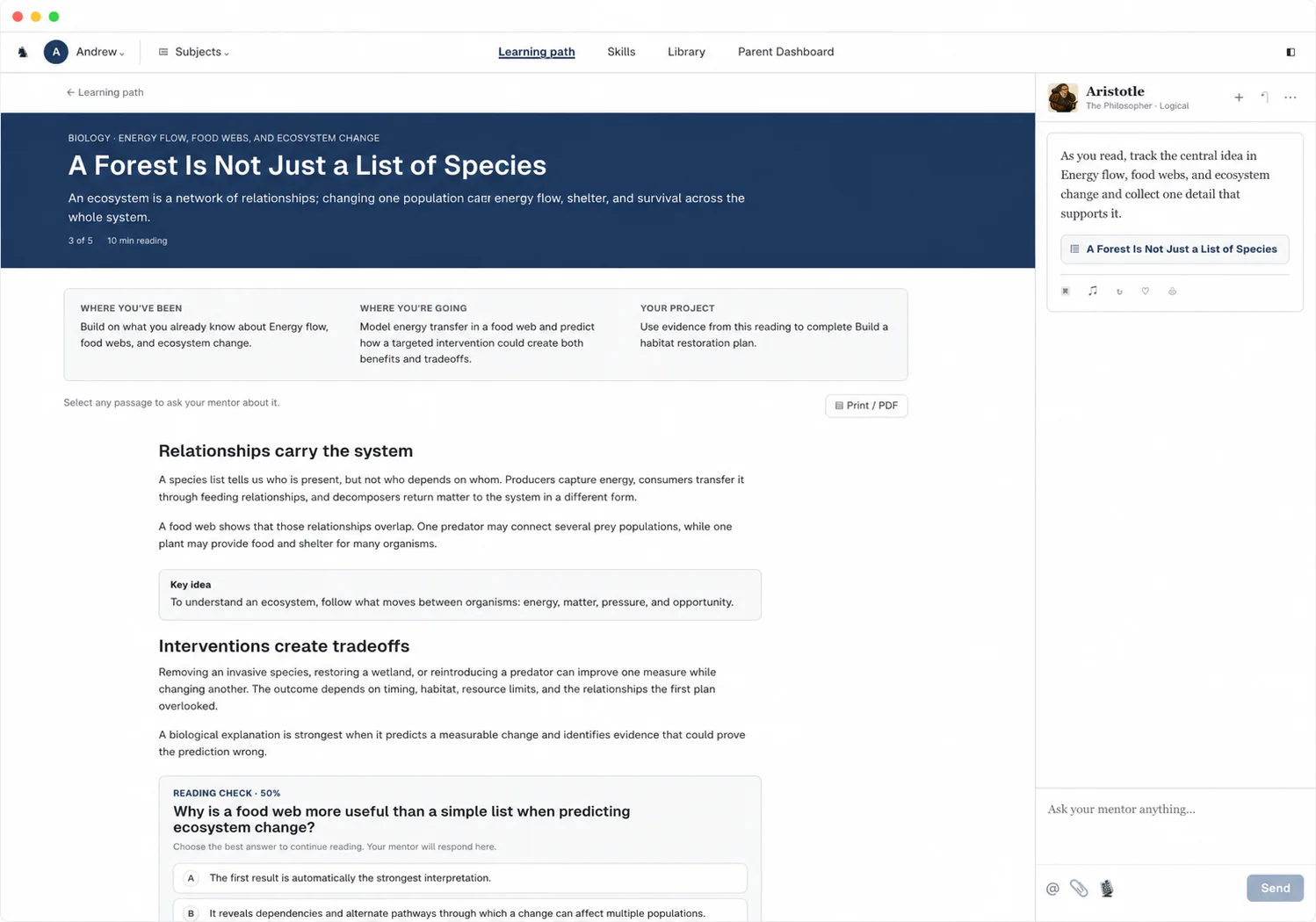
An ecosystem is a network of relationships; changing one population can change energy flow, shelter, and survival across the whole system.
- Lesson
- A Forest Is Not Just a List of Species
- Goal
- Model energy transfer in a food web and predict how a targeted intervention could create both benefits and tradeoffs.
How a lesson works
A 10-minute reading
This example lesson comes from the unit on energy flow, food webs, and ecosystem change. It moves from “Relationships carry the system” to “Interventions create tradeoffs” and builds to one idea: to understand an ecosystem, follow what moves between organisms: energy, matter, pressure, and opportunity.
Help inside the reading
If your child says a plant grew taller because it got more light, our Always-On Mentor can help check what the comparison shows and what else might explain it. Your child can also highlight any line of “A Forest Is Not Just a List of Species” to ask about it or ask for a visual, and the mentor offers help on its own when they seem stuck.
A check halfway through
Your child answers “Why is a food web more useful than a simple list when predicting ecosystem change?” before reading on, and the Reading Check at the end asks new questions.
A project your child hands in
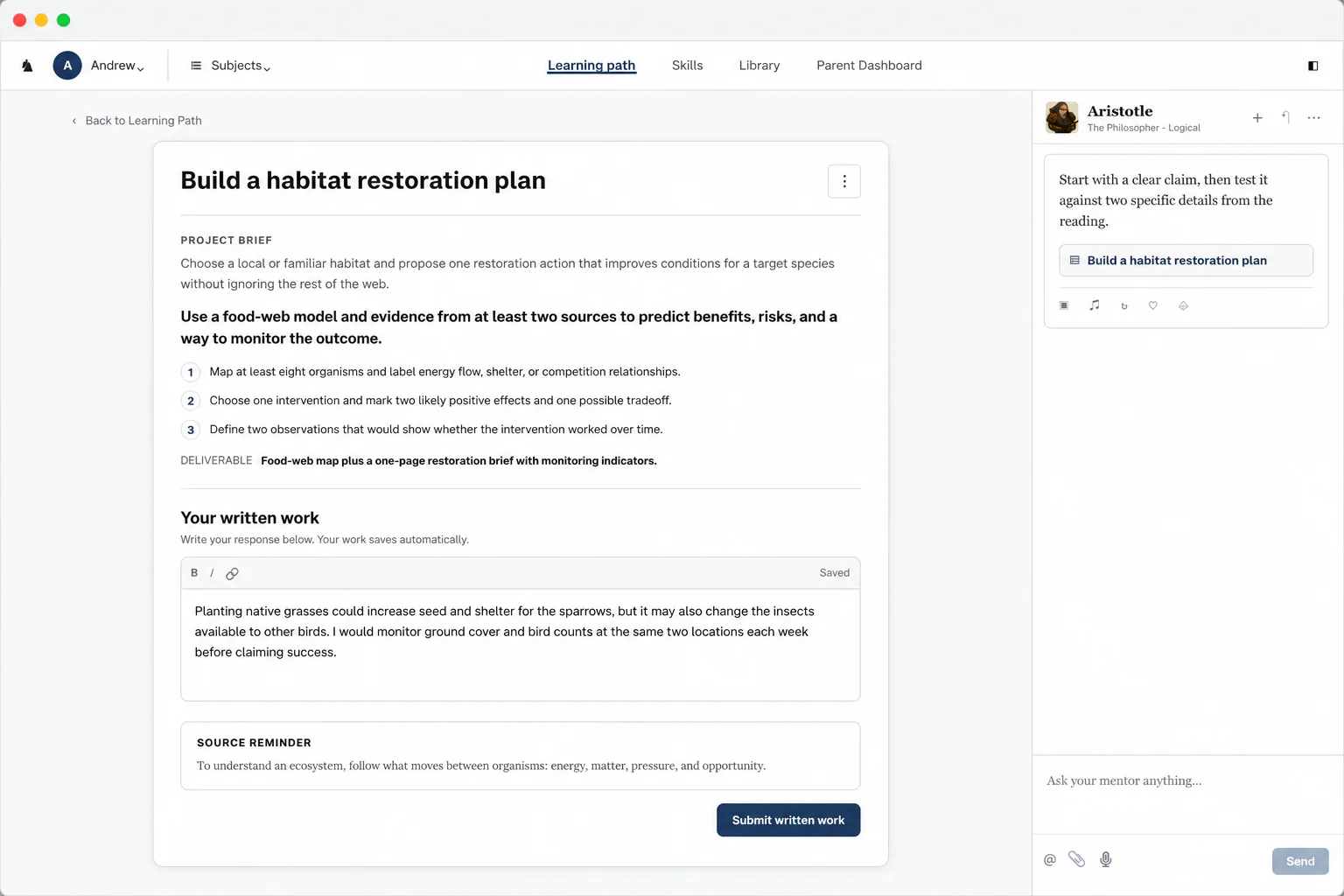
Choose a local or familiar habitat and propose one restoration action that improves conditions for a target species without ignoring the rest of the web.
- Task
- Use a food-web model and evidence from at least two sources to predict benefits, risks, and a way to monitor the outcome
- Hand in
- Food-web map plus a one-page restoration brief with monitoring indicators
Your parent dashboard
- Today
- Each subject's lesson, and whether it's done
- Grades
- Every submission graded instantly, with written feedback, so you never grade
- Records
- Attendance log and learning summary, ready to export

Units and skills by grade
Grades 3 to 5 each have their own biology units. From grade 6 through grade 12, biology is one full course: the same 8 units at every grade. Each grade adds a few skills of its own, and your child's grade sets how deep each unit goes.
Grade 36 units · 25 skills
Observing living things4 skills
- Sort living and nonliving things by evidence
- Record what an organism does over several days
- Use a hand lens to observe a small structure
- Draw and label an organism from observation
Plant structures5 skills
- Match a root to its job in a plant
- Match a stem to its job in a plant
- Explain how leaves help a plant get what it needs
- Explain how a flower helps a plant make seeds
- Predict what happens to a plant without light
Animal structures4 skills
- Match an animal body part to how it gets food
- Match an animal body part to how it moves
- Explain how a body covering protects an animal
- Compare how two animals sense their surroundings
Life cycles4 skills
- Sequence the stages of a butterfly life cycle
- Sequence the stages of a frog life cycle
- Compare the life cycle of a plant and an animal
- Explain what stays the same across one life cycle
Inherited traits3 skills
- Identify a trait an offspring gets from a parent
- Compare offspring with their parents
- Explain why offspring are not identical to parents
Living things and their homes5 skills
- Describe what an organism needs from its habitat
- Trace energy through a simple food chain
- Predict how a change in a habitat affects an organism
- Explain why an organism cannot live everywhere
- Give evidence that organisms depend on each other
Grade 45 units · 22 skills
Investigating organisms4 skills
- Plan a fair test about plant growth
- Record measurements of an organism over time
- Graph how a population changed
- Draw a conclusion about an organism from data
Structure and function5 skills
- Explain how a plant structure supports survival
- Explain how an animal structure supports survival
- Compare structures of two animals in the same habitat
- Predict the effect of losing a structure on survival
- Match a structure to the environment it suits
Life cycles and metamorphosis4 skills
- Compare complete and incomplete metamorphosis
- Sequence the life cycle of a flowering plant
- Compare the life cycles of two different animals
- Explain why some young resemble their parents and some do not
Adaptations4 skills
- Explain how an adaptation helps an organism survive
- Distinguish a physical adaptation from a behaviour
- Predict which organism survives an environmental change
- Give evidence that adaptations match a habitat
Food webs and ecosystems5 skills
- Trace energy through a food web
- Identify producers, consumers, and decomposers
- Predict the effect of removing one organism from a web
- Compare the living and nonliving parts of two ecosystems
- Explain how decomposers return matter to an ecosystem
Grade 55 units · 22 skills
Biological investigation4 skills
- Write a testable hypothesis about an organism
- Identify the control group in a biological investigation
- Choose a display that fits biological data
- Critique a conclusion that the data does not support
Structure, function, and systems5 skills
- Explain how a structure carries out a specific function
- Trace how a plant moves water from root to leaf
- Explain how one body system supports another
- Compare how two organisms solve the same survival problem
- Use evidence to link a structure to a habitat
Inherited and learned4 skills
- Distinguish an inherited trait from a learned behaviour
- Give evidence that a behaviour was learned
- Explain why traits vary within one species
- Predict which traits appear in offspring
Matter and energy in ecosystems4 skills
- Trace energy from the Sun through a food web
- Explain how matter cycles through an ecosystem
- Model what happens when a producer population falls
- Compare energy available at two levels of a food web
Environmental change5 skills
- Predict how a habitat change alters a population
- Use evidence to explain a species decline
- Compare a natural and a human-caused environmental change
- Propose a way to reduce harm to a local ecosystem
- Evaluate evidence behind a claim about an ecosystem
Grades 6 to 128 units · 95 skills
Cells14 skills
- Identify nucleus function
- Distinguish prokaryotic and eukaryotic cells
- Explain diffusion across a membrane
- Explain osmosis across a membrane
- Match organelles to cell functions
- Compare plant and animal cells
- Explain active transport
- Identify cell-cycle phases
- Use a microscope field of view to compare cell size
- Identify organelles in a microscope image
- Compare unicellular and multicellular organization
- Explain osmosis in a cell model
- Connect membrane transport to homeostasis in body systems
- Explain feedback control in homeostasis
Bioenergetics9 skills
- Trace energy flow through photosynthesis
- Identify reactants and products of cellular respiration
- Compare aerobic and anaerobic respiration
- Interpret an enzyme activity graph
- Connect chloroplast structure to photosynthesis
- Connect mitochondria to ATP production
- Explain energy loss between trophic levels
- Balance photosynthesis and respiration equations conceptually
- Identify reactants and products of photosynthesis
Genetics15 skills
- Model DNA base pairing
- Transcribe DNA to mRNA
- Translate mRNA codons to amino acids
- Distinguish genotype from phenotype
- Complete a monohybrid Punnett square
- Identify mutation types
- Explain gene expression regulation
- Use a codon chart
- Explain inherited traits using parent-offspring data
- Predict trait probability from a simple pedigree
- Use a Punnett square for one trait
- Explain gene regulation in cell differentiation
- Trace DNA to RNA to protein
- Evaluate CRISPR use in a case study
- Interpret a gel electrophoresis result
Biotechnology and health7 skills
- Explain PCR amplification
- Use gel bands to compare DNA samples
- Interpret vaccine efficacy data
- Evaluate antibiotic-resistance evidence
- Interpret a genetic screening result
- Explain how PCR copies a DNA segment
- Use antibiotic-resistance data to support a claim
Evolution12 skills
- Identify evidence from fossils
- Explain natural selection in a population
- Distinguish adaptation from acclimation
- Interpret a cladogram
- Identify homologous structures
- Explain genetic drift
- Explain speciation from reproductive isolation
- Explain variation as raw material for selection
- Use fossil layers to infer relative age
- Use allele-frequency change as evolution evidence
- Use homologous structures as common ancestry evidence
- Evaluate molecular evidence for relatedness
Ecology13 skills
- Identify producer and consumer roles
- Trace energy through a food web
- Interpret carrying capacity on a graph
- Predict an effect of an invasive species
- Analyze predator-prey cycles
- Interpret a population pyramid
- Explain succession after disturbance
- Identify ecosystem roles in a local habitat
- Model energy transfer between trophic levels
- Interpret a population growth curve
- Model carbon flow through ecosystems
- Use a food web to trace carbon movement
- Evaluate biodiversity data after disturbance
Body systems13 skills
- Identify major organ-system functions
- Trace blood flow through the heart
- Connect digestive enzymes to nutrient absorption
- Explain homeostasis in body temperature
- Explain endocrine signaling
- Trace digestion from mouth to small intestine
- Connect kidney filtration to homeostasis
- Trace oxygen through the respiratory and circulatory systems
- Connect alveoli structure to gas exchange
- Explain negative feedback in blood glucose regulation
- Trace nerve signal transmission across a synapse
- Connect immune response to pathogen exposure
- Compare innate and adaptive immune responses
Lab practice12 skills
- Identify independent and dependent variables
- Write a testable hypothesis
- Use a control group
- Interpret error bars in biological data
- Choose appropriate graph type
- Calculate percent change in data
- Evaluate experimental validity
- Design a controlled enzyme investigation
- Predict an outcome from an enzyme hypothesis
- Choose controls for a physiology investigation
- Critique a published biological study design
- Analyze error in a biology investigation
Questions parents ask
Which grades can use this Biology curriculum?
- Grades 3 to 12. The skill trees on this page show the units and skills by grade. Placement checks your child's current skills, so the first lesson can sit before or after their grade.
What should my child know before starting?
- Starting skills include basic reading comprehension for science texts, ability to follow multi-step procedures, and curiosity about living things. If placement finds a gap, the course starts with those skills.
How much of the teaching do I do?
- None of it. The course explains each new idea and checks how your child uses it, while the mentor answers questions as they work. Every submission is graded as soon as it comes in, so you never grade it yourself.
Can I use the record for high-school planning?
- Yes. The subject record holds every graded assignment with its written feedback, ready to export. We generate a transcript from the course records, ready for you to sign.
Biology, taught around your child
Biology your learner can investigate instead of merely recite.
$49/month after the trial.