Advanced Statistics homeschool curriculum.
From planning a study to explaining its results, your student practices what data can and cannot show.
A personalized lesson from the course
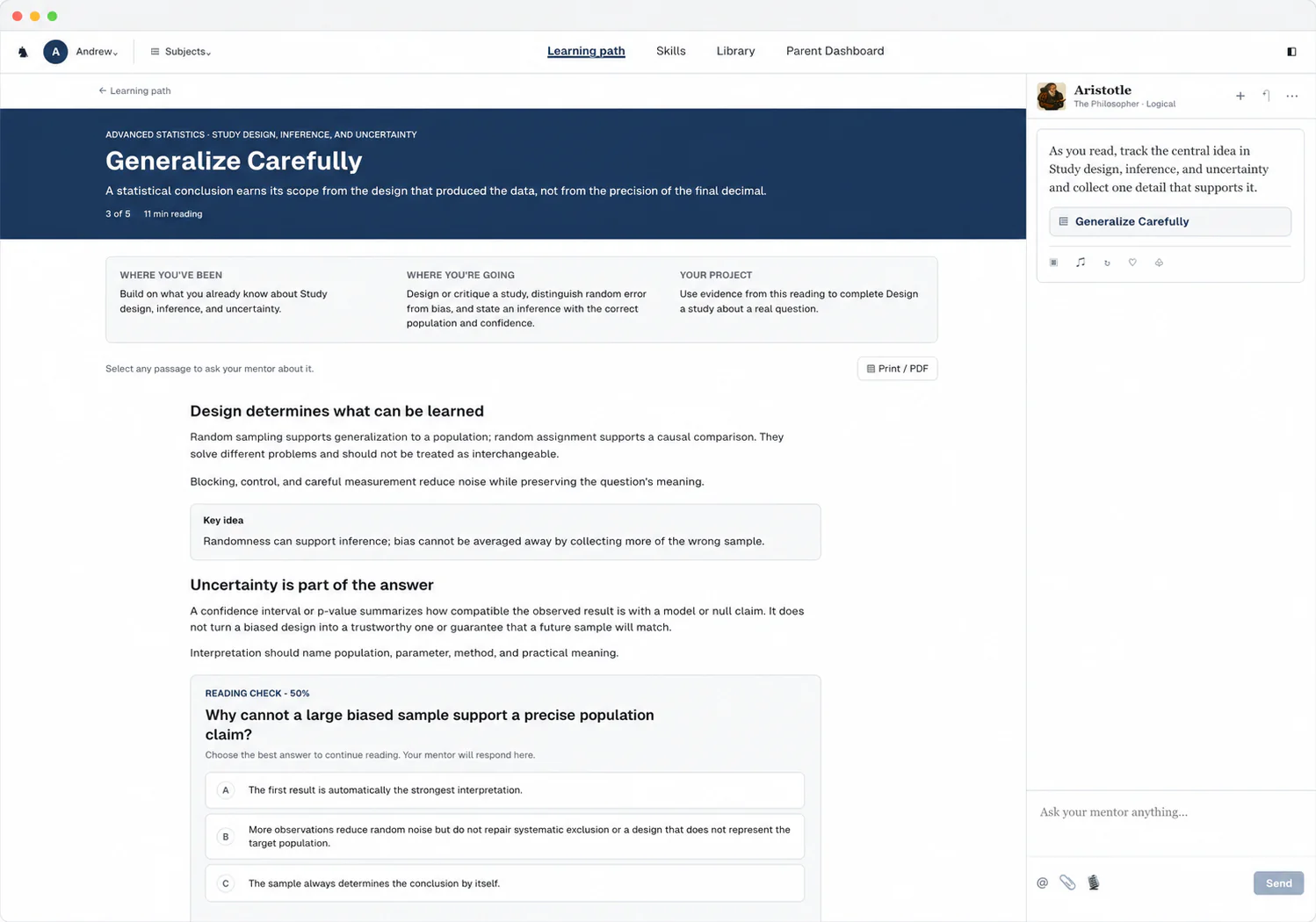
A statistical conclusion earns its scope from the design that produced the data, not from the precision of the final decimal.
- Lesson
- Generalize Carefully
- Goal
- Design or critique a study, distinguish random error from bias, and state an inference with the correct population and confidence.
How a lesson works
An 11-minute reading
This example lesson comes from the unit on study design, inference, and uncertainty. It moves from “Design determines what can be learned” to “Uncertainty is part of the answer” and builds to one idea: randomness can support inference; bias cannot be averaged away by collecting more of the wrong sample.
Help inside the reading
Our Always-On Mentor stays beside “Generalize Carefully” the whole way through, answering questions about any highlighted line and, during the Reading Check, clarifying a question without giving the answer away.
A check halfway through
Your child answers “Why cannot a large biased sample support a precise population claim?” before reading on, and the Reading Check at the end asks new questions.
A project your child hands in
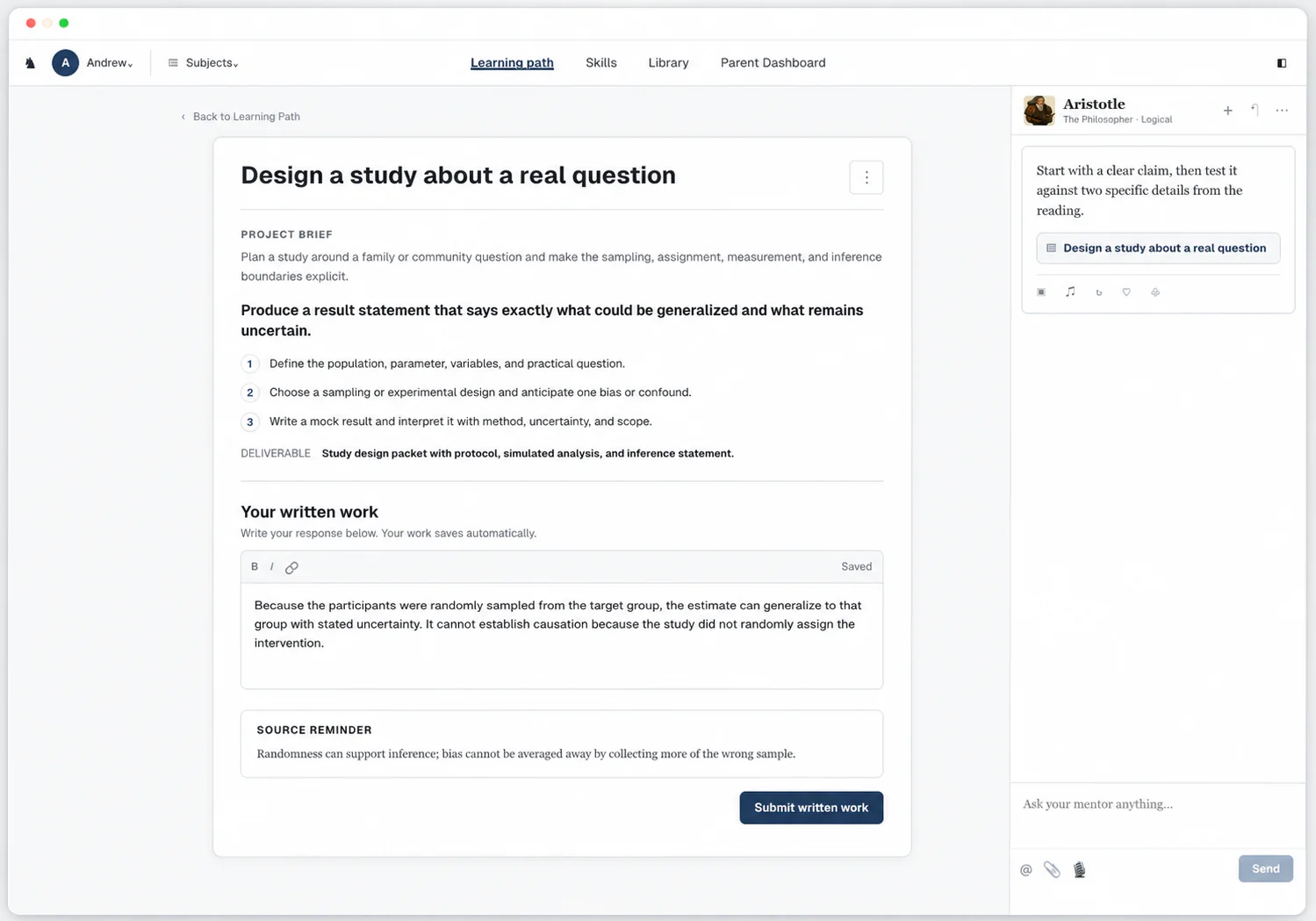
Plan a study around a family or community question and make the sampling, assignment, measurement, and inference boundaries explicit.
- Task
- Produce a result statement that says exactly what could be generalized and what remains uncertain
- Hand in
- Study design packet with protocol, simulated analysis, and inference statement
See the reasoning behind the answer
Students formulate questions, collect and analyze data, and explain results in the context of the original problem. Advanced Statistics runs through 17 units and 68 skills, starting with exploring one-variable data, exploring two-variable data, and collecting data.
- Technology-supported data investigations
- Experimental and sampling designs
- Written statistical conclusions with conditions and limits
Units and skills
Advanced Statistics17 units · 68 skills
Exploring one-variable data4 skills
- Formulate a statistical investigative question involving Exploring one-variable data
- Select or evaluate a data-collection method for Exploring one-variable data
- Analyze data and uncertainty connected to Exploring one-variable data
- Interpret and communicate statistical results about Exploring one-variable data
Exploring two-variable data4 skills
- Formulate a statistical investigative question involving Exploring two-variable data
- Select or evaluate a data-collection method for Exploring two-variable data
- Analyze data and uncertainty connected to Exploring two-variable data
- Interpret and communicate statistical results about Exploring two-variable data
Collecting data4 skills
- Formulate a statistical investigative question involving Collecting data
- Select or evaluate a data-collection method for Collecting data
- Analyze data and uncertainty connected to Collecting data
- Interpret and communicate statistical results about Collecting data
Probability, random variables, and probability distributions4 skills
- Formulate a statistical investigative question involving Probability, random variables, and probability distributions
- Select or evaluate a data-collection method for Probability, random variables, and probability distributions
- Analyze data and uncertainty connected to Probability, random variables, and probability distributions
- Interpret and communicate statistical results about Probability, random variables, and probability distributions
Sampling distributions and inference4 skills
- Formulate a statistical investigative question involving Sampling distributions and inference
- Select or evaluate a data-collection method for Sampling distributions and inference
- Analyze data and uncertainty connected to Sampling distributions and inference
- Interpret and communicate statistical results about Sampling distributions and inference
Formulating statistical questions4 skills
- Formulate a statistical investigative question involving Formulating statistical questions
- Select or evaluate a data-collection method for Formulating statistical questions
- Analyze data and uncertainty connected to Formulating statistical questions
- Interpret and communicate statistical results about Formulating statistical questions
Technology-enabled analysis4 skills
- Formulate a statistical investigative question involving Technology-enabled analysis
- Select or evaluate a data-collection method for Technology-enabled analysis
- Analyze data and uncertainty connected to Technology-enabled analysis
- Interpret and communicate statistical results about Technology-enabled analysis
Statistical argumentation4 skills
- Formulate a statistical investigative question involving Statistical argumentation
- Select or evaluate a data-collection method for Statistical argumentation
- Analyze data and uncertainty connected to Statistical argumentation
- Interpret and communicate statistical results about Statistical argumentation
Cumulative statistical investigation4 skills
- Formulate a statistical investigative question involving Cumulative statistical investigation
- Select or evaluate a data-collection method for Cumulative statistical investigation
- Analyze data and uncertainty connected to Cumulative statistical investigation
- Interpret and communicate statistical results about Cumulative statistical investigation
Multiple quantitative representations4 skills
- Formulate a statistical investigative question involving Multiple quantitative representations
- Select or evaluate a data-collection method for Multiple quantitative representations
- Analyze data and uncertainty connected to Multiple quantitative representations
- Interpret and communicate statistical results about Multiple quantitative representations
Graph construction and interpretation4 skills
- Formulate a statistical investigative question involving Graph construction and interpretation
- Select or evaluate a data-collection method for Graph construction and interpretation
- Analyze data and uncertainty connected to Graph construction and interpretation
- Interpret and communicate statistical results about Graph construction and interpretation
Written mathematical justification4 skills
- Formulate a statistical investigative question involving Written mathematical justification
- Select or evaluate a data-collection method for Written mathematical justification
- Analyze data and uncertainty connected to Written mathematical justification
- Interpret and communicate statistical results about Written mathematical justification
Research ethics and design4 skills
- Formulate a statistical investigative question involving Research ethics and design
- Select or evaluate a data-collection method for Research ethics and design
- Analyze data and uncertainty connected to Research ethics and design
- Interpret and communicate statistical results about Research ethics and design
Evidence quality and limitations4 skills
- Formulate a statistical investigative question involving Evidence quality and limitations
- Select or evaluate a data-collection method for Evidence quality and limitations
- Analyze data and uncertainty connected to Evidence quality and limitations
- Interpret and communicate statistical results about Evidence quality and limitations
Advanced Statistics cumulative assessment4 skills
- Formulate a statistical investigative question involving Advanced Statistics cumulative assessment
- Select or evaluate a data-collection method for Advanced Statistics cumulative assessment
- Analyze data and uncertainty connected to Advanced Statistics cumulative assessment
- Interpret and communicate statistical results about Advanced Statistics cumulative assessment
Advanced Statistics exam-mode practice4 skills
- Formulate a statistical investigative question involving Advanced Statistics exam-mode practice
- Select or evaluate a data-collection method for Advanced Statistics exam-mode practice
- Analyze data and uncertainty connected to Advanced Statistics exam-mode practice
- Interpret and communicate statistical results about Advanced Statistics exam-mode practice
Advanced Statistics reflection and transfer4 skills
- Formulate a statistical investigative question involving Advanced Statistics reflection and transfer
- Select or evaluate a data-collection method for Advanced Statistics reflection and transfer
- Analyze data and uncertainty connected to Advanced Statistics reflection and transfer
- Interpret and communicate statistical results about Advanced Statistics reflection and transfer
Questions parents ask
How does Advanced Statistics prepare my student for AP Statistics?
- Advanced Statistics follows the AP Statistics framework unit by unit, as its skill tree shows. Your teen explains and applies the ideas in written responses and projects, so the work shows which skills are secure and which need more practice.
How does a homeschooler register for an AP exam?
- An AP coordinator at an AP-authorized local school arranges registration. Use College Board’s homeschool exam guidance to find a host school. That school sets its deadlines and outside-student policies; its coordinator orders the exam, collects fees, and tells your child where and when to test.
Which course title goes on a homeschool transcript?
- Advanced Statistics, not AP Statistics. The AP designation requires College Board Course Audit authorization of the course, which framework alignment does not give. We generate the transcript with that title, ready for you to sign as homeschool administrator.
How can AP scores earn college credit?
- Colleges award credit under their own AP score policies. College Board reports scores on a 1–5 scale, separately from our coursework grades; check the college’s required score and whether it grants credit, placement, or both.
Advanced Statistics, with the teaching and records handled
$49/month after the trial.