Physical Fitness & Health for your homeschool
Your child connects a movement goal to practice, recovery, and ways to measure progress that fit their starting point.
A lesson built around your child
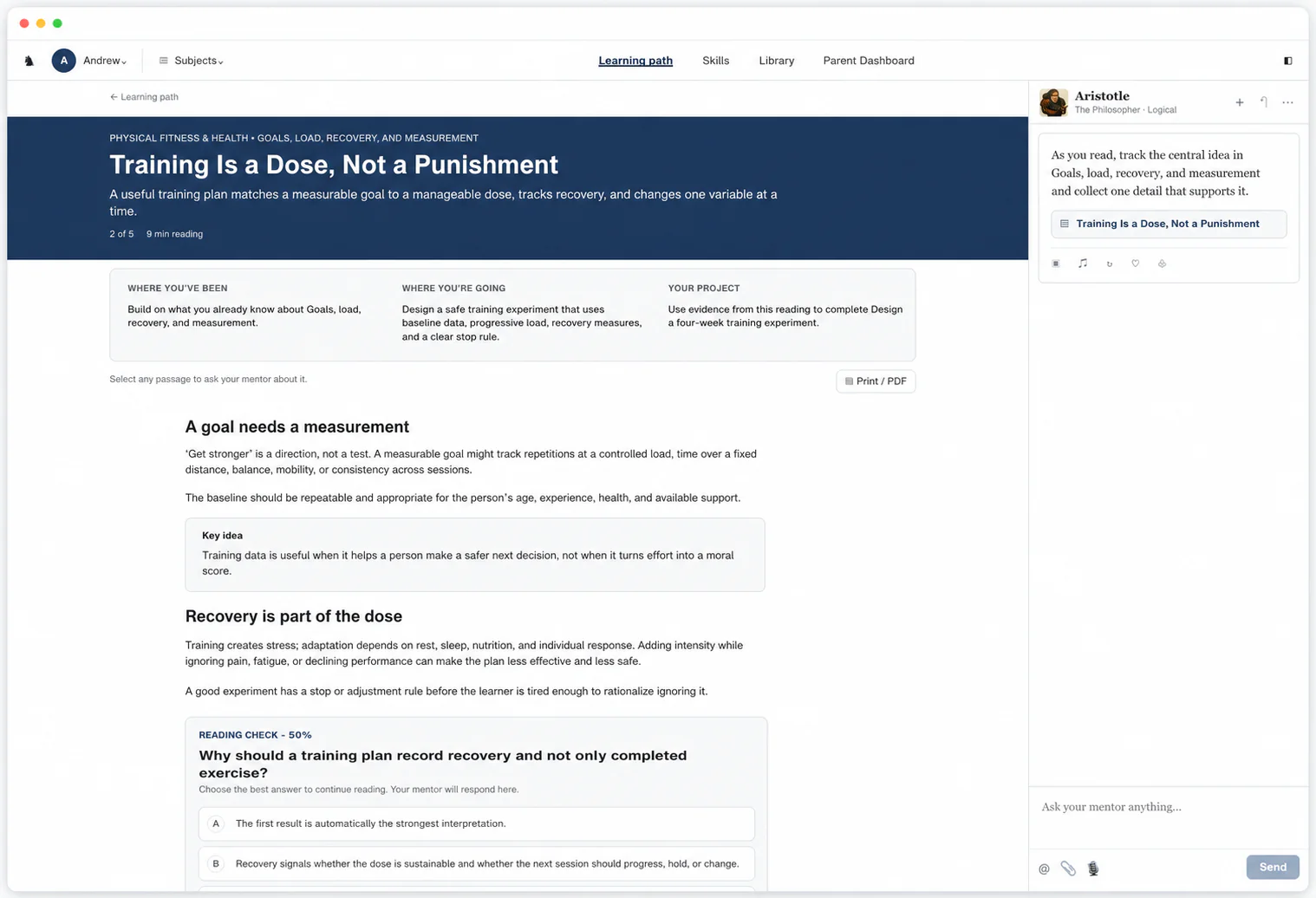
A useful training plan matches a measurable goal to a manageable dose, tracks recovery, and changes one variable at a time.
- Lesson
- Training Is a Dose, Not a Punishment
- Goal
- Design a safe training experiment that uses baseline data, progressive load, recovery measures, and a clear stop rule.
How a lesson works
A 9-minute reading
This example lesson comes from the unit on goals, load, recovery, and measurement. It moves from “A goal needs a measurement” to “Recovery is part of the dose” and builds to one idea: training data is useful when it helps a person make a safer next decision, not when it turns effort into a moral score.
Help inside the reading
If a training plan is not producing the expected result, our Always-On Mentor can help review the notes and adjust the plan. Pain or injury needs a qualified professional. Your child can also highlight any line of “Training Is a Dose, Not a Punishment” to ask about it or ask for a visual, and the mentor offers help on its own when they seem stuck.
A check halfway through
Your child answers “Why should a training plan record recovery and not only completed exercise?” before reading on, and the Reading Check at the end asks new questions.
A project your child hands in
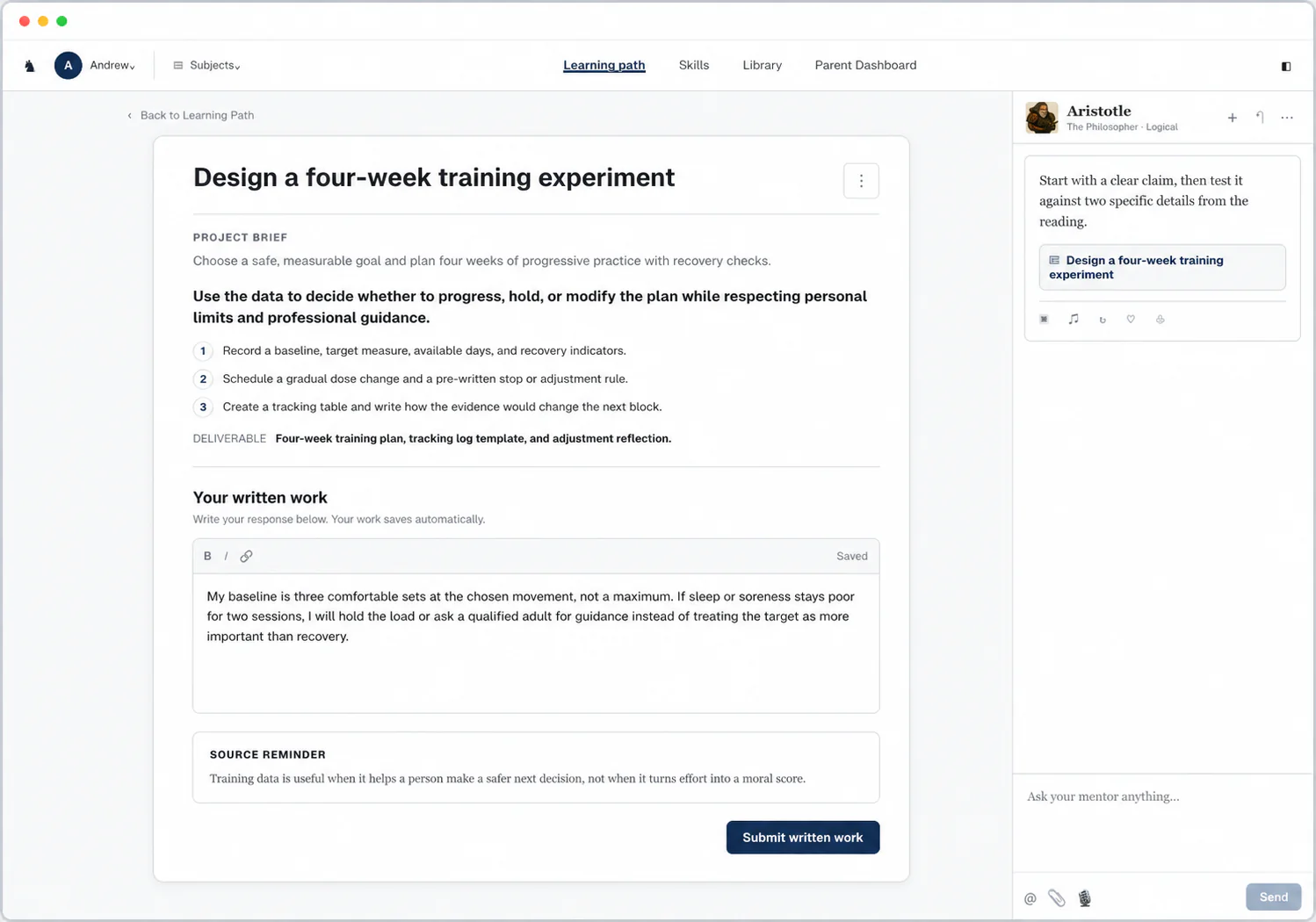
Choose a safe, measurable goal and plan four weeks of progressive practice with recovery checks.
- Task
- Use the data to decide whether to progress, hold, or modify the plan while respecting personal limits and professional guidance
- Hand in
- Four-week training plan, tracking log template, and adjustment reflection
Your parent dashboard
- Today
- Each subject's lesson, and whether it's done
- Grades
- Every submission graded instantly, with written feedback, so you never grade
- Records
- Attendance log and learning summary, ready to export

Units and skills
Builds personal fitness as evidence-informed self-management, with no body shaming or unsafe performance chasing. Physical Fitness & Health is one skill tree for every grade with 12 units, from movement safety and body mechanics to personal training plan capstone, and your child's grade sets how deep each unit goes.
Physical Fitness & Health12 units · 60 skills
Movement safety and body mechanics5 skills
- Define the vocabulary, boundaries, and common misconceptions of Movement safety and body mechanics
- Explain the main actors, mechanisms, sequence, and constraints in Movement safety and body mechanics
- Interpret evidence, data, cases, or examples connected to Movement safety and body mechanics
- Apply Movement safety and body mechanics to a realistic training or performance scenario
- Create a safe training plan that justifies decisions about Movement safety and body mechanics
Cardiorespiratory endurance5 skills
- Define the vocabulary, boundaries, and common misconceptions of Cardiorespiratory endurance
- Explain the main actors, mechanisms, sequence, and constraints in Cardiorespiratory endurance
- Interpret evidence, data, cases, or examples connected to Cardiorespiratory endurance
- Apply Cardiorespiratory endurance to a realistic training or performance scenario
- Create a safe training plan that justifies decisions about Cardiorespiratory endurance
Strength training fundamentals5 skills
- Define the vocabulary, boundaries, and common misconceptions of Strength training fundamentals
- Explain the main actors, mechanisms, sequence, and constraints in Strength training fundamentals
- Interpret evidence, data, cases, or examples connected to Strength training fundamentals
- Apply Strength training fundamentals to a realistic training or performance scenario
- Create a safe training plan that justifies decisions about Strength training fundamentals
Mobility, flexibility, and posture5 skills
- Define the vocabulary, boundaries, and common misconceptions of Mobility, flexibility, and posture
- Explain the main actors, mechanisms, sequence, and constraints in Mobility, flexibility, and posture
- Interpret evidence, data, cases, or examples connected to Mobility, flexibility, and posture
- Apply Mobility, flexibility, and posture to a realistic training or performance scenario
- Create a safe training plan that justifies decisions about Mobility, flexibility, and posture
Speed, agility, and coordination5 skills
- Define the vocabulary, boundaries, and common misconceptions of Speed, agility, and coordination
- Explain the main actors, mechanisms, sequence, and constraints in Speed, agility, and coordination
- Interpret evidence, data, cases, or examples connected to Speed, agility, and coordination
- Apply Speed, agility, and coordination to a realistic training or performance scenario
- Create a safe training plan that justifies decisions about Speed, agility, and coordination
Training plans and progressive overload5 skills
- Define the vocabulary, boundaries, and common misconceptions of Training plans and progressive overload
- Explain the main actors, mechanisms, sequence, and constraints in Training plans and progressive overload
- Interpret evidence, data, cases, or examples connected to Training plans and progressive overload
- Apply Training plans and progressive overload to a realistic training or performance scenario
- Create a safe training plan that justifies decisions about Training plans and progressive overload
Recovery, sleep, and injury prevention5 skills
- Define the vocabulary, boundaries, and common misconceptions of Recovery, sleep, and injury prevention
- Explain the main actors, mechanisms, sequence, and constraints in Recovery, sleep, and injury prevention
- Interpret evidence, data, cases, or examples connected to Recovery, sleep, and injury prevention
- Apply Recovery, sleep, and injury prevention to a realistic training or performance scenario
- Create a safe training plan that justifies decisions about Recovery, sleep, and injury prevention
Nutrition, hydration, and energy balance5 skills
- Define the vocabulary, boundaries, and common misconceptions of Nutrition, hydration, and energy balance
- Explain the main actors, mechanisms, sequence, and constraints in Nutrition, hydration, and energy balance
- Interpret evidence, data, cases, or examples connected to Nutrition, hydration, and energy balance
- Apply Nutrition, hydration, and energy balance to a realistic training or performance scenario
- Create a safe training plan that justifies decisions about Nutrition, hydration, and energy balance
Fitness assessment and data tracking5 skills
- Define the vocabulary, boundaries, and common misconceptions of Fitness assessment and data tracking
- Explain the main actors, mechanisms, sequence, and constraints in Fitness assessment and data tracking
- Interpret evidence, data, cases, or examples connected to Fitness assessment and data tracking
- Apply Fitness assessment and data tracking to a realistic training or performance scenario
- Create a safe training plan that justifies decisions about Fitness assessment and data tracking
Teamwork, coaching, and motivation5 skills
- Define the vocabulary, boundaries, and common misconceptions of Teamwork, coaching, and motivation
- Explain the main actors, mechanisms, sequence, and constraints in Teamwork, coaching, and motivation
- Interpret evidence, data, cases, or examples connected to Teamwork, coaching, and motivation
- Apply Teamwork, coaching, and motivation to a realistic training or performance scenario
- Create a safe training plan that justifies decisions about Teamwork, coaching, and motivation
Mental performance and habit formation5 skills
- Define the vocabulary, boundaries, and common misconceptions of Mental performance and habit formation
- Explain the main actors, mechanisms, sequence, and constraints in Mental performance and habit formation
- Interpret evidence, data, cases, or examples connected to Mental performance and habit formation
- Apply Mental performance and habit formation to a realistic training or performance scenario
- Create a safe training plan that justifies decisions about Mental performance and habit formation
Personal training plan capstone5 skills
- Define the vocabulary, boundaries, and common misconceptions of Personal training plan capstone
- Explain the main actors, mechanisms, sequence, and constraints in Personal training plan capstone
- Interpret evidence, data, cases, or examples connected to Personal training plan capstone
- Apply Personal training plan capstone to a realistic training or performance scenario
- Create a safe training plan that justifies decisions about Personal training plan capstone
Questions parents ask
Which grades can use this Physical Fitness & Health curriculum?
- One Physical Fitness & Health skill tree serves grades 3 to 12, with course pages for 6th grade and high school. Placement checks your child's current skills, so the first lesson can sit before or after their grade.
What should my child know before starting?
- Starting skills include medical clearance for exercise, basic willingness to move, and open mind about activities. If placement finds a gap, the course starts with those skills.
How much of the teaching do I do?
- None of it. The course explains each new idea and checks how your child uses it, while the mentor answers questions as they work. Every submission is graded as soon as it comes in, so you never grade it yourself.
Can I use the record for high-school planning?
- Yes. The subject record holds every graded assignment with its written feedback, ready to export. We generate a transcript from the course records, ready for you to sign.
Physical Fitness & Health, taught around your child
Movement knowledge and habits shaped around the learner's goals and constraints.
$49/month after the trial.