Chemistry for your homeschool
Your child uses an equation to predict a reaction, then examines the observations and calculations behind it.
A lesson built around your child
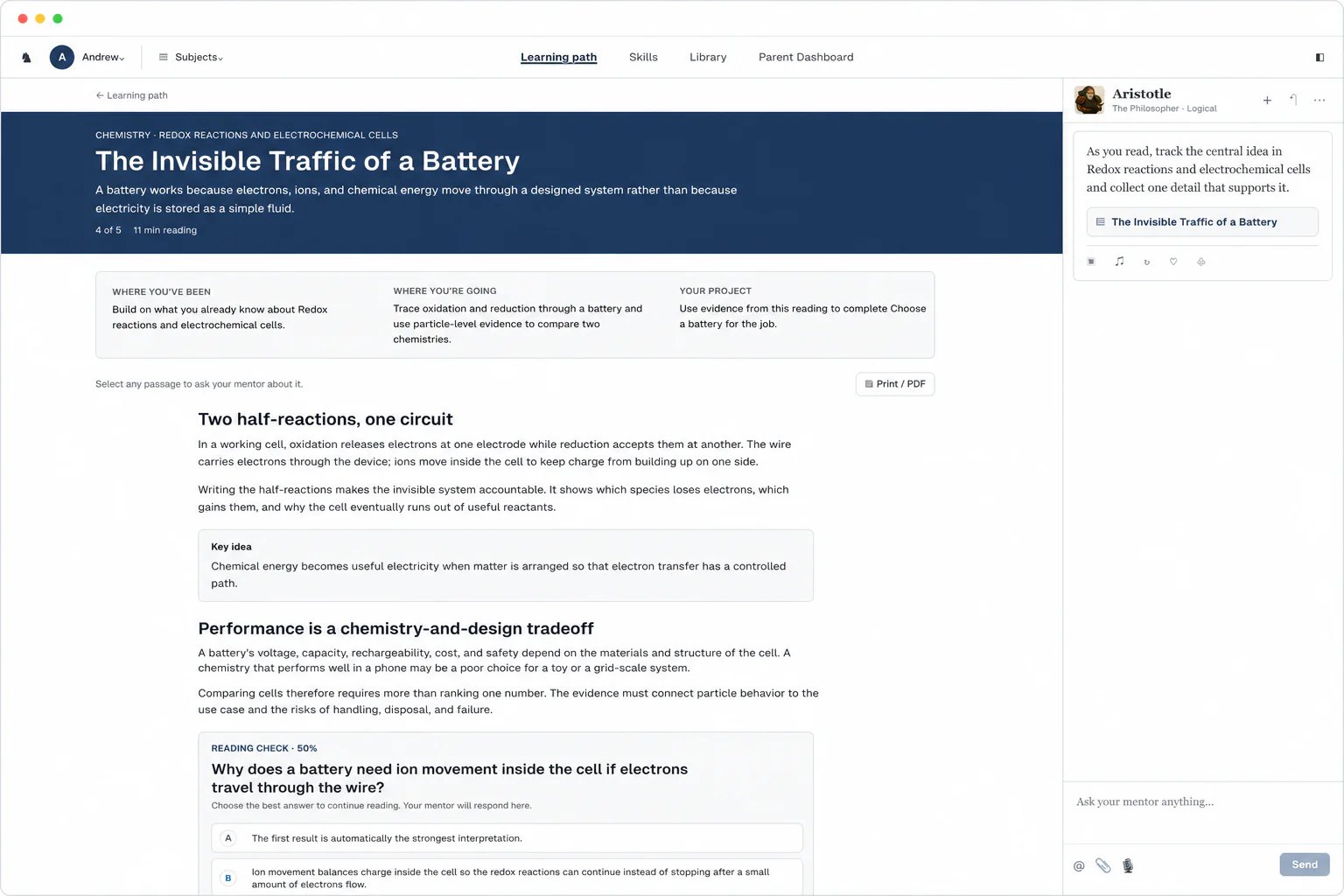
A battery works because electrons, ions, and chemical energy move through a designed system rather than because electricity is stored as a simple fluid.
- Lesson
- The Invisible Traffic of a Battery
- Goal
- Trace oxidation and reduction through a battery and use particle-level evidence to compare two chemistries.
How a lesson works
An 11-minute reading
This example lesson comes from the unit on redox reactions and electrochemical cells. It moves from “Two half-reactions, one circuit” to “Performance is a chemistry-and-design tradeoff” and builds to one idea: chemical energy becomes useful electricity when matter is arranged so that electron transfer has a controlled path.
Help inside the reading
If a reaction calculation is off, our Always-On Mentor can help your child check the particle model, units, ratio, and algebra behind it. Your child can also highlight any line of “The Invisible Traffic of a Battery” to ask about it or ask for a visual, and the mentor offers help on its own when they seem stuck.
A check halfway through
Your child answers “Why does a battery need ion movement inside the cell if electrons travel through the wire?” before reading on, and the Reading Check at the end asks new questions.
A project your child hands in
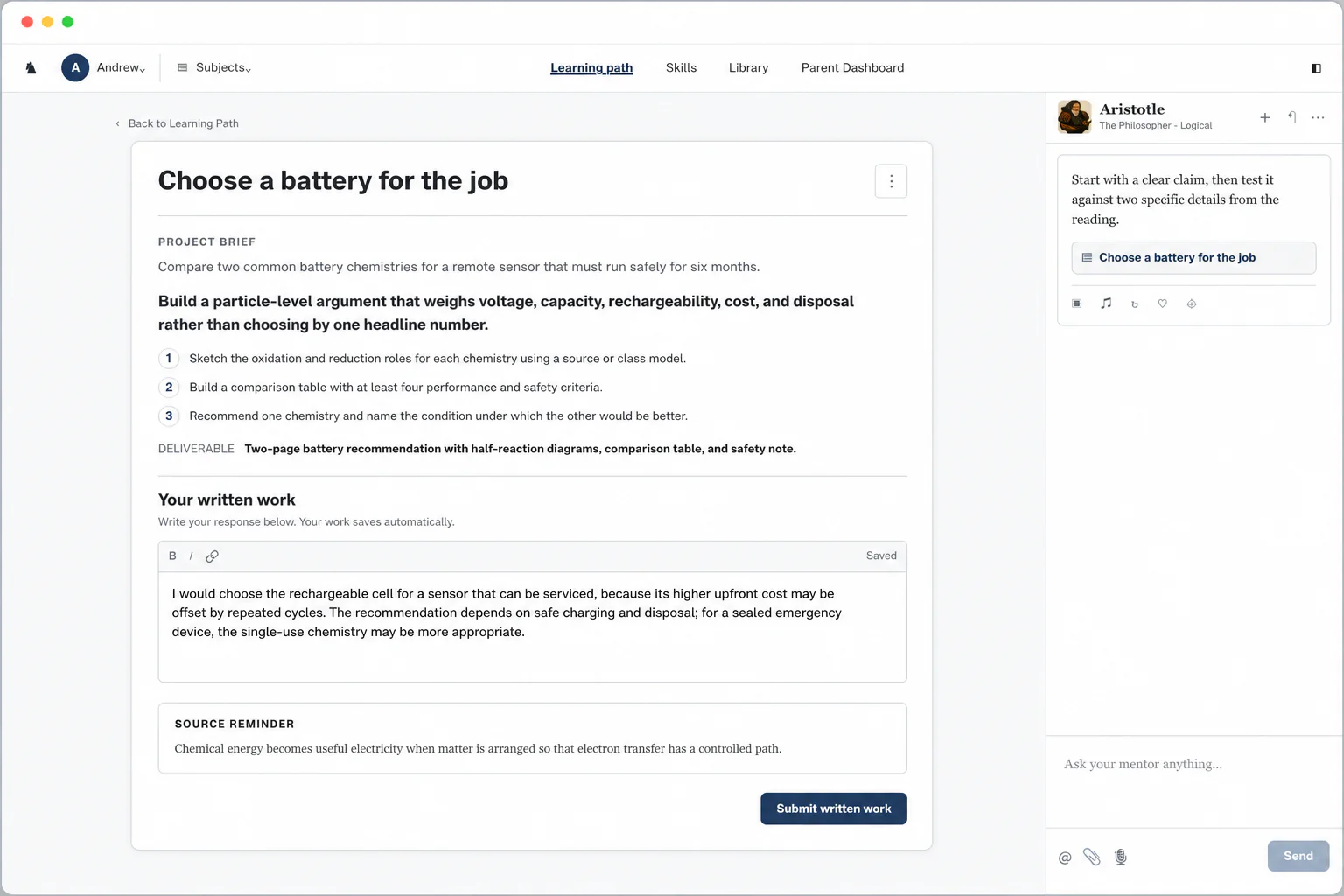
Compare two common battery chemistries for a remote sensor that must run safely for six months.
- Task
- Build a particle-level argument that weighs voltage, capacity, rechargeability, cost, and disposal rather than choosing by one headline number
- Hand in
- Two-page battery recommendation with half-reaction diagrams, comparison table, and safety note
Your parent dashboard
- Today
- Each subject's lesson, and whether it's done
- Grades
- Every submission graded instantly, with written feedback, so you never grade
- Records
- Attendance log and learning summary, ready to export

Units and skills by grade
Grades 3 to 5 each have their own chemistry units. From grade 6 through grade 12, chemistry is one full course: the same 7 units at every grade. Each grade adds a few skills of its own, and your child's grade sets how deep each unit goes.
Grade 36 units · 24 skills
Measuring matter4 skills
- Measure the mass of an object with a balance
- Measure the volume of a liquid with a marked container
- Measure temperature with a thermometer
- Record measurements with the correct unit
Physical properties5 skills
- Describe an object by colour, texture, and shape
- Compare two objects by mass
- Test whether an object sinks or floats
- Test whether an object is attracted to a magnet
- Sort materials by a property you choose
States of matter4 skills
- Classify matter as a solid, a liquid, or a gas
- Describe how a solid keeps its shape
- Describe how a liquid takes the shape of its container
- Give evidence that a gas takes up space
Heating and cooling4 skills
- Predict what happens when ice is heated
- Predict what happens when water is cooled
- Observe a change caused by heating
- Explain that some changes can be reversed
Mixing materials3 skills
- Combine two materials and describe the result
- Separate a mixture using a screen or a magnet
- Explain why the parts of a mixture keep their properties
Everyday materials4 skills
- Choose a material for a job based on its properties
- Explain why metal is used for cooking pans
- Explain why glass is used for windows
- Compare two materials for the same purpose
Grade 45 units · 21 skills
Testing materials4 skills
- Plan a fair test of one material property
- Record results of a material test in a table
- Compare results across repeated trials
- Choose a material for a job based on evidence
Properties and classification5 skills
- Classify matter by measurable physical properties
- Compare the density of two objects by sinking and floating
- Test whether a material conducts thermal energy
- Test whether a material conducts electricity
- Explain why one material suits a job better than another
Mixtures and solutions5 skills
- Distinguish a mixture from a solution
- Separate a mixture using a physical property
- Explain why a dissolved solid is still present
- Predict whether a substance will dissolve in water
- Speed up dissolving and explain why it worked
Changes in matter4 skills
- Identify a change of state caused by heating
- Identify a change of state caused by cooling
- Explain that mass does not change when matter changes state
- Give evidence that a change can be reversed
Matter in systems3 skills
- Explain the role of water as a solvent
- Describe how matter moves through the water cycle
- Choose a container material for a stated purpose
Grade 55 units · 21 skills
Chemical investigation4 skills
- Write a hypothesis about a material change
- Identify the variable tested in a materials investigation
- Use repeated trials to support a claim about matter
- Critique a conclusion about a chemical change
Properties including density5 skills
- Classify matter using density as a property
- Compare relative density using sinking and floating
- Test thermal and electrical conductivity
- Test whether a material is soluble in water
- Use a property table to identify an unknown material
Physical and chemical change5 skills
- Identify evidence of a physical change
- Identify evidence of a chemical change
- Explain that a new substance forms in a chemical change
- Classify an observed change with evidence
- Explain why rusting is a chemical change
Conservation of matter3 skills
- Explain that mass is conserved during a physical change
- Measure mass before and after a change of state
- Explain where matter goes when a liquid evaporates
Solutions and separation4 skills
- Separate a solution by evaporation
- Explain why filtering separates some mixtures and not others
- Design a procedure to recover a dissolved solid
- Compare two separation methods for the same mixture
Grades 6 to 127 units · 85 skills
Atomic structure12 skills
- Identify protons, neutrons, and electrons
- Calculate atomic mass from isotopes
- Determine ion charge from electron gain or loss
- Use periodic table group to predict valence electrons
- Write electron configurations
- Identify periodic trends
- Calculate average atomic mass
- Use particle models to distinguish atoms and molecules
- Use atomic number to identify an element
- Use mass number to find neutrons
- Interpret ionization energy trends
- Use quantum numbers to describe an electron
Bonding13 skills
- Distinguish ionic and covalent bonds
- Draw a simple Lewis structure
- Predict polarity from electronegativity
- Name a binary ionic compound
- Name a covalent compound
- Predict molecular geometry
- Identify intermolecular forces
- Use valence electrons to explain reactivity
- Predict ionic formula from ion charges
- Use formal charge to improve a Lewis structure
- Use polarity to predict solubility
- Analyze hybridization in a simple molecule
- Compare sigma and pi bonds
Reactions14 skills
- Balance a combination reaction
- Balance a combustion reaction
- Classify reaction type
- Predict products of a single replacement reaction
- Balance a decomposition reaction
- Balance a double replacement reaction
- Write a net ionic equation
- Identify evidence of a chemical reaction
- Classify reaction evidence from observations
- Use conservation of mass in a reaction model
- Identify reactants and products in a word equation
- Use activity series to predict reaction feasibility
- Classify combination and decomposition reactions
- Use equilibrium constant expression qualitatively
Stoichiometry10 skills
- Convert grams to moles
- Use mole ratio from a balanced equation
- Find limiting reactant in a simple reaction
- Calculate percent yield
- Calculate theoretical yield
- Use molar volume of a gas
- Convert particles to moles
- Use a balanced equation to compare particle ratios
- Convert moles to particles
- Solve a limiting-reactant problem with grams
Solutions14 skills
- Calculate molarity
- Use dilution equation
- Interpret solubility from a curve
- Distinguish acid and base by pH
- Identify strong and weak acids
- Calculate pH from hydrogen ion concentration
- Use titration data to find concentration
- Classify mixtures as solutions or suspensions
- Explain concentration using particles per volume
- Calculate simple concentration from mass and volume
- Distinguish electrolyte and nonelectrolyte solutions
- Use equilibrium ideas to explain saturated solutions
- Calculate final concentration after dilution
- Interpret a titration curve
Energy and equilibrium15 skills
- Identify activation energy on a reaction diagram
- Distinguish endothermic and exothermic reactions
- Explain dynamic equilibrium
- Predict rate change from temperature change
- Interpret catalyst effect on activation energy
- Predict equilibrium shift after pressure change
- Connect bond energy to reaction energy
- Classify a reaction as endothermic or exothermic
- Interpret temperature change as reaction evidence
- Use collision theory to explain reaction rate
- Predict rate change from concentration change
- Predict an equilibrium shift with Le Chatelier's principle
- Write an equilibrium-constant expression
- Interpret a reaction energy diagram
- Use Gibbs free energy sign to predict spontaneity qualitatively
Gases and thermochemistry7 skills
- Use the ideal gas law
- Interpret pressure-volume data
- Calculate heat from mass and temperature change
- Identify a system and surroundings
- Use combined gas law
- Convert Celsius to kelvin for gas calculations
- Interpret a calorimetry data table
Questions parents ask
Which grades can use this Chemistry curriculum?
- Grades 3 to 12. The skill trees on this page show the units and skills by grade. Placement checks your child's current skills, so the first lesson can sit before or after their grade.
What should my child know before starting?
- Starting skills include Algebra 1 in progress or completed, basic biology understanding helpful, and comfort with math in science contexts. If placement finds a gap, the course starts with those skills.
How much of the teaching do I do?
- None of it. The course explains each new idea and checks how your child uses it, while the mentor answers questions as they work. Every submission is graded as soon as it comes in, so you never grade it yourself.
Can I use the record for high-school planning?
- Yes. The subject record holds every graded assignment with its written feedback, ready to export. We generate a transcript from the course records, ready for you to sign.
Chemistry, taught around your child
Chemical reasoning that survives after the formula sheet is gone.
$49/month after the trial.