Geometry for your homeschool
Your child uses shapes, measurements, and proofs to solve design problems and explain why a solution works.
A lesson built around your child
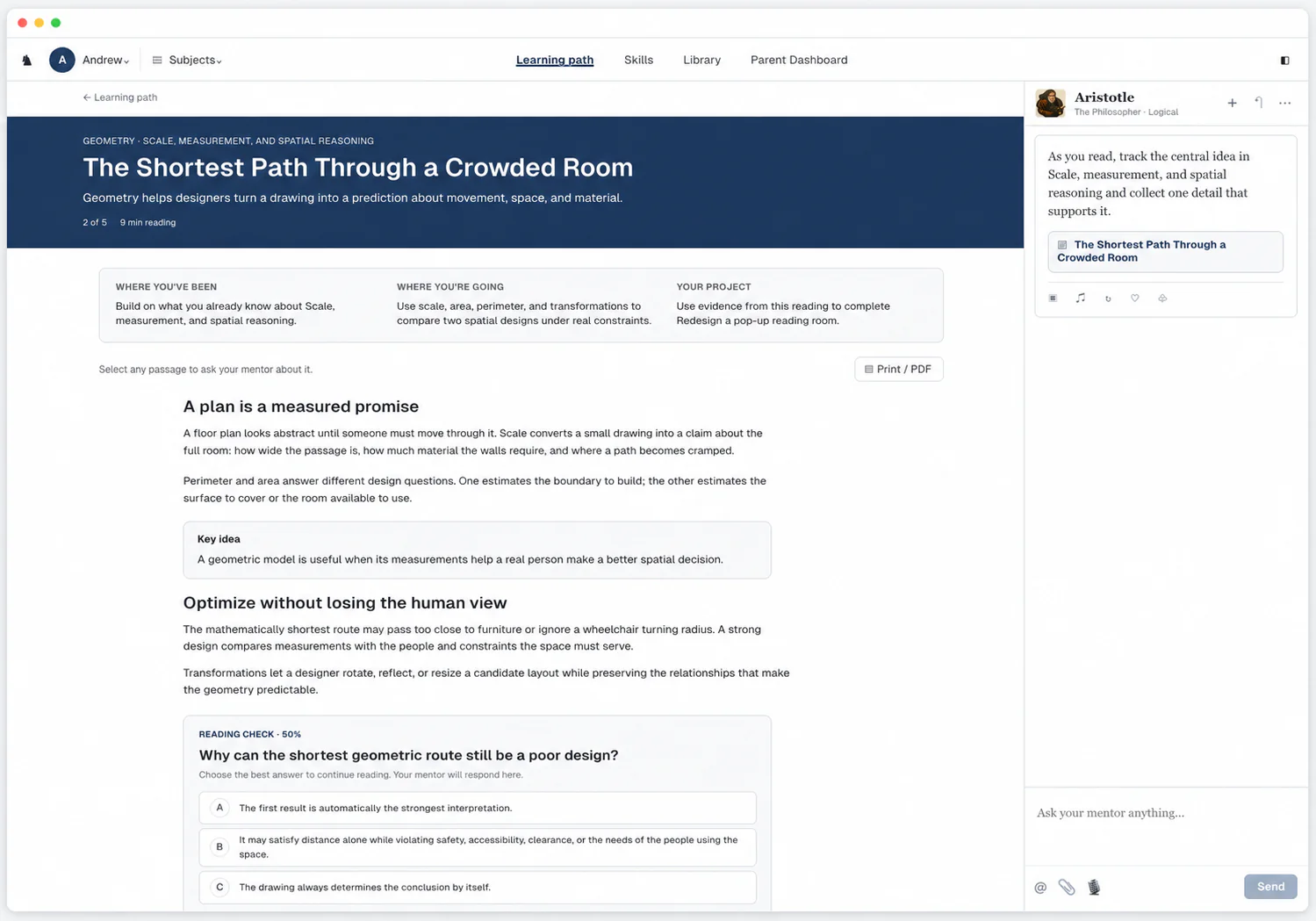
Geometry helps designers turn a drawing into a prediction about movement, space, and material.
- Lesson
- The Shortest Path Through a Crowded Room
- Goal
- Use scale, area, perimeter, and transformations to compare two spatial designs under real constraints.
How a lesson works
A 9-minute reading
This example lesson comes from the unit on scale, measurement, and spatial reasoning. It moves from “A plan is a measured promise” to “Optimize without losing the human view” and builds to one idea: a geometric model is useful when its measurements help a real person make a better spatial decision.
Help inside the reading
If a proof gets stuck, our Always-On Mentor can ask what the diagram shows and which step still needs a reason. Your child can also highlight any line of “The Shortest Path Through a Crowded Room” to ask about it or ask for a visual, and the mentor offers help on its own when they seem stuck.
A check halfway through
Your child answers “Why can the shortest geometric route still be a poor design?” before reading on, and the Reading Check at the end asks new questions.
A project your child hands in
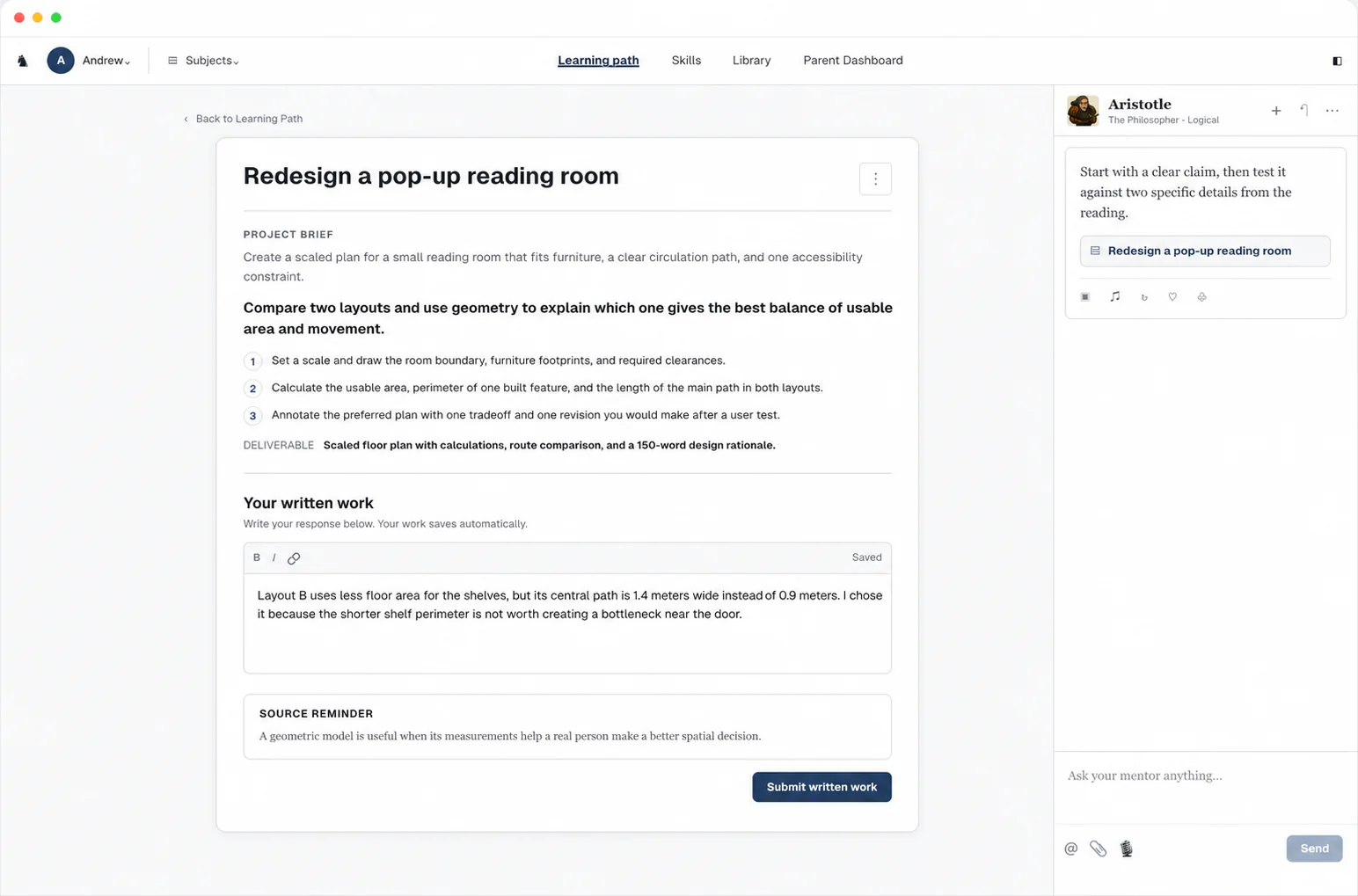
Create a scaled plan for a small reading room that fits furniture, a clear circulation path, and one accessibility constraint.
- Task
- Compare two layouts and use geometry to explain which one gives the best balance of usable area and movement
- Hand in
- Scaled floor plan with calculations, route comparison, and a 150-word design rationale
Your parent dashboard
- Today
- Each subject's lesson, and whether it's done
- Grades
- Every submission graded instantly, with written feedback, so you never grade
- Records
- Attendance log and learning summary, ready to export

Units and skills by grade
Grades 3 to 5 each have their own geometry units. From grade 6 through grade 12, geometry is one full course: the same 7 units at every grade. Each grade adds a few skills of its own, and your child's grade sets how deep each unit goes.
Grade 33 units · 9 skills
Quadrilateral categories, area models, perimeter strategies3 skills
- Quadrilateral Categories
- Area Models
- Perimeter Strategies
Fraction partitions, right angles, parallel and perpendicular lines3 skills
- Fraction Partitions
- Right Angles
- Parallel and Perpendicular Lines
Coordinate grid foundations, scaled drawings preview3 skills
- Coordinate Grid Foundations
- Scaled Drawings Preview
- Shape Classification Project
Grade 43 units · 9 skills
Angle measurement, lines and rays, parallel and perpendicular lines3 skills
- Angle Measurement
- Lines and Rays
- Parallel and Perpendicular Lines
Triangles by angles, symmetry lines, area and perimeter formulas3 skills
- Triangles by Angles
- Symmetry Lines
- Area and Perimeter Formulas
Coordinate plane patterns, composite figures, geometry design project3 skills
- Coordinate Plane Patterns
- Composite Figures
- Geometry Design Project
Grade 53 units · 9 skills
Coordinate plane geometry, volume of prisms3 skills
- Coordinate Plane Geometry
- Volume of Prisms
- Classify Triangles and Quadrilaterals
Properties of polygons, scale and measurement, nets and surface area preview3 skills
- Properties of Polygons
- Scale and Measurement
- Nets and Surface Area Preview
Graph geometric patterns, angle relationships preview, solid figure project3 skills
- Graph Geometric Patterns
- Angle Relationships Preview
- Solid Figure Project
Grades 6 to 127 units · 63 skills
Angles and lines8 skills
- Identify vertical angle pairs
- Use corresponding angles with parallel lines
- Solve for an angle using a transversal
- Classify triangle angles from side information
- Use alternate interior angles
- Use same-side interior angles
- Write an equation from angle relationships
- Measure angles with a protractor
Congruence10 skills
- Use SSS congruence
- Use SAS congruence
- Use ASA or AAS congruence
- Map a figure by rigid transformations
- Write a congruence proof with ordered reasons
- Use HL congruence
- Identify corresponding parts after congruence
- Complete a flow proof
- Describe rotations, reflections, and translations
- Represent transformations with matrices
Similarity9 skills
- Use AA similarity
- Solve a proportion from similar triangles
- Apply the triangle proportionality theorem
- Use scale factor to compare perimeter and area
- Use similar triangles to find height
- Identify dilation center and scale factor
- Prove triangles similar with SAS similarity
- Solve scale drawing problems
- Use trigonometric ratios in similar triangles
Right triangles9 skills
- Use the Pythagorean theorem
- Use the converse of the Pythagorean theorem
- Find a missing side with a special right triangle
- Use sine to find a side length
- Use cosine to find an angle measure
- Use inverse sine to find an angle
- Use inverse cosine to find an angle
- Solve an application with angle of elevation
- Use Pythagorean theorem in coordinate distance
Circles9 skills
- Find arc measure from a central angle
- Use an inscribed angle theorem
- Find tangent length from a common external point
- Write a circle equation from center and radius
- Find sector area
- Find arc length
- Use chord relationships
- Use circle theorems in a proof
- Derive circle equation from completing the square
Coordinate geometry11 skills
- Find slope between two points
- Use distance formula
- Use midpoint formula
- Classify a quadrilateral from coordinate evidence
- Write the equation of a parallel line
- Write the equation of a perpendicular line
- Find polygon area from coordinates
- Plot points in all four quadrants
- Prove a theorem using coordinates
- Use vectors for transformations
- Use parametric equations for geometric paths
Constructions and measurement7 skills
- Construct a perpendicular bisector
- Construct an angle bisector
- Construct a parallel line through a point
- Use a compass construction to copy an angle
- Construct an equilateral triangle
- Construct a perpendicular through a point
- Use construction steps to justify congruence
Questions parents ask
Which grades can use this Geometry curriculum?
- Grades 3 to 12. The skill trees on this page show the units and skills by grade. Placement checks your child's current skills, so the first lesson can sit before or after their grade.
What should my child know before starting?
- Starting skills include basic understanding of angles and shapes, comfort with rulers and protractors, and multiplication and division fluency. If placement finds a gap, the course starts with those skills.
How much of the teaching do I do?
- None of it. The course explains each new idea and checks how your child uses it, while the mentor answers questions as they work. Every submission is graded as soon as it comes in, so you never grade it yourself.
Can I use the record for high-school planning?
- Yes. The subject record holds every graded assignment with its written feedback, ready to export. We generate a transcript from the course records, ready for you to sign.
Geometry, taught around your child
Spatial reasoning your learner can use, explain, and defend.
$49/month after the trial.