4th grade homeschool curriculum
A full curriculum, starting at your child's level, with lessons connected to their interests and progress you can see.
See the work in 4th grade
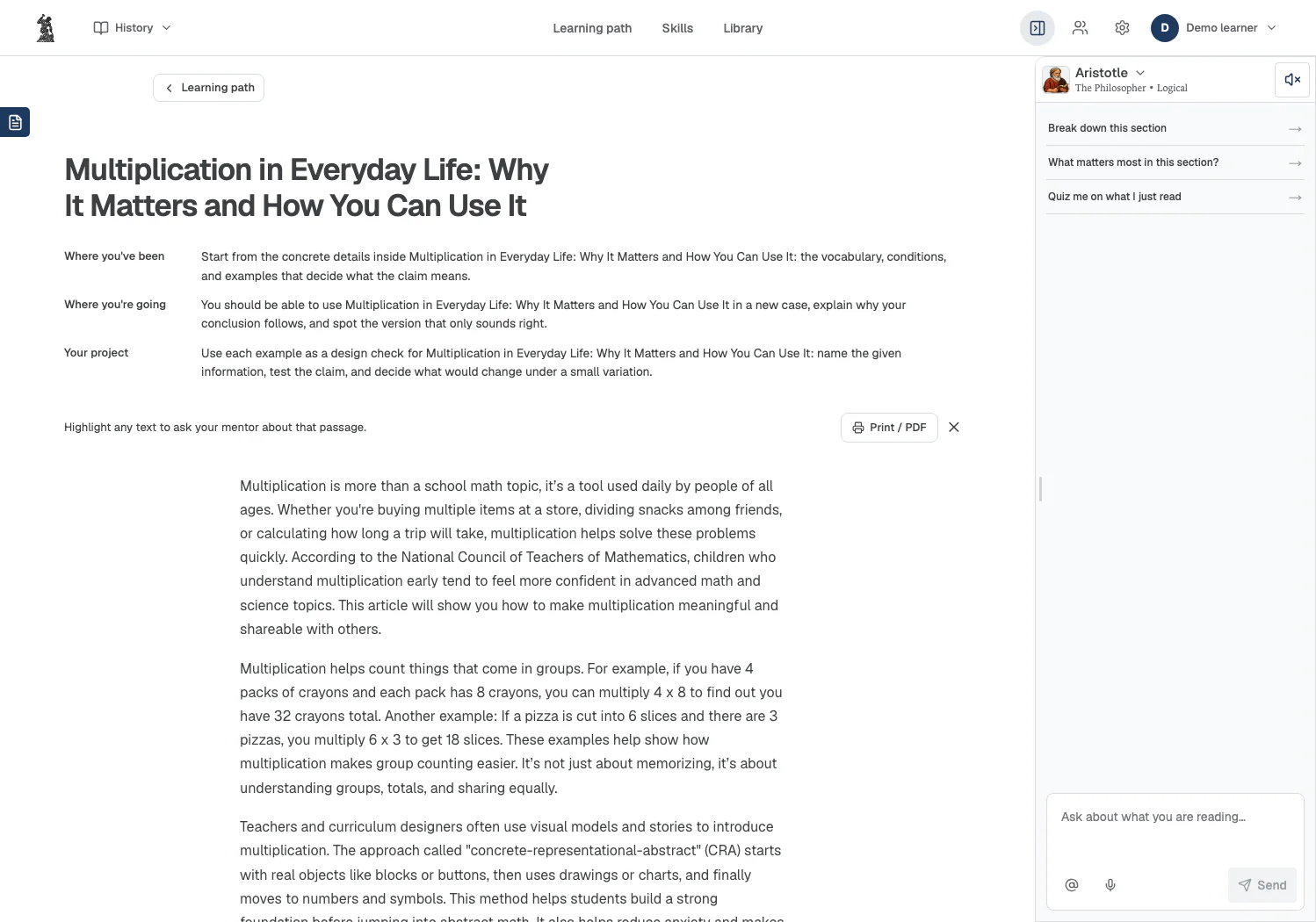
Your child reads how equal groups, like packs of crayons and slices of pizza, become multiplication.
- Lesson
- Multiplication in Everyday Life
- Goal
- Use multiplication in a new case and explain why the answer follows
- Project
- Test each example: name what is given and what changes
Your parent dashboard
- Today
- Each subject's lesson, and whether it's done
- Grades
- Every submission graded instantly, with written feedback, so you never grade
- Records
- Attendance log and learning summary, ready to export
- Documents
- Transcripts and state-aware compliance drafts, written for you and ready to sign

4th grade scope and sequence
Math7 units · 41 skills
Place value to 1,000,0006 skills
- Interpret the value of each place to the millions
- Write a number to 1,000,000 in expanded notation
- Compare two whole numbers to 1,000,000
- Round a whole number to a given place value
- Represent a decimal to the tenths with a model
- Represent a decimal to the hundredths with a model
Decimals5 skills
- Relate a decimal to the hundredths to its fraction
- Locate a decimal on a number line
- Compare two decimals to the hundredths
- Add two decimals to the hundredths
- Subtract two decimals to the hundredths
Multiplication and division6 skills
- Multiply a four-digit number by a one-digit number
- Multiply a two-digit number by a two-digit number
- Divide a four-digit number by a one-digit number
- Interpret a remainder in a division situation
- Estimate a product to check reasonableness
- Use the distributive property to multiply
Fraction operations6 skills
- Add fractions with equal denominators
- Subtract fractions with equal denominators
- Decompose a fraction into a sum of fractions
- Find an equivalent fraction using multiplication
- Compare two fractions with unlike denominators using benchmarks
- Relate a fraction greater than one to a mixed number
Geometry and angles6 skills
- Identify points, lines, rays, and line segments
- Identify parallel and perpendicular lines
- Classify a triangle by its angles
- Measure an angle with a protractor
- Draw an angle of a given measure
- Find an unknown angle in a decomposed figure
Measurement5 skills
- Use the perimeter formula for a rectangle
- Use the area formula for a rectangle
- Convert measurements within the customary system
- Convert measurements within the metric system
- Solve an elapsed time problem
Data and financial literacy7 skills
- Represent data on a frequency table
- Represent data on a dot plot
- Represent data on a stem-and-leaf plot
- Solve a one-step problem from a data representation
- Distinguish a fixed expense from a variable expense
- Calculate profit in a simple situation
- Describe how income is earned through work
Reading6 units · 27 skills
Comprehension and connection5 skills
- Summarize a text without adding personal opinion
- Make an inference and support it with text evidence
- Monitor comprehension and use a fix-up strategy
- Combine information from two sections of a text
- Explain how a text confirmed or changed your thinking
Analyzing fiction5 skills
- Explain how a character changes across a story
- Analyze the conflict and its resolution
- Explain how the setting influences a character's choice
- Determine a theme and support it with evidence
- Compare two characters in the same story
Analyzing informational text5 skills
- Determine the central idea and supporting evidence
- Identify a text structure such as cause and effect
- Explain how an author organized a section
- Distinguish a fact from an opinion in a text
- Use text features to locate specific information
Author's craft4 skills
- Explain the author's purpose for writing
- Identify figurative language and explain its effect
- Explain how word choice shapes meaning
- Identify the point of view of a narrator
Vocabulary development4 skills
- Use context to determine a word's meaning
- Use Greek and Latin roots to infer meaning
- Distinguish shades of meaning between similar words
- Use a dictionary entry to choose the right meaning
Comparing texts4 skills
- Compare two texts on the same topic
- Compare a print account with a visual account
- Explain which text answered a question better
- Combine evidence from two texts in one answer
Writing and language6 units · 27 skills
Planning and drafting5 skills
- Choose a genre that fits a purpose
- Plan writing with an organizational structure
- Draft an introduction that engages a reader
- Draft a conclusion that follows from the body
- Maintain focus on one controlling idea
Narrative craft4 skills
- Develop a character through action and dialogue
- Establish a setting that matters to the plot
- Use dialogue punctuation correctly in a narrative
- Build a narrative to a clear turning point
Informational writing5 skills
- Write a thesis-like controlling idea
- Organize a text with headings and sections
- Support an idea with a fact and an explanation
- Use a transition between two sections
- Write a conclusion that summarizes the idea
Argument writing4 skills
- State a position on a debatable question
- Support a position with two reasons
- Provide evidence for each reason
- Address an opposing view briefly
Revision and editing4 skills
- Revise for organization by moving a paragraph
- Revise for clarity by rewriting a confusing sentence
- Edit for subject-verb agreement
- Edit for punctuation in compound sentences
Research and presentation5 skills
- Narrow a broad topic into a research question
- Evaluate whether a source is relevant
- Take notes in your own words
- Give credit to a source
- Present findings with a visual aid
Science7 units · 34 skills
Investigation and evidence5 skills
- Plan a fair test that changes one variable
- Identify the variable being tested in an investigation
- Construct a bar graph from collected data
- Draw a conclusion supported by collected data
- Explain why two groups reached different results
Properties of matter5 skills
- Classify matter by its measurable physical properties
- Test whether a material conducts thermal energy
- Test whether a material conducts electricity
- Separate a mixture using a physical property
- Compare a mixture with a solution
Energy and circuits5 skills
- Identify a form of energy in an everyday system
- Trace an energy change from one form to another
- Build a complete electrical circuit
- Predict whether a circuit will light a bulb
- Compare an insulator with a conductor in a circuit
Forces and magnetism4 skills
- Measure a force with a spring scale
- Compare the effect of two different forces on motion
- Predict the interaction of two magnetic poles
- Explain how friction slows a moving object
Changing Earth5 skills
- Explain how weathering breaks down rock
- Explain how erosion moves earth materials
- Explain how deposition builds new landforms
- Classify a natural resource as renewable or nonrenewable
- Explain how the water cycle moves water through Earth's systems
Earth, sun, and moon4 skills
- Explain day and night using Earth's rotation
- Explain the year using Earth's orbit
- Model the phases of the Moon
- Compare the Sun, Earth, and Moon by size and motion
Life cycles and ecosystems6 skills
- Compare complete and incomplete metamorphosis
- Match a plant structure to its role in survival
- Trace energy through a food web
- Explain how an adaptation helps an organism survive
- Predict the effect of removing one organism from an ecosystem
- Compare two ecosystems by their living and nonliving parts
History6 units · 26 skills
First peoples of North America5 skills
- Describe how Northwest Coast nations used their environment
- Describe how Great Plains nations used their environment
- Describe how Eastern Woodlands nations used their environment
- Compare two American Indian nations from different regions
- Explain how trade connected American Indian nations
Exploration and encounter5 skills
- Explain why European nations sent explorers across the Atlantic
- Describe the first voyage of Christopher Columbus and its effects
- Compare the routes of two European explorers
- Explain what the Columbian Exchange moved between continents
- Explain how contact with Europeans changed American Indian life
First European settlements4 skills
- Describe the founding of St. Augustine
- Explain why the Jamestown settlement struggled
- Explain why the Pilgrims settled at Plymouth
- Compare Spanish, French, and English settlements
Geography shapes history4 skills
- Explain how rivers shaped where early settlements grew
- Explain how the Appalachian Mountains limited early settlement
- Explain how a natural resource drew settlers to a region
- Explain why harbors became trading centers
From territory to state4 skills
- Explain how a territory became a state
- Explain why the United States added states over time
- Sequence the addition of states on a timeline
- Explain how a new state chose its capital
Using historical evidence4 skills
- Use a primary source to describe life in early North America
- Interpret a historical map of exploration routes
- Sequence exploration and settlement events on a timeline
- Compare two accounts of the same encounter
FAQ
- What happens when my child is stuck in a lesson?
- Your child highlights the confusing line and asks the Always-On Mentor about exactly that passage, whether it is a long-division step or a word in a history source. It can draw the idea on its board, and after a missed answer it can explain it another way. During a reading check it still answers clarifying questions, without giving the answer away.
- How much time does school take each day?
- There is no fixed daily length. Each lesson shows its estimated time, and our Parent Dashboard adds up the day, so you can see the hours against your state's instruction-time rules.
- My 4th grader's work looks fine but tests go badly. Why?
- Practice can lean on a worked example, while a test asks for independent recall. The Parent Dashboard shows which skills hold up on their own and which need more practice.
- How much should a 4th grader do on their own?
- Most of the practice and some of the planning. Your child opens the next lesson and works through it without waiting for you. The mentor is beside the work for questions along the way.
Build 4th grade around your child
Start with the 4th grade skills your child needs next, with room to move ahead in one subject and review in another.
Start your 14-day free trial
$149/month per child after the trial.