Medicine & Health Sciences for your homeschool
Your teen studies biology and medical research through educational cases, weighing evidence, uncertainty, and ethical questions.
A lesson built around your child
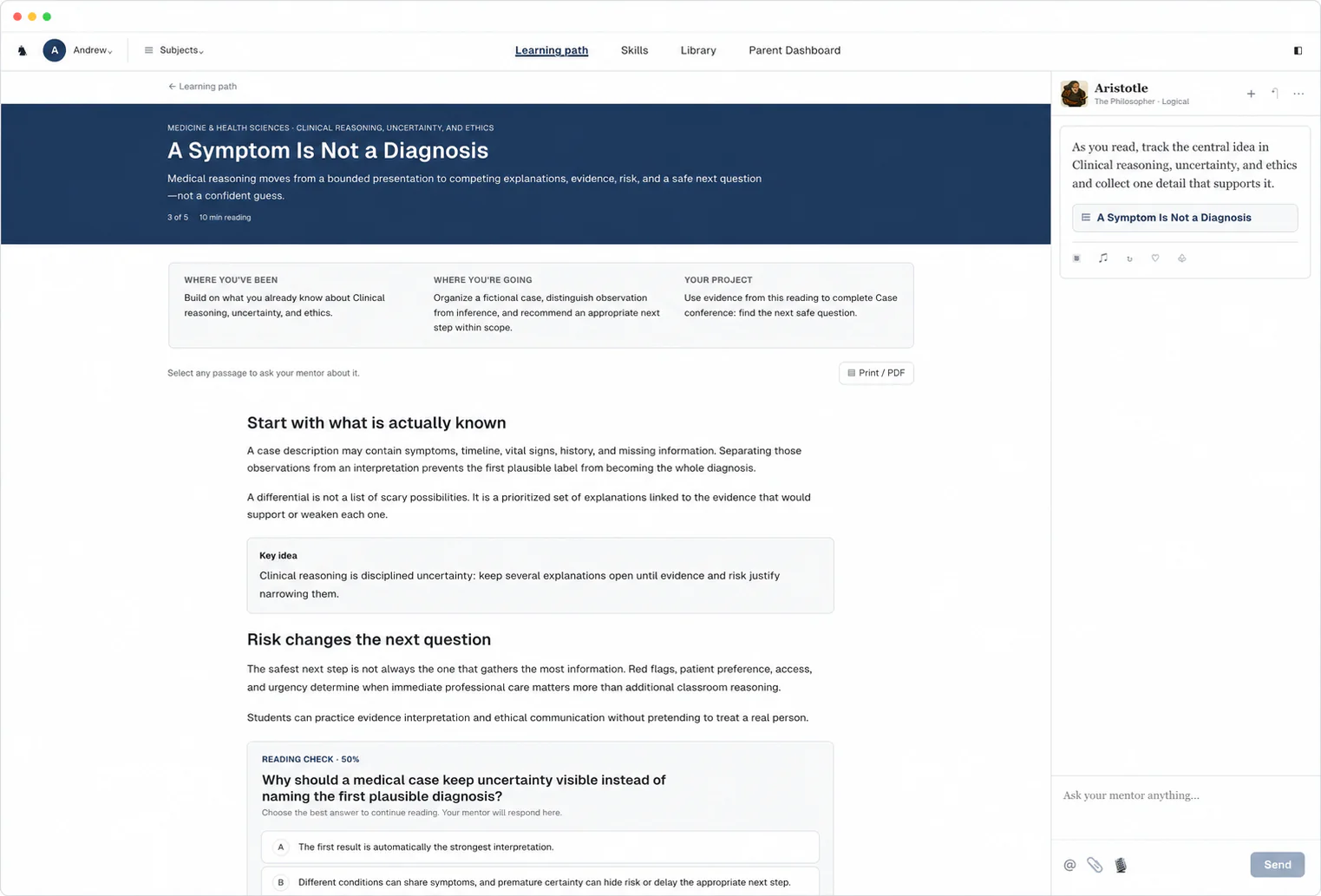
Medical reasoning moves from a bounded presentation to competing explanations, evidence, risk, and a safe next question, not a confident guess.
- Lesson
- A Symptom Is Not a Diagnosis
- Goal
- Organize a fictional case, distinguish observation from inference, and recommend an appropriate next step within scope.
How a lesson works
A 10-minute reading
This example lesson comes from the unit on clinical reasoning, uncertainty, and ethics. It moves from “Start with what is actually known” to “Risk changes the next question” and builds to one idea: clinical reasoning is disciplined uncertainty: keep several explanations open until evidence and risk justify narrowing them.
Help inside the reading
When a medical case has two possible explanations, our Always-On Mentor can help your teen compare evidence and uncertainty. The course does not train students to diagnose or treat patients. Your child can also highlight any line of “A Symptom Is Not a Diagnosis” to ask about it or ask for a visual, and the mentor offers help on its own when they seem stuck.
A check halfway through
Your child answers “Why should a medical case keep uncertainty visible instead of naming the first plausible diagnosis?” before reading on, and the Reading Check at the end asks new questions.
A project your child hands in
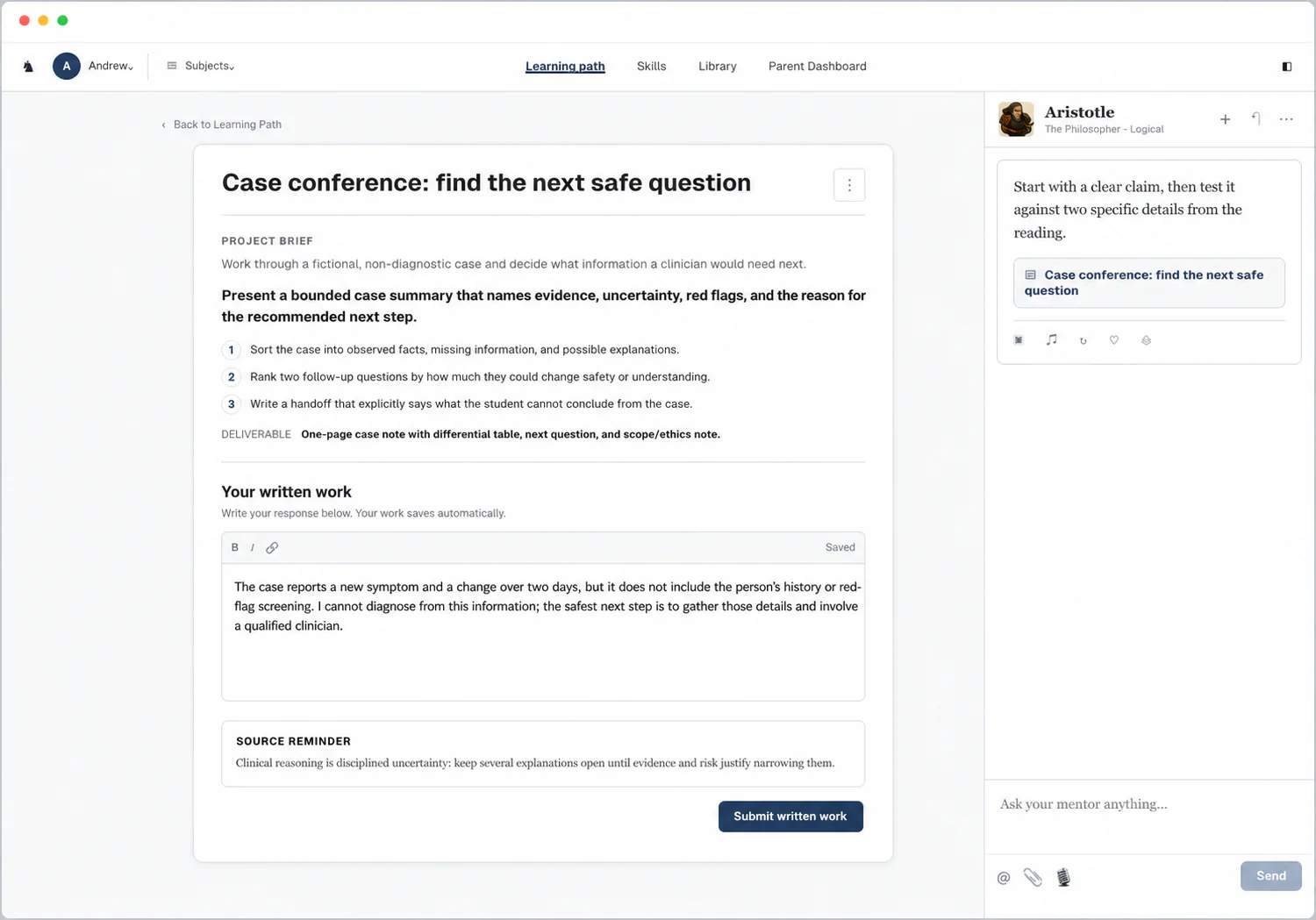
Work through a fictional, non-diagnostic case and decide what information a clinician would need next.
- Task
- Present a bounded case summary that names evidence, uncertainty, red flags, and the reason for the recommended next step
- Hand in
- One-page case note with differential table, next question, and scope/ethics note
Your parent dashboard
- Today
- Each subject's lesson, and whether it's done
- Grades
- Every submission graded instantly, with written feedback, so you never grade
- Records
- Attendance log and learning summary, ready to export

Units and skills
Builds health science literacy while avoiding diagnosis or treatment advice. The goal is safe reasoning, evidence, empathy, and systems awareness. Medicine & Health Sciences is one skill tree for every grade with 12 units, from human anatomy and body organization to clinical reasoning capstone, and your child's grade sets how deep each unit goes.
Medicine & Health Sciences12 units · 60 skills
Human anatomy and body organization5 skills
- Define the vocabulary, boundaries, and common misconceptions of Human anatomy and body organization
- Explain the main actors, mechanisms, sequence, and constraints in Human anatomy and body organization
- Interpret evidence, data, cases, or examples connected to Human anatomy and body organization
- Apply Human anatomy and body organization to a realistic patient, public-health, or physiology scenario
- Create a clinical reasoning note that justifies decisions about Human anatomy and body organization
Cell physiology and homeostasis5 skills
- Define the vocabulary, boundaries, and common misconceptions of Cell physiology and homeostasis
- Explain the main actors, mechanisms, sequence, and constraints in Cell physiology and homeostasis
- Interpret evidence, data, cases, or examples connected to Cell physiology and homeostasis
- Apply Cell physiology and homeostasis to a realistic patient, public-health, or physiology scenario
- Create a clinical reasoning note that justifies decisions about Cell physiology and homeostasis
Cardiovascular and respiratory systems5 skills
- Define the vocabulary, boundaries, and common misconceptions of Cardiovascular and respiratory systems
- Explain the main actors, mechanisms, sequence, and constraints in Cardiovascular and respiratory systems
- Interpret evidence, data, cases, or examples connected to Cardiovascular and respiratory systems
- Apply Cardiovascular and respiratory systems to a realistic patient, public-health, or physiology scenario
- Create a clinical reasoning note that justifies decisions about Cardiovascular and respiratory systems
Nervous, endocrine, and sensory systems5 skills
- Define the vocabulary, boundaries, and common misconceptions of Nervous, endocrine, and sensory systems
- Explain the main actors, mechanisms, sequence, and constraints in Nervous, endocrine, and sensory systems
- Interpret evidence, data, cases, or examples connected to Nervous, endocrine, and sensory systems
- Apply Nervous, endocrine, and sensory systems to a realistic patient, public-health, or physiology scenario
- Create a clinical reasoning note that justifies decisions about Nervous, endocrine, and sensory systems
Immune system, infection, and vaccines5 skills
- Define the vocabulary, boundaries, and common misconceptions of Immune system, infection, and vaccines
- Explain the main actors, mechanisms, sequence, and constraints in Immune system, infection, and vaccines
- Interpret evidence, data, cases, or examples connected to Immune system, infection, and vaccines
- Apply Immune system, infection, and vaccines to a realistic patient, public-health, or physiology scenario
- Create a clinical reasoning note that justifies decisions about Immune system, infection, and vaccines
Genetics, metabolism, and nutrition5 skills
- Define the vocabulary, boundaries, and common misconceptions of Genetics, metabolism, and nutrition
- Explain the main actors, mechanisms, sequence, and constraints in Genetics, metabolism, and nutrition
- Interpret evidence, data, cases, or examples connected to Genetics, metabolism, and nutrition
- Apply Genetics, metabolism, and nutrition to a realistic patient, public-health, or physiology scenario
- Create a clinical reasoning note that justifies decisions about Genetics, metabolism, and nutrition
Clinical history and physical examination5 skills
- Define the vocabulary, boundaries, and common misconceptions of Clinical history and physical examination
- Explain the main actors, mechanisms, sequence, and constraints in Clinical history and physical examination
- Interpret evidence, data, cases, or examples connected to Clinical history and physical examination
- Apply Clinical history and physical examination to a realistic patient, public-health, or physiology scenario
- Create a clinical reasoning note that justifies decisions about Clinical history and physical examination
Diagnostics, probability, and evidence5 skills
- Define the vocabulary, boundaries, and common misconceptions of Diagnostics, probability, and evidence
- Explain the main actors, mechanisms, sequence, and constraints in Diagnostics, probability, and evidence
- Interpret evidence, data, cases, or examples connected to Diagnostics, probability, and evidence
- Apply Diagnostics, probability, and evidence to a realistic patient, public-health, or physiology scenario
- Create a clinical reasoning note that justifies decisions about Diagnostics, probability, and evidence
Pharmacology, dosing, and side effects5 skills
- Define the vocabulary, boundaries, and common misconceptions of Pharmacology, dosing, and side effects
- Explain the main actors, mechanisms, sequence, and constraints in Pharmacology, dosing, and side effects
- Interpret evidence, data, cases, or examples connected to Pharmacology, dosing, and side effects
- Apply Pharmacology, dosing, and side effects to a realistic patient, public-health, or physiology scenario
- Create a clinical reasoning note that justifies decisions about Pharmacology, dosing, and side effects
Public health and epidemiology5 skills
- Define the vocabulary, boundaries, and common misconceptions of Public health and epidemiology
- Explain the main actors, mechanisms, sequence, and constraints in Public health and epidemiology
- Interpret evidence, data, cases, or examples connected to Public health and epidemiology
- Apply Public health and epidemiology to a realistic patient, public-health, or physiology scenario
- Create a clinical reasoning note that justifies decisions about Public health and epidemiology
Medical ethics and patient communication5 skills
- Define the vocabulary, boundaries, and common misconceptions of Medical ethics and patient communication
- Explain the main actors, mechanisms, sequence, and constraints in Medical ethics and patient communication
- Interpret evidence, data, cases, or examples connected to Medical ethics and patient communication
- Apply Medical ethics and patient communication to a realistic patient, public-health, or physiology scenario
- Create a clinical reasoning note that justifies decisions about Medical ethics and patient communication
Clinical reasoning capstone5 skills
- Define the vocabulary, boundaries, and common misconceptions of Clinical reasoning capstone
- Explain the main actors, mechanisms, sequence, and constraints in Clinical reasoning capstone
- Interpret evidence, data, cases, or examples connected to Clinical reasoning capstone
- Apply Clinical reasoning capstone to a realistic patient, public-health, or physiology scenario
- Create a clinical reasoning note that justifies decisions about Clinical reasoning capstone
Questions parents ask
Which grades can use this Medicine & Health Sciences curriculum?
- One Medicine & Health Sciences skill tree serves grades 3 to 12, with course pages for 9th grade and high school. Placement checks your child's current skills, so the first lesson can sit before or after their grade.
What should my child know before starting?
- Starting skills include interest in health and medicine, basic biology helpful, and curiosity about how bodies work. If placement finds a gap, the course starts with those skills.
How much of the teaching do I do?
- None of it. The course explains each new idea and checks how your child uses it, while the mentor answers questions as they work. Every submission is graded as soon as it comes in, so you never grade it yourself.
Can I use the record for high-school planning?
- Yes. The subject record holds every graded assignment with its written feedback, ready to export. We generate a transcript from the course records, ready for you to sign.
Medicine & Health Sciences, taught around your child
Serious health-science preparation without pretending a simulation is clinical training.
$49/month after the trial.