Law & Legal Studies for your homeschool
Your teen studies a case, supports a position with legal sources, and responds to the strongest argument against it.
A lesson built around your child
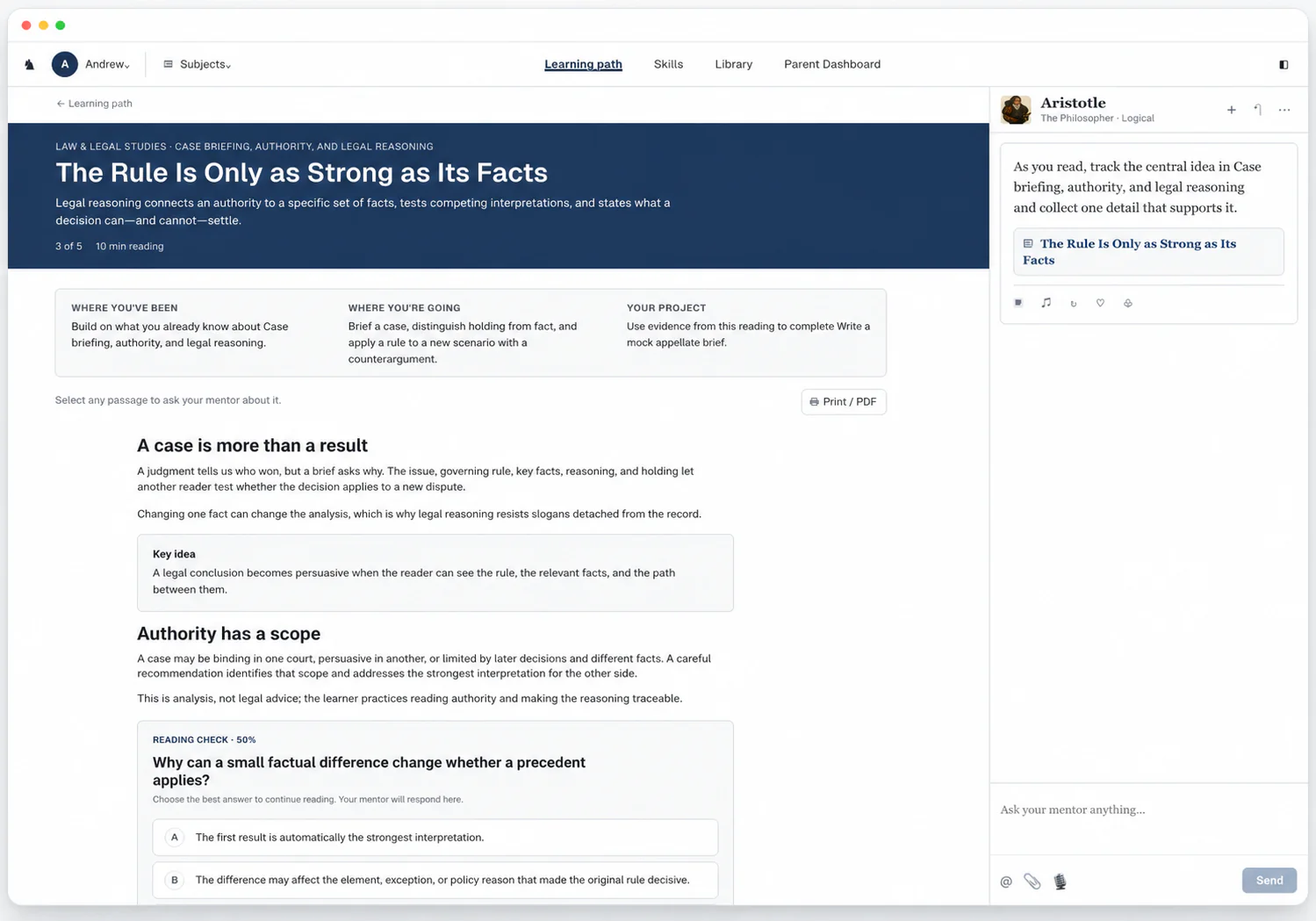
Legal reasoning connects an authority to a specific set of facts, tests competing interpretations, and states what a decision can and cannot settle.
- Lesson
- The Rule Is Only as Strong as Its Facts
- Goal
- Brief a case, distinguish holding from fact, and apply a rule to a new scenario with a counterargument.
How a lesson works
A 10-minute reading
This example lesson comes from the unit on case briefing, authority, and legal reasoning. It moves from “A case is more than a result” to “Authority has a scope” and builds to one idea: a legal conclusion becomes persuasive when the reader can see the rule, the relevant facts, and the path between them.
Help inside the reading
If a case argument skips a fact or legal source, our Always-On Mentor can ask your teen to check it and answer the strongest counterargument. This is course work, not legal advice. Your child can also highlight any line of “The Rule Is Only as Strong as Its Facts” to ask about it or ask for a visual, and the mentor offers help on its own when they seem stuck.
A check halfway through
Your child answers “Why can a small factual difference change whether a precedent applies?” before reading on, and the Reading Check at the end asks new questions.
A project your child hands in
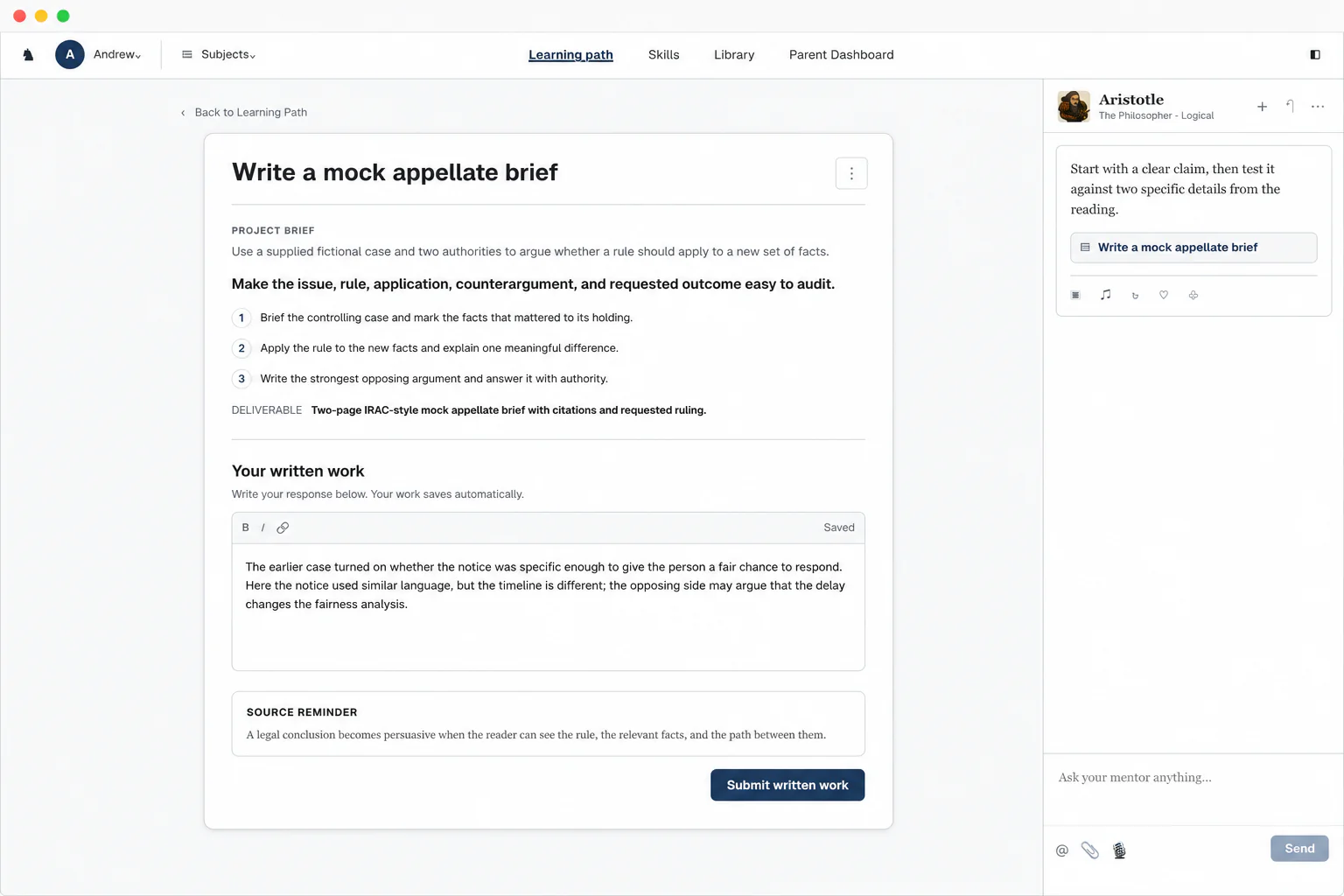
Use a supplied fictional case and two authorities to argue whether a rule should apply to a new set of facts.
- Task
- Make the issue, rule, application, counterargument, and requested outcome easy to audit
- Hand in
- Two-page IRAC-style mock appellate brief with citations and requested ruling
Your parent dashboard
- Today
- Each subject's lesson, and whether it's done
- Grades
- Every submission graded instantly, with written feedback, so you never grade
- Records
- Attendance log and learning summary, ready to export

Units and skills
Introduces legal literacy through reasoning from facts, rules, evidence, and competing interpretations. Law & Legal Studies is one skill tree for every grade with 12 units, from legal systems and sources of law to case brief and argument capstone, and your child's grade sets how deep each unit goes.
Law & Legal Studies12 units · 60 skills
Legal systems and sources of law5 skills
- Define the vocabulary, boundaries, and common misconceptions of Legal systems and sources of law
- Explain the main actors, mechanisms, sequence, and constraints in Legal systems and sources of law
- Interpret evidence, data, cases, or examples connected to Legal systems and sources of law
- Apply Legal systems and sources of law to a realistic legal dispute or policy problem
- Create a case brief or argument memo that justifies decisions about Legal systems and sources of law
Constitutional structure and judicial review5 skills
- Define the vocabulary, boundaries, and common misconceptions of Constitutional structure and judicial review
- Explain the main actors, mechanisms, sequence, and constraints in Constitutional structure and judicial review
- Interpret evidence, data, cases, or examples connected to Constitutional structure and judicial review
- Apply Constitutional structure and judicial review to a realistic legal dispute or policy problem
- Create a case brief or argument memo that justifies decisions about Constitutional structure and judicial review
Civil liberties and equal protection5 skills
- Define the vocabulary, boundaries, and common misconceptions of Civil liberties and equal protection
- Explain the main actors, mechanisms, sequence, and constraints in Civil liberties and equal protection
- Interpret evidence, data, cases, or examples connected to Civil liberties and equal protection
- Apply Civil liberties and equal protection to a realistic legal dispute or policy problem
- Create a case brief or argument memo that justifies decisions about Civil liberties and equal protection
Criminal law and procedure5 skills
- Define the vocabulary, boundaries, and common misconceptions of Criminal law and procedure
- Explain the main actors, mechanisms, sequence, and constraints in Criminal law and procedure
- Interpret evidence, data, cases, or examples connected to Criminal law and procedure
- Apply Criminal law and procedure to a realistic legal dispute or policy problem
- Create a case brief or argument memo that justifies decisions about Criminal law and procedure
Torts, negligence, and liability5 skills
- Define the vocabulary, boundaries, and common misconceptions of Torts, negligence, and liability
- Explain the main actors, mechanisms, sequence, and constraints in Torts, negligence, and liability
- Interpret evidence, data, cases, or examples connected to Torts, negligence, and liability
- Apply Torts, negligence, and liability to a realistic legal dispute or policy problem
- Create a case brief or argument memo that justifies decisions about Torts, negligence, and liability
Contracts and commercial obligations5 skills
- Define the vocabulary, boundaries, and common misconceptions of Contracts and commercial obligations
- Explain the main actors, mechanisms, sequence, and constraints in Contracts and commercial obligations
- Interpret evidence, data, cases, or examples connected to Contracts and commercial obligations
- Apply Contracts and commercial obligations to a realistic legal dispute or policy problem
- Create a case brief or argument memo that justifies decisions about Contracts and commercial obligations
Property, land use, and intellectual property5 skills
- Define the vocabulary, boundaries, and common misconceptions of Property, land use, and intellectual property
- Explain the main actors, mechanisms, sequence, and constraints in Property, land use, and intellectual property
- Interpret evidence, data, cases, or examples connected to Property, land use, and intellectual property
- Apply Property, land use, and intellectual property to a realistic legal dispute or policy problem
- Create a case brief or argument memo that justifies decisions about Property, land use, and intellectual property
Administrative law and agencies5 skills
- Define the vocabulary, boundaries, and common misconceptions of Administrative law and agencies
- Explain the main actors, mechanisms, sequence, and constraints in Administrative law and agencies
- Interpret evidence, data, cases, or examples connected to Administrative law and agencies
- Apply Administrative law and agencies to a realistic legal dispute or policy problem
- Create a case brief or argument memo that justifies decisions about Administrative law and agencies
Evidence, precedent, and legal reasoning5 skills
- Define the vocabulary, boundaries, and common misconceptions of Evidence, precedent, and legal reasoning
- Explain the main actors, mechanisms, sequence, and constraints in Evidence, precedent, and legal reasoning
- Interpret evidence, data, cases, or examples connected to Evidence, precedent, and legal reasoning
- Apply Evidence, precedent, and legal reasoning to a realistic legal dispute or policy problem
- Create a case brief or argument memo that justifies decisions about Evidence, precedent, and legal reasoning
Statutory interpretation and policy5 skills
- Define the vocabulary, boundaries, and common misconceptions of Statutory interpretation and policy
- Explain the main actors, mechanisms, sequence, and constraints in Statutory interpretation and policy
- Interpret evidence, data, cases, or examples connected to Statutory interpretation and policy
- Apply Statutory interpretation and policy to a realistic legal dispute or policy problem
- Create a case brief or argument memo that justifies decisions about Statutory interpretation and policy
Legal ethics and access to justice5 skills
- Define the vocabulary, boundaries, and common misconceptions of Legal ethics and access to justice
- Explain the main actors, mechanisms, sequence, and constraints in Legal ethics and access to justice
- Interpret evidence, data, cases, or examples connected to Legal ethics and access to justice
- Apply Legal ethics and access to justice to a realistic legal dispute or policy problem
- Create a case brief or argument memo that justifies decisions about Legal ethics and access to justice
Case brief and argument capstone5 skills
- Define the vocabulary, boundaries, and common misconceptions of Case brief and argument capstone
- Explain the main actors, mechanisms, sequence, and constraints in Case brief and argument capstone
- Interpret evidence, data, cases, or examples connected to Case brief and argument capstone
- Apply Case brief and argument capstone to a realistic legal dispute or policy problem
- Create a case brief or argument memo that justifies decisions about Case brief and argument capstone
Questions parents ask
Which grades can use this Law & Legal Studies curriculum?
- One Law & Legal Studies skill tree serves grades 3 to 12, with course pages for 9th grade and high school. Placement checks your child's current skills, so the first lesson can sit before or after their grade.
What should my child know before starting?
- Starting skills include basic reading comprehension, interest in rules and fairness, and logical thinking willingness. If placement finds a gap, the course starts with those skills.
How much of the teaching do I do?
- None of it. The course explains each new idea and checks how your child uses it, while the mentor answers questions as they work. Every submission is graded as soon as it comes in, so you never grade it yourself.
Can I use the record for high-school planning?
- Yes. The subject record holds every graded assignment with its written feedback, ready to export. We generate a transcript from the course records, ready for you to sign.
Law & Legal Studies, taught around your child
Legal reasoning that is precise about facts, authority, argument, and limits.
$49/month after the trial.