ACT Prep built around the questions your child misses.
We turn missed questions into targeted practice, with lessons starting at your child's level and work graded the moment it is submitted, with written feedback.
A lesson built around your child
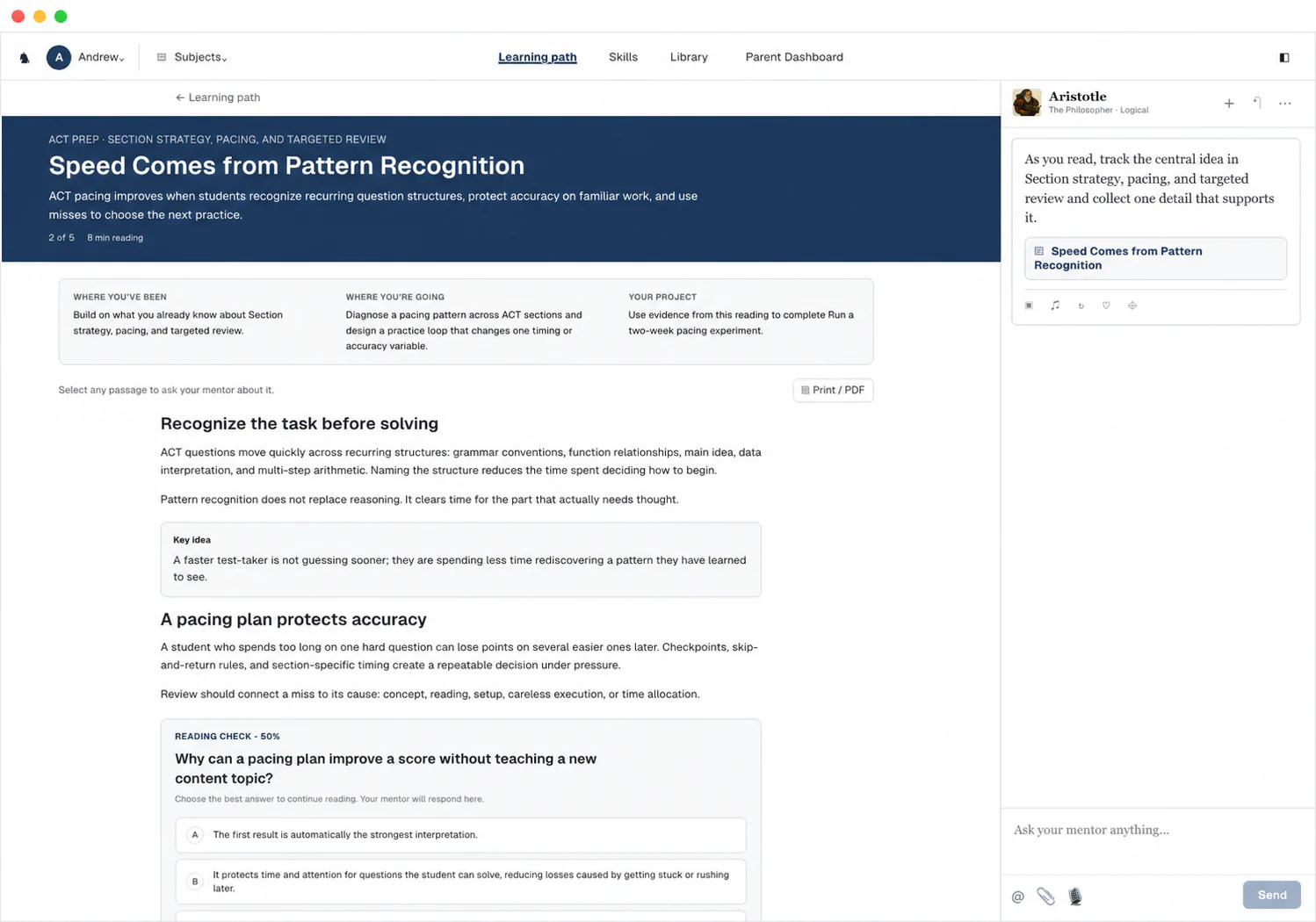
ACT pacing improves when students recognize recurring question structures, protect accuracy on familiar work, and use misses to choose the next practice.
- Lesson
- Speed Comes from Pattern Recognition
- Goal
- Diagnose a pacing pattern across ACT sections and design a practice loop that changes one timing or accuracy variable.
How a lesson works
An 8-minute reading
This example lesson comes from the unit on section strategy, pacing, and targeted review. It moves from “Recognize the task before solving” to “A pacing plan protects accuracy” and builds to one idea: a faster test-taker is not guessing sooner; they are spending less time rediscovering a pattern they have learned to see.
Help inside the reading
Our Always-On Mentor can help your teen work out whether a missed question came from a content gap, pacing, or test strategy, then practice that skill. Your child can also highlight any line of “Speed Comes from Pattern Recognition” to ask about it or ask for a visual, and the mentor offers help on its own when they seem stuck.
A check halfway through
Your child answers “Why can a pacing plan improve a score without teaching a new content topic?” before reading on, and the Reading Check at the end asks new questions.
A project your child hands in
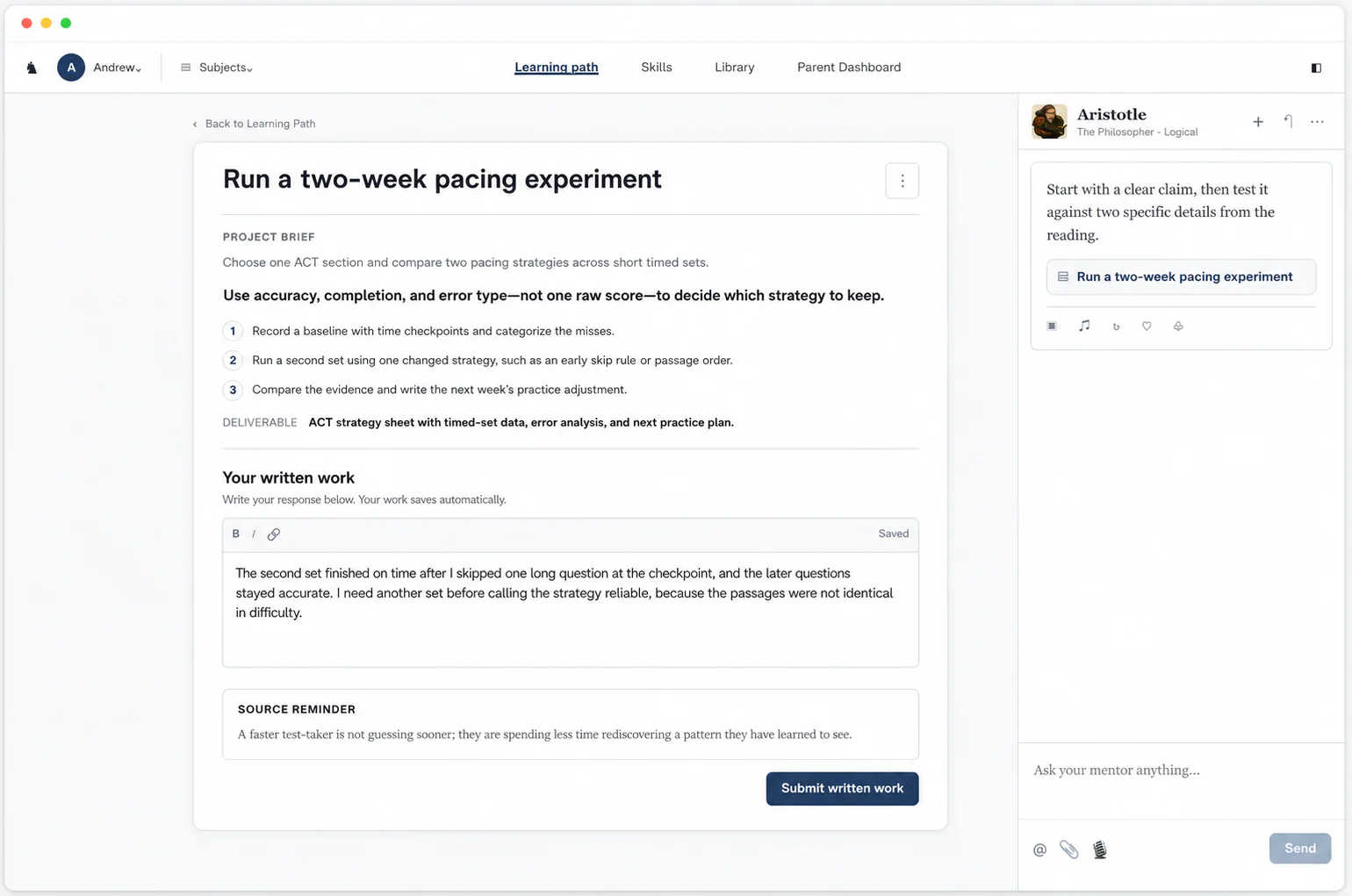
Choose one ACT section and compare two pacing strategies across short timed sets.
- Task
- Use accuracy, completion, and error type (not one raw score) to decide which strategy to keep
- Hand in
- ACT strategy sheet with timed-set data, error analysis, and next practice plan
Your parent dashboard
- Today
- Each subject's lesson, and whether it's done
- Grades
- Every submission graded instantly, with written feedback, so you never grade
- Records
- Attendance log and learning summary, ready to export

Units and skills
Focuses on ACT skill domains and test behaviors, alongside your child's math, reading, writing, and science courses. ACT Prep is one skill tree for every grade with 12 units, from ACT format and scoring strategy to timed full-section review and score planning, and your child's grade sets how deep each unit goes.
ACT Prep12 units · 60 skills
ACT format and scoring strategy5 skills
- Define the vocabulary, boundaries, and common misconceptions of ACT format and scoring strategy
- Explain the main actors, mechanisms, sequence, and constraints in ACT format and scoring strategy
- Interpret evidence, data, cases, or examples connected to ACT format and scoring strategy
- Apply ACT format and scoring strategy to a realistic timed ACT section
- Create a score-improvement plan that justifies decisions about ACT format and scoring strategy
English punctuation and mechanics5 skills
- Define the vocabulary, boundaries, and common misconceptions of English punctuation and mechanics
- Explain the main actors, mechanisms, sequence, and constraints in English punctuation and mechanics
- Interpret evidence, data, cases, or examples connected to English punctuation and mechanics
- Apply English punctuation and mechanics to a realistic timed ACT section
- Create a score-improvement plan that justifies decisions about English punctuation and mechanics
English grammar and sentence structure5 skills
- Define the vocabulary, boundaries, and common misconceptions of English grammar and sentence structure
- Explain the main actors, mechanisms, sequence, and constraints in English grammar and sentence structure
- Interpret evidence, data, cases, or examples connected to English grammar and sentence structure
- Apply English grammar and sentence structure to a realistic timed ACT section
- Create a score-improvement plan that justifies decisions about English grammar and sentence structure
Rhetorical skills and passage organization5 skills
- Define the vocabulary, boundaries, and common misconceptions of Rhetorical skills and passage organization
- Explain the main actors, mechanisms, sequence, and constraints in Rhetorical skills and passage organization
- Interpret evidence, data, cases, or examples connected to Rhetorical skills and passage organization
- Apply Rhetorical skills and passage organization to a realistic timed ACT section
- Create a score-improvement plan that justifies decisions about Rhetorical skills and passage organization
Algebra and functions5 skills
- Define the vocabulary, boundaries, and common misconceptions of Algebra and functions
- Explain the main actors, mechanisms, sequence, and constraints in Algebra and functions
- Interpret evidence, data, cases, or examples connected to Algebra and functions
- Apply Algebra and functions to a realistic timed ACT section
- Create a score-improvement plan that justifies decisions about Algebra and functions
Geometry and trigonometry5 skills
- Define the vocabulary, boundaries, and common misconceptions of Geometry and trigonometry
- Explain the main actors, mechanisms, sequence, and constraints in Geometry and trigonometry
- Interpret evidence, data, cases, or examples connected to Geometry and trigonometry
- Apply Geometry and trigonometry to a realistic timed ACT section
- Create a score-improvement plan that justifies decisions about Geometry and trigonometry
Data analysis and modeling5 skills
- Define the vocabulary, boundaries, and common misconceptions of Data analysis and modeling
- Explain the main actors, mechanisms, sequence, and constraints in Data analysis and modeling
- Interpret evidence, data, cases, or examples connected to Data analysis and modeling
- Apply Data analysis and modeling to a realistic timed ACT section
- Create a score-improvement plan that justifies decisions about Data analysis and modeling
Reading main idea and evidence5 skills
- Define the vocabulary, boundaries, and common misconceptions of Reading main idea and evidence
- Explain the main actors, mechanisms, sequence, and constraints in Reading main idea and evidence
- Interpret evidence, data, cases, or examples connected to Reading main idea and evidence
- Apply Reading main idea and evidence to a realistic timed ACT section
- Create a score-improvement plan that justifies decisions about Reading main idea and evidence
Reading structure and paired passages5 skills
- Define the vocabulary, boundaries, and common misconceptions of Reading structure and paired passages
- Explain the main actors, mechanisms, sequence, and constraints in Reading structure and paired passages
- Interpret evidence, data, cases, or examples connected to Reading structure and paired passages
- Apply Reading structure and paired passages to a realistic timed ACT section
- Create a score-improvement plan that justifies decisions about Reading structure and paired passages
Science data representation5 skills
- Define the vocabulary, boundaries, and common misconceptions of Science data representation
- Explain the main actors, mechanisms, sequence, and constraints in Science data representation
- Interpret evidence, data, cases, or examples connected to Science data representation
- Apply Science data representation to a realistic timed ACT section
- Create a score-improvement plan that justifies decisions about Science data representation
Science experiments and conflicting viewpoints5 skills
- Define the vocabulary, boundaries, and common misconceptions of Science experiments and conflicting viewpoints
- Explain the main actors, mechanisms, sequence, and constraints in Science experiments and conflicting viewpoints
- Interpret evidence, data, cases, or examples connected to Science experiments and conflicting viewpoints
- Apply Science experiments and conflicting viewpoints to a realistic timed ACT section
- Create a score-improvement plan that justifies decisions about Science experiments and conflicting viewpoints
Timed full-section review and score planning5 skills
- Define the vocabulary, boundaries, and common misconceptions of Timed full-section review and score planning
- Explain the main actors, mechanisms, sequence, and constraints in Timed full-section review and score planning
- Interpret evidence, data, cases, or examples connected to Timed full-section review and score planning
- Apply Timed full-section review and score planning to a realistic timed ACT section
- Create a score-improvement plan that justifies decisions about Timed full-section review and score planning
Questions parents ask
Where does my child start in ACT Prep?
- Placement checks your child's current ACT Prep skills and sets the first lesson from that result, not from their grade.
How much of the teaching do I do?
- None of it. The course explains each new idea and checks how your child uses it, while the mentor answers questions as they work. Every submission is graded as soon as it comes in, so you never grade it yourself.
Can I use the record for high-school planning?
- Yes. The subject record holds every graded assignment with its written feedback, ready to export. We generate a transcript from the course records, ready for you to sign.
ACT Prep, taught around your child
An ACT plan that spends limited study time on the errors most likely to repeat.
$49/month after the trial.