Astronomy for your homeschool
Your child studies light, motion, scale, and gravity to explain what we can observe in the sky.
A lesson built around your child
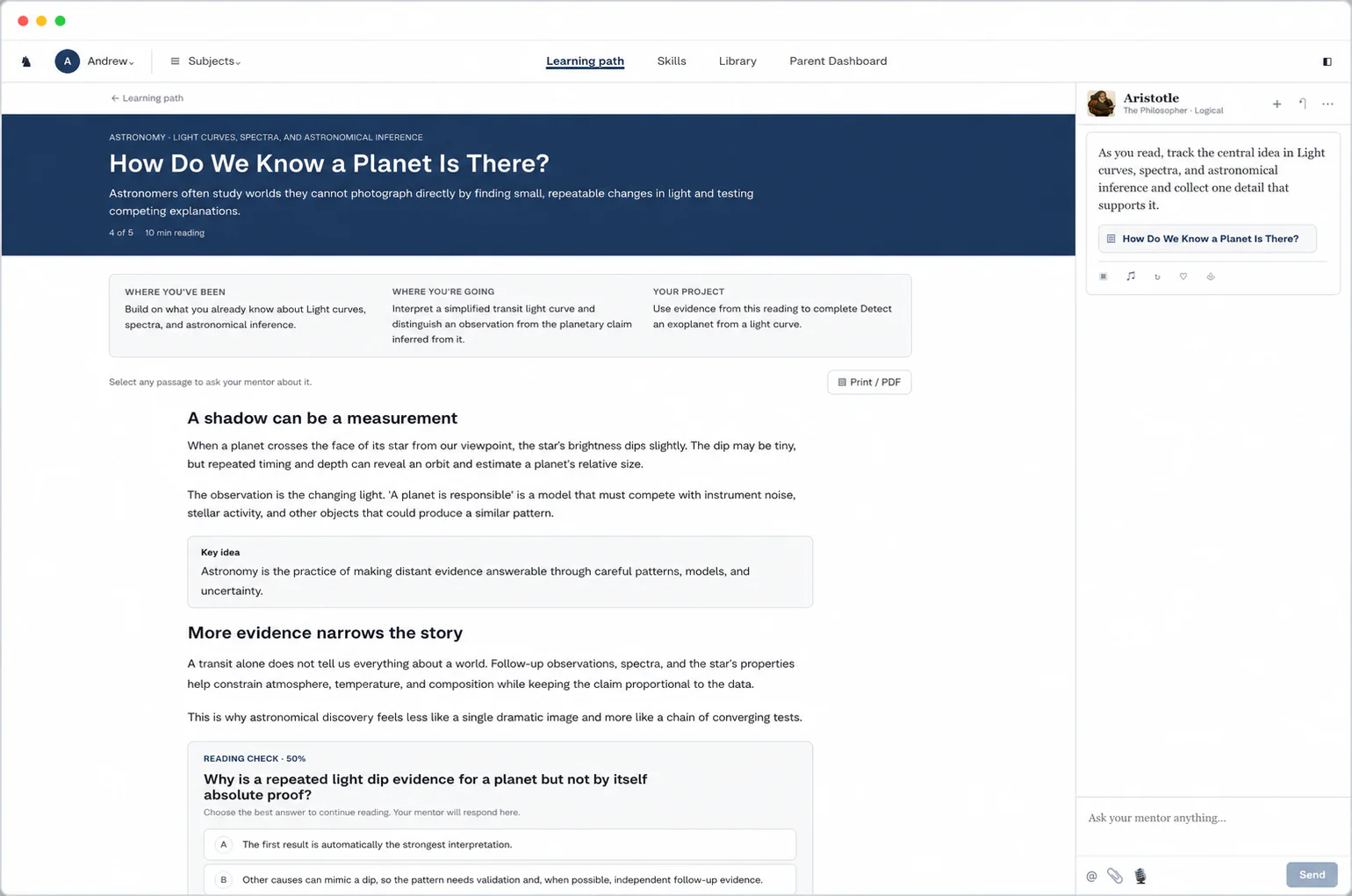
Astronomers often study worlds they cannot photograph directly by finding small, repeatable changes in light and testing competing explanations.
- Lesson
- How Do We Know a Planet Is There?
- Goal
- Interpret a simplified transit light curve and distinguish an observation from the planetary claim inferred from it.
How a lesson works
A 10-minute reading
This example lesson comes from the unit on light curves, spectra, and astronomical inference. It moves from “A shadow can be a measurement” to “More evidence narrows the story” and builds to one idea: astronomy is the practice of making distant evidence answerable through careful patterns, models, and uncertainty.
Help inside the reading
If a sky observation does not fit a prediction, our Always-On Mentor can help your child check the motion, scale, and evidence behind it. Your child can also highlight any line of “How Do We Know a Planet Is There?” to ask about it or ask for a visual, and the mentor offers help on its own when they seem stuck.
A check halfway through
Your child answers “Why is a repeated light dip evidence for a planet but not by itself absolute proof?” before reading on, and the Reading Check at the end asks new questions.
A project your child hands in
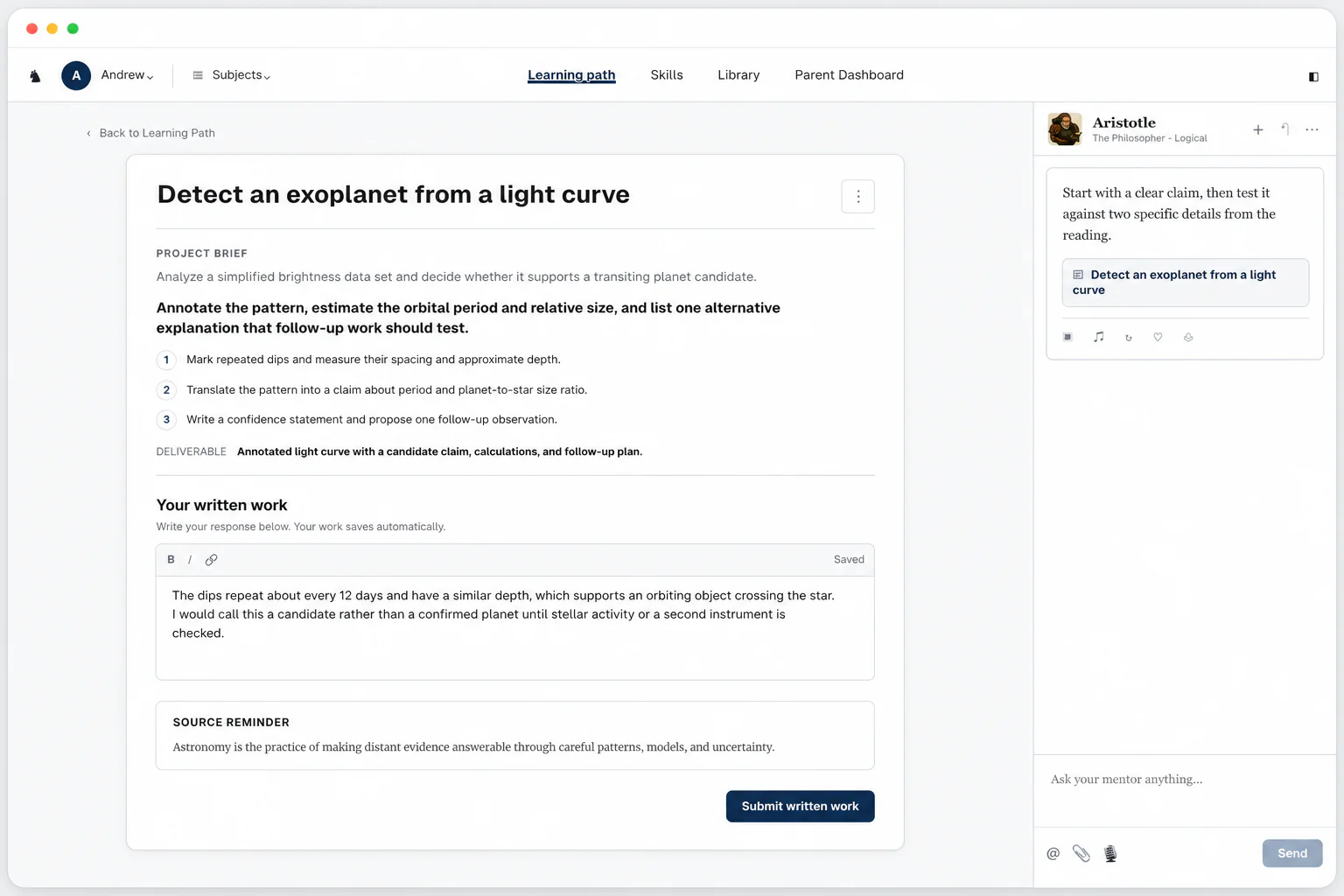
Analyze a simplified brightness data set and decide whether it supports a transiting planet candidate.
- Task
- Annotate the pattern, estimate the orbital period and relative size, and list one alternative explanation that follow-up work should test
- Hand in
- Annotated light curve with a candidate claim, calculations, and follow-up plan
Your parent dashboard
- Today
- Each subject's lesson, and whether it's done
- Grades
- Every submission graded instantly, with written feedback, so you never grade
- Records
- Attendance log and learning summary, ready to export

Units and skills by grade
Grades 3 to 5 each have their own astronomy units. From grade 6 through grade 12, astronomy is one full course: the same 6 units at every grade. Each grade adds a few skills of its own, and your child's grade sets how deep each unit goes.
Grade 35 units · 23 skills
Observing the sky4 skills
- Record what the sky looks like at different times of day
- Describe how the Sun appears to move across the sky
- Explain why stars are hard to see during the day
- Draw and label what you observe in the night sky
The sun6 skills
- Describe the Sun as a source of light
- Describe the Sun as a source of heat
- Explain why the Sun looks larger than other stars
- Explain why we must never look straight at the Sun
- Compare the Sun's warmth in shade and in direct light
- Explain why the Sun is important for life on Earth
The moon4 skills
- Describe how the Moon's appearance changes over a month
- Sequence the phases of the Moon
- Explain that the Moon does not make its own light
- Record the Moon's shape over several nights
Day, night, and seasons4 skills
- Explain day and night using Earth's spinning
- Explain why shadows change during a day
- Describe how weather changes across the seasons
- Explain why a year has seasons
Planets and space objects5 skills
- Name the planets in order from the Sun
- Compare the size of Earth with another planet
- Distinguish a star from a planet
- Describe what a telescope helps us see
- Explain why the Moon looks bigger than the stars
Grade 46 units · 24 skills
Space investigation4 skills
- Record observations of the Moon over several weeks
- Graph an observed pattern in the sky
- Use a model to test an idea about space
- Explain why astronomers repeat observations
Earth, sun, and moon system5 skills
- Explain day and night using Earth's rotation
- Explain the year using Earth's orbit around the Sun
- Model the phases of the Moon with a light source
- Compare the Sun, Earth, and Moon by size
- Compare the Sun, Earth, and Moon by motion
The solar system4 skills
- Order the planets by distance from the Sun
- Compare inner and outer planets
- Explain what a moon orbits
- Describe the path a planet takes around the Sun
Gravity in space3 skills
- Explain that gravity keeps a planet in orbit
- Explain that gravity keeps the Moon near Earth
- Compare weight on Earth with weight on the Moon
Tools and exploration4 skills
- Explain how a telescope gathers light
- Describe what a space probe can do that people cannot
- Explain why space exploration uses robots
- Use evidence from an image to describe a space object
Stars and constellations4 skills
- Explain what a constellation is
- Explain why constellations appear to move
- Compare a star with a planet in the night sky
- Explain why stars look small from Earth
Grade 55 units · 23 skills
Evidence in astronomy4 skills
- Write a testable question about a sky pattern
- Use a long record of observations to find a cycle
- Critique a claim about space that lacks evidence
- Explain how a model of the solar system is limited
Stars6 skills
- Explain that the Sun is a star
- Compare the Sun with other stars by distance
- Compare stars by brightness and colour
- Explain why a nearer star looks brighter
- Explain why some stars are only visible in some seasons
- Use brightness and distance together to compare two stars
Seasons and earth's tilt4 skills
- Explain seasons using Earth's tilt and orbit
- Explain why day length changes through the year
- Compare seasons in the northern and southern hemispheres
- Use a model to show why the tilt matters
Cycles in the sky5 skills
- Explain the repeating cycle of Moon phases
- Explain a solar eclipse using positions
- Explain a lunar eclipse using positions
- Predict the next phase from a record of observations
- Explain why an eclipse does not happen every month
The solar system in scale4 skills
- Compare planet sizes using a scale model
- Compare planet distances using a scale model
- Explain why a scale model cannot show size and distance at once
- Describe what makes a planet different from a dwarf planet
Grades 6 to 126 units · 80 skills
Earth-sun-moon12 skills
- Explain moon phases
- Distinguish solar and lunar eclipses
- Model seasons from Earth's tilt
- Calculate scale distance in the solar system
- Use lunar month evidence
- Explain tides from gravity
- Identify solstice and equinox positions
- Compare rotation and revolution
- Track moon phase observations across a month
- Model eclipse geometry with shadows
- Compare solar and lunar eclipse conditions
- Calculate angular size from distance and diameter
Solar system15 skills
- Classify terrestrial and gas giant planets
- Identify asteroid, comet, and meteoroid
- Explain gravity's role in orbits
- Interpret orbital period data
- Explain Kepler's laws qualitatively
- Compare planet atmospheres
- Identify dwarf planet criteria
- Explain formation of impact craters
- Order planets by distance from the Sun
- Compare planetary rotation and revolution data
- Use gravity to explain orbital speed differences
- Use relative scale to model planet distances
- Use Kepler's second law qualitatively
- Evaluate evidence for exoplanet detection
- Compare transit and radial-velocity exoplanet methods
Stars15 skills
- Read a Hertzsprung-Russell diagram
- Describe stellar life cycle stages
- Compare apparent and absolute magnitude
- Explain nuclear fusion in stars
- Use parallax to infer distance
- Classify stars by temperature
- Explain supernova evidence
- Compare white dwarfs and neutron stars
- Classify stars using color and brightness
- Use star color to infer surface temperature
- Use spectral lines to infer star composition
- Identify hydrogen fusion products in stars
- Estimate stellar distance from parallax
- Use luminosity class to compare stars
- Model a supernova as heavy-element evidence
Universe16 skills
- Use redshift as expansion evidence
- Identify galaxy types
- Explain cosmic microwave background evidence
- Compare models of universe scale
- Use Hubble's law qualitatively
- Explain light-year as distance
- Compare open and globular clusters
- Interpret evidence for dark matter
- Explain redshift evidence in expanding-space terms
- Estimate relative distance from redshift data
- Compare evidence for competing cosmological models
- Connect CMB uniformity to early-universe conditions
- Use Hubble data to infer expansion rate qualitatively
- Distinguish dark matter evidence from dark energy evidence
- Analyze uncertainty in astronomical distance measurements
- Evaluate uncertainty in a cosmology claim
Observation and measurement15 skills
- Interpret a sky map
- Use magnitude to compare brightness
- Identify absorption lines in a spectrum
- Estimate angular size from an image
- Choose a wavelength band for an astronomy observation
- Use exposure time to explain image brightness
- Compare ground and space telescope tradeoffs
- Use a star chart to locate a constellation
- Record sky-object altitude and azimuth
- Compare telescope aperture and light-gathering power
- Use magnitude scale to compare apparent brightness
- Interpret absorption lines in a stellar spectrum
- Estimate uncertainty in a parallax measurement
- Estimate angular separation between two sky objects
- Select an observation method for an astronomy question
Space technology and missions7 skills
- Match telescope type to observation target
- Interpret spacecraft flyby evidence
- Compare crewed and robotic mission tradeoffs
- Use mission data to revise a solar-system model
- Use rover evidence to infer past water
- Compare orbital and flyby mission data
- Identify instrument limits in a mission claim
Questions parents ask
Which grades can use this Astronomy curriculum?
- Grades 3 to 12. The skill trees on this page show the units and skills by grade. Placement checks your child's current skills, so the first lesson can sit before or after their grade.
What should my child know before starting?
- Starting skills include basic math skills, interest in space, and access to night sky (ideal but not required). If placement finds a gap, the course starts with those skills.
How much of the teaching do I do?
- None of it. The course explains each new idea and checks how your child uses it, while the mentor answers questions as they work. Every submission is graded as soon as it comes in, so you never grade it yourself.
Can I use the record for high-school planning?
- Yes. The subject record holds every graded assignment with its written feedback, ready to export. We generate a transcript from the course records, ready for you to sign.
Astronomy, taught around your child
Space science that rewards curiosity with real explanatory power.
$49/month after the trial.