Earth Sciences for your homeschool
Your child uses maps, measurements, and observations to explain weather, landscapes, and changes in the environment.
A lesson built around your child
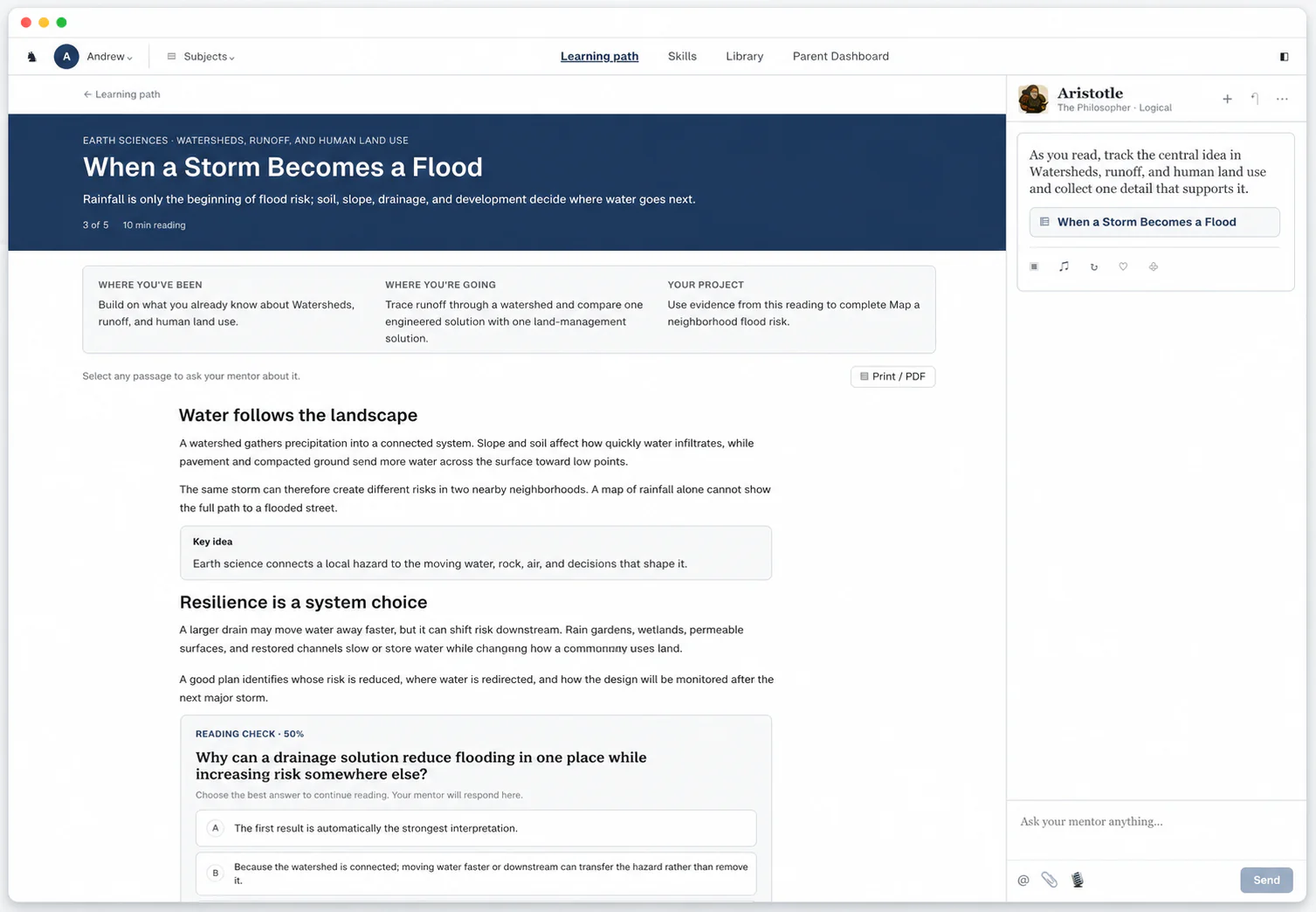
Rainfall is only the beginning of flood risk; soil, slope, drainage, and development decide where water goes next.
- Lesson
- When a Storm Becomes a Flood
- Goal
- Trace runoff through a watershed and compare one engineered solution with one land-management solution.
How a lesson works
A 10-minute reading
This example lesson comes from the unit on watersheds, runoff, and human land use. It moves from “Water follows the landscape” to “Resilience is a system choice” and builds to one idea: Earth science connects a local hazard to the moving water, rock, air, and decisions that shape it.
Help inside the reading
For a weather or landscape explanation, our Always-On Mentor can help your child sort what they observed from what the model suggests over time. Your child can also highlight any line of “When a Storm Becomes a Flood” to ask about it or ask for a visual, and the mentor offers help on its own when they seem stuck.
A check halfway through
Your child answers “Why can a drainage solution reduce flooding in one place while increasing risk somewhere else?” before reading on, and the Reading Check at the end asks new questions.
A project your child hands in
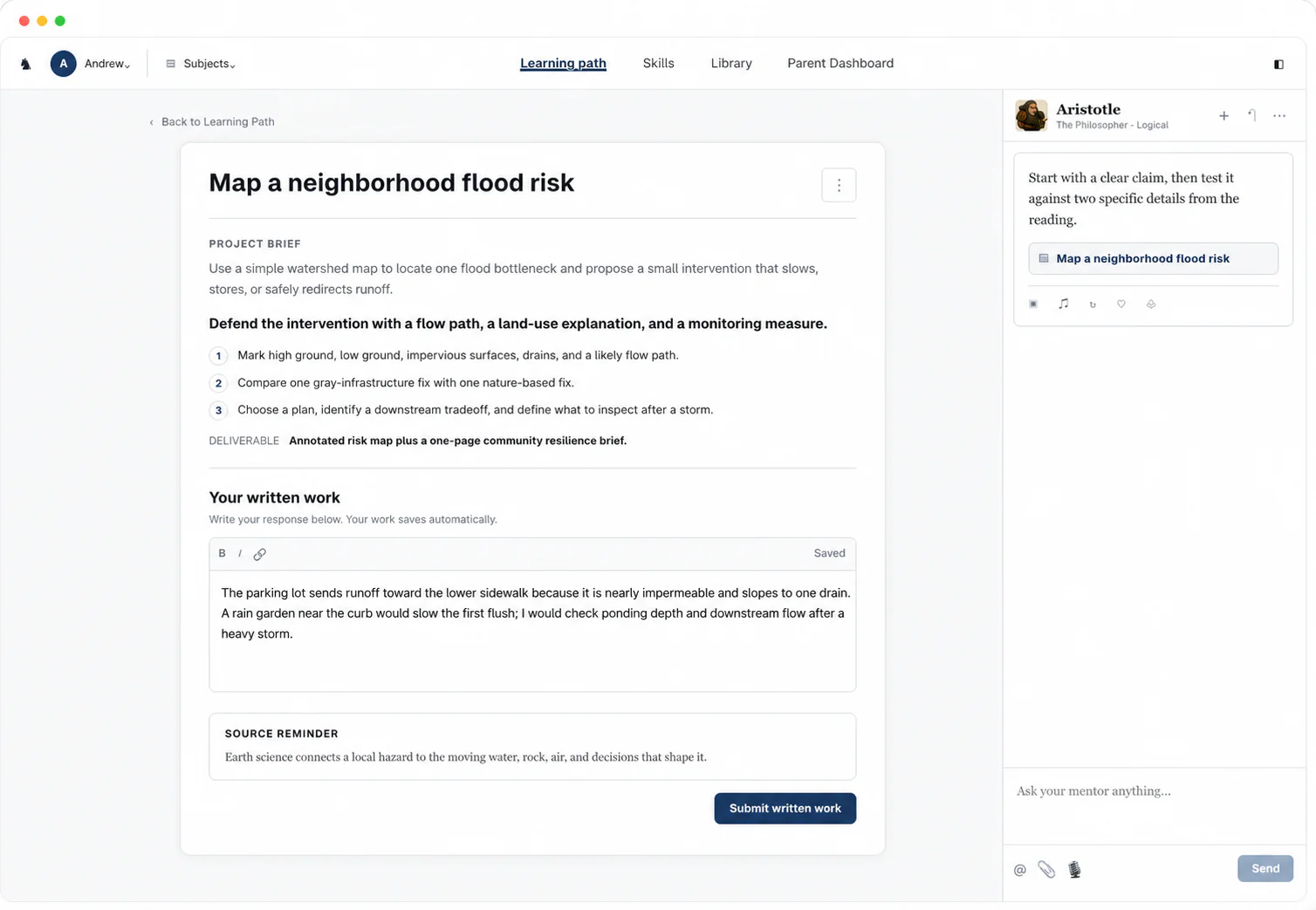
Use a simple watershed map to locate one flood bottleneck and propose a small intervention that slows, stores, or safely redirects runoff.
- Task
- Defend the intervention with a flow path, a land-use explanation, and a monitoring measure
- Hand in
- Annotated risk map plus a one-page community resilience brief
Your parent dashboard
- Today
- Each subject's lesson, and whether it's done
- Grades
- Every submission graded instantly, with written feedback, so you never grade
- Records
- Attendance log and learning summary, ready to export

Units and skills by grade
Grades 3 to 5 each have their own Earth sciences units. From grade 6 through grade 12, Earth sciences is one full course: the same 6 units at every grade. Each grade adds a few skills of its own, and your child's grade sets how deep each unit goes.
Grade 36 units · 23 skills
Earth materials4 skills
- Compare soil samples by texture and colour
- Sort rocks by observable properties
- Explain what soil is made of
- Explain why soil matters for plants
Water on Earth4 skills
- Describe the steps of the water cycle
- Identify where fresh water is found
- Explain why most of Earth's water is not drinkable
- Trace a drop of water through the cycle
Weather4 skills
- Record weather observations over several days
- Describe a weather pattern from recorded data
- Measure temperature and rainfall
- Explain how clouds relate to rain
Seasons and sky3 skills
- Explain why seasons change during a year
- Compare weather across two seasons
- Explain how the Sun warms the land and the air
Using earth's resources4 skills
- Identify a natural resource used every day
- Explain why some resources must be conserved
- Compare two ways of reducing waste
- Give evidence that a resource is limited
Landforms4 skills
- Identify a mountain, a valley, and a plain
- Explain how a river shapes the land around it
- Compare two landforms by how they formed
- Describe the landforms near where you live
Grade 45 units · 20 skills
Investigating Earth4 skills
- Plan a fair test about soil or water
- Record earth-science measurements in a table
- Graph weather data collected over time
- Draw a conclusion about a landform from evidence
Weathering, erosion, and deposition5 skills
- Explain how weathering breaks down rock
- Explain how erosion moves earth materials
- Explain how deposition builds new landforms
- Model erosion by moving water
- Identify a landform shaped by erosion
The water cycle4 skills
- Explain how the water cycle moves water through Earth's systems
- Describe evaporation and condensation
- Explain the role of the Sun in the water cycle
- Model the water cycle in a closed container
Natural resources4 skills
- Classify a natural resource as renewable or nonrenewable
- Explain how a fossil fuel formed
- Compare two energy sources by their supply
- Evaluate a choice about using a resource
Earth in space3 skills
- Explain day and night using Earth's rotation
- Explain the year using Earth's orbit
- Explain how Earth's shape affects where it is warmest
Grade 55 units · 21 skills
Earth science practice4 skills
- Write a testable hypothesis about an earth process
- Use repeated measurements to describe a pattern
- Choose a graph that fits earth-science data
- Critique a conclusion about climate that the data cannot support
Rocks and fossils5 skills
- Classify a rock as sedimentary, igneous, or metamorphic
- Explain how each rock type forms
- Explain how fossils form in sedimentary rock
- Use a rock layer to infer what happened first
- Use a fossil to infer a past environment
Weather and climate4 skills
- Distinguish weather from climate
- Read a weather map for a pattern
- Explain how oceans influence nearby climate
- Compare climate in two different regions
Earth's interacting systems4 skills
- Explain how the water cycle connects Earth's systems
- Explain how land shape affects where water flows
- Trace matter moving between two Earth systems
- Predict the effect of a change in one Earth system
Resources and stewardship4 skills
- Evaluate a choice about using a natural resource
- Compare the cost and benefit of an energy source
- Propose a way to protect a local water supply
- Use evidence to support a conservation recommendation
Grades 6 to 126 units · 81 skills
Earth systems13 skills
- Identify geosphere, hydrosphere, atmosphere, and biosphere interactions
- Trace water through the water cycle
- Explain feedback in a climate system
- Interpret a systems diagram
- Explain carbon cycle reservoirs
- Trace nitrogen through an ecosystem
- Identify positive and negative feedback
- Model interaction between water and landforms
- Trace matter through Earth system cycles
- Trace carbon between atmosphere and ocean
- Analyze feedback loops in climate systems
- Analyze albedo feedback
- Model feedback in Earth systems
Earth data and field methods7 skills
- Read a topographic contour map
- Use a soil profile to infer drainage
- Record stream-flow observations
- Compare satellite and field evidence
- Interpret a topographic profile
- Use stream-gauge data to infer flood risk
- Classify soil texture from field evidence
Geology15 skills
- Identify igneous, sedimentary, and metamorphic rock
- Use relative dating with rock layers
- Locate plate boundaries from earthquake data
- Explain seafloor spreading evidence
- Identify fault types
- Use index fossils for correlation
- Explain volcano formation at subduction zones
- Use fossils to infer past environments
- Use sedimentary layers to infer sequence
- Use earthquake data to map plate boundaries
- Triangulate an earthquake epicenter
- Use radiometric dating evidence conceptually
- Use half-life data for relative dating
- Analyze resource extraction tradeoffs
- Compare costs and benefits of mineral extraction
Weather and climate14 skills
- Read a weather map
- Identify air mass characteristics
- Explain convection in the atmosphere
- Interpret a climate graph
- Interpret a station model
- Explain pressure gradients and wind
- Identify fronts on a weather map
- Use weather observations to identify patterns
- Explain uneven heating and convection
- Explain sea breeze formation
- Interpret climate normals for a region
- Compare weather and climate statements
- Explain jet stream effects
- Use climate anomaly maps
Oceans and hazards17 skills
- Explain wave erosion on a coastline
- Interpret ocean-current maps
- Identify earthquake hazard from fault location
- Use flood maps to identify risk
- Explain tide patterns from gravity
- Use bathymetry to infer seafloor features
- Evaluate earthquake preparedness evidence
- Use tsunami evidence to infer seafloor displacement
- Identify tsunami warning signs from earthquake data
- Interpret a hurricane track forecast
- Use storm-surge maps to estimate flood exposure
- Explain El Nino effects on regional weather
- Explain coastal erosion from wave action
- Trace heat transfer by ocean currents
- Interpret ocean-acidification data
- Evaluate coastal risk from storm surge
- Compare mitigation options for coastal hazards
Human impacts15 skills
- Interpret carbon dioxide trend data
- Distinguish weather from climate
- Evaluate evidence for climate change
- Predict effects of land-use change
- Evaluate renewable energy tradeoffs
- Analyze groundwater depletion
- Interpret sea-level rise data
- Analyze human impact on watershed quality
- Interpret water-quality indicator data
- Evaluate mitigation for natural hazards
- Evaluate flood mitigation strategies
- Interpret carbon-budget data
- Interpret emissions scenario graphs
- Evaluate evidence in a climate policy claim
- Evaluate a climate adaptation plan
Questions parents ask
Which grades can use this Earth Sciences curriculum?
- Grades 3 to 12. The skill trees on this page show the units and skills by grade. Placement checks your child's current skills, so the first lesson can sit before or after their grade.
What should my child know before starting?
- Starting skills include basic science curiosity, math for measurement, and ability to observe carefully. If placement finds a gap, the course starts with those skills.
How much of the teaching do I do?
- None of it. The course explains each new idea and checks how your child uses it, while the mentor answers questions as they work. Every submission is graded as soon as it comes in, so you never grade it yourself.
Can I use the record for high-school planning?
- Yes. The subject record holds every graded assignment with its written feedback, ready to export. We generate a transcript from the course records, ready for you to sign.
Earth Sciences, taught around your child
Earth science your learner can use to read the world around them.
$49/month after the trial.