Manufacturing Engineering for your homeschool
Your child learns how real things get made, then designs a process that can make them reliably, affordably, and at scale.
A lesson built around your child
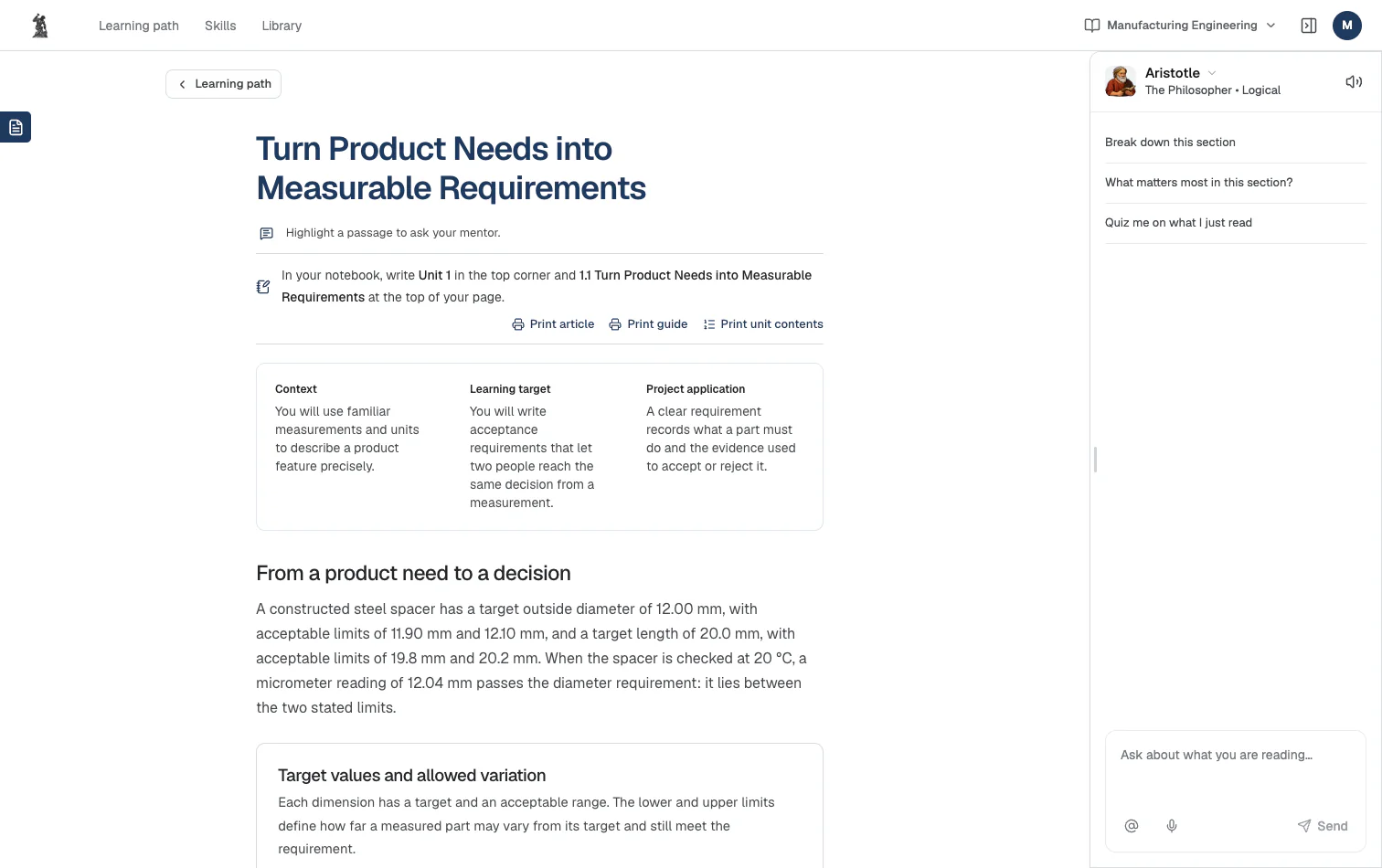
You will use familiar measurements and units to describe a product feature precisely.
- Lesson
- Turn Product Needs into Measurable Requirements
- Goal
- Write acceptance requirements that let two people reach the same decision from a measurement.
- Project
- A clear requirement records what a part must do and the evidence used to accept or reject it.
Your parent dashboard
- Today
- Each subject's lesson, and whether it's done
- Grades
- Every submission graded instantly, with written feedback, so you never grade
- Records
- Attendance log and learning summary, ready to export

Units and skills
Manufacturing Engineering16 units · 80 skills
From one prototype to a production run5 skills
- Turn a product need into a measurable acceptance requirement
- Build a bill of materials from a supplied product teardown
- Trace material through a product's manufacturing route
- Distinguish a working prototype from evidence of repeatable production
- Choose a safe classroom substitute for an industrial process
Drawings, fits, and measurement5 skills
- Locate a feature from a drawing's specified datum
- Calculate upper and lower limits for a dimension
- Determine worst-case clearance between two mating parts
- Choose a measuring instrument for a specified feature
- Decide whether a measurement supports accepting a part
Materials and stock5 skills
- Match a material property to a product's service requirement
- Select stock that can contain a finished part
- Calculate material utilization for a supplied cutting layout
- Calculate purchased material cost per usable blank
- Choose a material from a constrained comparison
Choosing a process at scale5 skills
- Classify a process by how it changes material
- Identify a geometry constraint that rules out a process
- Check whether a process can meet a supplied specification
- Calculate the production quantity where two process costs match
- Select a manufacturing route for a stated order quantity
Design for manufacturing5 skills
- Identify a missing constraint in a dimensioned part sketch
- Revise a wall feature to meet supplied process limits
- Identify a mold-release obstruction in a supplied part section
- Revise a feature that a specified cutting tool cannot reach
- Remove an unnecessary part from an assembly proposal
Additive manufacturing5 skills
- Choose a print orientation from supplied strength and surface constraints
- Identify which features need support under supplied print rules
- Compare print plans using supplied time and surface data
- Calculate usable printed parts per build
- Choose one print revision from measured defect evidence
Machining and CNC planning5 skills
- Choose a setup reference that preserves a drawing datum
- Identify a workholding failure in a machining setup diagram
- Trace a simulated toolpath relative to stock and clamps
- Estimate machining cycle time from supplied operation times
- Separate internal and external setup tasks in a supplied changeover
Forming, casting, and molding5 skills
- Calculate a mold dimension from a supplied shrinkage convention
- Calculate a flat blank length using supplied bend allowances
- Select a parting direction from supplied mold alternatives
- Distinguish a mold-filling observation from its possible cause
- Order forming and finishing operations for a specified part
Assembly, fixtures, and mistake-proofing5 skills
- Choose locating features for a repeatable assembly fixture
- Calculate worst-case assembly tolerance stack-up
- Sequence an assembly under stated access constraints
- Design a feature that prevents a specified assembly error
- Write repeatable instructions for a safe model assembly
Quality, variation, and inspection5 skills
- Choose an inspection plan for a stated decision
- Calculate first-pass yield for a production run
- Prioritize defect categories from supplied production counts
- Interpret a process chart using supplied control limits and rules
- Calculate Cpk from supplied stable-process estimates
Experiments and root-cause analysis5 skills
- Choose a test that distinguishes two proposed defect causes
- Identify a confounding change in a process comparison
- Plan a small process experiment with replicates
- Identify an interaction in a supplied two-factor experiment
- Decide whether a trial supports a proposed process improvement
Factory flow and bottlenecks5 skills
- Calculate takt time from available time and demand
- Calculate a station's capacity from its cycle time
- Find the bottleneck in a supplied production line
- Count work in process within a stated system boundary
- Estimate average lead time using Little's Law
Sensors, automation, and production cells5 skills
- Choose a sensor signal for a specified production decision
- Explain a safety interlock in a simulated production cell
- Trace a production-cell state machine through supplied inputs
- Specify a controlled recovery from a simulated cell fault
- Choose whether to automate a process step
Production economics and supply5 skills
- Calculate purchased-component cost per finished product
- Calculate cost per accepted unit for a production run
- Compare supplier offers against a production requirement
- Calculate a reorder point from supplied demand and lead time
- Build a feasible production schedule for a small order
Repair, waste, and resource use5 skills
- Reconcile input material with output and waste streams
- Calculate energy use per accepted unit
- Revise an assembly for a specified repair operation
- Compare two process plans within a stated life-cycle boundary
- Choose a material-recovery route under stated constraints
Capstone: launch a small production run5 skills
- Write a production plan for a specified small order
- Write a control plan for a critical product feature
- Record a pilot run using a safe model or supplied production data
- Decide whether a pilot run is ready for the stated order
- Defend one revision before scaling production
Questions parents ask
Where does my child start in Manufacturing Engineering?
- Placement checks your child's current Manufacturing Engineering skills and sets the first lesson from that result, not from their grade.
How much of the teaching do I do?
- None of it. The course explains each new idea and checks how your child uses it, while the Always-On Mentor answers questions as they work. Every submission is graded as soon as it comes in, so you never grade it yourself.
Can I use the record for high-school planning?
- Yes. The subject record holds every graded assignment with its written feedback, ready to export. We generate a transcript from the course records, ready for you to sign.
Manufacturing Engineering, taught around your child
A production decision supported by measurements and a feasible plan.
Start your 14-day free trial
$49/month after the trial.