Finance for your homeschool
Your teen compares financial choices, calculates the costs, and explains the risks before making a recommendation.
A lesson built around your child
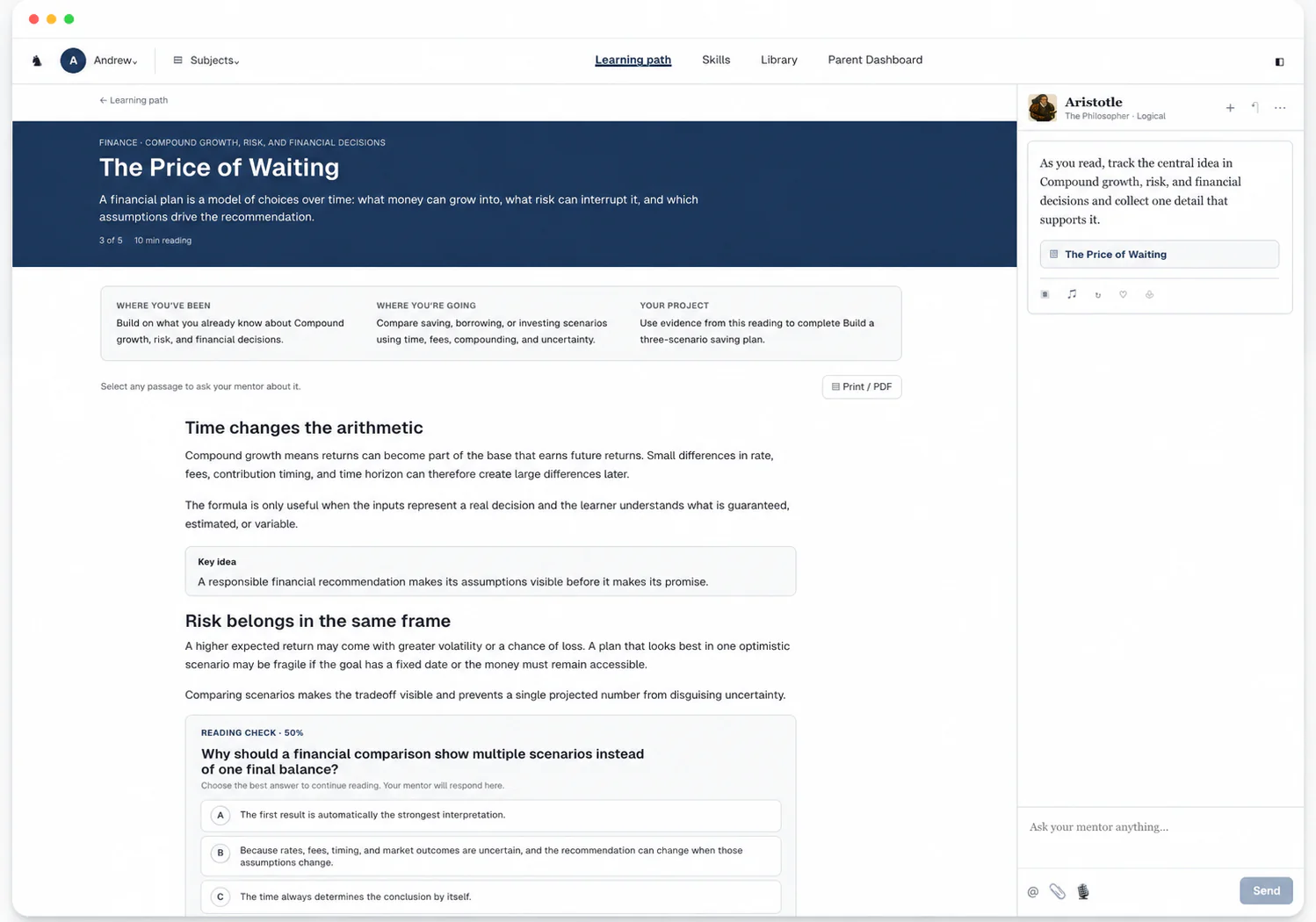
A financial plan is a model of choices over time: what money can grow into, what risk can interrupt it, and which assumptions drive the recommendation.
- Lesson
- The Price of Waiting
- Goal
- Compare saving, borrowing, or investing scenarios using time, fees, compounding, and uncertainty.
How a lesson works
A 10-minute reading
This example lesson comes from the unit on compound growth, risk, and financial decisions. It moves from “Time changes the arithmetic” to “Risk belongs in the same frame” and builds to one idea: a responsible financial recommendation makes its assumptions visible before it makes its promise.
Help inside the reading
If two savings or borrowing options look alike, our Always-On Mentor can help your teen check the totals, assumptions, and risks. It is course help, not personal financial advice. Your child can also highlight any line of “The Price of Waiting” to ask about it or ask for a visual, and the mentor offers help on its own when they seem stuck.
A check halfway through
Your child answers “Why should a financial comparison show multiple scenarios instead of one final balance?” before reading on, and the Reading Check at the end asks new questions.
A project your child hands in
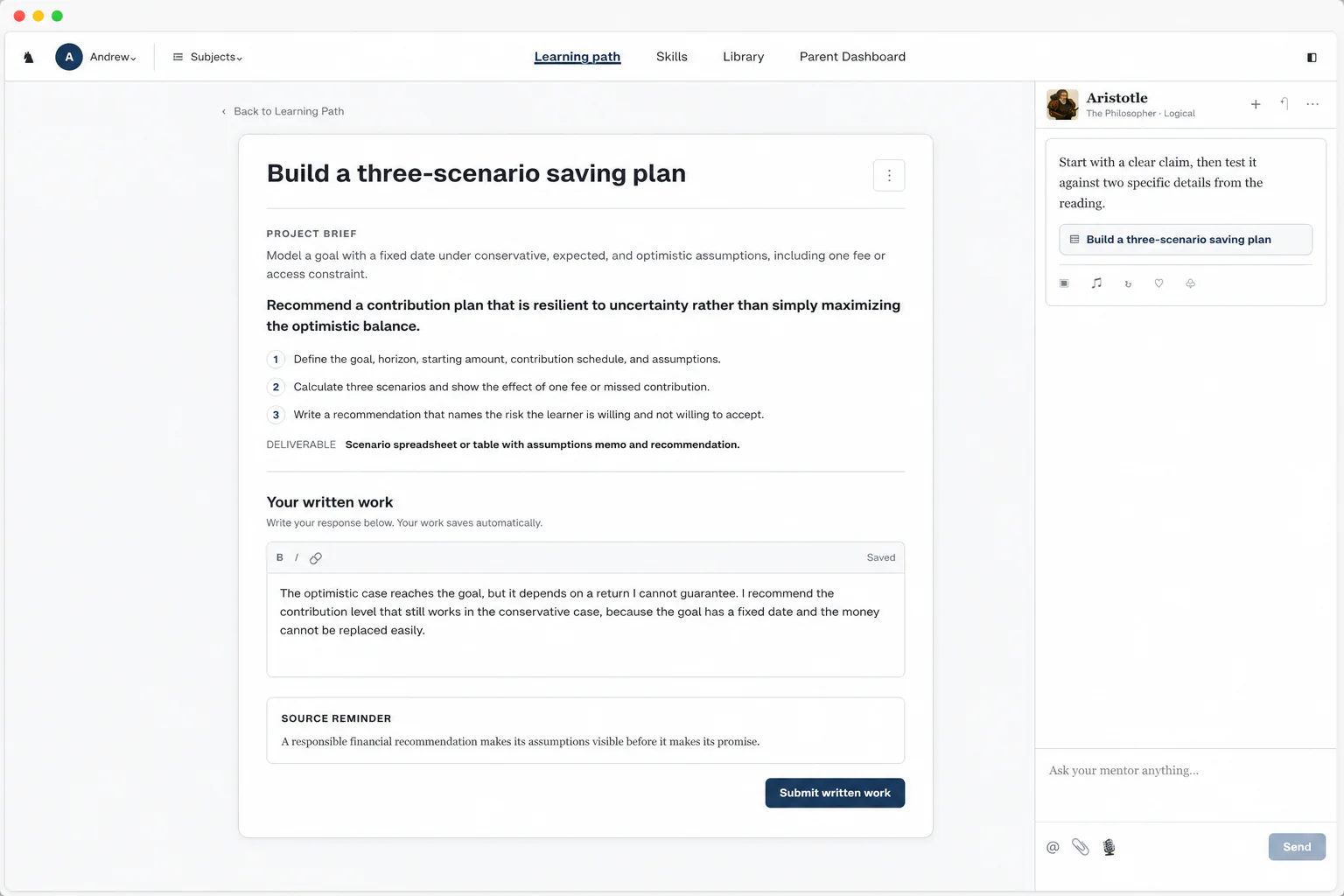
Model a goal with a fixed date under conservative, expected, and optimistic assumptions, including one fee or access constraint.
- Task
- Recommend a contribution plan that is resilient to uncertainty rather than simply maximizing the optimistic balance
- Hand in
- Scenario spreadsheet or table with assumptions memo and recommendation
Your parent dashboard
- Today
- Each subject's lesson, and whether it's done
- Grades
- Every submission graded instantly, with written feedback, so you never grade
- Records
- Attendance log and learning summary, ready to export

Units and skills
Practical financial literacy, not generic life advice: every skill asks for a calculation, evidence, or a decision in a scenario. Finance is one skill tree for every grade with 12 units, from personal budgeting and financial goals to financial plan or investment memo, and your child's grade sets how deep each unit goes.
Finance12 units · 60 skills
Personal budgeting and financial goals5 skills
- Define the vocabulary, boundaries, and common misconceptions of Personal budgeting and financial goals
- Explain the main actors, mechanisms, sequence, and constraints in Personal budgeting and financial goals
- Interpret evidence, data, cases, or examples connected to Personal budgeting and financial goals
- Apply Personal budgeting and financial goals to a realistic personal or business finance scenario
- Create a financial decision memo that justifies decisions about Personal budgeting and financial goals
Banking, credit, and debt5 skills
- Define the vocabulary, boundaries, and common misconceptions of Banking, credit, and debt
- Explain the main actors, mechanisms, sequence, and constraints in Banking, credit, and debt
- Interpret evidence, data, cases, or examples connected to Banking, credit, and debt
- Apply Banking, credit, and debt to a realistic personal or business finance scenario
- Create a financial decision memo that justifies decisions about Banking, credit, and debt
Interest, compounding, and time value5 skills
- Define the vocabulary, boundaries, and common misconceptions of Interest, compounding, and time value
- Explain the main actors, mechanisms, sequence, and constraints in Interest, compounding, and time value
- Interpret evidence, data, cases, or examples connected to Interest, compounding, and time value
- Apply Interest, compounding, and time value to a realistic personal or business finance scenario
- Create a financial decision memo that justifies decisions about Interest, compounding, and time value
Investing basics and asset classes5 skills
- Define the vocabulary, boundaries, and common misconceptions of Investing basics and asset classes
- Explain the main actors, mechanisms, sequence, and constraints in Investing basics and asset classes
- Interpret evidence, data, cases, or examples connected to Investing basics and asset classes
- Apply Investing basics and asset classes to a realistic personal or business finance scenario
- Create a financial decision memo that justifies decisions about Investing basics and asset classes
Risk, diversification, and portfolio allocation5 skills
- Define the vocabulary, boundaries, and common misconceptions of Risk, diversification, and portfolio allocation
- Explain the main actors, mechanisms, sequence, and constraints in Risk, diversification, and portfolio allocation
- Interpret evidence, data, cases, or examples connected to Risk, diversification, and portfolio allocation
- Apply Risk, diversification, and portfolio allocation to a realistic personal or business finance scenario
- Create a financial decision memo that justifies decisions about Risk, diversification, and portfolio allocation
Financial statements and business analysis5 skills
- Define the vocabulary, boundaries, and common misconceptions of Financial statements and business analysis
- Explain the main actors, mechanisms, sequence, and constraints in Financial statements and business analysis
- Interpret evidence, data, cases, or examples connected to Financial statements and business analysis
- Apply Financial statements and business analysis to a realistic personal or business finance scenario
- Create a financial decision memo that justifies decisions about Financial statements and business analysis
Taxes, insurance, and planning5 skills
- Define the vocabulary, boundaries, and common misconceptions of Taxes, insurance, and planning
- Explain the main actors, mechanisms, sequence, and constraints in Taxes, insurance, and planning
- Interpret evidence, data, cases, or examples connected to Taxes, insurance, and planning
- Apply Taxes, insurance, and planning to a realistic personal or business finance scenario
- Create a financial decision memo that justifies decisions about Taxes, insurance, and planning
Behavioral finance and decision traps5 skills
- Define the vocabulary, boundaries, and common misconceptions of Behavioral finance and decision traps
- Explain the main actors, mechanisms, sequence, and constraints in Behavioral finance and decision traps
- Interpret evidence, data, cases, or examples connected to Behavioral finance and decision traps
- Apply Behavioral finance and decision traps to a realistic personal or business finance scenario
- Create a financial decision memo that justifies decisions about Behavioral finance and decision traps
Markets, rates, and economic indicators5 skills
- Define the vocabulary, boundaries, and common misconceptions of Markets, rates, and economic indicators
- Explain the main actors, mechanisms, sequence, and constraints in Markets, rates, and economic indicators
- Interpret evidence, data, cases, or examples connected to Markets, rates, and economic indicators
- Apply Markets, rates, and economic indicators to a realistic personal or business finance scenario
- Create a financial decision memo that justifies decisions about Markets, rates, and economic indicators
Valuation and capital budgeting5 skills
- Define the vocabulary, boundaries, and common misconceptions of Valuation and capital budgeting
- Explain the main actors, mechanisms, sequence, and constraints in Valuation and capital budgeting
- Interpret evidence, data, cases, or examples connected to Valuation and capital budgeting
- Apply Valuation and capital budgeting to a realistic personal or business finance scenario
- Create a financial decision memo that justifies decisions about Valuation and capital budgeting
Ethics, fiduciary duty, and regulation5 skills
- Define the vocabulary, boundaries, and common misconceptions of Ethics, fiduciary duty, and regulation
- Explain the main actors, mechanisms, sequence, and constraints in Ethics, fiduciary duty, and regulation
- Interpret evidence, data, cases, or examples connected to Ethics, fiduciary duty, and regulation
- Apply Ethics, fiduciary duty, and regulation to a realistic personal or business finance scenario
- Create a financial decision memo that justifies decisions about Ethics, fiduciary duty, and regulation
Financial plan or investment memo5 skills
- Define the vocabulary, boundaries, and common misconceptions of Financial plan or investment memo
- Explain the main actors, mechanisms, sequence, and constraints in Financial plan or investment memo
- Interpret evidence, data, cases, or examples connected to Financial plan or investment memo
- Apply Financial plan or investment memo to a realistic personal or business finance scenario
- Create a financial decision memo that justifies decisions about Financial plan or investment memo
Questions parents ask
Which grades can use this Finance curriculum?
- One Finance skill tree serves grades 3 to 12, with course pages for 9th grade, 10th grade, and high school. Placement checks your child's current skills, so the first lesson can sit before or after their grade.
What should my child know before starting?
- Starting skills include basic arithmetic, some income or allowance helpful, and interest in money. If placement finds a gap, the course starts with those skills.
How much of the teaching do I do?
- None of it. The course explains each new idea and checks how your child uses it, while the mentor answers questions as they work. Every submission is graded as soon as it comes in, so you never grade it yourself.
Can I use the record for high-school planning?
- Yes. The subject record holds every graded assignment with its written feedback, ready to export. We generate a transcript from the course records, ready for you to sign.
Finance, taught around your child
Financial decisions grounded in math, evidence, and explicit tradeoffs.
$49/month after the trial.