Arts for your homeschool
Your child chooses what they want a piece to express, studies the techniques it needs, and revises the work toward that effect.
A lesson built around your child
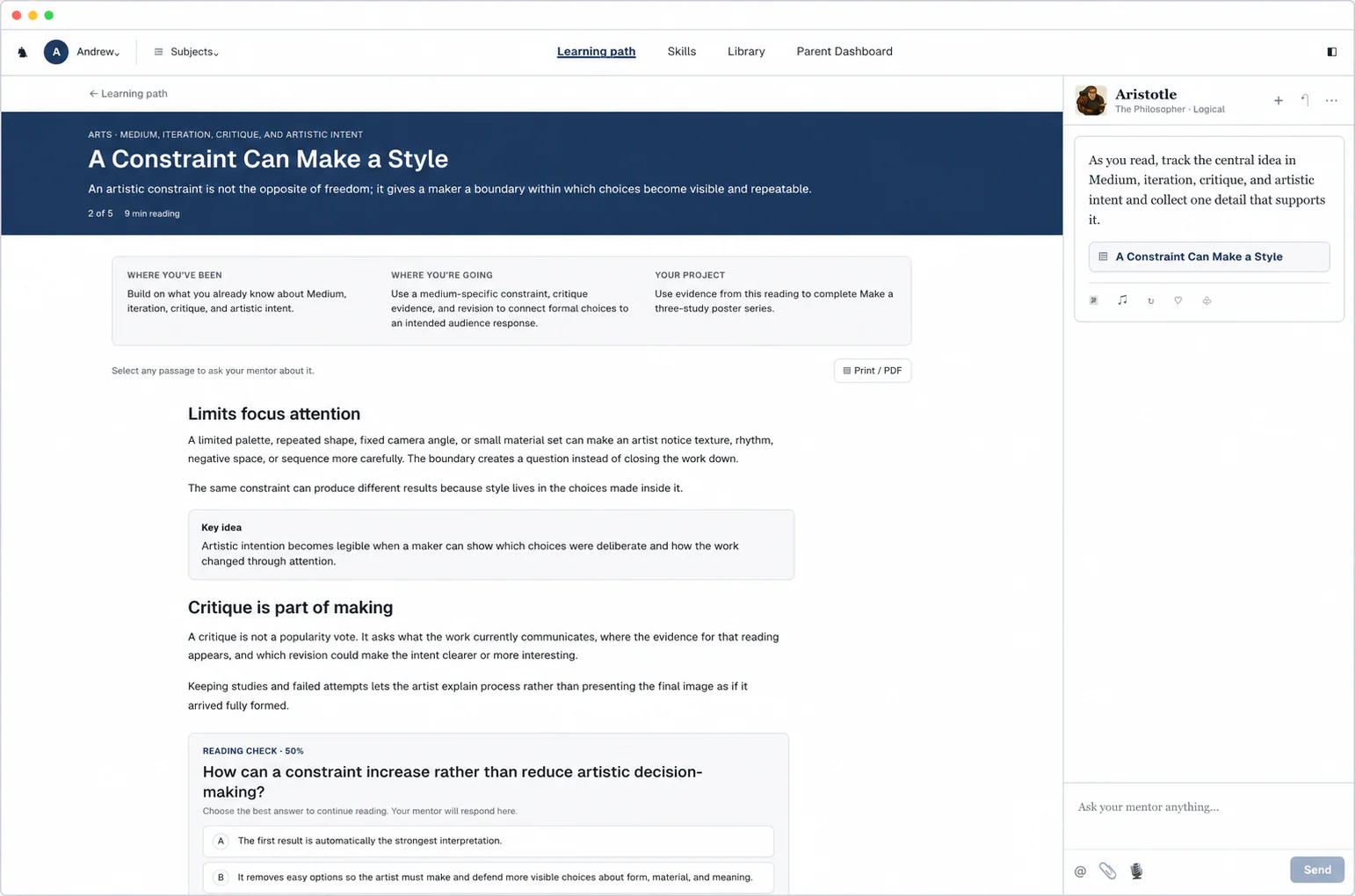
An artistic constraint is not the opposite of freedom; it gives a maker a boundary within which choices become visible and repeatable.
- Lesson
- A Constraint Can Make a Style
- Goal
- Use a medium-specific constraint, critique evidence, and revision to connect formal choices to an intended audience response.
How a lesson works
A 9-minute reading
This example lesson comes from the unit on medium, iteration, critique, and artistic intent. It moves from “Limits focus attention” to “Critique is part of making” and builds to one idea: artistic intention becomes legible when a maker can show which choices were deliberate and how the work changed through attention.
Help inside the reading
When a piece does not create the effect your child wants, our Always-On Mentor can discuss composition and technique while leaving the artistic choices to them. Your child can also highlight any line of “A Constraint Can Make a Style” to ask about it or ask for a visual, and the mentor offers help on its own when they seem stuck.
A check halfway through
Your child answers “How can a constraint increase rather than reduce artistic decision-making?” before reading on, and the Reading Check at the end asks new questions.
A project your child hands in
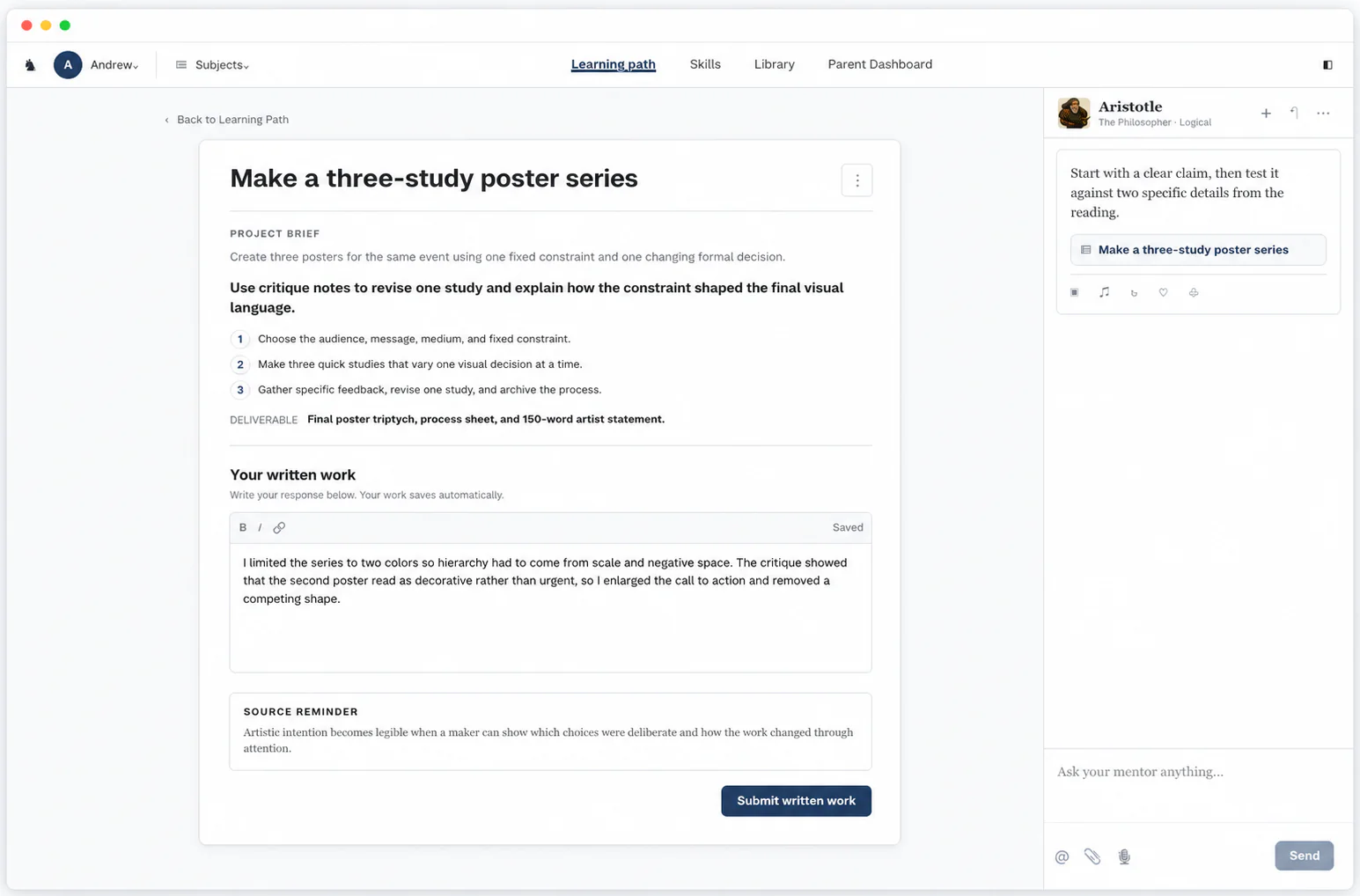
Create three posters for the same event using one fixed constraint and one changing formal decision.
- Task
- Use critique notes to revise one study and explain how the constraint shaped the final visual language
- Hand in
- Final poster triptych, process sheet, and 150-word artist statement
Your parent dashboard
- Today
- Each subject's lesson, and whether it's done
- Grades
- Every submission graded instantly, with written feedback, so you never grade
- Records
- Attendance log and learning summary, ready to export

Units and skills
Supports visual and interdisciplinary arts as a rigorous practice of making, interpreting, revising, and presenting. Arts is one skill tree for every grade with 12 units, from visual elements and design principles to original body of work capstone, and your child's grade sets how deep each unit goes.
Arts12 units · 60 skills
Visual elements and design principles5 skills
- Define the vocabulary, boundaries, and common misconceptions of Visual elements and design principles
- Explain the main actors, mechanisms, sequence, and constraints in Visual elements and design principles
- Interpret evidence, data, cases, or examples connected to Visual elements and design principles
- Apply Visual elements and design principles to a realistic original artwork or visual study
- Create a portfolio entry that justifies decisions about Visual elements and design principles
Drawing from observation5 skills
- Define the vocabulary, boundaries, and common misconceptions of Drawing from observation
- Explain the main actors, mechanisms, sequence, and constraints in Drawing from observation
- Interpret evidence, data, cases, or examples connected to Drawing from observation
- Apply Drawing from observation to a realistic original artwork or visual study
- Create a portfolio entry that justifies decisions about Drawing from observation
Color, value, and composition5 skills
- Define the vocabulary, boundaries, and common misconceptions of Color, value, and composition
- Explain the main actors, mechanisms, sequence, and constraints in Color, value, and composition
- Interpret evidence, data, cases, or examples connected to Color, value, and composition
- Apply Color, value, and composition to a realistic original artwork or visual study
- Create a portfolio entry that justifies decisions about Color, value, and composition
Painting media and surface preparation5 skills
- Define the vocabulary, boundaries, and common misconceptions of Painting media and surface preparation
- Explain the main actors, mechanisms, sequence, and constraints in Painting media and surface preparation
- Interpret evidence, data, cases, or examples connected to Painting media and surface preparation
- Apply Painting media and surface preparation to a realistic original artwork or visual study
- Create a portfolio entry that justifies decisions about Painting media and surface preparation
Sculpture, form, and material behavior5 skills
- Define the vocabulary, boundaries, and common misconceptions of Sculpture, form, and material behavior
- Explain the main actors, mechanisms, sequence, and constraints in Sculpture, form, and material behavior
- Interpret evidence, data, cases, or examples connected to Sculpture, form, and material behavior
- Apply Sculpture, form, and material behavior to a realistic original artwork or visual study
- Create a portfolio entry that justifies decisions about Sculpture, form, and material behavior
Digital art and image editing5 skills
- Define the vocabulary, boundaries, and common misconceptions of Digital art and image editing
- Explain the main actors, mechanisms, sequence, and constraints in Digital art and image editing
- Interpret evidence, data, cases, or examples connected to Digital art and image editing
- Apply Digital art and image editing to a realistic original artwork or visual study
- Create a portfolio entry that justifies decisions about Digital art and image editing
Photography, light, and framing5 skills
- Define the vocabulary, boundaries, and common misconceptions of Photography, light, and framing
- Explain the main actors, mechanisms, sequence, and constraints in Photography, light, and framing
- Interpret evidence, data, cases, or examples connected to Photography, light, and framing
- Apply Photography, light, and framing to a realistic original artwork or visual study
- Create a portfolio entry that justifies decisions about Photography, light, and framing
Art history and visual culture5 skills
- Define the vocabulary, boundaries, and common misconceptions of Art history and visual culture
- Explain the main actors, mechanisms, sequence, and constraints in Art history and visual culture
- Interpret evidence, data, cases, or examples connected to Art history and visual culture
- Apply Art history and visual culture to a realistic original artwork or visual study
- Create a portfolio entry that justifies decisions about Art history and visual culture
Critique, revision, and artist statements5 skills
- Define the vocabulary, boundaries, and common misconceptions of Critique, revision, and artist statements
- Explain the main actors, mechanisms, sequence, and constraints in Critique, revision, and artist statements
- Interpret evidence, data, cases, or examples connected to Critique, revision, and artist statements
- Apply Critique, revision, and artist statements to a realistic original artwork or visual study
- Create a portfolio entry that justifies decisions about Critique, revision, and artist statements
Portfolio planning and documentation5 skills
- Define the vocabulary, boundaries, and common misconceptions of Portfolio planning and documentation
- Explain the main actors, mechanisms, sequence, and constraints in Portfolio planning and documentation
- Interpret evidence, data, cases, or examples connected to Portfolio planning and documentation
- Apply Portfolio planning and documentation to a realistic original artwork or visual study
- Create a portfolio entry that justifies decisions about Portfolio planning and documentation
Installation, exhibition, and audience5 skills
- Define the vocabulary, boundaries, and common misconceptions of Installation, exhibition, and audience
- Explain the main actors, mechanisms, sequence, and constraints in Installation, exhibition, and audience
- Interpret evidence, data, cases, or examples connected to Installation, exhibition, and audience
- Apply Installation, exhibition, and audience to a realistic original artwork or visual study
- Create a portfolio entry that justifies decisions about Installation, exhibition, and audience
Original body of work capstone5 skills
- Define the vocabulary, boundaries, and common misconceptions of Original body of work capstone
- Explain the main actors, mechanisms, sequence, and constraints in Original body of work capstone
- Interpret evidence, data, cases, or examples connected to Original body of work capstone
- Apply Original body of work capstone to a realistic original artwork or visual study
- Create a portfolio entry that justifies decisions about Original body of work capstone
Questions parents ask
Which grades can use this Arts curriculum?
- One Arts skill tree serves grades 3 to 12, with course pages for 6th grade and high school. Placement checks your child's current skills, so the first lesson can sit before or after their grade.
What should my child know before starting?
- Starting skills include interest in creating, willingness to try, and basic fine motor skills. If placement finds a gap, the course starts with those skills.
How much of the teaching do I do?
- None of it. The course explains each new idea and checks how your child uses it, while the mentor answers questions as they work. Every submission is graded as soon as it comes in, so you never grade it yourself.
Can I use the record for high-school planning?
- Yes. The subject record holds every graded assignment with its written feedback, ready to export. We generate a transcript from the course records, ready for you to sign.
Arts, taught around your child
A body of work that shows both personal direction and visible technical growth.
$49/month after the trial.