Science for your homeschool
Your child asks a question, tests an idea, and learns to explain what the results show.
A lesson built around your child
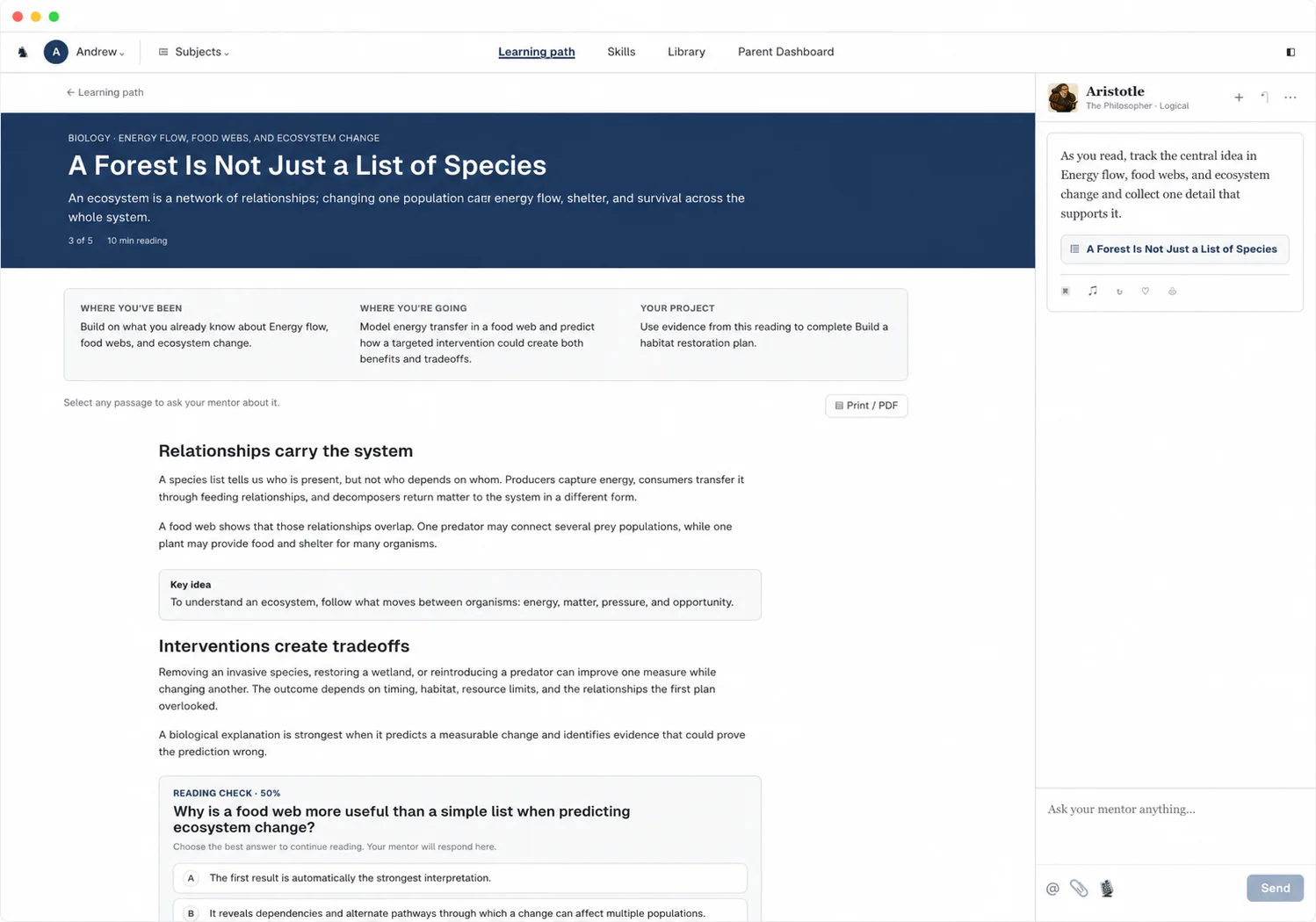
An ecosystem is a network of relationships; changing one population can change energy flow, shelter, and survival across the whole system.
- Lesson
- A Forest Is Not Just a List of Species
- Goal
- Model energy transfer in a food web and predict how a targeted intervention could create both benefits and tradeoffs.
How a lesson works
A 10-minute reading
This example lesson comes from the unit on energy flow, food webs, and ecosystem change. It moves from “Relationships carry the system” to “Interventions create tradeoffs” and builds to one idea: to understand an ecosystem, follow what moves between organisms: energy, matter, pressure, and opportunity.
Help inside the reading
If your child says a plant grew taller because it got more light, our Always-On Mentor can help them check what the comparison shows and what else might explain it. Your child can also highlight any line of “A Forest Is Not Just a List of Species” to ask about it or ask for a visual, and the mentor offers help on its own when they seem stuck.
A check halfway through
Your child answers “Why is a food web more useful than a simple list when predicting ecosystem change?” before reading on, and the Reading Check at the end asks new questions.
A project your child hands in
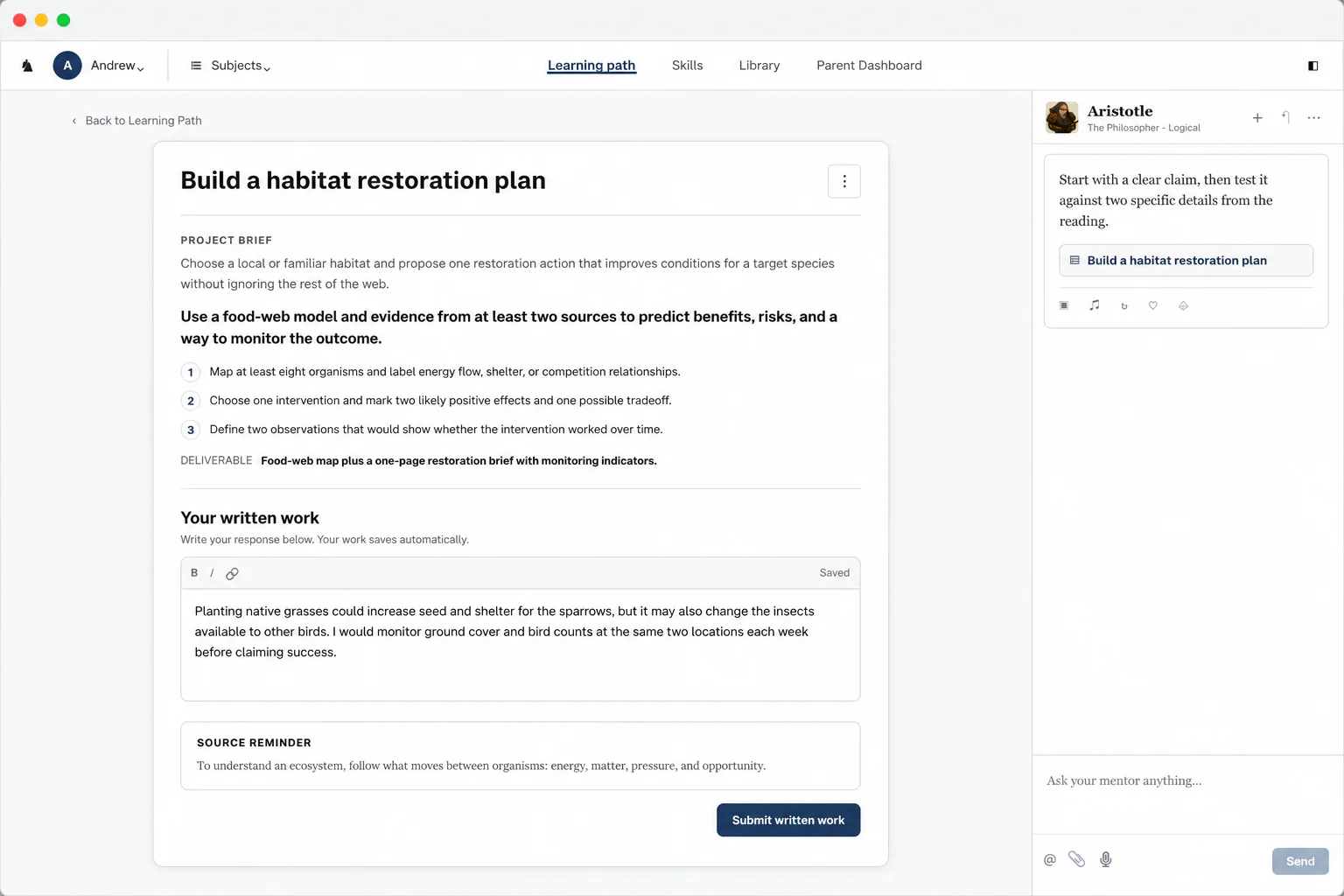
Choose a local or familiar habitat and propose one restoration action that improves conditions for a target species without ignoring the rest of the web.
- Task
- Use a food-web model and evidence from at least two sources to predict benefits, risks, and a way to monitor the outcome
- Hand in
- Food-web map plus a one-page restoration brief with monitoring indicators
Your parent dashboard
- Today
- Each subject's lesson, and whether it's done
- Grades
- Every submission graded instantly, with written feedback, so you never grade
- Records
- Attendance log and learning summary, ready to export

Units and skills by grade
Grade 37 units · 34 skills
Investigation and measurement5 skills
- Ask a testable question about an observation
- Choose a tool to measure length, mass, or temperature
- Record observations in a data table
- Explain why an investigation is repeated
- Communicate a result using a drawing and labels
Matter and its properties5 skills
- Describe an object by its measurable physical properties
- Compare the mass of two objects using a balance
- Measure the volume of a liquid
- Classify matter as a solid, a liquid, or a gas
- Predict what happens to matter when it is heated
Forms of energy5 skills
- Identify mechanical energy in a moving object
- Identify light energy from a source
- Identify sound energy from a vibration
- Identify thermal energy transfer between objects
- Trace energy from its source to its use
Force and motion4 skills
- Describe the motion of an object as a pattern
- Explain how a push or a pull changes motion
- Explain how gravity pulls objects toward Earth
- Compare motion on a smooth and a rough surface
Earth materials and weather5 skills
- Compare soil samples by texture and colour
- Explain how rocks form part of the land
- Describe the steps of the water cycle
- Record weather over several days and describe a pattern
- Explain why seasons change during a year
Sun, moon, and planets4 skills
- Describe the Sun as a source of light and heat
- Describe the pattern of the Moon's appearance
- Explain why the Sun appears to move across the sky
- Name the planets in order from the Sun
Organisms and environments6 skills
- Match a structure of a plant to its function
- Match a structure of an animal to its function
- Sequence the stages of an animal life cycle
- Explain how an inherited trait passes to offspring
- Trace energy through a simple food chain
- Predict how an environmental change affects an organism
Grade 47 units · 34 skills
Investigation and evidence5 skills
- Plan a fair test that changes one variable
- Identify the variable being tested in an investigation
- Construct a bar graph from collected data
- Draw a conclusion supported by collected data
- Explain why two groups reached different results
Properties of matter5 skills
- Classify matter by its measurable physical properties
- Test whether a material conducts thermal energy
- Test whether a material conducts electricity
- Separate a mixture using a physical property
- Compare a mixture with a solution
Energy and circuits5 skills
- Identify a form of energy in an everyday system
- Trace an energy change from one form to another
- Build a complete electrical circuit
- Predict whether a circuit will light a bulb
- Compare an insulator with a conductor in a circuit
Forces and magnetism4 skills
- Measure a force with a spring scale
- Compare the effect of two different forces on motion
- Predict the interaction of two magnetic poles
- Explain how friction slows a moving object
Changing Earth5 skills
- Explain how weathering breaks down rock
- Explain how erosion moves earth materials
- Explain how deposition builds new landforms
- Classify a natural resource as renewable or nonrenewable
- Explain how the water cycle moves water through Earth's systems
Earth, sun, and moon4 skills
- Explain day and night using Earth's rotation
- Explain the year using Earth's orbit
- Model the phases of the Moon
- Compare the Sun, Earth, and Moon by size and motion
Life cycles and ecosystems6 skills
- Compare complete and incomplete metamorphosis
- Match a plant structure to its role in survival
- Trace energy through a food web
- Explain how an adaptation helps an organism survive
- Predict the effect of removing one organism from an ecosystem
- Compare two ecosystems by their living and nonliving parts
Grade 57 units · 34 skills
Scientific practice5 skills
- Write a hypothesis that can be tested
- Identify the control group in an investigation
- Choose a graph type that fits the data collected
- Explain how repeated trials improve confidence in a result
- Critique a conclusion that goes beyond the evidence
Matter and change5 skills
- Classify matter by physical properties including density
- Identify evidence of a physical change
- Identify evidence of a chemical change
- Explain that mass is conserved during a physical change
- Separate a solution and explain the method
Energy transfer5 skills
- Compare how light travels through different materials
- Explain how sound travels through a medium
- Explain thermal energy transfer from warmer to cooler
- Design a circuit that meets a stated requirement
- Trace energy transfer through a connected system
Forces and motion4 skills
- Measure and compare forces acting on an object
- Predict motion when balanced forces act on an object
- Predict motion when unbalanced forces act on an object
- Graph the position of an object over time
Earth systems and resources5 skills
- Classify a rock as sedimentary, igneous, or metamorphic
- Explain how fossils form in sedimentary rock
- Distinguish weather from climate
- Explain how the water cycle connects Earth's systems
- Evaluate a choice about using a natural resource
Space systems4 skills
- Explain that the Sun is a star
- Compare the Sun with other stars by distance and size
- Explain seasons using Earth's tilt and orbit
- Describe how the Moon's phases repeat in a cycle
Organisms and environmental change6 skills
- Explain how a structure helps an organism function
- Compare an inherited trait with a learned behaviour
- Trace matter and energy through a food web
- Predict how an environmental change alters a population
- Explain how organisms respond to a change in their habitat
- Use evidence to explain a species decline
Grade 612 units · 53 skills
Investigation and measurement5 skills
- Identify variables in a controlled investigation
- Measure length, mass, time, and temperature with appropriate precision
- Record observations and measurements in a data table
- Distinguish observation, inference, and explanation
- Revise a simple model after new evidence
Matter and particle models5 skills
- Distinguish substances and mixtures
- Use a particle model to explain states of matter
- Measure density from mass and volume
- Explain conservation of mass in a closed system
- Compare physical and chemical changes
Energy transfer5 skills
- Trace thermal energy transfer by conduction, convection, and radiation
- Compare kinetic and potential energy in simple systems
- Use a model to show energy transformation
- Explain why insulation changes heat flow
- Measure temperature change in an investigation
Forces and motion4 skills
- Calculate speed from distance and time
- Use a graph to describe motion
- Identify balanced and unbalanced forces
- Explain friction in a real motion case
Earth systems and water5 skills
- Model the water cycle with reservoirs and flows
- Explain weathering, erosion, and deposition
- Use maps to identify landform patterns
- Describe how groundwater and surface water interact
- Connect human water use to system limits
Weather and climate introduction4 skills
- Read a weather map for temperature and precipitation
- Explain air pressure and wind in simple terms
- Compare weather and climate
- Use climate data to describe a regional pattern
Ecosystem interactions4 skills
- Build a food web from organisms in an ecosystem
- Explain producer, consumer, and decomposer roles
- Predict effects of a population change
- Describe adaptations in a habitat
Earth, sun, and moon4 skills
- Model day and night from Earth rotation
- Explain seasons using tilt and orbit
- Connect moon phases to relative positions
- Compare solar and lunar eclipses
Engineering design4 skills
- Define criteria and constraints for a design problem
- Compare two design solutions with evidence
- Build a simple prototype plan
- Explain tradeoffs among materials, cost, and performance
Science data and graphs4 skills
- Choose a graph type for investigation data
- Identify a trend from a data display
- Explain an outlier cautiously
- Write a claim using one data pattern
Lab safety and tools4 skills
- Choose safe equipment for a measurement task
- Explain why a lab procedure controls one variable
- Use a microscope or hand lens observation accurately
- Describe how repeated trials improve confidence
Science capstone5 skills
- Design an investigation about matter, energy, water, or ecosystems
- Use a model and data table to support a claim
- Explain a source of measurement error
- Revise a claim after peer feedback
- Present a Grade 6 science explanation
Grade 712 units · 53 skills
Cell structure and function5 skills
- Identify cell membrane, nucleus, cytoplasm, mitochondria, and chloroplast roles
- Compare plant and animal cells
- Use a microscope image to make a cell claim
- Explain how cell structures support life processes
- Distinguish unicellular and multicellular organization
Energy in organisms5 skills
- Trace energy through producers and consumers
- Explain photosynthesis as matter and energy change
- Explain cellular respiration at a middle-school level
- Compare food webs and energy pyramids
- Predict effects of reduced producer population
Genetics and inheritance5 skills
- Distinguish inherited and acquired traits
- Use a Punnett square for a simple trait
- Explain genotype and phenotype in a family example
- Describe mutation as a DNA change
- Interpret a pedigree for a single trait
Human body systems4 skills
- Explain how circulatory and respiratory systems interact
- Describe digestion as matter breakdown and absorption
- Explain nervous-system signaling in a reflex
- Connect exercise to body-system responses
Evolution and adaptation5 skills
- Explain natural selection with variation and environment
- Use fossil evidence to infer change over time
- Compare structural and behavioral adaptations
- Distinguish individual survival from population change
- Interpret a simple evolutionary tree
Ecosystem dynamics4 skills
- Model competition, predation, and mutualism
- Explain carrying capacity with limiting factors
- Use population data to identify a trend
- Predict effects of invasive species
Microbes and health4 skills
- Distinguish bacteria, viruses, and fungi
- Explain how vaccines prepare immune response
- Describe antibiotic resistance as selection
- Evaluate hygiene claims with evidence
Earth and life connections4 skills
- Connect climate patterns to biome distribution
- Explain how water availability shapes ecosystems
- Use a map to compare biodiversity patterns
- Describe human impacts on habitat change
Biotechnology introduction4 skills
- Explain selective breeding with examples
- Interpret a simple DNA fingerprint pattern
- Compare benefits and risks of a biotechnology use
- Use evidence to discuss genetic privacy
Life science investigation4 skills
- Design an investigation with living or model organisms
- Control variables in a growth experiment
- Use repeated measurements for organism data
- Write a claim about a biological pattern
Engineering for living systems4 skills
- Define a problem related to health or ecosystems
- Design a model solution with biological constraints
- Test a prototype using organism or ecosystem criteria
- Revise a design from data
Science capstone5 skills
- Explain an organism system with cells, traits, and environment
- Use data to defend an ecosystem claim
- Compare two biological explanations
- Discuss limits of a life-science model
- Present a Grade 7 evidence argument
Grade 812 units · 53 skills
Atomic matter and periodic patterns5 skills
- Explain atoms, molecules, and compounds with models
- Use the periodic table to infer element properties
- Distinguish pure substances from mixtures
- Model conservation of atoms in a reaction
- Compare acids, bases, and neutral substances with evidence
Chemical reactions5 skills
- Identify signs of a chemical reaction
- Balance a simple chemical equation by atoms
- Explain endothermic and exothermic changes
- Use evidence to distinguish reaction from phase change
- Predict products from a familiar reaction pattern
Forces and Newtonian motion5 skills
- Use Newton's first law to explain motion changes
- Connect net force to acceleration qualitatively
- Explain action-reaction force pairs
- Use free-body diagrams for simple cases
- Calculate speed or acceleration from data
Energy, waves, and information4 skills
- Compare mechanical and electromagnetic waves
- Relate amplitude and energy in a wave
- Explain reflection, refraction, and absorption
- Use wave models to explain sound or light behavior
Electricity and magnetism4 skills
- Build a simple circuit diagram
- Distinguish series and parallel circuits
- Explain current, voltage, and resistance qualitatively
- Describe magnetic fields around magnets and wires
Earth history and geologic time5 skills
- Use rock layers to infer relative age
- Interpret fossil evidence for past environments
- Explain plate tectonics with evidence
- Connect geologic time to gradual and sudden change
- Use maps to identify plate-boundary hazards
Solar system and gravity4 skills
- Explain gravity as an attractive force
- Compare planets by orbit, composition, and atmosphere
- Use scale to model solar-system distances
- Explain tides from Earth-Moon-Sun interactions
Climate systems4 skills
- Trace carbon through atmosphere, ocean, living things, and rocks
- Use climate data to distinguish trend from variation
- Explain feedback in a climate system
- Compare natural and human climate drivers
Scientific modeling and error4 skills
- Revise a model after contradictory evidence
- Interpret error bars in a data display
- Identify confounding variables in a simple investigation
- Use proportional reasoning in science data
Engineering physical systems4 skills
- Design a device that transfers energy
- Optimize a structure under force constraints
- Test a circuit or mechanical prototype
- Use data to choose between designs
Science data argument4 skills
- Use multiple data sources to support a claim
- Explain uncertainty in a measurement
- Identify when data do not support a claim
- Write a scientific explanation with claim, evidence, and reasoning
Science capstone5 skills
- Model a physical or Earth system with matter and energy flows
- Analyze data from a force, reaction, or climate investigation
- Defend a model revision with evidence
- Compare competing explanations
- Present a high-school-readiness science argument
Grade 913 units · 58 skills
Biology: methods and models5 skills
- Design a controlled biology investigation
- Use a microscope image as evidence
- Model matter and energy flow in living systems
- Calculate and interpret biological rates
- Explain limits of a biological model
Cells and homeostasis5 skills
- Explain membrane transport with concentration gradients
- Describe enzyme function and factors that affect it
- Connect organelles to cell energy needs
- Explain cell cycle checkpoints at an introductory level
- Use evidence to identify loss of homeostasis
Photosynthesis and respiration5 skills
- Trace matter through photosynthesis
- Trace energy through cellular respiration
- Compare aerobic and anaerobic respiration
- Use a model to connect carbon cycling and organism energy
- Interpret data from a plant-growth investigation
Molecular genetics5 skills
- Explain DNA, genes, chromosomes, and proteins
- Use base-pairing rules in a DNA model
- Predict inheritance using Mendelian patterns
- Explain mutation effects on proteins and traits
- Interpret a simple gel or pedigree result
Evolution and common ancestry4 skills
- Explain natural selection using variation, inheritance, and differential survival
- Use fossil, anatomical, and molecular evidence for common ancestry
- Distinguish adaptation from acclimation
- Model allele-frequency change qualitatively
Ecology and human impact5 skills
- Analyze energy flow through trophic levels
- Use population data to explain ecosystem change
- Evaluate human impacts on biodiversity
- Explain resilience and disturbance in ecosystems
- Compare conservation strategies with tradeoffs
Body systems and feedback4 skills
- Explain negative feedback in blood glucose regulation
- Connect nervous and endocrine signaling
- Explain immune response to infection
- Analyze how body systems maintain internal stability
Biotechnology and ethics4 skills
- Explain gene editing at a conceptual level
- Interpret DNA evidence in a case scenario
- Compare medical and agricultural biotechnology uses
- Evaluate ethical tradeoffs with evidence
Biology data and statistics4 skills
- Use mean and variability in biological data
- Interpret a graph of population or enzyme data
- Distinguish correlation and causation in health claims
- Evaluate sample size in a biology study
Biological engineering design4 skills
- Design a solution for a health or ecosystem problem
- Choose biological criteria and constraints
- Test a prototype or intervention plan
- Revise a design from biological evidence
Scientific sources in biology4 skills
- Read a biology abstract for claim and method
- Compare a popular article with a primary-data claim
- Identify overstatement in a health headline
- Cite biological evidence accurately
AP exam readiness4 skills
- Analyze a Biology-style experimental stimulus with variables and controls
- Interpret a cell, genetics, evolution, or ecology graph under time limits
- Choose evidence that supports or weakens a biological explanation
- Write a concise Biology claim-evidence-reasoning response
Science capstone5 skills
- Build a model of a living system across scales
- Use data to defend an ecological or genetic claim
- Critique a biological explanation
- Discuss ethical limits of a biotechnology use
- Present a Biology-level science argument
Grade 1013 units · 58 skills
Atomic structure and periodic trends6 skills
- Identify protons, neutrons, and electrons by charge and location
- Use atomic number and mass number to infer particles
- Explain isotopes and average atomic mass
- Use periodic trends to compare atoms
- Connect electron arrangement to chemical behavior
- Interpret evidence from atomic models over time
Chemical bonding and structure5 skills
- Compare ionic, covalent, and metallic bonding
- Draw Lewis structures for simple molecules
- Predict molecular polarity from bond and shape evidence
- Relate structure to melting point or conductivity
- Explain intermolecular forces in a substance property
Reactions and stoichiometry5 skills
- Balance a chemical equation
- Classify common reaction types
- Use mole ratios in a stoichiometry calculation
- Identify limiting reactant in a simple case
- Connect conservation of mass to reaction calculations
Thermochemistry4 skills
- Distinguish endothermic and exothermic processes
- Interpret an energy diagram
- Calculate heat transfer using temperature change
- Explain bond energy in reaction energy change
Solutions, acids, and bases5 skills
- Calculate solution concentration from amount and volume
- Explain dissolving with particle interactions
- Interpret pH as a logarithmic scale
- Compare strong and weak acid behavior
- Predict precipitation from ion evidence
Reaction rates and equilibrium4 skills
- Explain collision theory with temperature and concentration
- Interpret a reaction-rate graph
- Predict an equilibrium shift with Le Chatelier's principle
- Distinguish rate from equilibrium position
Gases and kinetic theory4 skills
- Use gas laws to relate pressure, volume, and temperature
- Explain gas behavior using particle motion
- Interpret real data from a gas experiment
- Identify limits of ideal gas assumptions
Quantitative chemistry lab4 skills
- Measure mass and volume with significant figures
- Calculate percent yield
- Use calibration or controls in a lab procedure
- Analyze error sources in a chemistry lab
Chemistry data and models4 skills
- Graph reaction data to support a claim
- Compare particle models with macroscopic evidence
- Use dimensional analysis in a chemistry problem
- Evaluate uncertainty in measured chemical data
Chemistry in materials and environment4 skills
- Explain polymers through monomers and properties
- Analyze water quality with chemical indicators
- Compare fuel chemistry and emissions evidence
- Evaluate a materials choice by property and impact
Chemical engineering design4 skills
- Define criteria for a chemical process design
- Optimize reaction or separation conditions
- Test a material against performance constraints
- Revise a process using data
AP exam readiness4 skills
- Analyze a Chemistry-style experimental stimulus with quantities and controls
- Interpret an atomic, reaction, solution, or equilibrium data table under time limits
- Choose evidence that supports or weakens a chemical explanation
- Write a concise Chemistry claim-evidence-reasoning response
Science capstone5 skills
- Use atomic and bonding models to explain a substance property
- Solve a reaction calculation with units and assumptions
- Defend an equilibrium or rate explanation
- Analyze chemistry data with error limits
- Present a Chemistry-level science argument
Grade 1113 units · 59 skills
Kinematics5 skills
- Interpret position-time and velocity-time graphs
- Calculate velocity and acceleration from motion data
- Use equations of motion for constant acceleration
- Analyze projectile motion in horizontal and vertical components
- Connect calculus-style slope ideas to motion graphs
Forces and dynamics6 skills
- Draw a free-body diagram for a multi-force situation
- Apply Newton's second law quantitatively
- Analyze friction on a surface
- Explain action-reaction force pairs without canceling them
- Use force components on an incline
- Evaluate limits of a simplified force model
Energy, work, and power5 skills
- Calculate work from force and displacement
- Use conservation of mechanical energy
- Analyze energy loss to thermal transfer
- Calculate power in a physical system
- Compare energy and force explanations of motion
Momentum and collisions4 skills
- Calculate momentum and impulse
- Use conservation of momentum in one dimension
- Compare elastic and inelastic collisions
- Interpret collision data from a graph
Circular motion and gravitation5 skills
- Calculate centripetal acceleration
- Explain circular motion as changing velocity
- Use universal gravitation qualitatively and quantitatively
- Analyze orbital speed and radius relationships
- Connect satellite motion to gravitational force
Waves, sound, and light4 skills
- Use wave speed, frequency, and wavelength relationships
- Explain interference and standing waves
- Analyze Doppler-effect evidence
- Use ray models for reflection and refraction
Electricity and circuits5 skills
- Use Ohm's law in a circuit problem
- Analyze series and parallel circuits
- Calculate electric power in a device
- Explain electric fields and potential difference
- Use circuit data to identify a faulty component
Magnetism and electromagnetic induction4 skills
- Describe magnetic force on moving charges
- Explain field patterns around magnets and currents
- Analyze induction in a generator or transformer
- Connect electromagnetic waves to energy transfer
Thermal physics and fluids4 skills
- Apply conservation of energy to thermal systems
- Explain pressure in fluids
- Use density and buoyancy in a model
- Interpret phase-change energy data
Modern physics4 skills
- Explain photoelectric-effect evidence conceptually
- Compare wave and particle models of light
- Interpret nuclear decay notation
- Analyze benefits and risks of nuclear technology
Physics lab and modeling4 skills
- Linearize data to test a physics model
- Use uncertainty to compare measured and expected values
- Design a controlled mechanics or circuit investigation
- Defend a model choice from data
AP exam readiness4 skills
- Analyze a Physics-style experimental stimulus with variables and controls
- Interpret a motion, force, energy, wave, or circuit graph under time limits
- Choose evidence that supports or weakens a physical explanation
- Write a concise Physics claim-evidence-reasoning response
Science capstone5 skills
- Build and test a quantitative physics model
- Use multiple graphs to defend a motion or circuit claim
- Critique assumptions in a force or energy model
- Quantify uncertainty in an experiment
- Present a Physics-level science argument
Grade 1213 units · 57 skills
Advanced scientific research design6 skills
- Turn a broad science question into a testable research design
- Choose variables, controls, and comparison groups
- Plan measurement precision and replication
- Anticipate confounding variables and bias
- Pre-register a claim, method, and analysis plan
- Revise a design after feasibility review
Advanced systems modeling5 skills
- Build a stock-and-flow model for a science system
- Identify feedback loops and delays
- Compare model predictions with data
- Explain assumptions and boundary conditions
- Use sensitivity analysis to test a model
Climate and environmental systems4 skills
- Analyze climate forcing and feedback evidence
- Interpret ocean, atmosphere, and ice data together
- Evaluate land-use and biodiversity tradeoffs
- Compare mitigation and adaptation strategies
Space and planetary science4 skills
- Interpret stellar spectra for composition or motion
- Compare planetary atmospheres and habitability factors
- Use orbital evidence to explain exoplanet detection
- Evaluate claims about space exploration with evidence
Molecular biology and biotechnology4 skills
- Analyze gene regulation at a conceptual level
- Interpret sequencing or protein evidence in a case
- Compare gene therapy, CRISPR, and synthetic biology applications
- Evaluate biosecurity and privacy tradeoffs
Advanced chemistry and materials4 skills
- Connect molecular structure to material properties
- Analyze battery or fuel-cell chemistry evidence
- Compare catalysts by mechanism and performance
- Evaluate a material life-cycle claim
Advanced physics and technology4 skills
- Explain semiconductor behavior conceptually
- Compare sensor technologies by signal and noise
- Analyze energy conversion in a modern device
- Evaluate limits of a physical technology model
Field and community science methods4 skills
- Design a field sampling protocol
- Use geospatial or sensor data responsibly
- Compare citizen-science and controlled-lab evidence
- Explain ethical duties in community data collection
Scientific data analysis4 skills
- Use statistical uncertainty in a science claim
- Compare competing models with residuals or error metrics
- Detect misleading graph choices
- Explain reproducibility and replication limits
Research engineering design4 skills
- Translate research evidence into design criteria
- Prototype a solution under scientific constraints
- Test reliability and failure modes
- Revise a design using quantitative evidence
Science, ethics, and policy4 skills
- Separate scientific claim, value judgment, and policy choice
- Evaluate risk and benefit for affected groups
- Use uncertainty honestly in a recommendation
- Critique a science communication artifact
AP exam readiness4 skills
- Analyze an advanced science research stimulus with method and uncertainty
- Interpret climate, molecular, materials, field, or systems data under time limits
- Choose evidence that supports or weakens an interdisciplinary science claim
- Write a concise advanced science claim-evidence-reasoning response
Science capstone6 skills
- Design an original science investigation or engineering study
- Analyze evidence across at least two scientific domains
- Defend assumptions and uncertainty in a research claim
- Evaluate ethical and societal implications
- Present a college-ready science argument
- Revise the final claim after critique
Questions parents ask
Where does my child start in Science?
- Placement checks your child's current Science skills and sets the first lesson from that result, not from their grade.
How much of the teaching do I do?
- None of it. The course explains each new idea and checks how your child uses it, while the mentor answers questions as they work. Every submission is graded as soon as it comes in, so you never grade it yourself.
Can I use the record for high-school planning?
- Yes. The subject record holds every graded assignment with its written feedback, ready to export. We generate a transcript from the course records, ready for you to sign.
Science, taught around your child
A Science foundation that makes specialized courses more productive when the learner is ready.
$49/month after the trial.