6th grade homeschool curriculum
A full curriculum, starting at your child's level, with lessons connected to their interests and progress you can see.
See the work in 6th grade
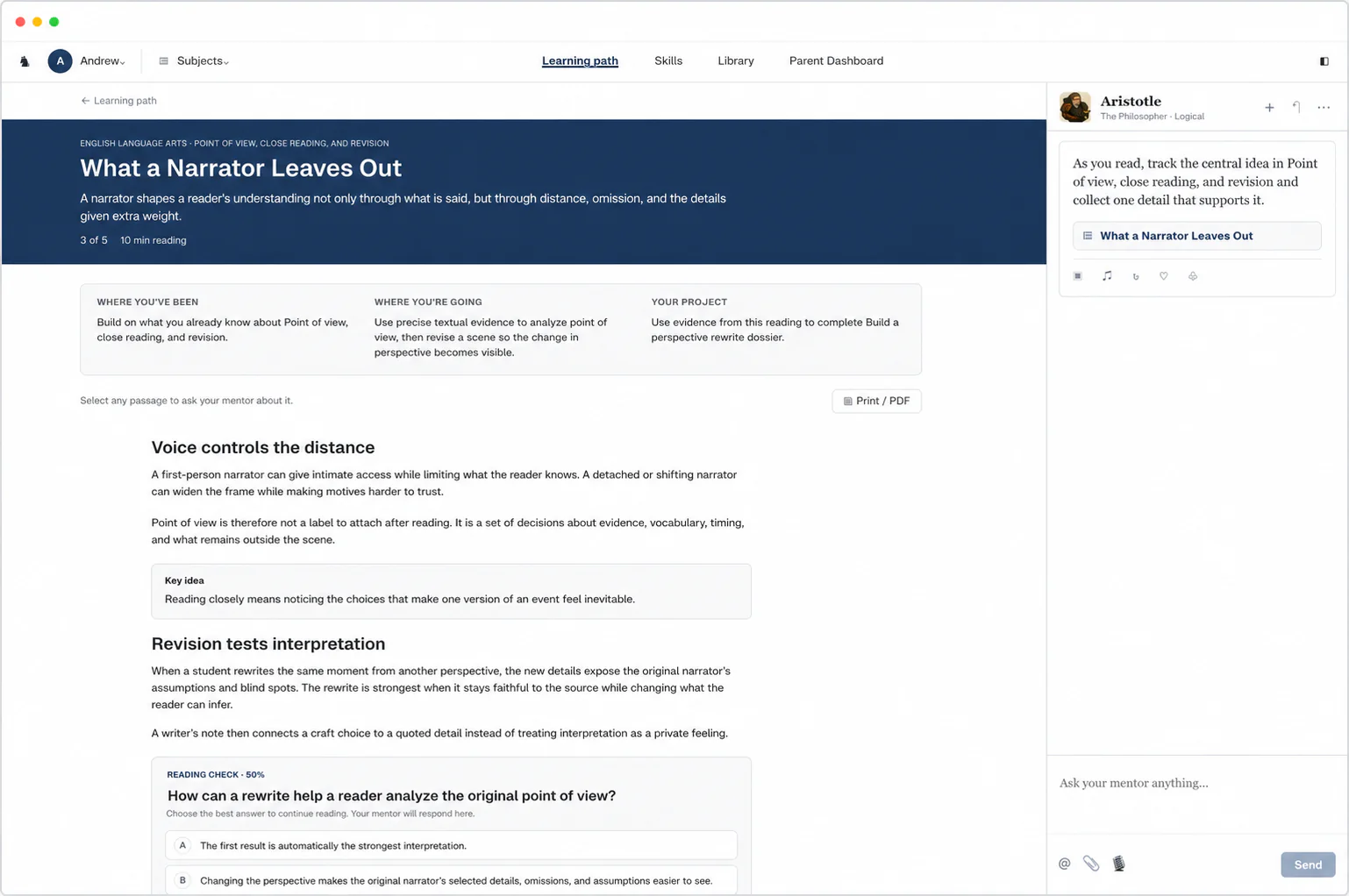
A narrator shapes a reader's understanding not only through what is said, but through distance, omission, and the details given extra weight.
- Lesson
- What a Narrator Leaves Out
- Goal
- Use precise textual evidence to analyze point of view, then revise a scene so the change in perspective becomes visible.
- Project
- Build a perspective rewrite dossier
Your parent dashboard
- Today
- Each subject's lesson, and whether it's done
- Grades
- Every submission graded instantly, with written feedback, so you never grade
- Records
- Attendance log and learning summary, ready to export
- Documents
- Transcripts and state-aware compliance drafts, written for you and ready to sign

6th grade scope and sequence
Math12 units · 54 skills
Ratios, rates, and percents6 skills
- Write a ratio from a real comparison
- Build an equivalent ratio table
- Find a unit rate in a shopping context
- Use a double number line for a ratio situation
- Solve a percent-of-quantity problem
- Explain a rate conversion using units
Fraction and decimal operations5 skills
- Divide fractions with a visual model
- Multiply decimals in a measurement problem
- Use common denominators to compare fractions
- Convert between fractions, decimals, and percents
- Estimate before computing with rational numbers
Integers and coordinate plane4 skills
- Order positive and negative numbers on a number line
- Interpret absolute value as distance
- Plot ordered pairs in all four quadrants
- Use coordinates to describe a real location
Expressions and one-variable equations5 skills
- Evaluate an expression with exponents and variables
- Write an expression from a verbal phrase
- Use the distributive property to rewrite an expression
- Solve a one-step equation with rational numbers
- Write an inequality for a real constraint
Area, surface area, and volume5 skills
- Find area of triangles and parallelograms
- Decompose a polygon into simpler shapes
- Use nets to find surface area
- Find volume of a rectangular prism with fractional edges
- Explain which measurement formula fits a figure
Statistical questions and displays4 skills
- Distinguish statistical from nonstatistical questions
- Make a dot plot from a small data set
- Find mean and median from a data display
- Describe variability using range and clusters
Mathematical reasoning4 skills
- Choose a strategy for a multi-step word problem
- Explain why an estimate is reasonable
- Check an answer using inverse operations
- Compare exact and approximate answers
Scale drawings and maps4 skills
- Read a map scale in a distance problem
- Find a missing length in a scale drawing
- Explain how scale changes perimeter
- Compare original and scaled measurements
Everyday financial math4 skills
- Compute a discount from a percent
- Find sales tax on a purchase
- Compare two unit-price offers
- Explain a simple budget tradeoff
Numeric patterns4 skills
- Extend a pattern from a table
- Describe a rule in words and symbols
- Compare additive and multiplicative patterns
- Use a table to predict a later value
Measurement data project4 skills
- Collect consistent measurement data
- Choose a graph for measurement results
- Write a claim about a class data set
- Revise a claim after checking an outlier
Math capstone5 skills
- Solve a ratio and measurement design problem
- Defend a multi-step calculation with units
- Use a data display to support a decision
- Explain an error in a fraction or percent solution
- Present a complete Grade 6 math argument
Reading6 units · 46 skills
Literary reading9 skills
- Identify theme from repeated details
- Explain character motivation
- Analyze how setting shapes conflict
- Interpret figurative language in context
- Compare narrator perspective
- Analyze symbolism
- Trace conflict development
- Compare character arcs
- Track plot episodes across a chapter
Informational reading9 skills
- Identify central idea
- Trace an author's claim
- Distinguish evidence from commentary
- Summarize a section objectively
- Evaluate source credibility
- Identify text structure
- Evaluate evidence relevance
- Analyze author's assumptions
- Identify main idea and supporting detail
Media and multimodal reading7 skills
- Interpret a chart embedded in an article
- Connect image evidence to a text claim
- Evaluate a caption's relationship to an image
- Compare video and print accounts of an event
- Evaluate scale in an infographic
- Interpret a timeline embedded in text
- Compare headline and article evidence
Vocabulary7 skills
- Use context clues for an unfamiliar word
- Identify connotation
- Distinguish denotation from connotation
- Use word parts to infer meaning
- Infer meaning from analogy
- Use roots and affixes
- Identify figurative versus literal meaning
Evidence7 skills
- Quote textual evidence accurately
- Paraphrase evidence without changing meaning
- Connect evidence to an inference
- Compare evidence across two texts
- Rank evidence by strength
- Explain why evidence is relevant
- Integrate evidence across genres
Fluency and text complexity7 skills
- Read grade-level prose with appropriate pacing
- Use punctuation to guide oral phrasing
- Identify sentence complexity in a passage
- Use background knowledge to prepare for a difficult text
- Use paragraph structure to plan reading pace
- Identify unfamiliar syntax before rereading
- Use repeated reading to improve accuracy
English language arts12 units · 52 skills
Literary elements5 skills
- Identify theme in a short story or poem
- Explain character motivation from dialogue and action
- Analyze how setting shapes conflict
- Describe plot structure with turning points
- Use quoted evidence to support a reading claim
Informational reading5 skills
- Find central idea in an informational article
- Trace how details develop an explanation
- Distinguish fact, opinion, and reasoned claim
- Use text features to locate evidence
- Compare two articles on the same topic
Vocabulary in context4 skills
- Use context clues for an unfamiliar academic word
- Use Greek and Latin roots to infer meaning
- Distinguish literal and figurative language
- Explain how word choice affects tone
Sentences and paragraphs4 skills
- Identify sentence complexity in a passage
- Combine sentences for clarity
- Use commas in a series and introductory phrase
- Write a paragraph with topic sentence and evidence
Narrative writing5 skills
- Plan a narrative with conflict and resolution
- Use dialogue to reveal character
- Control pacing with scene and summary
- Revise sensory details for clarity
- Write an ending that follows from events
Introductory argument writing4 skills
- State a clear claim for a familiar issue
- Choose relevant evidence for a claim
- Explain how evidence supports a reason
- Respond respectfully to a simple counterclaim
Research basics4 skills
- Write a focused research question
- Take notes without copying whole sentences
- Quote and paraphrase a source accurately
- Create a simple works-cited entry
Media and multimodal texts4 skills
- Interpret image, caption, and headline together
- Identify purpose in a short video or infographic
- Compare print and visual versions of information
- Notice missing evidence in media claims
Speaking and listening4 skills
- Prepare discussion notes from a text
- Ask a follow-up question during discussion
- Use evidence in a short oral response
- Organize an oral claim with evidence
Revision and editing4 skills
- Revise vague words into precise words
- Edit for subject-verb agreement
- Use transitions between reasons
- Proofread quotation punctuation
Independent reading habits4 skills
- Track confusion and questions while reading
- Summarize a chapter without retelling every detail
- Explain why a passage matters to the whole text
- Choose a stretch text and reading plan
ELA capstone5 skills
- Write a text-based literary paragraph
- Write a short informational explanation
- Present a claim in discussion
- Revise writing after feedback
- Prepare a Grade 6 reading and writing portfolio
Science12 units · 53 skills
Investigation and measurement5 skills
- Identify variables in a controlled investigation
- Measure length, mass, time, and temperature with appropriate precision
- Record observations and measurements in a data table
- Distinguish observation, inference, and explanation
- Revise a simple model after new evidence
Matter and particle models5 skills
- Distinguish substances and mixtures
- Use a particle model to explain states of matter
- Measure density from mass and volume
- Explain conservation of mass in a closed system
- Compare physical and chemical changes
Energy transfer5 skills
- Trace thermal energy transfer by conduction, convection, and radiation
- Compare kinetic and potential energy in simple systems
- Use a model to show energy transformation
- Explain why insulation changes heat flow
- Measure temperature change in an investigation
Forces and motion4 skills
- Calculate speed from distance and time
- Use a graph to describe motion
- Identify balanced and unbalanced forces
- Explain friction in a real motion case
Earth systems and water5 skills
- Model the water cycle with reservoirs and flows
- Explain weathering, erosion, and deposition
- Use maps to identify landform patterns
- Describe how groundwater and surface water interact
- Connect human water use to system limits
Weather and climate introduction4 skills
- Read a weather map for temperature and precipitation
- Explain air pressure and wind in simple terms
- Compare weather and climate
- Use climate data to describe a regional pattern
Ecosystem interactions4 skills
- Build a food web from organisms in an ecosystem
- Explain producer, consumer, and decomposer roles
- Predict effects of a population change
- Describe adaptations in a habitat
Earth, sun, and moon4 skills
- Model day and night from Earth rotation
- Explain seasons using tilt and orbit
- Connect moon phases to relative positions
- Compare solar and lunar eclipses
Engineering design4 skills
- Define criteria and constraints for a design problem
- Compare two design solutions with evidence
- Build a simple prototype plan
- Explain tradeoffs among materials, cost, and performance
Science data and graphs4 skills
- Choose a graph type for investigation data
- Identify a trend from a data display
- Explain an outlier cautiously
- Write a claim using one data pattern
Lab safety and tools4 skills
- Choose safe equipment for a measurement task
- Explain why a lab procedure controls one variable
- Use a microscope or hand lens observation accurately
- Describe how repeated trials improve confidence
Science capstone5 skills
- Design an investigation about matter, energy, water, or ecosystems
- Use a model and data table to support a claim
- Explain a source of measurement error
- Revise a claim after peer feedback
- Present a Grade 6 science explanation
History12 units · 53 skills
Historical methods for ancient worlds5 skills
- Distinguish artifact, primary source, secondary interpretation, chronology, and context
- Build a timeline using BCE/CE, sequence, duration, and turning point language
- Infer limits of evidence from archaeology, inscriptions, oral traditions, and later texts
- Compare two ancient-world sources by author, purpose, audience, and reliability
- Defend a Grade 6 historical claim about historical methods for ancient worlds using conflicting evidence
River valley civilizations4 skills
- Explain how Mesopotamian city-states used irrigation, writing, temples, and law codes
- Analyze Egyptian state power through Nile ecology, pharaohs, bureaucracy, and monument building
- Compare Indus Valley urban planning, trade, sanitation, and unresolved source questions
- Trace early Chinese dynastic authority through geography, ritual, writing, and mandate claims
Agriculture, cities, and social order5 skills
- Explain the Neolithic shift from foraging to farming using evidence and tradeoffs
- Connect surplus, specialization, hierarchy, taxation, and record keeping in early cities
- Compare slavery, labor obligations, gender roles, and class structure in ancient societies
- Evaluate how geography shaped food, settlement, defense, and exchange in early states
- Defend a Grade 6 historical claim about agriculture, cities, and social order using conflicting evidence
Ancient law, religion, and power4 skills
- Analyze Hammurabi-style law as evidence of order, hierarchy, punishment, and authority
- Explain how priesthoods, temples, rituals, and sacred kingship legitimized ancient power
- Compare polytheistic traditions and state religion in Mesopotamia, Egypt, Greece, and Rome
- Assess how myths and origin stories preserved values, memory, and political claims
Classical Greece5 skills
- Compare Athens, Sparta, and other poleis by citizenship, military organization, and values
- Explain Athenian direct democracy, exclusion, debate, empire, and civic participation
- Analyze Persian Wars and Peloponnesian War as turning points in Greek power and identity
- Use Greek art, drama, philosophy, and history writing as evidence of cultural priorities
- Defend a Grade 6 historical claim about classical greece using conflicting evidence
Roman Republic and Empire4 skills
- Explain Roman Republic institutions, patronage, citizenship, and checks on power
- Trace Roman expansion from republic to empire using military, economic, and political causes
- Analyze Julius Caesar, Augustus, and imperial rule as evidence of republican breakdown
- Evaluate Roman law, roads, cities, slavery, and citizenship as tools of imperial integration
South Asia and Buddhist worlds4 skills
- Explain Mauryan rule, Ashoka, edicts, Buddhism, and imperial moral authority
- Analyze caste, dharma, kingship, trade, and religious change in ancient South Asia
- Trace Buddhist spread across Asia through merchants, monks, rulers, and translation
- Compare Hindu, Buddhist, and Jain ideas through duty, liberation, nonviolence, and practice
East Asia and classical China5 skills
- Explain Qin standardization, Legalism, bureaucracy, walls, and imperial consolidation
- Analyze Han rule through Confucianism, civil service, Silk Roads, and frontier policy
- Compare Confucian, Daoist, and Legalist views of order, family, state, and human nature
- Use Chinese inventions, texts, and material evidence to explain continuity and change
- Defend a Grade 6 historical claim about east asia and classical china using conflicting evidence
Exchange networks and empires4 skills
- Map Silk Road exchange of goods, beliefs, technologies, disease, and political influence
- Compare land and sea trade routes by geography, risk, intermediaries, and cultural contact
- Explain how empires used roads, coins, languages, and law to govern diverse peoples
- Assess exchange as both connection and disruption using evidence from multiple regions
Late antiquity and world religions4 skills
- Trace the rise and spread of Christianity inside and beyond the Roman Empire
- Explain Jewish diaspora, preservation of identity, imperial pressure, and religious memory
- Compare religious diffusion through conquest, trade, mission, migration, and state sponsorship
- Analyze late-antique transformations as continuity, crisis, adaptation, and new religious and political forms
Ancient-world comparison4 skills
- Compare two ancient civilizations using governance, environment, labor, belief, and exchange
- Construct a causation paragraph explaining why one ancient state expanded or declined
- Use archaeological and written evidence together without overstating what either proves
- Evaluate whether ancient empires solved or intensified problems of diversity and distance
Ancient history capstone5 skills
- Build an evidence-backed museum exhibit label for an ancient-world artifact
- Defend a claim about state power in an ancient civilization using three source types
- Compare classical societies by citizenship, empire, labor, gender, and political legitimacy
- Present a historical argument with claim, evidence, context, counterclaim, and limits
- Defend a Grade 6 historical claim about ancient history capstone using conflicting evidence
FAQ
- What happens when my child is stuck in a lesson?
- Help arrives before frustration does. Our Always-On Mentor offers help on its own when your child seems stuck, and they can highlight any ratio problem or ancient-history paragraph to ask about it. After a missed answer it can explain the idea another way or sketch it on its board.
- How much time does school take each day?
- There is no fixed daily length. Each lesson shows its estimated time, and our Parent Dashboard adds up the day, so you can see the hours against your state's instruction-time rules.
- What math does 6th grade cover?
- Ratios and proportional reasoning, dividing fractions, negative numbers, expressions and equations, basic statistics, and area, surface area, and volume. Lessons ask your child to explain why each procedure works, because this is the year arithmetic turns into algebra.
- Which skills does my 6th grader need before algebra?
- Fractions, decimals, and negative numbers are prerequisites for Algebra 1. Placement checks those skills and finds the starting point, so your child can strengthen a gap or move into algebra when ready.
- How much of 6th grade can my child do on their own?
- More than last year, one subject at a time. Your child opens the next lesson and works through it on their own. On longer projects the mentor guides each step without doing the work for them.
Build 6th grade around your child
Start with the 6th grade skills your child needs next, with room to move ahead in one subject and review in another.
Start your 14-day free trial
$149/month per child after the trial.