Materials Science for your homeschool
Your child compares materials, predicts how they will perform, and uses test results to decide which fits a design.
A lesson built around your child
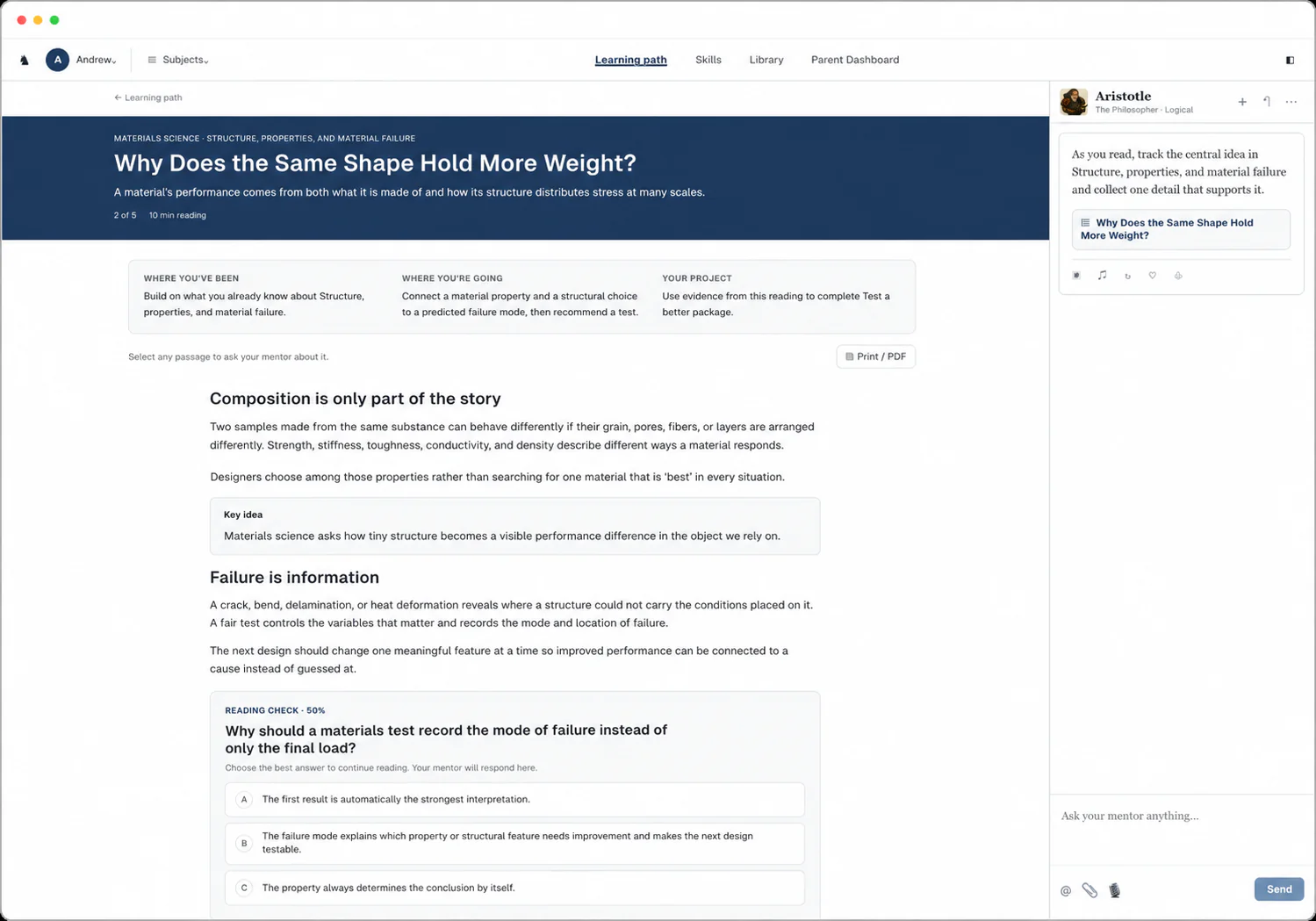
A material's performance comes from both what it is made of and how its structure distributes stress at many scales.
- Lesson
- Why Does the Same Shape Hold More Weight?
- Goal
- Connect a material property and a structural choice to a predicted failure mode, then recommend a test.
How a lesson works
A 10-minute reading
This example lesson comes from the unit on structure, properties, and material failure. It moves from “Composition is only part of the story” to “Failure is information” and builds to one idea: materials science asks how tiny structure becomes a visible performance difference in the object we rely on.
Help inside the reading
If a material bends or breaks in a test, our Always-On Mentor can help your child compare the result with the design requirement and measurements. Your child can also highlight any line of “Why Does the Same Shape Hold More Weight?” to ask about it or ask for a visual, and the mentor offers help on its own when they seem stuck.
A check halfway through
Your child answers “Why should a materials test record the mode of failure instead of only the final load?” before reading on, and the Reading Check at the end asks new questions.
A project your child hands in
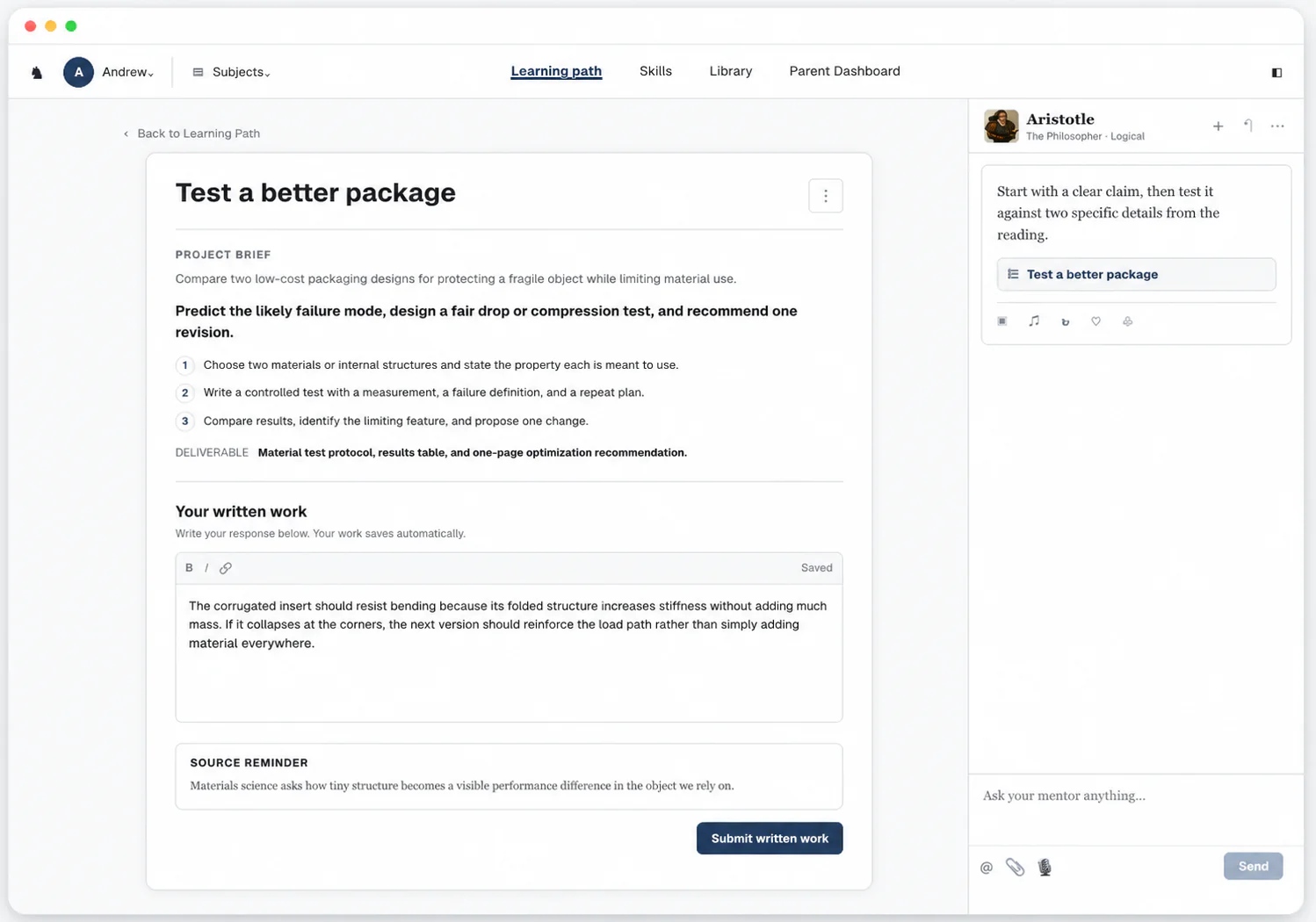
Compare two low-cost packaging designs for protecting a fragile object while limiting material use.
- Task
- Predict the likely failure mode, design a fair drop or compression test, and recommend one revision
- Hand in
- Material test protocol, results table, and one-page optimization recommendation
Your parent dashboard
- Today
- Each subject's lesson, and whether it's done
- Grades
- Every submission graded instantly, with written feedback, so you never grade
- Records
- Attendance log and learning summary, ready to export

Units and skills
Connects chemistry, physics, and engineering through why materials behave differently and how designers choose them. Materials Science is one skill tree for every grade with 12 units, from atomic structure and bonding to materials selection capstone, and your child's grade sets how deep each unit goes.
Materials Science12 units · 60 skills
Atomic structure and bonding5 skills
- Define the vocabulary, boundaries, and common misconceptions of Atomic structure and bonding
- Explain the main actors, mechanisms, sequence, and constraints in Atomic structure and bonding
- Interpret evidence, data, cases, or examples connected to Atomic structure and bonding
- Apply Atomic structure and bonding to a realistic materials selection or failure problem
- Create a materials selection memo that justifies decisions about Atomic structure and bonding
Crystal structures and defects5 skills
- Define the vocabulary, boundaries, and common misconceptions of Crystal structures and defects
- Explain the main actors, mechanisms, sequence, and constraints in Crystal structures and defects
- Interpret evidence, data, cases, or examples connected to Crystal structures and defects
- Apply Crystal structures and defects to a realistic materials selection or failure problem
- Create a materials selection memo that justifies decisions about Crystal structures and defects
Mechanical properties and stress-strain behavior5 skills
- Define the vocabulary, boundaries, and common misconceptions of Mechanical properties and stress-strain behavior
- Explain the main actors, mechanisms, sequence, and constraints in Mechanical properties and stress-strain behavior
- Interpret evidence, data, cases, or examples connected to Mechanical properties and stress-strain behavior
- Apply Mechanical properties and stress-strain behavior to a realistic materials selection or failure problem
- Create a materials selection memo that justifies decisions about Mechanical properties and stress-strain behavior
Thermal properties and phase change5 skills
- Define the vocabulary, boundaries, and common misconceptions of Thermal properties and phase change
- Explain the main actors, mechanisms, sequence, and constraints in Thermal properties and phase change
- Interpret evidence, data, cases, or examples connected to Thermal properties and phase change
- Apply Thermal properties and phase change to a realistic materials selection or failure problem
- Create a materials selection memo that justifies decisions about Thermal properties and phase change
Polymers, ceramics, metals, and composites5 skills
- Define the vocabulary, boundaries, and common misconceptions of Polymers, ceramics, metals, and composites
- Explain the main actors, mechanisms, sequence, and constraints in Polymers, ceramics, metals, and composites
- Interpret evidence, data, cases, or examples connected to Polymers, ceramics, metals, and composites
- Apply Polymers, ceramics, metals, and composites to a realistic materials selection or failure problem
- Create a materials selection memo that justifies decisions about Polymers, ceramics, metals, and composites
Materials processing and manufacturing5 skills
- Define the vocabulary, boundaries, and common misconceptions of Materials processing and manufacturing
- Explain the main actors, mechanisms, sequence, and constraints in Materials processing and manufacturing
- Interpret evidence, data, cases, or examples connected to Materials processing and manufacturing
- Apply Materials processing and manufacturing to a realistic materials selection or failure problem
- Create a materials selection memo that justifies decisions about Materials processing and manufacturing
Corrosion, degradation, and failure5 skills
- Define the vocabulary, boundaries, and common misconceptions of Corrosion, degradation, and failure
- Explain the main actors, mechanisms, sequence, and constraints in Corrosion, degradation, and failure
- Interpret evidence, data, cases, or examples connected to Corrosion, degradation, and failure
- Apply Corrosion, degradation, and failure to a realistic materials selection or failure problem
- Create a materials selection memo that justifies decisions about Corrosion, degradation, and failure
Microstructure, imaging, and characterization5 skills
- Define the vocabulary, boundaries, and common misconceptions of Microstructure, imaging, and characterization
- Explain the main actors, mechanisms, sequence, and constraints in Microstructure, imaging, and characterization
- Interpret evidence, data, cases, or examples connected to Microstructure, imaging, and characterization
- Apply Microstructure, imaging, and characterization to a realistic materials selection or failure problem
- Create a materials selection memo that justifies decisions about Microstructure, imaging, and characterization
Electronic, magnetic, and optical properties5 skills
- Define the vocabulary, boundaries, and common misconceptions of Electronic, magnetic, and optical properties
- Explain the main actors, mechanisms, sequence, and constraints in Electronic, magnetic, and optical properties
- Interpret evidence, data, cases, or examples connected to Electronic, magnetic, and optical properties
- Apply Electronic, magnetic, and optical properties to a realistic materials selection or failure problem
- Create a materials selection memo that justifies decisions about Electronic, magnetic, and optical properties
Biomaterials and soft materials5 skills
- Define the vocabulary, boundaries, and common misconceptions of Biomaterials and soft materials
- Explain the main actors, mechanisms, sequence, and constraints in Biomaterials and soft materials
- Interpret evidence, data, cases, or examples connected to Biomaterials and soft materials
- Apply Biomaterials and soft materials to a realistic materials selection or failure problem
- Create a materials selection memo that justifies decisions about Biomaterials and soft materials
Sustainability and life-cycle assessment5 skills
- Define the vocabulary, boundaries, and common misconceptions of Sustainability and life-cycle assessment
- Explain the main actors, mechanisms, sequence, and constraints in Sustainability and life-cycle assessment
- Interpret evidence, data, cases, or examples connected to Sustainability and life-cycle assessment
- Apply Sustainability and life-cycle assessment to a realistic materials selection or failure problem
- Create a materials selection memo that justifies decisions about Sustainability and life-cycle assessment
Materials selection capstone5 skills
- Define the vocabulary, boundaries, and common misconceptions of Materials selection capstone
- Explain the main actors, mechanisms, sequence, and constraints in Materials selection capstone
- Interpret evidence, data, cases, or examples connected to Materials selection capstone
- Apply Materials selection capstone to a realistic materials selection or failure problem
- Create a materials selection memo that justifies decisions about Materials selection capstone
Questions parents ask
Which grades can use this Materials Science curriculum?
- One Materials Science skill tree serves grades 3 to 12, with course pages for 9th grade and high school. Placement checks your child's current skills, so the first lesson can sit before or after their grade.
What should my child know before starting?
- Starting skills include basic chemistry helpful, interest in how things work, and comfort with measurement. If placement finds a gap, the course starts with those skills.
How much of the teaching do I do?
- None of it. The course explains each new idea and checks how your child uses it, while the mentor answers questions as they work. Every submission is graded as soon as it comes in, so you never grade it yourself.
Can I use the record for high-school planning?
- Yes. The subject record holds every graded assignment with its written feedback, ready to export. We generate a transcript from the course records, ready for you to sign.
Materials Science, taught around your child
Materials knowledge that improves the next design decision.
$49/month after the trial.