Architecture for your homeschool
Your child designs for a real set of needs, tests the layout against the constraints, and explains the changes they make.
A lesson built around your child
Architecture turns a client's needs, a site's conditions, and material limits into a space people can actually inhabit.
- Lesson
- A Building Is a Negotiation With Light
- Goal
- Compare two spatial concepts and justify a revision using circulation, daylight, structure, and user needs.
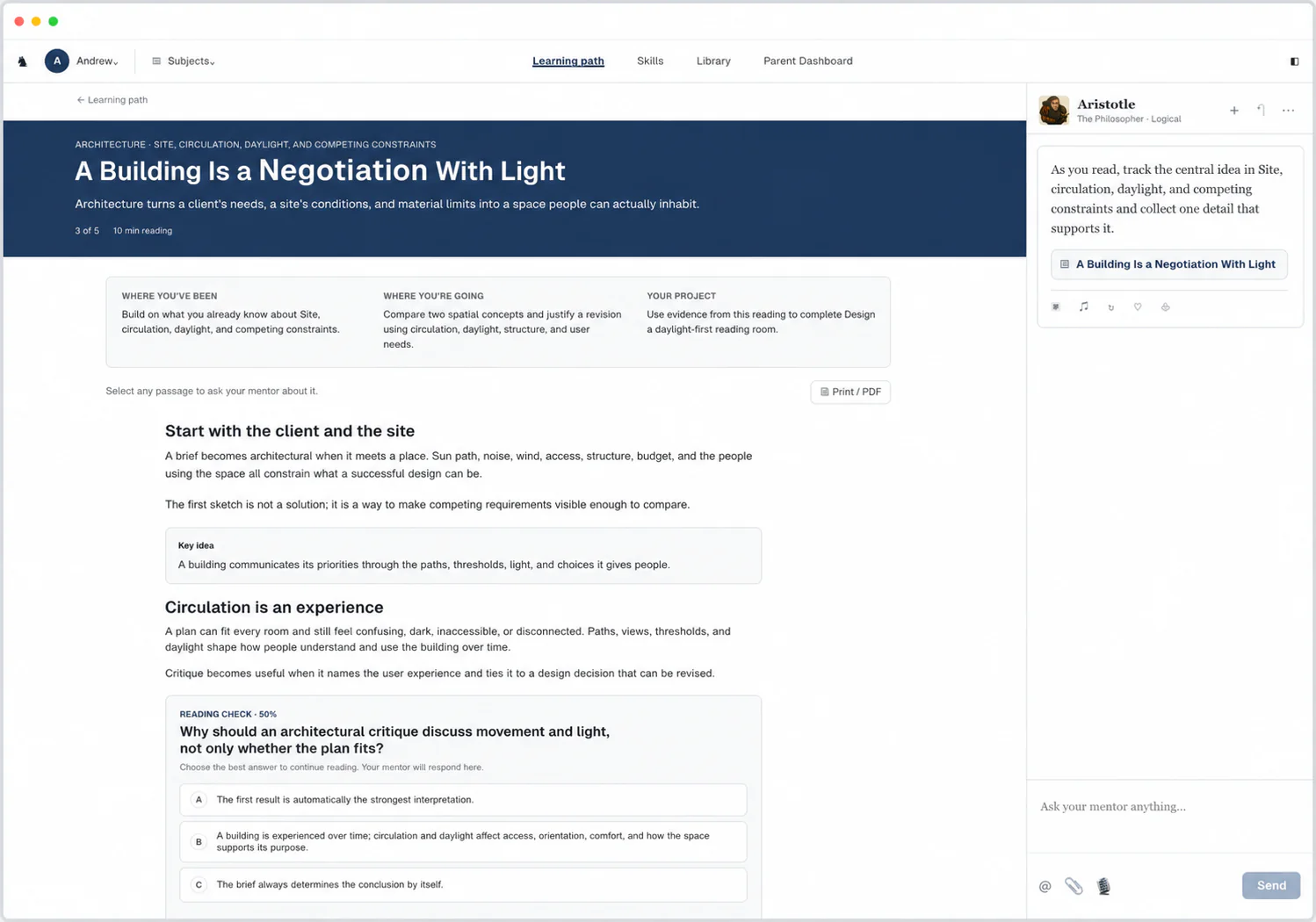
How a lesson works
A 10-minute reading
This example lesson comes from the unit on site, circulation, daylight, and competing constraints. It moves from “Start with the client and the site” to “Circulation is an experience” and builds to one idea: a building communicates its priorities through the paths, thresholds, light, and choices it gives people.
Help inside the reading
If a room plan looks good but blocks a doorway, our Always-On Mentor can help your child check the measurements and the needs behind the design. Your child can also highlight any line of “A Building Is a Negotiation With Light” to ask about it or ask for a visual, and the mentor offers help on its own when they seem stuck.
A check halfway through
Your child answers “Why should an architectural critique discuss movement and light, not only whether the plan fits?” before reading on, and the Reading Check at the end asks new questions.
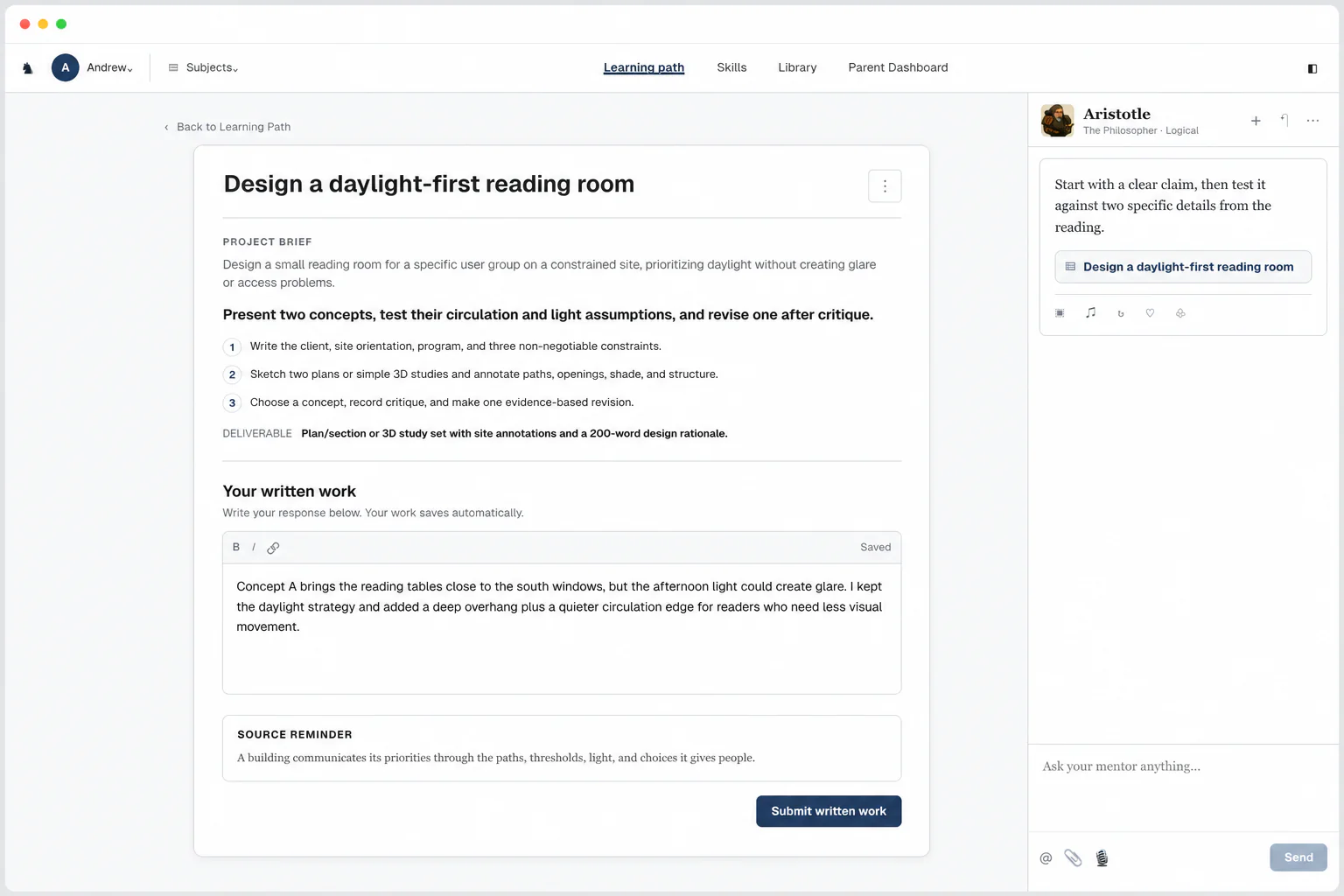
A project your child hands in
Design a small reading room for a specific user group on a constrained site, prioritizing daylight without creating glare or access problems.
- Task
- Present two concepts, test their circulation and light assumptions, and revise one after critique
- Hand in
- Plan/section or 3D study set with site annotations and a 200-word design rationale
Your parent dashboard
- Today
- Each subject's lesson, and whether it's done
- Grades
- Every submission graded instantly, with written feedback, so you never grade
- Records
- Attendance log and learning summary, ready to export

Units and skills
Treats architecture as an integration of geometry, structure, human experience, culture, environment, and communication. Architecture is one skill tree for every grade with 12 units, from site, climate, and human use to architecture studio capstone, and your child's grade sets how deep each unit goes.
Architecture12 units · 60 skills
Site, climate, and human use5 skills
- Define the vocabulary, boundaries, and common misconceptions of Site, climate, and human use
- Explain the main actors, mechanisms, sequence, and constraints in Site, climate, and human use
- Interpret evidence, data, cases, or examples connected to Site, climate, and human use
- Apply Site, climate, and human use to a realistic site and building brief
- Create a studio board that justifies decisions about Site, climate, and human use
Architectural drawing and visual conventions5 skills
- Define the vocabulary, boundaries, and common misconceptions of Architectural drawing and visual conventions
- Explain the main actors, mechanisms, sequence, and constraints in Architectural drawing and visual conventions
- Interpret evidence, data, cases, or examples connected to Architectural drawing and visual conventions
- Apply Architectural drawing and visual conventions to a realistic site and building brief
- Create a studio board that justifies decisions about Architectural drawing and visual conventions
Scale, proportion, and spatial organization5 skills
- Define the vocabulary, boundaries, and common misconceptions of Scale, proportion, and spatial organization
- Explain the main actors, mechanisms, sequence, and constraints in Scale, proportion, and spatial organization
- Interpret evidence, data, cases, or examples connected to Scale, proportion, and spatial organization
- Apply Scale, proportion, and spatial organization to a realistic site and building brief
- Create a studio board that justifies decisions about Scale, proportion, and spatial organization
Materials, structure, and envelope5 skills
- Define the vocabulary, boundaries, and common misconceptions of Materials, structure, and envelope
- Explain the main actors, mechanisms, sequence, and constraints in Materials, structure, and envelope
- Interpret evidence, data, cases, or examples connected to Materials, structure, and envelope
- Apply Materials, structure, and envelope to a realistic site and building brief
- Create a studio board that justifies decisions about Materials, structure, and envelope
Circulation, accessibility, and life safety5 skills
- Define the vocabulary, boundaries, and common misconceptions of Circulation, accessibility, and life safety
- Explain the main actors, mechanisms, sequence, and constraints in Circulation, accessibility, and life safety
- Interpret evidence, data, cases, or examples connected to Circulation, accessibility, and life safety
- Apply Circulation, accessibility, and life safety to a realistic site and building brief
- Create a studio board that justifies decisions about Circulation, accessibility, and life safety
Building systems and environmental performance5 skills
- Define the vocabulary, boundaries, and common misconceptions of Building systems and environmental performance
- Explain the main actors, mechanisms, sequence, and constraints in Building systems and environmental performance
- Interpret evidence, data, cases, or examples connected to Building systems and environmental performance
- Apply Building systems and environmental performance to a realistic site and building brief
- Create a studio board that justifies decisions about Building systems and environmental performance
Housing, civic, and institutional precedents5 skills
- Define the vocabulary, boundaries, and common misconceptions of Housing, civic, and institutional precedents
- Explain the main actors, mechanisms, sequence, and constraints in Housing, civic, and institutional precedents
- Interpret evidence, data, cases, or examples connected to Housing, civic, and institutional precedents
- Apply Housing, civic, and institutional precedents to a realistic site and building brief
- Create a studio board that justifies decisions about Housing, civic, and institutional precedents
Urban context and public realm5 skills
- Define the vocabulary, boundaries, and common misconceptions of Urban context and public realm
- Explain the main actors, mechanisms, sequence, and constraints in Urban context and public realm
- Interpret evidence, data, cases, or examples connected to Urban context and public realm
- Apply Urban context and public realm to a realistic site and building brief
- Create a studio board that justifies decisions about Urban context and public realm
Codes, clients, budget, and project delivery5 skills
- Define the vocabulary, boundaries, and common misconceptions of Codes, clients, budget, and project delivery
- Explain the main actors, mechanisms, sequence, and constraints in Codes, clients, budget, and project delivery
- Interpret evidence, data, cases, or examples connected to Codes, clients, budget, and project delivery
- Apply Codes, clients, budget, and project delivery to a realistic site and building brief
- Create a studio board that justifies decisions about Codes, clients, budget, and project delivery
Modeling, critique, and iteration5 skills
- Define the vocabulary, boundaries, and common misconceptions of Modeling, critique, and iteration
- Explain the main actors, mechanisms, sequence, and constraints in Modeling, critique, and iteration
- Interpret evidence, data, cases, or examples connected to Modeling, critique, and iteration
- Apply Modeling, critique, and iteration to a realistic site and building brief
- Create a studio board that justifies decisions about Modeling, critique, and iteration
Sustainable design and resilience5 skills
- Define the vocabulary, boundaries, and common misconceptions of Sustainable design and resilience
- Explain the main actors, mechanisms, sequence, and constraints in Sustainable design and resilience
- Interpret evidence, data, cases, or examples connected to Sustainable design and resilience
- Apply Sustainable design and resilience to a realistic site and building brief
- Create a studio board that justifies decisions about Sustainable design and resilience
Architecture studio capstone5 skills
- Define the vocabulary, boundaries, and common misconceptions of Architecture studio capstone
- Explain the main actors, mechanisms, sequence, and constraints in Architecture studio capstone
- Interpret evidence, data, cases, or examples connected to Architecture studio capstone
- Apply Architecture studio capstone to a realistic site and building brief
- Create a studio board that justifies decisions about Architecture studio capstone
Questions parents ask
Which grades can use this Architecture curriculum?
- One Architecture skill tree serves grades 3 to 12, with course pages for 9th grade and high school. Placement checks your child's current skills, so the first lesson can sit before or after their grade.
What should my child know before starting?
- Starting skills include spatial awareness, interest in buildings and spaces, and basic drawing or modeling willingness. If placement finds a gap, the course starts with those skills.
How much of the teaching do I do?
- None of it. The course explains each new idea and checks how your child uses it, while the mentor answers questions as they work. Every submission is graded as soon as it comes in, so you never grade it yourself.
Can I use the record for high-school planning?
- Yes. The subject record holds every graded assignment with its written feedback, ready to export. We generate a transcript from the course records, ready for you to sign.
Architecture, taught around your child
Design work that becomes stronger when real constraints enter the room.
$49/month after the trial.