Mechanical Engineering for your homeschool
Your child works through a design problem, calculates what it needs, and tests and revises a model or prototype.
A lesson built around your child
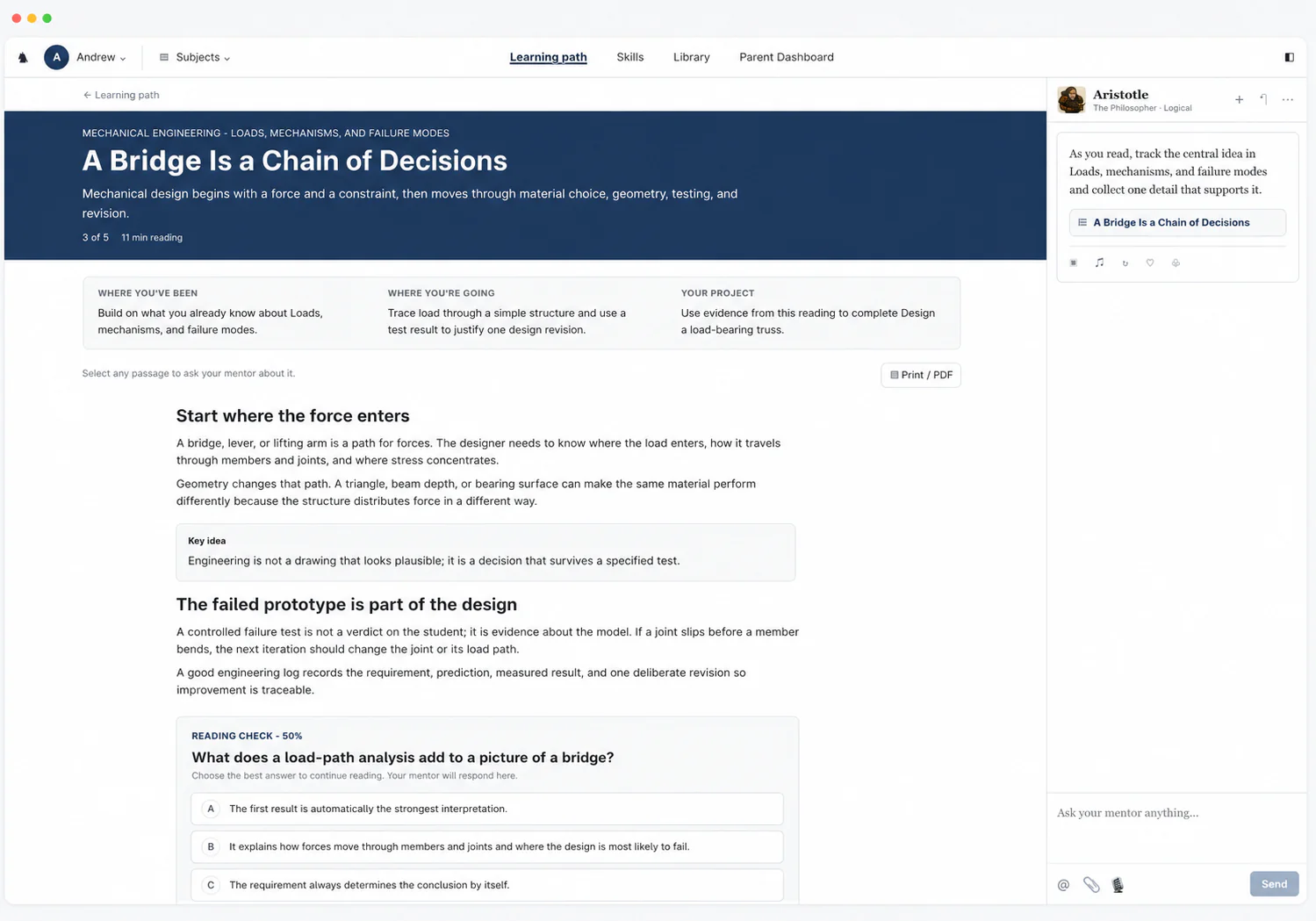
Mechanical design begins with a force and a constraint, then moves through material choice, geometry, testing, and revision.
- Lesson
- A Bridge Is a Chain of Decisions
- Goal
- Trace load through a simple structure and use a test result to justify one design revision.
How a lesson works
An 11-minute reading
This example lesson comes from the unit on loads, mechanisms, and failure modes. It moves from “Start where the force enters” to “The failed prototype is part of the design” and builds to one idea: engineering is not a drawing that looks plausible; it is a decision that survives a specified test.
Help inside the reading
If a model does not move as expected, our Always-On Mentor can help your child check the force, measurement, or design constraint before changing it. Your child can also highlight any line of “A Bridge Is a Chain of Decisions” to ask about it or ask for a visual, and the mentor offers help on its own when they seem stuck.
A check halfway through
Your child answers “What does a load-path analysis add to a picture of a bridge?” before reading on, and the Reading Check at the end asks new questions.
A project your child hands in
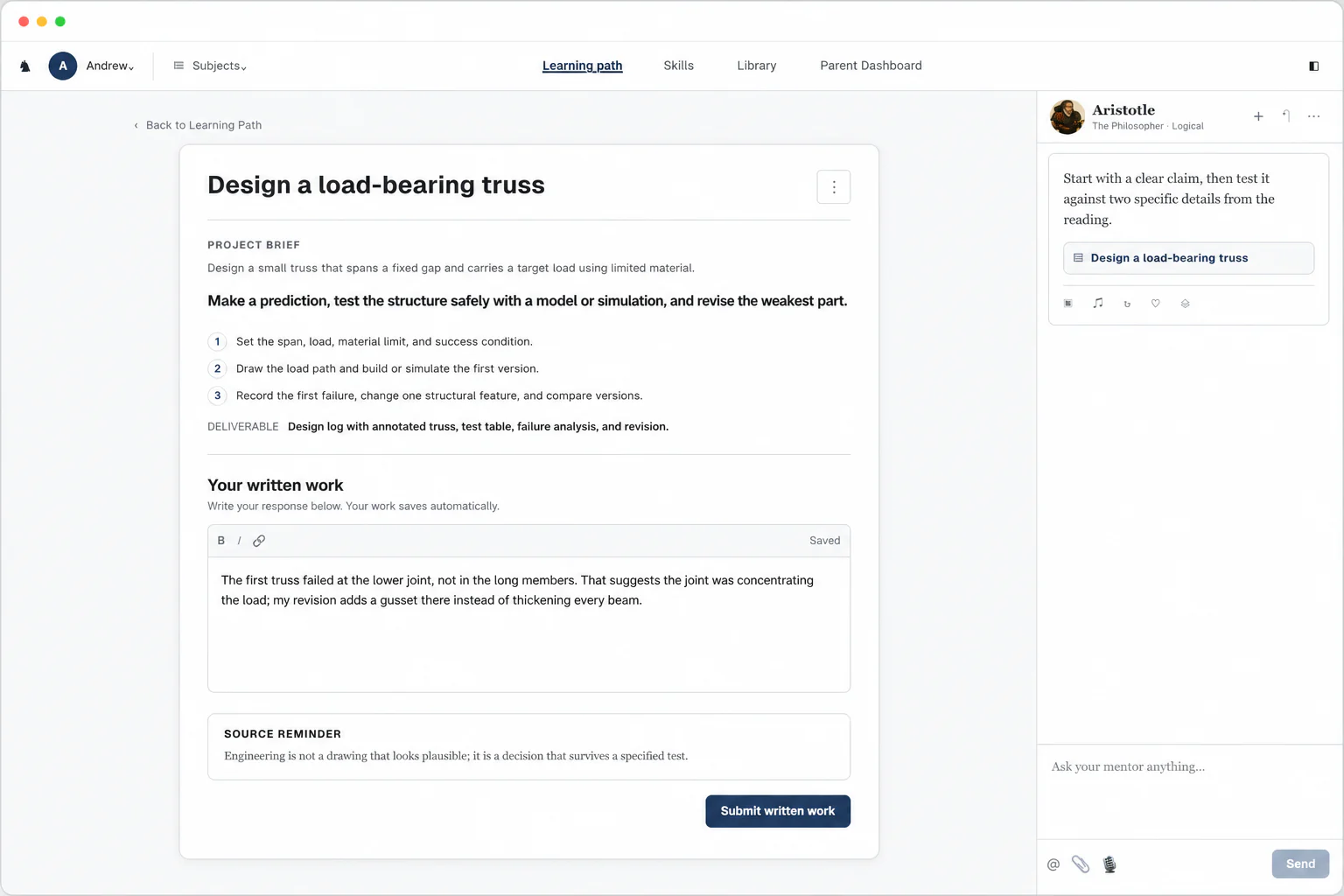
Design a small truss that spans a fixed gap and carries a target load using limited material.
- Task
- Make a prediction, test the structure safely with a model or simulation, and revise the weakest part
- Hand in
- Design log with annotated truss, test table, failure analysis, and revision
Your parent dashboard
- Today
- Each subject's lesson, and whether it's done
- Grades
- Every submission graded instantly, with written feedback, so you never grade
- Records
- Attendance log and learning summary, ready to export

Units and skills
Uses hands-on design to connect physics with mechanisms and practical engineering decisions. Mechanical Engineering is one skill tree for every grade with 12 units, from forces, free-body diagrams, and equilibrium to mechanical design capstone, and your child's grade sets how deep each unit goes.
Mechanical Engineering12 units · 60 skills
Forces, free-body diagrams, and equilibrium5 skills
- Define the vocabulary, boundaries, and common misconceptions of Forces, free-body diagrams, and equilibrium
- Explain the main actors, mechanisms, sequence, and constraints in Forces, free-body diagrams, and equilibrium
- Interpret evidence, data, cases, or examples connected to Forces, free-body diagrams, and equilibrium
- Apply Forces, free-body diagrams, and equilibrium to a realistic mechanical design or analysis problem
- Create a mechanical design report that justifies decisions about Forces, free-body diagrams, and equilibrium
Kinematics and mechanism motion5 skills
- Define the vocabulary, boundaries, and common misconceptions of Kinematics and mechanism motion
- Explain the main actors, mechanisms, sequence, and constraints in Kinematics and mechanism motion
- Interpret evidence, data, cases, or examples connected to Kinematics and mechanism motion
- Apply Kinematics and mechanism motion to a realistic mechanical design or analysis problem
- Create a mechanical design report that justifies decisions about Kinematics and mechanism motion
Energy, work, power, and efficiency5 skills
- Define the vocabulary, boundaries, and common misconceptions of Energy, work, power, and efficiency
- Explain the main actors, mechanisms, sequence, and constraints in Energy, work, power, and efficiency
- Interpret evidence, data, cases, or examples connected to Energy, work, power, and efficiency
- Apply Energy, work, power, and efficiency to a realistic mechanical design or analysis problem
- Create a mechanical design report that justifies decisions about Energy, work, power, and efficiency
Stress, strain, and machine elements5 skills
- Define the vocabulary, boundaries, and common misconceptions of Stress, strain, and machine elements
- Explain the main actors, mechanisms, sequence, and constraints in Stress, strain, and machine elements
- Interpret evidence, data, cases, or examples connected to Stress, strain, and machine elements
- Apply Stress, strain, and machine elements to a realistic mechanical design or analysis problem
- Create a mechanical design report that justifies decisions about Stress, strain, and machine elements
Fluid mechanics and pressure5 skills
- Define the vocabulary, boundaries, and common misconceptions of Fluid mechanics and pressure
- Explain the main actors, mechanisms, sequence, and constraints in Fluid mechanics and pressure
- Interpret evidence, data, cases, or examples connected to Fluid mechanics and pressure
- Apply Fluid mechanics and pressure to a realistic mechanical design or analysis problem
- Create a mechanical design report that justifies decisions about Fluid mechanics and pressure
Thermodynamics and heat transfer5 skills
- Define the vocabulary, boundaries, and common misconceptions of Thermodynamics and heat transfer
- Explain the main actors, mechanisms, sequence, and constraints in Thermodynamics and heat transfer
- Interpret evidence, data, cases, or examples connected to Thermodynamics and heat transfer
- Apply Thermodynamics and heat transfer to a realistic mechanical design or analysis problem
- Create a mechanical design report that justifies decisions about Thermodynamics and heat transfer
Manufacturing processes and tolerances5 skills
- Define the vocabulary, boundaries, and common misconceptions of Manufacturing processes and tolerances
- Explain the main actors, mechanisms, sequence, and constraints in Manufacturing processes and tolerances
- Interpret evidence, data, cases, or examples connected to Manufacturing processes and tolerances
- Apply Manufacturing processes and tolerances to a realistic mechanical design or analysis problem
- Create a mechanical design report that justifies decisions about Manufacturing processes and tolerances
CAD assemblies and dimensioning5 skills
- Define the vocabulary, boundaries, and common misconceptions of CAD assemblies and dimensioning
- Explain the main actors, mechanisms, sequence, and constraints in CAD assemblies and dimensioning
- Interpret evidence, data, cases, or examples connected to CAD assemblies and dimensioning
- Apply CAD assemblies and dimensioning to a realistic mechanical design or analysis problem
- Create a mechanical design report that justifies decisions about CAD assemblies and dimensioning
Control systems and instrumentation5 skills
- Define the vocabulary, boundaries, and common misconceptions of Control systems and instrumentation
- Explain the main actors, mechanisms, sequence, and constraints in Control systems and instrumentation
- Interpret evidence, data, cases, or examples connected to Control systems and instrumentation
- Apply Control systems and instrumentation to a realistic mechanical design or analysis problem
- Create a mechanical design report that justifies decisions about Control systems and instrumentation
Failure analysis and reliability5 skills
- Define the vocabulary, boundaries, and common misconceptions of Failure analysis and reliability
- Explain the main actors, mechanisms, sequence, and constraints in Failure analysis and reliability
- Interpret evidence, data, cases, or examples connected to Failure analysis and reliability
- Apply Failure analysis and reliability to a realistic mechanical design or analysis problem
- Create a mechanical design report that justifies decisions about Failure analysis and reliability
Design optimization and tradeoffs5 skills
- Define the vocabulary, boundaries, and common misconceptions of Design optimization and tradeoffs
- Explain the main actors, mechanisms, sequence, and constraints in Design optimization and tradeoffs
- Interpret evidence, data, cases, or examples connected to Design optimization and tradeoffs
- Apply Design optimization and tradeoffs to a realistic mechanical design or analysis problem
- Create a mechanical design report that justifies decisions about Design optimization and tradeoffs
Mechanical design capstone5 skills
- Define the vocabulary, boundaries, and common misconceptions of Mechanical design capstone
- Explain the main actors, mechanisms, sequence, and constraints in Mechanical design capstone
- Interpret evidence, data, cases, or examples connected to Mechanical design capstone
- Apply Mechanical design capstone to a realistic mechanical design or analysis problem
- Create a mechanical design report that justifies decisions about Mechanical design capstone
Questions parents ask
Which grades can use this Mechanical Engineering curriculum?
- One Mechanical Engineering skill tree serves grades 3 to 12, with course pages for 9th grade, 10th grade, and high school. Placement checks your child's current skills, so the first lesson can sit before or after their grade.
What should my child know before starting?
- Starting skills include basic math skills, interest in building things, and willingness to iterate. If placement finds a gap, the course starts with those skills.
How much of the teaching do I do?
- None of it. The course explains each new idea and checks how your child uses it, while the mentor answers questions as they work. Every submission is graded as soon as it comes in, so you never grade it yourself.
Can I use the record for high-school planning?
- Yes. The subject record holds every graded assignment with its written feedback, ready to export. We generate a transcript from the course records, ready for you to sign.
Mechanical Engineering, taught around your child
Engineering evidence behind every successful build.
$49/month after the trial.