Middle school homeschool curriculum
Grades 6-8, starting at your child's level and built around their interests, with progress you can see in every subject.
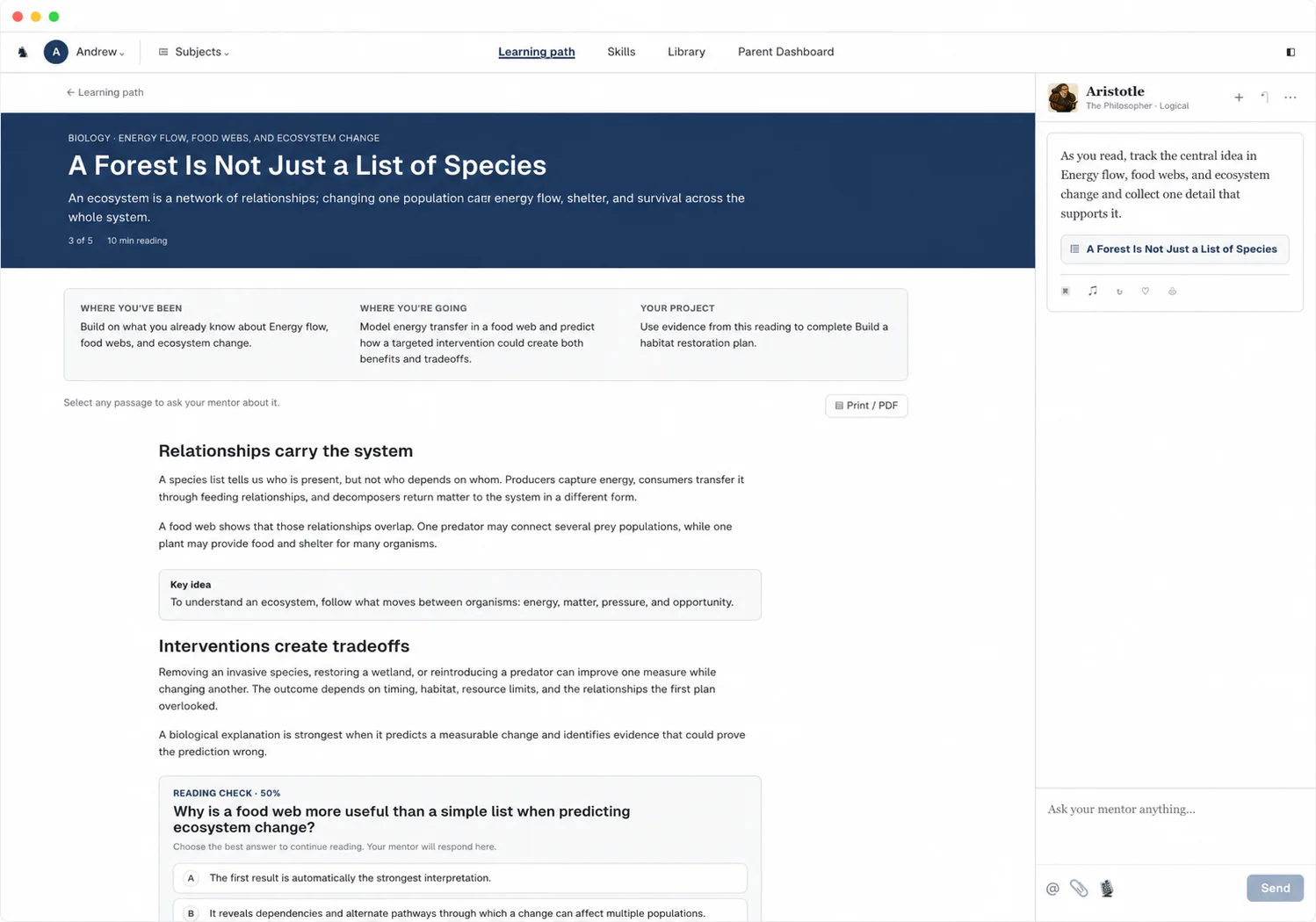
Life science: energy through a forest food web
An ecosystem is a network of relationships; changing one population can change energy flow, shelter, and survival across the whole system.
- Lesson
- A Forest Is Not Just a List of Species
- Goal
- Model energy transfer in a food web and predict how a targeted intervention could create both benefits and tradeoffs.
- Project
- Build a habitat restoration plan
The bridge to high school
Grade 6: build the bridge
Ratios, ancient civilizations, science models, and organized writing build on elementary skills.
Grade 7: connect and explain
Proportional reasoning, life science, source-based writing, and global history demand evidence.
Grade 8: prepare for high school
Linear functions, physical science, argument essays, and U.S. history lead into high school work.
Every grade: a notebook in order
An optional Notebook guide offers tips for organizing notes, including lesson headings, unit names, and ideas worth remembering. Your child can gather useful takeaways onto a review page.
Your parent dashboard
- Today
- Each subject's lesson, and whether it's done
- Grades
- Every submission graded instantly, with written feedback, so you never grade
- Records
- Attendance log and learning summary, ready to export
- Documents
- Transcripts and state-aware compliance drafts, written for you and ready to sign

Scope and sequence by grade
Grade 6
Math12 units · 54 skills
Ratios, rates, and percents6 skills
- Write a ratio from a real comparison
- Build an equivalent ratio table
- Find a unit rate in a shopping context
- Use a double number line for a ratio situation
- Solve a percent-of-quantity problem
- Explain a rate conversion using units
Fraction and decimal operations5 skills
- Divide fractions with a visual model
- Multiply decimals in a measurement problem
- Use common denominators to compare fractions
- Convert between fractions, decimals, and percents
- Estimate before computing with rational numbers
Integers and coordinate plane4 skills
- Order positive and negative numbers on a number line
- Interpret absolute value as distance
- Plot ordered pairs in all four quadrants
- Use coordinates to describe a real location
Expressions and one-variable equations5 skills
- Evaluate an expression with exponents and variables
- Write an expression from a verbal phrase
- Use the distributive property to rewrite an expression
- Solve a one-step equation with rational numbers
- Write an inequality for a real constraint
Area, surface area, and volume5 skills
- Find area of triangles and parallelograms
- Decompose a polygon into simpler shapes
- Use nets to find surface area
- Find volume of a rectangular prism with fractional edges
- Explain which measurement formula fits a figure
Statistical questions and displays4 skills
- Distinguish statistical from nonstatistical questions
- Make a dot plot from a small data set
- Find mean and median from a data display
- Describe variability using range and clusters
Mathematical reasoning4 skills
- Choose a strategy for a multi-step word problem
- Explain why an estimate is reasonable
- Check an answer using inverse operations
- Compare exact and approximate answers
Scale drawings and maps4 skills
- Read a map scale in a distance problem
- Find a missing length in a scale drawing
- Explain how scale changes perimeter
- Compare original and scaled measurements
Everyday financial math4 skills
- Compute a discount from a percent
- Find sales tax on a purchase
- Compare two unit-price offers
- Explain a simple budget tradeoff
Numeric patterns4 skills
- Extend a pattern from a table
- Describe a rule in words and symbols
- Compare additive and multiplicative patterns
- Use a table to predict a later value
Measurement data project4 skills
- Collect consistent measurement data
- Choose a graph for measurement results
- Write a claim about a class data set
- Revise a claim after checking an outlier
Math capstone5 skills
- Solve a ratio and measurement design problem
- Defend a multi-step calculation with units
- Use a data display to support a decision
- Explain an error in a fraction or percent solution
- Present a complete Grade 6 math argument
Reading6 units · 46 skills
Literary reading9 skills
- Identify theme from repeated details
- Explain character motivation
- Analyze how setting shapes conflict
- Interpret figurative language in context
- Compare narrator perspective
- Analyze symbolism
- Trace conflict development
- Compare character arcs
- Track plot episodes across a chapter
Informational reading9 skills
- Identify central idea
- Trace an author's claim
- Distinguish evidence from commentary
- Summarize a section objectively
- Evaluate source credibility
- Identify text structure
- Evaluate evidence relevance
- Analyze author's assumptions
- Identify main idea and supporting detail
Media and multimodal reading7 skills
- Interpret a chart embedded in an article
- Connect image evidence to a text claim
- Evaluate a caption's relationship to an image
- Compare video and print accounts of an event
- Evaluate scale in an infographic
- Interpret a timeline embedded in text
- Compare headline and article evidence
Vocabulary7 skills
- Use context clues for an unfamiliar word
- Identify connotation
- Distinguish denotation from connotation
- Use word parts to infer meaning
- Infer meaning from analogy
- Use roots and affixes
- Identify figurative versus literal meaning
Evidence7 skills
- Quote textual evidence accurately
- Paraphrase evidence without changing meaning
- Connect evidence to an inference
- Compare evidence across two texts
- Rank evidence by strength
- Explain why evidence is relevant
- Integrate evidence across genres
Fluency and text complexity7 skills
- Read grade-level prose with appropriate pacing
- Use punctuation to guide oral phrasing
- Identify sentence complexity in a passage
- Use background knowledge to prepare for a difficult text
- Use paragraph structure to plan reading pace
- Identify unfamiliar syntax before rereading
- Use repeated reading to improve accuracy
English language arts12 units · 52 skills
Literary elements5 skills
- Identify theme in a short story or poem
- Explain character motivation from dialogue and action
- Analyze how setting shapes conflict
- Describe plot structure with turning points
- Use quoted evidence to support a reading claim
Informational reading5 skills
- Find central idea in an informational article
- Trace how details develop an explanation
- Distinguish fact, opinion, and reasoned claim
- Use text features to locate evidence
- Compare two articles on the same topic
Vocabulary in context4 skills
- Use context clues for an unfamiliar academic word
- Use Greek and Latin roots to infer meaning
- Distinguish literal and figurative language
- Explain how word choice affects tone
Sentences and paragraphs4 skills
- Identify sentence complexity in a passage
- Combine sentences for clarity
- Use commas in a series and introductory phrase
- Write a paragraph with topic sentence and evidence
Narrative writing5 skills
- Plan a narrative with conflict and resolution
- Use dialogue to reveal character
- Control pacing with scene and summary
- Revise sensory details for clarity
- Write an ending that follows from events
Introductory argument writing4 skills
- State a clear claim for a familiar issue
- Choose relevant evidence for a claim
- Explain how evidence supports a reason
- Respond respectfully to a simple counterclaim
Research basics4 skills
- Write a focused research question
- Take notes without copying whole sentences
- Quote and paraphrase a source accurately
- Create a simple works-cited entry
Media and multimodal texts4 skills
- Interpret image, caption, and headline together
- Identify purpose in a short video or infographic
- Compare print and visual versions of information
- Notice missing evidence in media claims
Speaking and listening4 skills
- Prepare discussion notes from a text
- Ask a follow-up question during discussion
- Use evidence in a short oral response
- Organize an oral claim with evidence
Revision and editing4 skills
- Revise vague words into precise words
- Edit for subject-verb agreement
- Use transitions between reasons
- Proofread quotation punctuation
Independent reading habits4 skills
- Track confusion and questions while reading
- Summarize a chapter without retelling every detail
- Explain why a passage matters to the whole text
- Choose a stretch text and reading plan
ELA capstone5 skills
- Write a text-based literary paragraph
- Write a short informational explanation
- Present a claim in discussion
- Revise writing after feedback
- Prepare a Grade 6 reading and writing portfolio
Science12 units · 53 skills
Investigation and measurement5 skills
- Identify variables in a controlled investigation
- Measure length, mass, time, and temperature with appropriate precision
- Record observations and measurements in a data table
- Distinguish observation, inference, and explanation
- Revise a simple model after new evidence
Matter and particle models5 skills
- Distinguish substances and mixtures
- Use a particle model to explain states of matter
- Measure density from mass and volume
- Explain conservation of mass in a closed system
- Compare physical and chemical changes
Energy transfer5 skills
- Trace thermal energy transfer by conduction, convection, and radiation
- Compare kinetic and potential energy in simple systems
- Use a model to show energy transformation
- Explain why insulation changes heat flow
- Measure temperature change in an investigation
Forces and motion4 skills
- Calculate speed from distance and time
- Use a graph to describe motion
- Identify balanced and unbalanced forces
- Explain friction in a real motion case
Earth systems and water5 skills
- Model the water cycle with reservoirs and flows
- Explain weathering, erosion, and deposition
- Use maps to identify landform patterns
- Describe how groundwater and surface water interact
- Connect human water use to system limits
Weather and climate introduction4 skills
- Read a weather map for temperature and precipitation
- Explain air pressure and wind in simple terms
- Compare weather and climate
- Use climate data to describe a regional pattern
Ecosystem interactions4 skills
- Build a food web from organisms in an ecosystem
- Explain producer, consumer, and decomposer roles
- Predict effects of a population change
- Describe adaptations in a habitat
Earth, sun, and moon4 skills
- Model day and night from Earth rotation
- Explain seasons using tilt and orbit
- Connect moon phases to relative positions
- Compare solar and lunar eclipses
Engineering design4 skills
- Define criteria and constraints for a design problem
- Compare two design solutions with evidence
- Build a simple prototype plan
- Explain tradeoffs among materials, cost, and performance
Science data and graphs4 skills
- Choose a graph type for investigation data
- Identify a trend from a data display
- Explain an outlier cautiously
- Write a claim using one data pattern
Lab safety and tools4 skills
- Choose safe equipment for a measurement task
- Explain why a lab procedure controls one variable
- Use a microscope or hand lens observation accurately
- Describe how repeated trials improve confidence
Science capstone5 skills
- Design an investigation about matter, energy, water, or ecosystems
- Use a model and data table to support a claim
- Explain a source of measurement error
- Revise a claim after peer feedback
- Present a Grade 6 science explanation
History12 units · 53 skills
Historical methods for ancient worlds5 skills
- Distinguish artifact, primary source, secondary interpretation, chronology, and context
- Build a timeline using BCE/CE, sequence, duration, and turning point language
- Infer limits of evidence from archaeology, inscriptions, oral traditions, and later texts
- Compare two ancient-world sources by author, purpose, audience, and reliability
- Defend a Grade 6 historical claim about historical methods for ancient worlds using conflicting evidence
River valley civilizations4 skills
- Explain how Mesopotamian city-states used irrigation, writing, temples, and law codes
- Analyze Egyptian state power through Nile ecology, pharaohs, bureaucracy, and monument building
- Compare Indus Valley urban planning, trade, sanitation, and unresolved source questions
- Trace early Chinese dynastic authority through geography, ritual, writing, and mandate claims
Agriculture, cities, and social order5 skills
- Explain the Neolithic shift from foraging to farming using evidence and tradeoffs
- Connect surplus, specialization, hierarchy, taxation, and record keeping in early cities
- Compare slavery, labor obligations, gender roles, and class structure in ancient societies
- Evaluate how geography shaped food, settlement, defense, and exchange in early states
- Defend a Grade 6 historical claim about agriculture, cities, and social order using conflicting evidence
Ancient law, religion, and power4 skills
- Analyze Hammurabi-style law as evidence of order, hierarchy, punishment, and authority
- Explain how priesthoods, temples, rituals, and sacred kingship legitimized ancient power
- Compare polytheistic traditions and state religion in Mesopotamia, Egypt, Greece, and Rome
- Assess how myths and origin stories preserved values, memory, and political claims
Classical Greece5 skills
- Compare Athens, Sparta, and other poleis by citizenship, military organization, and values
- Explain Athenian direct democracy, exclusion, debate, empire, and civic participation
- Analyze Persian Wars and Peloponnesian War as turning points in Greek power and identity
- Use Greek art, drama, philosophy, and history writing as evidence of cultural priorities
- Defend a Grade 6 historical claim about classical greece using conflicting evidence
Roman Republic and Empire4 skills
- Explain Roman Republic institutions, patronage, citizenship, and checks on power
- Trace Roman expansion from republic to empire using military, economic, and political causes
- Analyze Julius Caesar, Augustus, and imperial rule as evidence of republican breakdown
- Evaluate Roman law, roads, cities, slavery, and citizenship as tools of imperial integration
South Asia and Buddhist worlds4 skills
- Explain Mauryan rule, Ashoka, edicts, Buddhism, and imperial moral authority
- Analyze caste, dharma, kingship, trade, and religious change in ancient South Asia
- Trace Buddhist spread across Asia through merchants, monks, rulers, and translation
- Compare Hindu, Buddhist, and Jain ideas through duty, liberation, nonviolence, and practice
East Asia and classical China5 skills
- Explain Qin standardization, Legalism, bureaucracy, walls, and imperial consolidation
- Analyze Han rule through Confucianism, civil service, Silk Roads, and frontier policy
- Compare Confucian, Daoist, and Legalist views of order, family, state, and human nature
- Use Chinese inventions, texts, and material evidence to explain continuity and change
- Defend a Grade 6 historical claim about east asia and classical china using conflicting evidence
Exchange networks and empires4 skills
- Map Silk Road exchange of goods, beliefs, technologies, disease, and political influence
- Compare land and sea trade routes by geography, risk, intermediaries, and cultural contact
- Explain how empires used roads, coins, languages, and law to govern diverse peoples
- Assess exchange as both connection and disruption using evidence from multiple regions
Late antiquity and world religions4 skills
- Trace the rise and spread of Christianity inside and beyond the Roman Empire
- Explain Jewish diaspora, preservation of identity, imperial pressure, and religious memory
- Compare religious diffusion through conquest, trade, mission, migration, and state sponsorship
- Analyze late-antique transformations as continuity, crisis, adaptation, and new religious and political forms
Ancient-world comparison4 skills
- Compare two ancient civilizations using governance, environment, labor, belief, and exchange
- Construct a causation paragraph explaining why one ancient state expanded or declined
- Use archaeological and written evidence together without overstating what either proves
- Evaluate whether ancient empires solved or intensified problems of diversity and distance
Ancient history capstone5 skills
- Build an evidence-backed museum exhibit label for an ancient-world artifact
- Defend a claim about state power in an ancient civilization using three source types
- Compare classical societies by citizenship, empire, labor, gender, and political legitimacy
- Present a historical argument with claim, evidence, context, counterclaim, and limits
- Defend a Grade 6 historical claim about ancient history capstone using conflicting evidence
Grade 7
Math12 units · 54 skills
Proportional relationships6 skills
- Identify a proportional relationship from a table
- Find the constant of proportionality
- Write a proportional equation from a context
- Graph a proportional relationship through the origin
- Use slope as a unit rate
- Compare proportional relationships across forms
Rational number operations5 skills
- Add rational numbers with opposite signs
- Subtract rational numbers using distance
- Multiply signed fractions in a context
- Divide signed rational numbers
- Explain why signs change in multiplication and division
Linear equations and inequalities5 skills
- Solve a two-step equation with rational coefficients
- Solve an equation with variables on both sides
- Write an inequality from a constraint
- Graph a one-variable inequality
- Check a solution against the original context
Percents and financial reasoning4 skills
- Solve a percent increase problem
- Solve a percent decrease problem
- Find simple interest over time
- Compare markup, discount, tax, and tip situations
Angles, circles, and scale5 skills
- Use angle relationships to find an unknown measure
- Find circumference from diameter
- Find area of a circle
- Use scale factor to compare side lengths
- Solve a composite-area problem with circles and polygons
Probability models4 skills
- Find theoretical probability from equally likely outcomes
- Estimate probability from repeated trials
- Use a tree diagram for compound events
- Compare experimental and theoretical probability
Sampling and inference4 skills
- Use a random sample to estimate a population value
- Compare two data distributions by center and spread
- Identify a biased sampling method
- Write a cautious inference from sample data
Linear model introduction4 skills
- Find slope from two points
- Interpret y-intercept in a context
- Write a line from a table
- Compare linear and nonlinear patterns
Mathematical reasoning4 skills
- Break a percent problem into smaller steps
- Use units to catch a wrong answer
- Explain why two proportional methods agree
- Choose a graph that matches a situation
Equation and geometry transfer4 skills
- Write an equation for an angle relationship
- Use an equation to find a scale length
- Model perimeter with a linear expression
- Connect circle formulas to proportional reasoning
Data project4 skills
- Design a sampling question
- Collect and display sample data
- Compare two groups using medians
- Defend a conclusion with sampling limits
Math capstone5 skills
- Solve a proportional finance problem
- Build and interpret a probability model
- Defend a geometry solution with equations
- Critique a statistical claim from a sample
- Present a connected Grade 7 math solution
Reading6 units · 47 skills
Literary reading10 skills
- Identify theme from repeated details
- Explain character motivation
- Analyze how setting shapes conflict
- Interpret figurative language in context
- Compare narrator perspective
- Analyze symbolism
- Trace conflict development
- Compare character arcs
- Analyze how dialogue reveals character
- Infer character change from dialogue
Informational reading8 skills
- Identify central idea
- Trace an author's claim
- Distinguish evidence from commentary
- Summarize a section objectively
- Evaluate source credibility
- Identify text structure
- Evaluate evidence relevance
- Analyze author's assumptions
Media and multimodal reading7 skills
- Interpret a chart embedded in an article
- Connect image evidence to a text claim
- Evaluate a caption's relationship to an image
- Compare video and print accounts of an event
- Evaluate scale in an infographic
- Interpret a timeline embedded in text
- Compare headline and article evidence
Vocabulary7 skills
- Use context clues for an unfamiliar word
- Identify connotation
- Distinguish denotation from connotation
- Use word parts to infer meaning
- Infer meaning from analogy
- Use roots and affixes
- Identify figurative versus literal meaning
Evidence8 skills
- Quote textual evidence accurately
- Paraphrase evidence without changing meaning
- Connect evidence to an inference
- Compare evidence across two texts
- Rank evidence by strength
- Explain why evidence is relevant
- Integrate evidence across genres
- Use two pieces of evidence for one inference
Fluency and text complexity7 skills
- Read grade-level prose with appropriate pacing
- Use punctuation to guide oral phrasing
- Identify sentence complexity in a passage
- Use background knowledge to prepare for a difficult text
- Use paragraph structure to plan reading pace
- Identify unfamiliar syntax before rereading
- Use repeated reading to improve accuracy
English language arts12 units · 52 skills
Literary analysis5 skills
- Analyze how setting and conflict shape character choices
- Trace theme development across a story
- Compare two narrators' points of view
- Explain how imagery shapes mood
- Use embedded quotations in a literary claim
Informational claims and evidence5 skills
- Identify claim, reason, and evidence in an article
- Distinguish strong evidence from interesting detail
- Trace how headings and sections organize an argument
- Compare two authors' explanations of one issue
- Identify loaded language in an informational text
Rhetoric introduction4 skills
- Identify audience and purpose in a speech or editorial
- Explain how repetition emphasizes a point
- Identify appeal to emotion, credibility, or logic
- Evaluate whether a rhetorical choice fits the audience
Grammar and style4 skills
- Use phrases and clauses to add detail
- Edit comma use with coordinate adjectives
- Vary sentence openings for flow
- Choose active verbs over vague verbs
Argument writing5 skills
- Write a claim with two supporting reasons
- Use evidence from multiple sources
- Explain a counterargument fairly
- Write a conclusion that extends the argument
- Revise evidence order for stronger logic
Informational writing4 skills
- Organize an explanation with categories
- Use definitions and examples to teach a concept
- Integrate a quotation smoothly
- Write transitions that show cause and effect
Narrative craft4 skills
- Use point of view deliberately
- Develop a scene with dialogue and action
- Use pacing to build tension
- Revise a narrative for voice
Source-based research4 skills
- Narrow a research question after background reading
- Evaluate source credibility for author and purpose
- Paraphrase evidence with citation
- Group notes by subtopic
Academic discussion4 skills
- Prepare a discussion question that invites evidence
- Connect a comment to another speaker's idea
- Use evidence in a discussion response
- Disagree with a reason and text support
Media literacy4 skills
- Analyze how visuals shape a message
- Compare a news story and opinion piece
- Identify sponsored or persuasive content
- Check a media claim against a source
Revision and editing4 skills
- Revise for precise academic vocabulary
- Edit pronoun-antecedent agreement
- Fix sentence fragments and run-ons
- Strengthen transitions among paragraphs
ELA capstone5 skills
- Write a multi-paragraph literary analysis
- Write a source-based argument
- Present research findings clearly
- Revise a piece through two drafts
- Defend evidence choices in a portfolio reflection
Science12 units · 53 skills
Cell structure and function5 skills
- Identify cell membrane, nucleus, cytoplasm, mitochondria, and chloroplast roles
- Compare plant and animal cells
- Use a microscope image to make a cell claim
- Explain how cell structures support life processes
- Distinguish unicellular and multicellular organization
Energy in organisms5 skills
- Trace energy through producers and consumers
- Explain photosynthesis as matter and energy change
- Explain cellular respiration at a middle-school level
- Compare food webs and energy pyramids
- Predict effects of reduced producer population
Genetics and inheritance5 skills
- Distinguish inherited and acquired traits
- Use a Punnett square for a simple trait
- Explain genotype and phenotype in a family example
- Describe mutation as a DNA change
- Interpret a pedigree for a single trait
Human body systems4 skills
- Explain how circulatory and respiratory systems interact
- Describe digestion as matter breakdown and absorption
- Explain nervous-system signaling in a reflex
- Connect exercise to body-system responses
Evolution and adaptation5 skills
- Explain natural selection with variation and environment
- Use fossil evidence to infer change over time
- Compare structural and behavioral adaptations
- Distinguish individual survival from population change
- Interpret a simple evolutionary tree
Ecosystem dynamics4 skills
- Model competition, predation, and mutualism
- Explain carrying capacity with limiting factors
- Use population data to identify a trend
- Predict effects of invasive species
Microbes and health4 skills
- Distinguish bacteria, viruses, and fungi
- Explain how vaccines prepare immune response
- Describe antibiotic resistance as selection
- Evaluate hygiene claims with evidence
Earth and life connections4 skills
- Connect climate patterns to biome distribution
- Explain how water availability shapes ecosystems
- Use a map to compare biodiversity patterns
- Describe human impacts on habitat change
Biotechnology introduction4 skills
- Explain selective breeding with examples
- Interpret a simple DNA fingerprint pattern
- Compare benefits and risks of a biotechnology use
- Use evidence to discuss genetic privacy
Life science investigation4 skills
- Design an investigation with living or model organisms
- Control variables in a growth experiment
- Use repeated measurements for organism data
- Write a claim about a biological pattern
Engineering for living systems4 skills
- Define a problem related to health or ecosystems
- Design a model solution with biological constraints
- Test a prototype using organism or ecosystem criteria
- Revise a design from data
Science capstone5 skills
- Explain an organism system with cells, traits, and environment
- Use data to defend an ecosystem claim
- Compare two biological explanations
- Discuss limits of a life-science model
- Present a Grade 7 evidence argument
History12 units · 54 skills
Post-classical historical methods5 skills
- Explain periodization by distinguishing ancient, medieval, post-classical, and early modern labels
- Use maps to compare political fragmentation, trade routes, religious zones, and empire boundaries
- Corroborate a travel account with a map, artifact, legal source, or later interpretation
- Identify continuity and change across 500-1750 without treating Europe as the whole story
- Defend a Grade 7 historical claim about post-classical historical methods using conflicting evidence
Byzantine and Islamic worlds4 skills
- Explain Byzantine preservation, Orthodox Christianity, Justinian law, and imperial geography
- Trace the rise of Islam through Arabian context, revelation, community, and caliphate expansion
- Analyze Abbasid Baghdad as a center of translation, science, trade, and administration
- Compare Sunni-Shia divisions, legal traditions, and political authority in Islamic history
African kingdoms and trade5 skills
- Explain Ghana, Mali, and Songhai through gold-salt trade, Islam, taxation, and geography
- Analyze Mansa Musa's pilgrimage as evidence of wealth, faith, diplomacy, and global connection
- Compare Swahili coast city-states through Indian Ocean trade, Islam, language, and architecture
- Use oral tradition and archaeology to reason carefully about African political history
- Defend a Grade 7 historical claim about african kingdoms and trade using conflicting evidence
Medieval Europe4 skills
- Explain feudal obligations, manorialism, Church authority, and local political order
- Analyze the Crusades through religious, political, economic, and cross-cultural causes
- Assess Magna Carta, Parliament, and legal limits on monarchy as institutional changes
- Explain the Black Death through trade networks, social disruption, labor, and religious response
South and Southeast Asia5 skills
- Compare Delhi Sultanate and Mughal foundations through rule, religion, military power, and culture
- Analyze Hindu-Buddhist and Islamic interactions in South Asian politics and society
- Explain Angkor, Srivijaya, and maritime Southeast Asia through water, temples, and trade
- Use art and architecture as evidence for cultural exchange and political authority
- Defend a Grade 7 historical claim about south and southeast asia using conflicting evidence
East Asia after Han4 skills
- Explain Tang and Song governance, exams, urbanization, printing, commerce, and technology
- Compare samurai Japan, Heian court culture, shogunate power, and social hierarchy
- Analyze Mongol conquest, Yuan rule, trade protection, and cross-Eurasian exchange
- Assess Ming voyages and later restrictions through state priorities and maritime power
Americas before Columbus4 skills
- Compare Maya city-states, calendars, writing, warfare, and environmental constraints
- Explain Mexica-Aztec power through tribute, military alliances, religion, and city planning
- Analyze Inca roads, labor obligations, quipu, terraces, and imperial integration
- Evaluate how geography shaped political forms in Mesoamerica, Andes, and North America
Renaissance, Reformation, and science5 skills
- Explain Renaissance humanism, patronage, printing, city-states, and classical revival
- Analyze Reformation causes through theology, printing, politics, corruption, and state power
- Compare Catholic reform, religious wars, and toleration as responses to fragmentation
- Trace scientific revolution claims through observation, mathematics, instruments, and authority
- Defend a Grade 7 historical claim about renaissance, reformation, and science using conflicting evidence
Exploration and Columbian Exchange5 skills
- Explain Portuguese and Spanish expansion through navigation, trade, conquest, and state rivalry
- Analyze Columbian Exchange effects on disease, crops, animals, labor, population, and environment
- Compare Indigenous, African, and European experiences of conquest and exchange
- Use maps and demographic evidence to explain global change after 1492
- Trace Zheng He, Prince Henry, Dias, da Gama, Columbus, and Magellan across motives, routes, and consequences
Atlantic slavery and empire4 skills
- Explain Atlantic slavery through plantation demand, racial ideology, law, violence, and profit
- Analyze resistance through maroon communities, rebellion, everyday survival, and culture
- Compare Spanish, Portuguese, French, Dutch, and English imperial systems in the Americas
- Evaluate mercantilism, chartered companies, and colonial trade as state-backed economic systems
Gunpowder empires and absolutism4 skills
- Compare Ottoman, Safavid, Mughal, and Qing state-building through military, taxation, and legitimacy
- Explain European absolutism and constitutionalism through Louis XIV, Parliament, and fiscal states
- Analyze religious diversity and state control in early modern empires
- Assess how gunpowder, bureaucracy, and trade reshaped power between 1450 and 1750
Early modern global history capstone5 skills
- Build a comparative argument about two early modern empires using political and economic evidence
- Explain a global exchange network with causes, participants, commodities, coercion, and effects
- Evaluate a source from travel, trade, mission, or conquest for perspective and limits
- Present a claim about 500-1750 global change with evidence, counterclaim, and map support
- Defend a Grade 7 historical claim about early modern global history capstone using conflicting evidence
Grade 8
Math12 units · 54 skills
Linear functions and slope6 skills
- Find slope from a graph
- Find slope from two points
- Write a linear equation from a table
- Interpret rate of change and initial value
- Compare two linear functions in different forms
- Explain why a relationship is not linear
Systems of linear equations5 skills
- Solve a system by graphing
- Solve a system by substitution
- Solve a system by elimination
- Interpret intersection as a shared solution
- Classify systems with no solution or many solutions
Exponents and scientific notation5 skills
- Apply exponent product and quotient rules
- Use zero and negative exponents
- Convert between standard and scientific notation
- Compute with numbers in scientific notation
- Compare quantities written in scientific notation
Irrational numbers and roots4 skills
- Approximate a square root on a number line
- Distinguish rational and irrational numbers
- Use cube roots in volume contexts
- Compare decimal expansions of real numbers
Pythagorean theorem5 skills
- Use the Pythagorean theorem to find a missing side
- Use the converse to classify a triangle
- Find distance between two coordinate points
- Solve a real-world diagonal-distance problem
- Explain why the theorem fits right triangles
Transformations and congruence4 skills
- Describe a translation using coordinates
- Describe a reflection across an axis
- Describe a rotation about the origin
- Use transformations to show congruence
Similarity, volume, and scale4 skills
- Use dilations to explain similarity
- Find a missing side in similar figures
- Find volume of cylinders, cones, or spheres
- Explain how scale affects volume
Scatter plots and association4 skills
- Make a scatter plot from paired data
- Describe positive, negative, or no association
- Draw an informal line of fit
- Use a line of fit to make a prediction
Function modeling4 skills
- Decide whether a table defines a function
- Compare linear, quadratic, and exponential growth patterns
- Interpret function notation in a context
- Use a function rule to solve a problem
Mathematical reasoning4 skills
- Write a multi-step justification for a system solution
- Explain when an estimate is enough
- Check reasonableness using graph and equation forms
- Identify a hidden assumption in a model
High school math readiness4 skills
- Connect slope to Algebra I linear functions
- Connect Pythagorean distance to coordinate geometry
- Use exponent rules in scientific contexts
- Organize a solution for a high-school-style problem
Math capstone5 skills
- Model a real situation with a linear function
- Use a system to compare two plans
- Apply exponent notation to a science quantity
- Defend a geometry solution with a diagram
- Present a Grade 8 math argument with multiple formats
Reading6 units · 48 skills
Literary reading8 skills
- Identify theme from repeated details
- Explain character motivation
- Analyze how setting shapes conflict
- Interpret figurative language in context
- Compare narrator perspective
- Analyze symbolism
- Trace conflict development
- Compare character arcs
Informational reading10 skills
- Identify central idea
- Trace an author's claim
- Distinguish evidence from commentary
- Summarize a section objectively
- Evaluate source credibility
- Identify text structure
- Evaluate evidence relevance
- Analyze author's assumptions
- Compare conflicting accounts of the same event
- Compare two accounts of the same event
Media and multimodal reading7 skills
- Interpret a chart embedded in an article
- Connect image evidence to a text claim
- Evaluate a caption's relationship to an image
- Compare video and print accounts of an event
- Evaluate scale in an infographic
- Interpret a timeline embedded in text
- Compare headline and article evidence
Vocabulary9 skills
- Use context clues for an unfamiliar word
- Identify connotation
- Distinguish denotation from connotation
- Use word parts to infer meaning
- Infer meaning from analogy
- Use roots and affixes
- Identify figurative versus literal meaning
- Use connotation to explain tone
- Use connotation to infer tone
Evidence7 skills
- Quote textual evidence accurately
- Paraphrase evidence without changing meaning
- Connect evidence to an inference
- Compare evidence across two texts
- Rank evidence by strength
- Explain why evidence is relevant
- Integrate evidence across genres
Fluency and text complexity7 skills
- Read grade-level prose with appropriate pacing
- Use punctuation to guide oral phrasing
- Identify sentence complexity in a passage
- Use background knowledge to prepare for a difficult text
- Use paragraph structure to plan reading pace
- Identify unfamiliar syntax before rereading
- Use repeated reading to improve accuracy
English language arts12 units · 54 skills
Literary complexity5 skills
- Analyze how theme develops through conflict
- Explain how structure creates suspense or contrast
- Compare a text with a film or dramatic adaptation
- Analyze symbolism in a poem or story
- Use precise evidence to support interpretation
Civic and informational texts5 skills
- Analyze conflicting accounts of one event
- Trace a central idea through a complex article
- Identify assumptions in an argument
- Evaluate evidence in a civic text
- Compare source reliability across articles
Rhetoric and argument5 skills
- Analyze how an author appeals to audience values
- Identify concession and rebuttal
- Explain how word choice affects credibility
- Evaluate whether evidence fully supports a claim
- Compare arguments on the same issue
Grammar for high school readiness4 skills
- Use verbals to combine ideas
- Edit misplaced and dangling modifiers
- Punctuate restrictive and nonrestrictive information
- Revise for concise academic style
Literary essay5 skills
- Write a thesis about theme or character
- Organize body paragraphs by interpretive reason
- Integrate quotations with context
- Analyze rather than summarize evidence
- Revise commentary for depth
Argument essay4 skills
- Write a debatable claim on a complex issue
- Use credible evidence from multiple sources
- Address a counterclaim with respect and logic
- Use transitions to show relationships among reasons
Research project5 skills
- Develop a research question with scope
- Use search terms strategically
- Create an annotated note set
- Avoid plagiarism through paraphrase and citation
- Explain source limits
Presentation and discussion4 skills
- Lead a text-based discussion segment
- Ask a clarifying and a challenging question
- Present research with visual support
- Use speaking pace and emphasis deliberately
Media analysis4 skills
- Analyze design choices in an infographic
- Compare social media claim and original source
- Identify missing context in a media excerpt
- Explain how medium changes message
Academic vocabulary and morphology4 skills
- Use Greek and Latin roots in academic vocabulary
- Distinguish denotation and connotation
- Explain figurative language in context
- Use domain vocabulary accurately
Revision and editing4 skills
- Revise paragraph order for logic
- Edit sentence boundaries
- Strengthen quotation lead-ins
- Remove redundancy without losing meaning
ELA capstone5 skills
- Write a high-school-ready literary analysis
- Write an evidence-backed civic argument
- Present a research claim with source evaluation
- Revise for style, structure, and correctness
- Defend a Grade 8 portfolio with text evidence
Science12 units · 53 skills
Atomic matter and periodic patterns5 skills
- Explain atoms, molecules, and compounds with models
- Use the periodic table to infer element properties
- Distinguish pure substances from mixtures
- Model conservation of atoms in a reaction
- Compare acids, bases, and neutral substances with evidence
Chemical reactions5 skills
- Identify signs of a chemical reaction
- Balance a simple chemical equation by atoms
- Explain endothermic and exothermic changes
- Use evidence to distinguish reaction from phase change
- Predict products from a familiar reaction pattern
Forces and Newtonian motion5 skills
- Use Newton's first law to explain motion changes
- Connect net force to acceleration qualitatively
- Explain action-reaction force pairs
- Use free-body diagrams for simple cases
- Calculate speed or acceleration from data
Energy, waves, and information4 skills
- Compare mechanical and electromagnetic waves
- Relate amplitude and energy in a wave
- Explain reflection, refraction, and absorption
- Use wave models to explain sound or light behavior
Electricity and magnetism4 skills
- Build a simple circuit diagram
- Distinguish series and parallel circuits
- Explain current, voltage, and resistance qualitatively
- Describe magnetic fields around magnets and wires
Earth history and geologic time5 skills
- Use rock layers to infer relative age
- Interpret fossil evidence for past environments
- Explain plate tectonics with evidence
- Connect geologic time to gradual and sudden change
- Use maps to identify plate-boundary hazards
Solar system and gravity4 skills
- Explain gravity as an attractive force
- Compare planets by orbit, composition, and atmosphere
- Use scale to model solar-system distances
- Explain tides from Earth-Moon-Sun interactions
Climate systems4 skills
- Trace carbon through atmosphere, ocean, living things, and rocks
- Use climate data to distinguish trend from variation
- Explain feedback in a climate system
- Compare natural and human climate drivers
Scientific modeling and error4 skills
- Revise a model after contradictory evidence
- Interpret error bars in a data display
- Identify confounding variables in a simple investigation
- Use proportional reasoning in science data
Engineering physical systems4 skills
- Design a device that transfers energy
- Optimize a structure under force constraints
- Test a circuit or mechanical prototype
- Use data to choose between designs
Science data argument4 skills
- Use multiple data sources to support a claim
- Explain uncertainty in a measurement
- Identify when data do not support a claim
- Write a scientific explanation with claim, evidence, and reasoning
Science capstone5 skills
- Model a physical or Earth system with matter and energy flows
- Analyze data from a force, reaction, or climate investigation
- Defend a model revision with evidence
- Compare competing explanations
- Present a high-school-readiness science argument
History12 units · 55 skills
Indigenous and colonial worlds5 skills
- Compare Indigenous nations before colonization by governance, diplomacy, economy, and land use
- Explain European colonization through charter, religion, labor demand, commerce, and empire rivalry
- Analyze colonial regions by economy, slavery, settlement pattern, religion, and political culture
- Use maps and sources to explain conflict, alliance, and exchange in early North America
- Defend a Grade 8 historical claim about indigenous and colonial worlds using conflicting evidence
Imperial crisis and revolutionary ideas5 skills
- Explain taxation without representation through imperial debt, Parliament, colonies, and protest
- Analyze natural rights, consent, republicanism, liberty, property, slavery, and popular sovereignty
- Compare Patriot, Loyalist, Indigenous, enslaved, and women's perspectives on revolution
- Use pamphlets, petitions, sermons, and declarations to trace revolutionary ideology
- Compare Locke, Montesquieu, Paine, Adams, Jefferson, and Otis on natural rights and resistance
American Revolution war6 skills
- Lexington and Concord
- Battle of Saratoga
- Valley Forge
- Battle of Yorktown
- Defend a Grade 8 historical claim about american revolution war using conflicting evidence
- Explain why geography, French alliance, logistics, morale, and leadership shaped Revolutionary War outcomes
American Revolution outcomes4 skills
- Treaty of Paris 1783
- Explain how the Revolution changed and failed to change slavery, citizenship, gender, and property
- Analyze state constitutions, republican experiments, and conflicts over representation
- Compare revolutionary rhetoric with limits on equality in the new United States
Constitution and early republic5 skills
- Federalist No. 10
- Marbury v. Madison
- Explain Articles of Confederation weaknesses and the Constitutional Convention compromises
- Compare Federalist and Anti-Federalist arguments over power, rights, factions, and republic size
- Defend a Grade 8 historical claim about constitution and early republic using conflicting evidence
Early republic policy and identity4 skills
- War of 1812
- Monroe Doctrine
- Analyze political parties, Hamiltonian finance, Jeffersonian republicanism, and executive power
- Explain nationalism, sectionalism, market growth, and foreign policy in the early republic
Expansion, removal, and market revolution4 skills
- Explain Louisiana Purchase, Manifest Destiny, and westward expansion through opportunity and coercion
- Analyze Indian Removal, Cherokee resistance, and federal power through law and human consequences
- Compare market revolution effects on labor, gender, transportation, cities, and regional economies
- Use maps to explain settlement, migration, canals, railroads, cotton, and territorial conflict
Slavery, reform, and sectional conflict5 skills
- Missouri Compromise
- Kansas-Nebraska Act
- Dred Scott v. Sandford
- Analyze abolition, women's rights, religious reform, resistance to slavery, and sectional politics
- Defend a Grade 8 historical claim about slavery, reform, and sectional conflict using conflicting evidence
Civil War causes and war4 skills
- Fort Sumter
- Battle of Antietam
- Battle of Gettysburg
- Siege of Vicksburg
Civil War emancipation and memory4 skills
- Gettysburg Address
- Appomattox surrender
- Explain emancipation as military policy, moral argument, self-emancipation, and constitutional change
- Compare Union and Confederate war aims, resources, strategy, casualties, and political leadership
Reconstruction and unfinished freedom4 skills
- Black Codes
- Compromise of 1877
- Analyze Reconstruction amendments, Freedmen's Bureau, Black political participation, and white resistance
- Evaluate whether Reconstruction was a revolution, failure, unfinished project, or contested settlement
U.S. founding to Reconstruction capstone5 skills
- Defend an interpretation of the American Revolution using ideology, military events, and social limits
- Compare the Constitution and Reconstruction amendments as competing answers to union and liberty
- Build a Civil War causation argument using slavery, politics, economics, ideology, and federal power
- Present a source-based argument about freedom, citizenship, and equality from 1763 to 1877
- Defend a Grade 8 historical claim about u.s. founding to reconstruction capstone using conflicting evidence
FAQ
- What happens when my child is stuck in a lesson?
- Our Always-On Mentor sits beside every reading and project in grades 6 to 8. Your child can highlight any passage and ask about it, or ask for a visual, and when they seem stuck, it offers help on its own. During a reading check it answers clarifying questions without giving the answer away.
- How much time does school take each day?
- There is no fixed daily length. Each lesson shows its estimated time, and our Parent Dashboard adds up the day, so you can see the hours against your state's instruction-time rules.
- What actually changes between elementary and middle school?
- Students learn to manage longer assignments, plan their next steps, and ask specific questions. The sixth-grade path teaches those habits, and the mentor guides each project step without doing the work for them.
- How much can a middle school student do independently?
- More each year, and not the same amount in every subject. Your child opens the next lesson and works through it, and the Parent Dashboard shows how far each subject has come.
- How is middle school work documented?
- Your child's writing, reading checks, and projects are saved with their grades and written feedback. Attendance and subject progress build from the same work, and your state's page on this site lists anything more it requires.
Help them grow into independent work
Longer assignments and clear feedback give your child practice working independently, one subject at a time.
After the 14-day trial, Single Subject is $49/month for one subject and School in a Box is $149/month per child for up to 12 subjects.