8th grade homeschool curriculum
A full curriculum, starting at your child's level, with lessons connected to their interests and progress you can see.
See the work in 8th grade
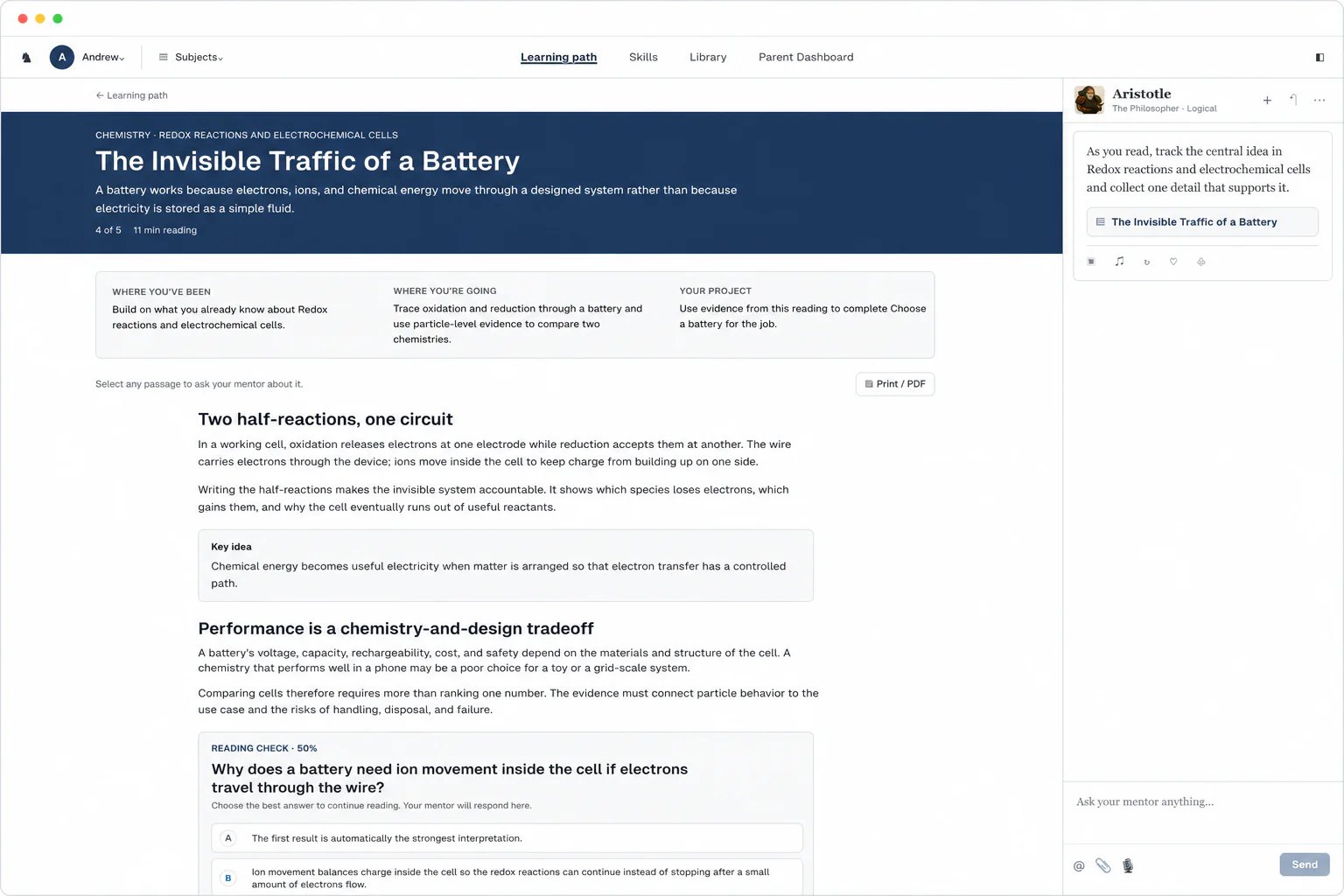
A battery works because electrons, ions, and chemical energy move through a designed system rather than because electricity is stored as a simple fluid.
- Lesson
- The Invisible Traffic of a Battery
- Goal
- Trace oxidation and reduction through a battery and use particle-level evidence to compare two chemistries.
- Project
- Choose a battery for the job
Your parent dashboard
- Today
- Each subject's lesson, and whether it's done
- Grades
- Every submission graded instantly, with written feedback, so you never grade
- Records
- Attendance log and learning summary, ready to export
- Documents
- Transcripts and state-aware compliance drafts, written for you and ready to sign

8th grade scope and sequence
Math12 units · 54 skills
Linear functions and slope6 skills
- Find slope from a graph
- Find slope from two points
- Write a linear equation from a table
- Interpret rate of change and initial value
- Compare two linear functions in different forms
- Explain why a relationship is not linear
Systems of linear equations5 skills
- Solve a system by graphing
- Solve a system by substitution
- Solve a system by elimination
- Interpret intersection as a shared solution
- Classify systems with no solution or many solutions
Exponents and scientific notation5 skills
- Apply exponent product and quotient rules
- Use zero and negative exponents
- Convert between standard and scientific notation
- Compute with numbers in scientific notation
- Compare quantities written in scientific notation
Irrational numbers and roots4 skills
- Approximate a square root on a number line
- Distinguish rational and irrational numbers
- Use cube roots in volume contexts
- Compare decimal expansions of real numbers
Pythagorean theorem5 skills
- Use the Pythagorean theorem to find a missing side
- Use the converse to classify a triangle
- Find distance between two coordinate points
- Solve a real-world diagonal-distance problem
- Explain why the theorem fits right triangles
Transformations and congruence4 skills
- Describe a translation using coordinates
- Describe a reflection across an axis
- Describe a rotation about the origin
- Use transformations to show congruence
Similarity, volume, and scale4 skills
- Use dilations to explain similarity
- Find a missing side in similar figures
- Find volume of cylinders, cones, or spheres
- Explain how scale affects volume
Scatter plots and association4 skills
- Make a scatter plot from paired data
- Describe positive, negative, or no association
- Draw an informal line of fit
- Use a line of fit to make a prediction
Function modeling4 skills
- Decide whether a table defines a function
- Compare linear, quadratic, and exponential growth patterns
- Interpret function notation in a context
- Use a function rule to solve a problem
Mathematical reasoning4 skills
- Write a multi-step justification for a system solution
- Explain when an estimate is enough
- Check reasonableness using graph and equation forms
- Identify a hidden assumption in a model
High school math readiness4 skills
- Connect slope to Algebra I linear functions
- Connect Pythagorean distance to coordinate geometry
- Use exponent rules in scientific contexts
- Organize a solution for a high-school-style problem
Math capstone5 skills
- Model a real situation with a linear function
- Use a system to compare two plans
- Apply exponent notation to a science quantity
- Defend a geometry solution with a diagram
- Present a Grade 8 math argument with multiple formats
Reading6 units · 48 skills
Literary reading8 skills
- Identify theme from repeated details
- Explain character motivation
- Analyze how setting shapes conflict
- Interpret figurative language in context
- Compare narrator perspective
- Analyze symbolism
- Trace conflict development
- Compare character arcs
Informational reading10 skills
- Identify central idea
- Trace an author's claim
- Distinguish evidence from commentary
- Summarize a section objectively
- Evaluate source credibility
- Identify text structure
- Evaluate evidence relevance
- Analyze author's assumptions
- Compare conflicting accounts of the same event
- Compare two accounts of the same event
Media and multimodal reading7 skills
- Interpret a chart embedded in an article
- Connect image evidence to a text claim
- Evaluate a caption's relationship to an image
- Compare video and print accounts of an event
- Evaluate scale in an infographic
- Interpret a timeline embedded in text
- Compare headline and article evidence
Vocabulary9 skills
- Use context clues for an unfamiliar word
- Identify connotation
- Distinguish denotation from connotation
- Use word parts to infer meaning
- Infer meaning from analogy
- Use roots and affixes
- Identify figurative versus literal meaning
- Use connotation to explain tone
- Use connotation to infer tone
Evidence7 skills
- Quote textual evidence accurately
- Paraphrase evidence without changing meaning
- Connect evidence to an inference
- Compare evidence across two texts
- Rank evidence by strength
- Explain why evidence is relevant
- Integrate evidence across genres
Fluency and text complexity7 skills
- Read grade-level prose with appropriate pacing
- Use punctuation to guide oral phrasing
- Identify sentence complexity in a passage
- Use background knowledge to prepare for a difficult text
- Use paragraph structure to plan reading pace
- Identify unfamiliar syntax before rereading
- Use repeated reading to improve accuracy
English language arts12 units · 54 skills
Literary complexity5 skills
- Analyze how theme develops through conflict
- Explain how structure creates suspense or contrast
- Compare a text with a film or dramatic adaptation
- Analyze symbolism in a poem or story
- Use precise evidence to support interpretation
Civic and informational texts5 skills
- Analyze conflicting accounts of one event
- Trace a central idea through a complex article
- Identify assumptions in an argument
- Evaluate evidence in a civic text
- Compare source reliability across articles
Rhetoric and argument5 skills
- Analyze how an author appeals to audience values
- Identify concession and rebuttal
- Explain how word choice affects credibility
- Evaluate whether evidence fully supports a claim
- Compare arguments on the same issue
Grammar for high school readiness4 skills
- Use verbals to combine ideas
- Edit misplaced and dangling modifiers
- Punctuate restrictive and nonrestrictive information
- Revise for concise academic style
Literary essay5 skills
- Write a thesis about theme or character
- Organize body paragraphs by interpretive reason
- Integrate quotations with context
- Analyze rather than summarize evidence
- Revise commentary for depth
Argument essay4 skills
- Write a debatable claim on a complex issue
- Use credible evidence from multiple sources
- Address a counterclaim with respect and logic
- Use transitions to show relationships among reasons
Research project5 skills
- Develop a research question with scope
- Use search terms strategically
- Create an annotated note set
- Avoid plagiarism through paraphrase and citation
- Explain source limits
Presentation and discussion4 skills
- Lead a text-based discussion segment
- Ask a clarifying and a challenging question
- Present research with visual support
- Use speaking pace and emphasis deliberately
Media analysis4 skills
- Analyze design choices in an infographic
- Compare social media claim and original source
- Identify missing context in a media excerpt
- Explain how medium changes message
Academic vocabulary and morphology4 skills
- Use Greek and Latin roots in academic vocabulary
- Distinguish denotation and connotation
- Explain figurative language in context
- Use domain vocabulary accurately
Revision and editing4 skills
- Revise paragraph order for logic
- Edit sentence boundaries
- Strengthen quotation lead-ins
- Remove redundancy without losing meaning
ELA capstone5 skills
- Write a high-school-ready literary analysis
- Write an evidence-backed civic argument
- Present a research claim with source evaluation
- Revise for style, structure, and correctness
- Defend a Grade 8 portfolio with text evidence
Science12 units · 53 skills
Atomic matter and periodic patterns5 skills
- Explain atoms, molecules, and compounds with models
- Use the periodic table to infer element properties
- Distinguish pure substances from mixtures
- Model conservation of atoms in a reaction
- Compare acids, bases, and neutral substances with evidence
Chemical reactions5 skills
- Identify signs of a chemical reaction
- Balance a simple chemical equation by atoms
- Explain endothermic and exothermic changes
- Use evidence to distinguish reaction from phase change
- Predict products from a familiar reaction pattern
Forces and Newtonian motion5 skills
- Use Newton's first law to explain motion changes
- Connect net force to acceleration qualitatively
- Explain action-reaction force pairs
- Use free-body diagrams for simple cases
- Calculate speed or acceleration from data
Energy, waves, and information4 skills
- Compare mechanical and electromagnetic waves
- Relate amplitude and energy in a wave
- Explain reflection, refraction, and absorption
- Use wave models to explain sound or light behavior
Electricity and magnetism4 skills
- Build a simple circuit diagram
- Distinguish series and parallel circuits
- Explain current, voltage, and resistance qualitatively
- Describe magnetic fields around magnets and wires
Earth history and geologic time5 skills
- Use rock layers to infer relative age
- Interpret fossil evidence for past environments
- Explain plate tectonics with evidence
- Connect geologic time to gradual and sudden change
- Use maps to identify plate-boundary hazards
Solar system and gravity4 skills
- Explain gravity as an attractive force
- Compare planets by orbit, composition, and atmosphere
- Use scale to model solar-system distances
- Explain tides from Earth-Moon-Sun interactions
Climate systems4 skills
- Trace carbon through atmosphere, ocean, living things, and rocks
- Use climate data to distinguish trend from variation
- Explain feedback in a climate system
- Compare natural and human climate drivers
Scientific modeling and error4 skills
- Revise a model after contradictory evidence
- Interpret error bars in a data display
- Identify confounding variables in a simple investigation
- Use proportional reasoning in science data
Engineering physical systems4 skills
- Design a device that transfers energy
- Optimize a structure under force constraints
- Test a circuit or mechanical prototype
- Use data to choose between designs
Science data argument4 skills
- Use multiple data sources to support a claim
- Explain uncertainty in a measurement
- Identify when data do not support a claim
- Write a scientific explanation with claim, evidence, and reasoning
Science capstone5 skills
- Model a physical or Earth system with matter and energy flows
- Analyze data from a force, reaction, or climate investigation
- Defend a model revision with evidence
- Compare competing explanations
- Present a high-school-readiness science argument
History12 units · 55 skills
Indigenous and colonial worlds5 skills
- Compare Indigenous nations before colonization by governance, diplomacy, economy, and land use
- Explain European colonization through charter, religion, labor demand, commerce, and empire rivalry
- Analyze colonial regions by economy, slavery, settlement pattern, religion, and political culture
- Use maps and sources to explain conflict, alliance, and exchange in early North America
- Defend a Grade 8 historical claim about indigenous and colonial worlds using conflicting evidence
Imperial crisis and revolutionary ideas5 skills
- Explain taxation without representation through imperial debt, Parliament, colonies, and protest
- Analyze natural rights, consent, republicanism, liberty, property, slavery, and popular sovereignty
- Compare Patriot, Loyalist, Indigenous, enslaved, and women's perspectives on revolution
- Use pamphlets, petitions, sermons, and declarations to trace revolutionary ideology
- Compare Locke, Montesquieu, Paine, Adams, Jefferson, and Otis on natural rights and resistance
American Revolution war6 skills
- Lexington and Concord
- Battle of Saratoga
- Valley Forge
- Battle of Yorktown
- Defend a Grade 8 historical claim about american revolution war using conflicting evidence
- Explain why geography, French alliance, logistics, morale, and leadership shaped Revolutionary War outcomes
American Revolution outcomes4 skills
- Treaty of Paris 1783
- Explain how the Revolution changed and failed to change slavery, citizenship, gender, and property
- Analyze state constitutions, republican experiments, and conflicts over representation
- Compare revolutionary rhetoric with limits on equality in the new United States
Constitution and early republic5 skills
- Federalist No. 10
- Marbury v. Madison
- Explain Articles of Confederation weaknesses and the Constitutional Convention compromises
- Compare Federalist and Anti-Federalist arguments over power, rights, factions, and republic size
- Defend a Grade 8 historical claim about constitution and early republic using conflicting evidence
Early republic policy and identity4 skills
- War of 1812
- Monroe Doctrine
- Analyze political parties, Hamiltonian finance, Jeffersonian republicanism, and executive power
- Explain nationalism, sectionalism, market growth, and foreign policy in the early republic
Expansion, removal, and market revolution4 skills
- Explain Louisiana Purchase, Manifest Destiny, and westward expansion through opportunity and coercion
- Analyze Indian Removal, Cherokee resistance, and federal power through law and human consequences
- Compare market revolution effects on labor, gender, transportation, cities, and regional economies
- Use maps to explain settlement, migration, canals, railroads, cotton, and territorial conflict
Slavery, reform, and sectional conflict5 skills
- Missouri Compromise
- Kansas-Nebraska Act
- Dred Scott v. Sandford
- Analyze abolition, women's rights, religious reform, resistance to slavery, and sectional politics
- Defend a Grade 8 historical claim about slavery, reform, and sectional conflict using conflicting evidence
Civil War causes and war4 skills
- Fort Sumter
- Battle of Antietam
- Battle of Gettysburg
- Siege of Vicksburg
Civil War emancipation and memory4 skills
- Gettysburg Address
- Appomattox surrender
- Explain emancipation as military policy, moral argument, self-emancipation, and constitutional change
- Compare Union and Confederate war aims, resources, strategy, casualties, and political leadership
Reconstruction and unfinished freedom4 skills
- Black Codes
- Compromise of 1877
- Analyze Reconstruction amendments, Freedmen's Bureau, Black political participation, and white resistance
- Evaluate whether Reconstruction was a revolution, failure, unfinished project, or contested settlement
U.S. founding to Reconstruction capstone5 skills
- Defend an interpretation of the American Revolution using ideology, military events, and social limits
- Compare the Constitution and Reconstruction amendments as competing answers to union and liberty
- Build a Civil War causation argument using slavery, politics, economics, ideology, and federal power
- Present a source-based argument about freedom, citizenship, and equality from 1763 to 1877
- Defend a Grade 8 historical claim about u.s. founding to reconstruction capstone using conflicting evidence
FAQ
- What happens when my child is stuck in a lesson?
- Our Always-On Mentor helps right there in the reading. Your child can highlight a line about chemical reactions or the Constitution and ask what it means, or ask for a visual. When it looks like they are having a hard time, it offers help on its own, and during a reading check it answers clarifying questions without pointing to the answer.
- How much time does school take each day?
- There is no fixed daily length. Each lesson shows its estimated time, and our Parent Dashboard adds up the day, so you can see the hours against your state's instruction-time rules.
- How do I decide whether 8th grade work earns high school credit?
- Your state's rules and graduation plan decide. Some families include high-school-level work completed in 8th grade, such as Algebra 1 or a language course. The Parent Dashboard keeps that completed work and its grades, ready for the transcript we generate.
- What math should my 8th grader complete?
- Usually pre-algebra or Algebra 1; geometry can follow Algebra 1 taken in seventh grade. Placement sets the starting point, with solid understanding and the graduation sequence guiding the pace.
Build 8th grade around your child
Start with the 8th grade skills your child needs next, with room to move ahead in one subject and review in another.
Start your 14-day free trial
$149/month per child after the trial.