Advanced Latin homeschool curriculum.
Read Latin closely enough to hear the author's choices, not merely decode the sentence.
A personalized lesson from the course
Latin close reading asks how grammar, word order, sound, genre, and historical context make an argument move.
- Lesson
- A Sentence Is an Engine
- Goal
- Annotate a passage's syntax and style, then connect those choices to an interpretive claim about voice, power, or genre.
How a lesson works
A 10-minute reading
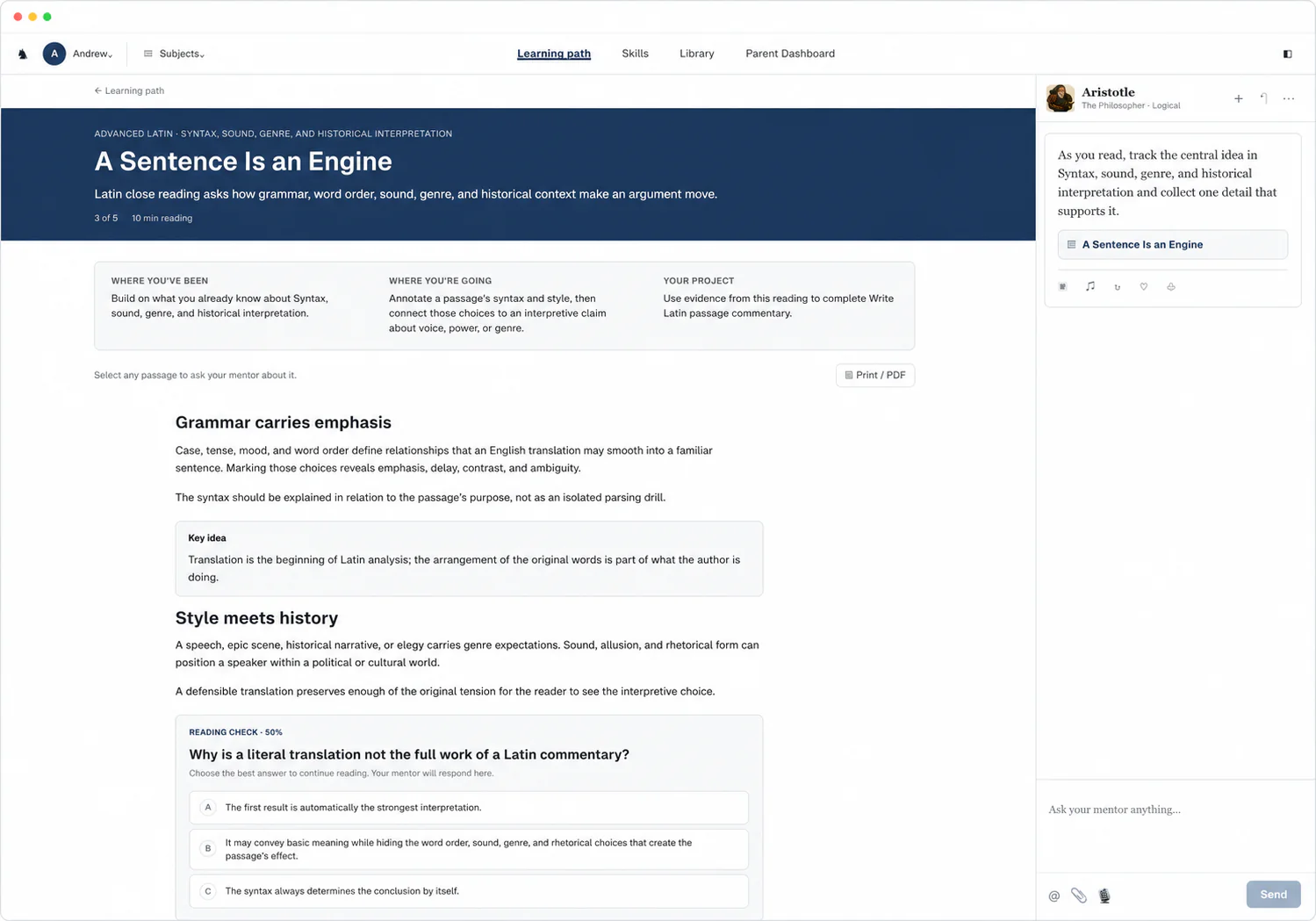
This example lesson comes from the unit on syntax, sound, genre, and historical interpretation. It moves from “Grammar carries emphasis” to “Style meets history” and builds to one idea: translation is the beginning of Latin analysis; the arrangement of the original words is part of what the author is doing.
Help inside the reading
Your child can highlight any line of “A Sentence Is an Engine” and ask our Always-On Mentor about it or ask for a visual, and it offers help on its own whenever they seem stuck.
A check halfway through
Your child answers “Why is a literal translation not the full work of a Latin commentary?” before reading on, and the Reading Check at the end asks new questions.
A project your child hands in
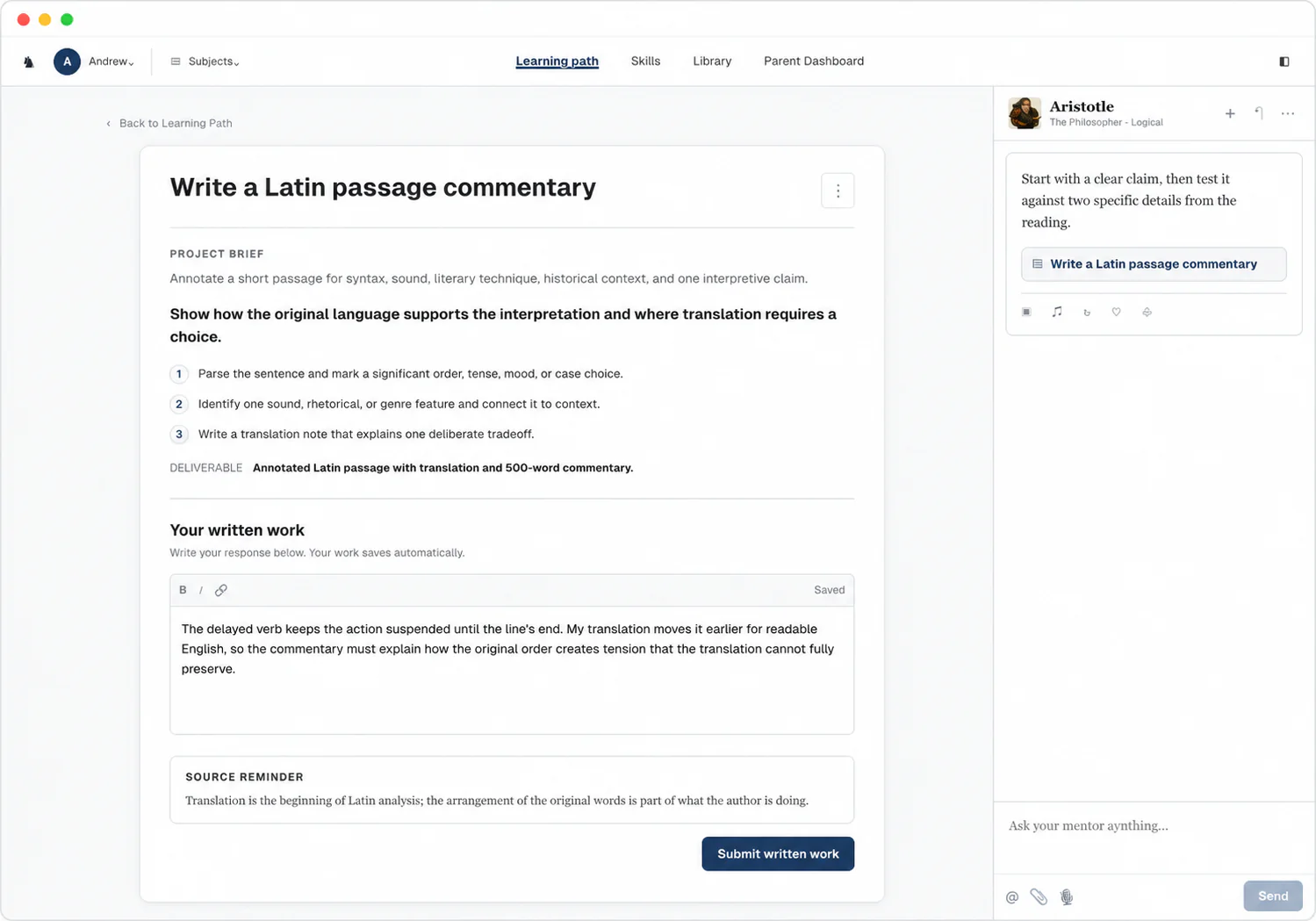
Annotate a short passage for syntax, sound, literary technique, historical context, and one interpretive claim.
- Task
- Show how the original language supports the interpretation and where translation requires a choice
- Hand in
- Annotated Latin passage with translation and 500-word commentary
Use the language, keep the evidence
The course includes prepared selections, sight reading, translation, grammar, meter, historical context, and literary analysis. Advanced Latin runs through 24 units and 120 skills, starting with vergil: Aeneid selections, pliny: Letters selections, and sight reading prose.
- Corrected translations with syntax notes
- Sight-reading records
- Latin evidence-based analytical essays
Units and skills
Advanced Latin24 units · 120 skills
Vergil: Aeneid selections5 skills
- Interpret authentic written, audio, or audiovisual material about Vergil: Aeneid selections
- Sustain an appropriate interpersonal exchange about Vergil: Aeneid selections
- Present organized spoken or written communication about Vergil: Aeneid selections
- Compare products, practices, and perspectives connected to Vergil: Aeneid selections
- Use course-level vocabulary and language control in Vergil: Aeneid selections
Pliny: Letters selections5 skills
- Interpret authentic written, audio, or audiovisual material about Pliny: Letters selections
- Sustain an appropriate interpersonal exchange about Pliny: Letters selections
- Present organized spoken or written communication about Pliny: Letters selections
- Compare products, practices, and perspectives connected to Pliny: Letters selections
- Use course-level vocabulary and language control in Pliny: Letters selections
Sight reading prose5 skills
- Interpret authentic written, audio, or audiovisual material about Sight reading prose
- Sustain an appropriate interpersonal exchange about Sight reading prose
- Present organized spoken or written communication about Sight reading prose
- Compare products, practices, and perspectives connected to Sight reading prose
- Use course-level vocabulary and language control in Sight reading prose
Sight reading poetry5 skills
- Interpret authentic written, audio, or audiovisual material about Sight reading poetry
- Sustain an appropriate interpersonal exchange about Sight reading poetry
- Present organized spoken or written communication about Sight reading poetry
- Compare products, practices, and perspectives connected to Sight reading poetry
- Use course-level vocabulary and language control in Sight reading poetry
Translation accuracy5 skills
- Interpret authentic written, audio, or audiovisual material about Translation accuracy
- Sustain an appropriate interpersonal exchange about Translation accuracy
- Present organized spoken or written communication about Translation accuracy
- Compare products, practices, and perspectives connected to Translation accuracy
- Use course-level vocabulary and language control in Translation accuracy
Grammar and syntax5 skills
- Interpret authentic written, audio, or audiovisual material about Grammar and syntax
- Sustain an appropriate interpersonal exchange about Grammar and syntax
- Present organized spoken or written communication about Grammar and syntax
- Compare products, practices, and perspectives connected to Grammar and syntax
- Use course-level vocabulary and language control in Grammar and syntax
Meter and scansion5 skills
- Interpret authentic written, audio, or audiovisual material about Meter and scansion
- Sustain an appropriate interpersonal exchange about Meter and scansion
- Present organized spoken or written communication about Meter and scansion
- Compare products, practices, and perspectives connected to Meter and scansion
- Use course-level vocabulary and language control in Meter and scansion
Literary devices5 skills
- Interpret authentic written, audio, or audiovisual material about Literary devices
- Sustain an appropriate interpersonal exchange about Literary devices
- Present organized spoken or written communication about Literary devices
- Compare products, practices, and perspectives connected to Literary devices
- Use course-level vocabulary and language control in Literary devices
Roman historical context5 skills
- Interpret authentic written, audio, or audiovisual material about Roman historical context
- Sustain an appropriate interpersonal exchange about Roman historical context
- Present organized spoken or written communication about Roman historical context
- Compare products, practices, and perspectives connected to Roman historical context
- Use course-level vocabulary and language control in Roman historical context
Cultural context5 skills
- Interpret authentic written, audio, or audiovisual material about Cultural context
- Sustain an appropriate interpersonal exchange about Cultural context
- Present organized spoken or written communication about Cultural context
- Compare products, practices, and perspectives connected to Cultural context
- Use course-level vocabulary and language control in Cultural context
Textual analysis5 skills
- Interpret authentic written, audio, or audiovisual material about Textual analysis
- Sustain an appropriate interpersonal exchange about Textual analysis
- Present organized spoken or written communication about Textual analysis
- Compare products, practices, and perspectives connected to Textual analysis
- Use course-level vocabulary and language control in Textual analysis
Latin evidence-based argument5 skills
- Interpret authentic written, audio, or audiovisual material about Latin evidence-based argument
- Sustain an appropriate interpersonal exchange about Latin evidence-based argument
- Present organized spoken or written communication about Latin evidence-based argument
- Compare products, practices, and perspectives connected to Latin evidence-based argument
- Use course-level vocabulary and language control in Latin evidence-based argument
Source credibility and provenance5 skills
- Interpret authentic written, audio, or audiovisual material about Source credibility and provenance
- Sustain an appropriate interpersonal exchange about Source credibility and provenance
- Present organized spoken or written communication about Source credibility and provenance
- Compare products, practices, and perspectives connected to Source credibility and provenance
- Use course-level vocabulary and language control in Source credibility and provenance
Claim, evidence, and reasoning5 skills
- Interpret authentic written, audio, or audiovisual material about Claim, evidence, and reasoning
- Sustain an appropriate interpersonal exchange about Claim, evidence, and reasoning
- Present organized spoken or written communication about Claim, evidence, and reasoning
- Compare products, practices, and perspectives connected to Claim, evidence, and reasoning
- Use course-level vocabulary and language control in Claim, evidence, and reasoning
Counterargument and qualification5 skills
- Interpret authentic written, audio, or audiovisual material about Counterargument and qualification
- Sustain an appropriate interpersonal exchange about Counterargument and qualification
- Present organized spoken or written communication about Counterargument and qualification
- Compare products, practices, and perspectives connected to Counterargument and qualification
- Use course-level vocabulary and language control in Counterargument and qualification
Cultural comparison5 skills
- Interpret authentic written, audio, or audiovisual material about Cultural comparison
- Sustain an appropriate interpersonal exchange about Cultural comparison
- Present organized spoken or written communication about Cultural comparison
- Compare products, practices, and perspectives connected to Cultural comparison
- Use course-level vocabulary and language control in Cultural comparison
Authentic source interpretation5 skills
- Interpret authentic written, audio, or audiovisual material about Authentic source interpretation
- Sustain an appropriate interpersonal exchange about Authentic source interpretation
- Present organized spoken or written communication about Authentic source interpretation
- Compare products, practices, and perspectives connected to Authentic source interpretation
- Use course-level vocabulary and language control in Authentic source interpretation
Inquiry proposal and source approval5 skills
- Interpret authentic written, audio, or audiovisual material about Inquiry proposal and source approval
- Sustain an appropriate interpersonal exchange about Inquiry proposal and source approval
- Present organized spoken or written communication about Inquiry proposal and source approval
- Compare products, practices, and perspectives connected to Inquiry proposal and source approval
- Use course-level vocabulary and language control in Inquiry proposal and source approval
Research artifact, presentation, and defense5 skills
- Interpret authentic written, audio, or audiovisual material about Research artifact, presentation, and defense
- Sustain an appropriate interpersonal exchange about Research artifact, presentation, and defense
- Present organized spoken or written communication about Research artifact, presentation, and defense
- Compare products, practices, and perspectives connected to Research artifact, presentation, and defense
- Use course-level vocabulary and language control in Research artifact, presentation, and defense
Controlled performance-task planning5 skills
- Interpret authentic written, audio, or audiovisual material about Controlled performance-task planning
- Sustain an appropriate interpersonal exchange about Controlled performance-task planning
- Present organized spoken or written communication about Controlled performance-task planning
- Compare products, practices, and perspectives connected to Controlled performance-task planning
- Use course-level vocabulary and language control in Controlled performance-task planning
Final artifact integrity and attestation5 skills
- Interpret authentic written, audio, or audiovisual material about Final artifact integrity and attestation
- Sustain an appropriate interpersonal exchange about Final artifact integrity and attestation
- Present organized spoken or written communication about Final artifact integrity and attestation
- Compare products, practices, and perspectives connected to Final artifact integrity and attestation
- Use course-level vocabulary and language control in Final artifact integrity and attestation
Advanced Latin cumulative assessment5 skills
- Interpret authentic written, audio, or audiovisual material about Advanced Latin cumulative assessment
- Sustain an appropriate interpersonal exchange about Advanced Latin cumulative assessment
- Present organized spoken or written communication about Advanced Latin cumulative assessment
- Compare products, practices, and perspectives connected to Advanced Latin cumulative assessment
- Use course-level vocabulary and language control in Advanced Latin cumulative assessment
Advanced Latin exam-mode practice5 skills
- Interpret authentic written, audio, or audiovisual material about Advanced Latin exam-mode practice
- Sustain an appropriate interpersonal exchange about Advanced Latin exam-mode practice
- Present organized spoken or written communication about Advanced Latin exam-mode practice
- Compare products, practices, and perspectives connected to Advanced Latin exam-mode practice
- Use course-level vocabulary and language control in Advanced Latin exam-mode practice
Advanced Latin reflection and transfer5 skills
- Interpret authentic written, audio, or audiovisual material about Advanced Latin reflection and transfer
- Sustain an appropriate interpersonal exchange about Advanced Latin reflection and transfer
- Present organized spoken or written communication about Advanced Latin reflection and transfer
- Compare products, practices, and perspectives connected to Advanced Latin reflection and transfer
- Use course-level vocabulary and language control in Advanced Latin reflection and transfer
Questions parents ask
How does Advanced Latin prepare my student for AP Latin?
- Advanced Latin follows the AP Latin framework unit by unit, as its skill tree shows. Your teen explains and applies the ideas in written responses and projects, so the work shows which skills are secure and which need more practice.
How does a homeschooler register for an AP exam?
- An AP coordinator at an AP-authorized local school arranges registration. Use College Board’s homeschool exam guidance to find a host school. That school sets its deadlines and outside-student policies; its coordinator orders the exam, collects fees, and tells your child where and when to test.
Which course title goes on a homeschool transcript?
- Advanced Latin, not AP Latin. The AP designation requires College Board Course Audit authorization of the course, which framework alignment does not give. We generate the transcript with that title, ready for you to sign as homeschool administrator.
How can AP scores earn college credit?
- Colleges award credit under their own AP score policies. College Board reports scores on a 1–5 scale, separately from our coursework grades; check the college’s required score and whether it grants credit, placement, or both.
Advanced Latin, with the teaching and records handled
$49/month after the trial.