English Language Arts for your homeschool
Your child reads closely, develops an argument, and revises a draft after feedback. Their interests help shape the texts and writing.
A lesson built around your child
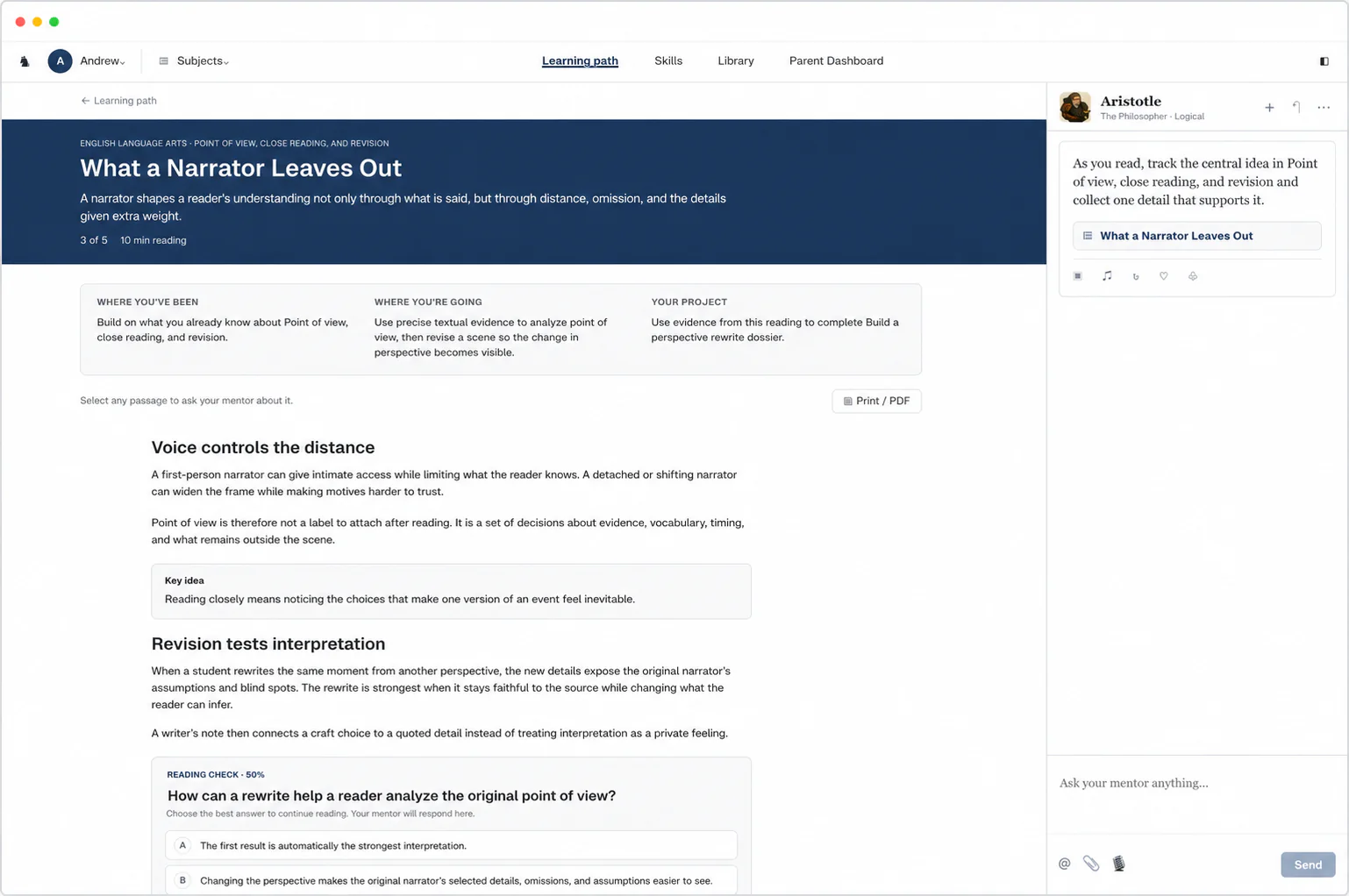
A narrator shapes a reader's understanding not only through what is said, but through distance, omission, and the details given extra weight.
- Lesson
- What a Narrator Leaves Out
- Goal
- Use precise textual evidence to analyze point of view, then revise a scene so the change in perspective becomes visible.
How a lesson works
A 10-minute reading
This example lesson comes from the unit on point of view, close reading, and revision. It moves from “Voice controls the distance” to “Revision tests interpretation” and builds to one idea: reading closely means noticing the choices that make one version of an event feel inevitable.
Help inside the reading
Our Always-On Mentor can start with what the draft is trying to say, then help your child revise a confusing paragraph while keeping their voice. Your child can also highlight any line of “What a Narrator Leaves Out” to ask about it or ask for a visual, and the mentor offers help on its own when they seem stuck.
A check halfway through
Your child answers “How can a rewrite help a reader analyze the original point of view?” before reading on, and the Reading Check at the end asks new questions.
A project your child hands in
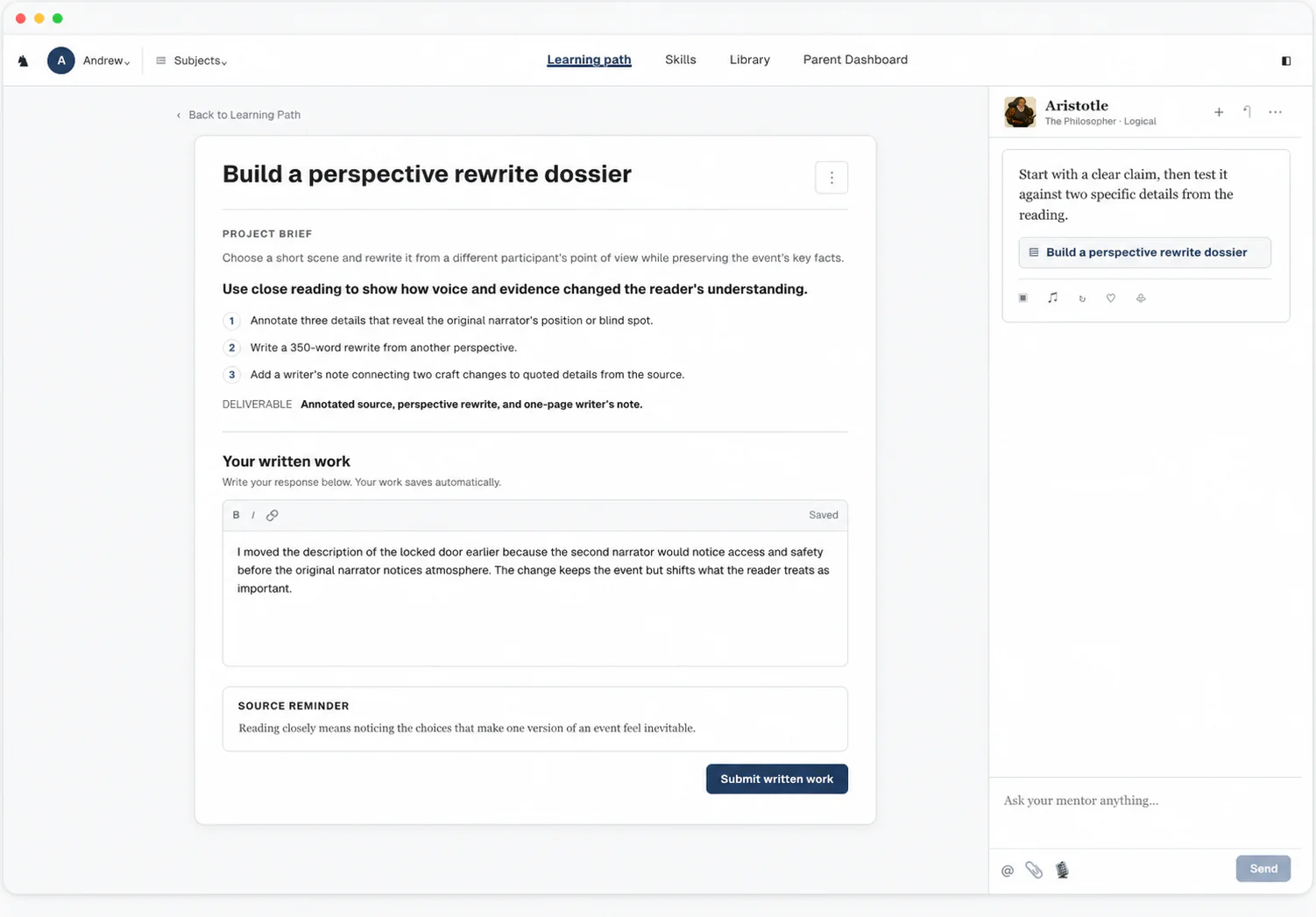
Choose a short scene and rewrite it from a different participant's point of view while preserving the event's key facts.
- Task
- Use close reading to show how voice and evidence changed the reader's understanding
- Hand in
- Annotated source, perspective rewrite, and one-page writer's note
Your parent dashboard
- Today
- Each subject's lesson, and whether it's done
- Grades
- Every submission graded instantly, with written feedback, so you never grade
- Records
- Attendance log and learning summary, ready to export

Units and skills by grade
Grade 36 units · 25 skills
The writing process5 skills
- Brainstorm ideas for a chosen topic
- Plan a piece of writing with a simple outline
- Write a first draft from a plan
- Revise a draft to add a missing detail
- Edit a draft for capitals and end punctuation
Paragraph writing4 skills
- Write a topic sentence for a paragraph
- Add supporting details to a topic sentence
- Write a closing sentence that fits the paragraph
- Keep every sentence in a paragraph on one topic
Narrative writing4 skills
- Write a narrative with a clear beginning
- Order events with time-order words
- Add a sensory detail to a narrative
- Write an ending that resolves the narrative
Informational writing4 skills
- State a fact and explain it
- Group related facts together
- Use a text feature such as a heading in writing
- Write an introduction that names the topic
Opinion writing4 skills
- State an opinion clearly
- Give a reason that supports an opinion
- Use a linking word to connect an opinion and a reason
- Write a closing that restates the opinion
Inquiry and speaking4 skills
- Generate a question worth researching
- Gather information from a provided source
- Present information clearly to an audience
- Listen and ask a relevant follow-up question
Grade 46 units · 27 skills
Planning and drafting5 skills
- Choose a genre that fits a purpose
- Plan writing with an organizational structure
- Draft an introduction that engages a reader
- Draft a conclusion that follows from the body
- Maintain focus on one controlling idea
Narrative craft4 skills
- Develop a character through action and dialogue
- Establish a setting that matters to the plot
- Use dialogue punctuation correctly in a narrative
- Build a narrative to a clear turning point
Informational writing5 skills
- Write a thesis-like controlling idea
- Organize a text with headings and sections
- Support an idea with a fact and an explanation
- Use a transition between two sections
- Write a conclusion that summarizes the idea
Argument writing4 skills
- State a position on a debatable question
- Support a position with two reasons
- Provide evidence for each reason
- Address an opposing view briefly
Revision and editing4 skills
- Revise for organization by moving a paragraph
- Revise for clarity by rewriting a confusing sentence
- Edit for subject-verb agreement
- Edit for punctuation in compound sentences
Research and presentation5 skills
- Narrow a broad topic into a research question
- Evaluate whether a source is relevant
- Take notes in your own words
- Give credit to a source
- Present findings with a visual aid
Grade 56 units · 27 skills
Composition planning4 skills
- Analyze a prompt to identify purpose and audience
- Select an organizational structure for a purpose
- Write a controlling idea that can be developed
- Plan paragraphs that each advance the controlling idea
Argument and evidence5 skills
- Write a claim that responds to a question
- Select evidence that supports a claim
- Write commentary that explains evidence
- Acknowledge and respond to a counterclaim
- Order reasons for the strongest effect
Informational and explanatory writing4 skills
- Write an explanation of a process in order
- Integrate a fact from a source into a sentence
- Use a transition that signals a relationship
- Write a conclusion that extends the idea
Narrative craft4 skills
- Use pacing to build tension in a narrative
- Develop a character's motivation through choices
- Use precise sensory language
- Write an ending that reflects on the events
Revision for craft5 skills
- Revise for sentence variety
- Revise word choice for tone
- Cut a sentence that does not serve the controlling idea
- Revise a paragraph for logical flow
- Edit for punctuation of nonessential phrases
Inquiry and citation5 skills
- Develop a research question with a clear scope
- Compare two sources on credibility
- Take notes without plagiarizing
- Cite a source in a consistent format
- Combine evidence from two sources into one claim
Grade 612 units · 52 skills
Literary elements5 skills
- Identify theme in a short story or poem
- Explain character motivation from dialogue and action
- Analyze how setting shapes conflict
- Describe plot structure with turning points
- Use quoted evidence to support a reading claim
Informational reading5 skills
- Find central idea in an informational article
- Trace how details develop an explanation
- Distinguish fact, opinion, and reasoned claim
- Use text features to locate evidence
- Compare two articles on the same topic
Vocabulary in context4 skills
- Use context clues for an unfamiliar academic word
- Use Greek and Latin roots to infer meaning
- Distinguish literal and figurative language
- Explain how word choice affects tone
Sentences and paragraphs4 skills
- Identify sentence complexity in a passage
- Combine sentences for clarity
- Use commas in a series and introductory phrase
- Write a paragraph with topic sentence and evidence
Narrative writing5 skills
- Plan a narrative with conflict and resolution
- Use dialogue to reveal character
- Control pacing with scene and summary
- Revise sensory details for clarity
- Write an ending that follows from events
Introductory argument writing4 skills
- State a clear claim for a familiar issue
- Choose relevant evidence for a claim
- Explain how evidence supports a reason
- Respond respectfully to a simple counterclaim
Research basics4 skills
- Write a focused research question
- Take notes without copying whole sentences
- Quote and paraphrase a source accurately
- Create a simple works-cited entry
Media and multimodal texts4 skills
- Interpret image, caption, and headline together
- Identify purpose in a short video or infographic
- Compare print and visual versions of information
- Notice missing evidence in media claims
Speaking and listening4 skills
- Prepare discussion notes from a text
- Ask a follow-up question during discussion
- Use evidence in a short oral response
- Organize an oral claim with evidence
Revision and editing4 skills
- Revise vague words into precise words
- Edit for subject-verb agreement
- Use transitions between reasons
- Proofread quotation punctuation
Independent reading habits4 skills
- Track confusion and questions while reading
- Summarize a chapter without retelling every detail
- Explain why a passage matters to the whole text
- Choose a stretch text and reading plan
ELA capstone5 skills
- Write a text-based literary paragraph
- Write a short informational explanation
- Present a claim in discussion
- Revise writing after feedback
- Prepare a Grade 6 reading and writing portfolio
Grade 712 units · 52 skills
Literary analysis5 skills
- Analyze how setting and conflict shape character choices
- Trace theme development across a story
- Compare two narrators' points of view
- Explain how imagery shapes mood
- Use embedded quotations in a literary claim
Informational claims and evidence5 skills
- Identify claim, reason, and evidence in an article
- Distinguish strong evidence from interesting detail
- Trace how headings and sections organize an argument
- Compare two authors' explanations of one issue
- Identify loaded language in an informational text
Rhetoric introduction4 skills
- Identify audience and purpose in a speech or editorial
- Explain how repetition emphasizes a point
- Identify appeal to emotion, credibility, or logic
- Evaluate whether a rhetorical choice fits the audience
Grammar and style4 skills
- Use phrases and clauses to add detail
- Edit comma use with coordinate adjectives
- Vary sentence openings for flow
- Choose active verbs over vague verbs
Argument writing5 skills
- Write a claim with two supporting reasons
- Use evidence from multiple sources
- Explain a counterargument fairly
- Write a conclusion that extends the argument
- Revise evidence order for stronger logic
Informational writing4 skills
- Organize an explanation with categories
- Use definitions and examples to teach a concept
- Integrate a quotation smoothly
- Write transitions that show cause and effect
Narrative craft4 skills
- Use point of view deliberately
- Develop a scene with dialogue and action
- Use pacing to build tension
- Revise a narrative for voice
Source-based research4 skills
- Narrow a research question after background reading
- Evaluate source credibility for author and purpose
- Paraphrase evidence with citation
- Group notes by subtopic
Academic discussion4 skills
- Prepare a discussion question that invites evidence
- Connect a comment to another speaker's idea
- Use evidence in a discussion response
- Disagree with a reason and text support
Media literacy4 skills
- Analyze how visuals shape a message
- Compare a news story and opinion piece
- Identify sponsored or persuasive content
- Check a media claim against a source
Revision and editing4 skills
- Revise for precise academic vocabulary
- Edit pronoun-antecedent agreement
- Fix sentence fragments and run-ons
- Strengthen transitions among paragraphs
ELA capstone5 skills
- Write a multi-paragraph literary analysis
- Write a source-based argument
- Present research findings clearly
- Revise a piece through two drafts
- Defend evidence choices in a portfolio reflection
Grade 812 units · 54 skills
Literary complexity5 skills
- Analyze how theme develops through conflict
- Explain how structure creates suspense or contrast
- Compare a text with a film or dramatic adaptation
- Analyze symbolism in a poem or story
- Use precise evidence to support interpretation
Civic and informational texts5 skills
- Analyze conflicting accounts of one event
- Trace a central idea through a complex article
- Identify assumptions in an argument
- Evaluate evidence in a civic text
- Compare source reliability across articles
Rhetoric and argument5 skills
- Analyze how an author appeals to audience values
- Identify concession and rebuttal
- Explain how word choice affects credibility
- Evaluate whether evidence fully supports a claim
- Compare arguments on the same issue
Grammar for high school readiness4 skills
- Use verbals to combine ideas
- Edit misplaced and dangling modifiers
- Punctuate restrictive and nonrestrictive information
- Revise for concise academic style
Literary essay5 skills
- Write a thesis about theme or character
- Organize body paragraphs by interpretive reason
- Integrate quotations with context
- Analyze rather than summarize evidence
- Revise commentary for depth
Argument essay4 skills
- Write a debatable claim on a complex issue
- Use credible evidence from multiple sources
- Address a counterclaim with respect and logic
- Use transitions to show relationships among reasons
Research project5 skills
- Develop a research question with scope
- Use search terms strategically
- Create an annotated note set
- Avoid plagiarism through paraphrase and citation
- Explain source limits
Presentation and discussion4 skills
- Lead a text-based discussion segment
- Ask a clarifying and a challenging question
- Present research with visual support
- Use speaking pace and emphasis deliberately
Media analysis4 skills
- Analyze design choices in an infographic
- Compare social media claim and original source
- Identify missing context in a media excerpt
- Explain how medium changes message
Academic vocabulary and morphology4 skills
- Use Greek and Latin roots in academic vocabulary
- Distinguish denotation and connotation
- Explain figurative language in context
- Use domain vocabulary accurately
Revision and editing4 skills
- Revise paragraph order for logic
- Edit sentence boundaries
- Strengthen quotation lead-ins
- Remove redundancy without losing meaning
ELA capstone5 skills
- Write a high-school-ready literary analysis
- Write an evidence-backed civic argument
- Present a research claim with source evaluation
- Revise for style, structure, and correctness
- Defend a Grade 8 portfolio with text evidence
Grade 913 units · 59 skills
Literary genres5 skills
- Analyze theme in a novel, drama, or epic excerpt
- Explain how structure shapes reader expectations
- Analyze characterization across a longer text
- Compare literary treatment of a shared archetype
- Use evidence to support an interpretive thesis
Informational reasoning5 skills
- Trace an author's line of reasoning
- Evaluate evidence quality in an explanatory text
- Distinguish summary, analysis, and evaluation
- Identify gaps in an informational argument
- Compare how two texts define the same problem
Rhetorical analysis5 skills
- Analyze audience, purpose, and occasion in a speech
- Explain how diction and syntax shape tone
- Identify rhetorical appeals and their effects
- Evaluate how structure builds persuasion
- Connect rhetorical choices to an author's claim
High school composition foundations4 skills
- Write a defensible thesis for analysis
- Build a paragraph with claim, evidence, and commentary
- Integrate quoted evidence grammatically
- Use transitions to develop reasoning
Argument composition5 skills
- Develop a nuanced position on a debatable issue
- Use evidence from more than one source
- Qualify a claim without weakening it
- Address counterargument with evidence
- Revise reasoning for logical order
Research and citation5 skills
- Build a working bibliography
- Evaluate database and web sources
- Use paraphrase, summary, and quotation appropriately
- Cite sources in a consistent style
- Track source credibility and relevance
Language, grammar, and style5 skills
- Use parallel structure in a sentence
- Edit pronoun case and agreement
- Use semicolons and colons correctly
- Revise for formal academic tone
- Choose precise verbs and nouns
Academic speaking and listening4 skills
- Deliver a short analytical presentation
- Respond to questions with evidence
- Use evidence in a discussion response
- Evaluate a peer presentation for claim and support
Media and visual argument4 skills
- Analyze how layout guides attention
- Evaluate a visual argument for evidence and bias
- Compare a written argument with a video argument
- Cite visual information accurately
Timed reading and writing4 skills
- Annotate a passage for claims and evidence
- Plan a timed analytical paragraph
- Write a thesis under time limits
- Revise a timed response for clarity
Independent text complexity4 skills
- Choose a challenging text and reading plan
- Track motifs or claims across chapters
- Write a reading journal entry with evidence
- Discuss interpretive uncertainty productively
AP exam readiness4 skills
- Analyze a grade 9 rhetoric or literature passage under time limits
- Plan a defensible thesis for a freshman argument or analysis prompt
- Select textual evidence that best supports a grade 9 line of reasoning
- Revise a freshman short response for clarity, precision, and evidence use
ELA capstone5 skills
- Write a literary analysis essay
- Write a source-based argument essay
- Present a rhetorical analysis
- Revise a portfolio piece using feedback
- Defend a Grade 9 reading and writing portfolio
Grade 1013 units · 59 skills
World literature5 skills
- Analyze a translated literary text with cultural context
- Compare themes across world literary traditions
- Explain how narrative structure shapes meaning
- Analyze symbol, motif, and irony in a complex text
- Use evidence while avoiding cultural overgeneralization
Complex nonfiction5 skills
- Analyze how an author develops a central idea
- Evaluate evidence in history, science, or policy nonfiction
- Compare two explanations of the same event
- Identify assumptions and limitations in a nonfiction text
- Summarize complex information without flattening nuance
Rhetoric in public texts5 skills
- Analyze a public speech for audience and context
- Explain how syntax and repetition create emphasis
- Evaluate appeals to shared values
- Compare persuasive strategies across two public texts
- Write a rhetorical claim with precise evidence
Comparative literary analysis4 skills
- Write a thesis comparing two texts
- Organize comparison by idea rather than by text order
- Integrate quotations from both texts
- Explain meaningful similarity and difference
Policy and issue argument5 skills
- Frame a public issue with stakes
- Use evidence from credible and varied sources
- Address counterargument and consequence
- Revise a policy claim for specificity
- Distinguish evidence from opinion in argument
Research paper foundations5 skills
- Develop a research question with significance
- Use source notes to build an outline
- Integrate paraphrase and quotation with citation
- Evaluate source bias and expertise
- Write a focused literature-background section
Style and syntax5 skills
- Use subordination to show relationships among ideas
- Control shifts in verb tense and mood
- Use punctuation to manage complex sentences
- Revise for concision and emphasis
- Imitate a sentence pattern for rhetorical effect
Seminar and presentation4 skills
- Prepare seminar notes with open questions
- Use evidence to extend another speaker's claim
- Present research with clear visual design
- Respond to challenges with source-based reasoning
Media argument analysis4 skills
- Analyze documentary choices for perspective
- Evaluate statistics in a media claim
- Compare headline, image, and article evidence
- Identify omission and framing in media
High school reading and writing readiness4 skills
- Annotate a difficult passage for structure
- Draft an analytical thesis quickly
- Select evidence under timed conditions
- Revise a response after reading new evidence
Independent reading and context4 skills
- Track historical or cultural context while reading
- Write a comparative reading log
- Explain ambiguity in a passage
- Develop a question for further reading
AP exam readiness4 skills
- Analyze a world-literature or public-rhetoric passage under time limits
- Plan a defensible thesis for a sophomore comparison or issue prompt
- Select textual evidence that best supports a grade 10 line of reasoning
- Revise a sophomore short response for clarity, precision, and evidence use
ELA capstone5 skills
- Write a comparative literary essay
- Write a research-backed public issue argument
- Present a seminar claim with evidence
- Revise style for mature academic voice
- Defend a Grade 10 ELA portfolio
Grade 1113 units · 60 skills
American literature6 skills
- Analyze a major theme across an American literary text
- Explain how historical context shapes meaning
- Analyze ambiguity in a complex passage
- Compare literary voices from different periods
- Use evidence to defend an interpretation of style
- Trace a motif across a long work
Foundational and civic texts5 skills
- Analyze claims in a foundational U.S. document
- Compare constitutional or civic arguments across texts
- Evaluate reasoning in a Supreme Court opinion excerpt
- Identify tension between principle and practice in a civic text
- Connect rhetoric to historical audience
Advanced rhetorical analysis5 skills
- Trace an author's line of reasoning
- Analyze syntax, diction, and arrangement together
- Evaluate how evidence and warrants support a claim
- Compare rhetorical strategies in paired passages
- Write a rhetorical analysis thesis with complexity
Advanced argument writing5 skills
- Develop a qualified claim for a complex issue
- Use sources as evidence rather than decoration
- Address counterargument and concession strategically
- Build a line of reasoning across paragraphs
- Revise an argument for precision and force
Advanced literary analysis4 skills
- Write an interpretation that accounts for ambiguity
- Use close reading of language and structure
- Integrate literary criticism cautiously
- Compare competing interpretations of a text
Research and source conversation5 skills
- Build a source conversation map
- Distinguish scholarly, journalistic, historical, and primary sources
- Use annotated bibliography notes to refine a claim
- Identify gaps and limits in available evidence
- Cite sources while preserving the writer's own reasoning
Advanced style and grammar4 skills
- Revise sentence rhythm for emphasis
- Use parallelism, antithesis, and cumulative syntax
- Edit for pronoun reference and modifier precision
- Control tone across formal and reflective writing
Speaking and listening5 skills
- Use evidence in a discussion response
- Challenge a claim with text-based reasoning
- Build on another speaker's interpretation
- Present an oral argument with concession and rebuttal
- Evaluate discussion quality using criteria
Media and civic literacy4 skills
- Analyze framing in a civic media text
- Evaluate data claims in public argument
- Compare an original document with commentary about it
- Explain how platform and audience affect message
AP-style reading and writing readiness4 skills
- Plan a rhetorical analysis essay from a cold passage
- Write an argument essay using provided sources
- Outline an AP-style argument essay
- Revise a thesis after encountering a counterexample
Independent advanced reading4 skills
- Maintain a reading notebook for a complex text
- Track contradictions and unresolved questions
- Develop an interpretive question for seminar
- Connect a text to a broader literary or civic conversation
AP exam readiness4 skills
- Analyze an American literature or civic-rhetoric passage under time limits
- Plan a defensible thesis for a junior source-based argument prompt
- Select textual evidence that best supports a grade 11 line of reasoning
- Revise a junior short response for clarity, precision, and evidence use
ELA capstone5 skills
- Write an American literature analysis essay
- Write a source-based civic argument
- Present a seminar argument with evidence
- Revise a piece for advanced style
- Defend a Grade 11 ELA portfolio with reflection
Grade 1213 units · 60 skills
College-level literature6 skills
- Analyze a complex text through form, context, and ambiguity
- Compare literary movements or traditions
- Evaluate competing interpretations of a text
- Explain intertextual allusion and echo
- Use close reading to support an original interpretation
- Recognize limits of a single interpretive lens
Interpretive lenses4 skills
- Apply a historical lens to a literary passage
- Apply a formal lens to language and structure
- Compare ethical, psychological, or social readings of a text
- Explain what an interpretive lens reveals and hides
Advanced nonfiction and ideas5 skills
- Analyze a philosophical or critical essay for claims and warrants
- Compare two complex arguments about the same issue
- Evaluate how definitions shape argument
- Trace nuance, qualification, and concession in nonfiction
- Summarize a difficult argument accurately
College composition5 skills
- Develop a thesis with stakes and qualification
- Organize a long essay by conceptual movement
- Use evidence from primary and secondary sources
- Write introductions that frame a problem
- Revise paragraphs for cohesion and emphasis
Research argument5 skills
- Design a research question with scholarly stakes
- Build a literature review paragraph
- Integrate source disagreement into an argument
- Use citation to show source relationships
- Revise a claim after evaluating stronger evidence
Creative and rhetorical craft4 skills
- Imitate a mentor text for structure or style
- Use voice deliberately for audience and purpose
- Revise imagery, pacing, and syntax for effect
- Write a reflective commentary on craft choices
Language precision and editing4 skills
- Edit a long essay for style consistency
- Use punctuation for complex academic sentences
- Revise nominalizations and passive constructions deliberately
- Control diction for disciplinary audience
College seminar5 skills
- Lead a seminar using prepared textual evidence
- Ask a question that opens an interpretive problem
- Respond to critique by refining a claim
- Connect multiple speakers' ideas into a shared issue
- Evaluate discussion through evidence and reasoning
Publication and multimodal communication4 skills
- Adapt an argument for a public audience
- Design a multimodal presentation with citation
- Evaluate digital publication credibility and accessibility
- Explain how medium changes audience responsibility
Portfolio revision4 skills
- Select portfolio pieces by evidence of growth
- Write a reflective introduction to a portfolio
- Revise a piece for college-level clarity
- Edit a final portfolio reflection
College reading and writing readiness4 skills
- Annotate a scholarly essay for structure and assumptions
- Write a timed analytical response
- Prepare a conference-style explanation of a paper
- Create a plan for independent reading beyond the course
AP exam readiness4 skills
- Analyze a college-level literature or nonfiction passage under time limits
- Plan a defensible thesis for a senior research or interpretation prompt
- Select textual evidence that best supports a grade 12 line of reasoning
- Revise a senior short response for clarity, precision, and evidence use
ELA capstone6 skills
- Write a college-level literary or nonfiction analysis
- Write a research argument with source conversation
- Present a polished seminar or public talk
- Revise a portfolio for audience and purpose
- Defend an original interpretation under questioning
- Reflect on growth as an independent reader and writer
Questions parents ask
Which grades can use this English Language Arts curriculum?
- Grades 3 to 12. The skill trees on this page show the units and skills by grade. Placement checks your child's current skills, so the first lesson can sit before or after their grade.
What should my child know before starting?
- Starting skills include grade-level reading ability, basic paragraph writing skills, and willingness to read longer books. If placement finds a gap, the course starts with those skills.
How much of the teaching do I do?
- None of it. The course explains each new idea and checks how your child uses it, while the mentor answers questions as they work. Every submission is graded as soon as it comes in, so you never grade it yourself.
Can I use the record for high-school planning?
- Yes. The subject record holds every graded assignment with its written feedback, ready to export. We generate a transcript from the course records, ready for you to sign.
English Language Arts, taught around your child
Reading and writing growth without making you the only editor in the house.
$49/month after the trial.