Advanced Precalculus homeschool curriculum.
Your student works with functions in equations, graphs, tables, and real situations before calculus.
A personalized lesson from the course
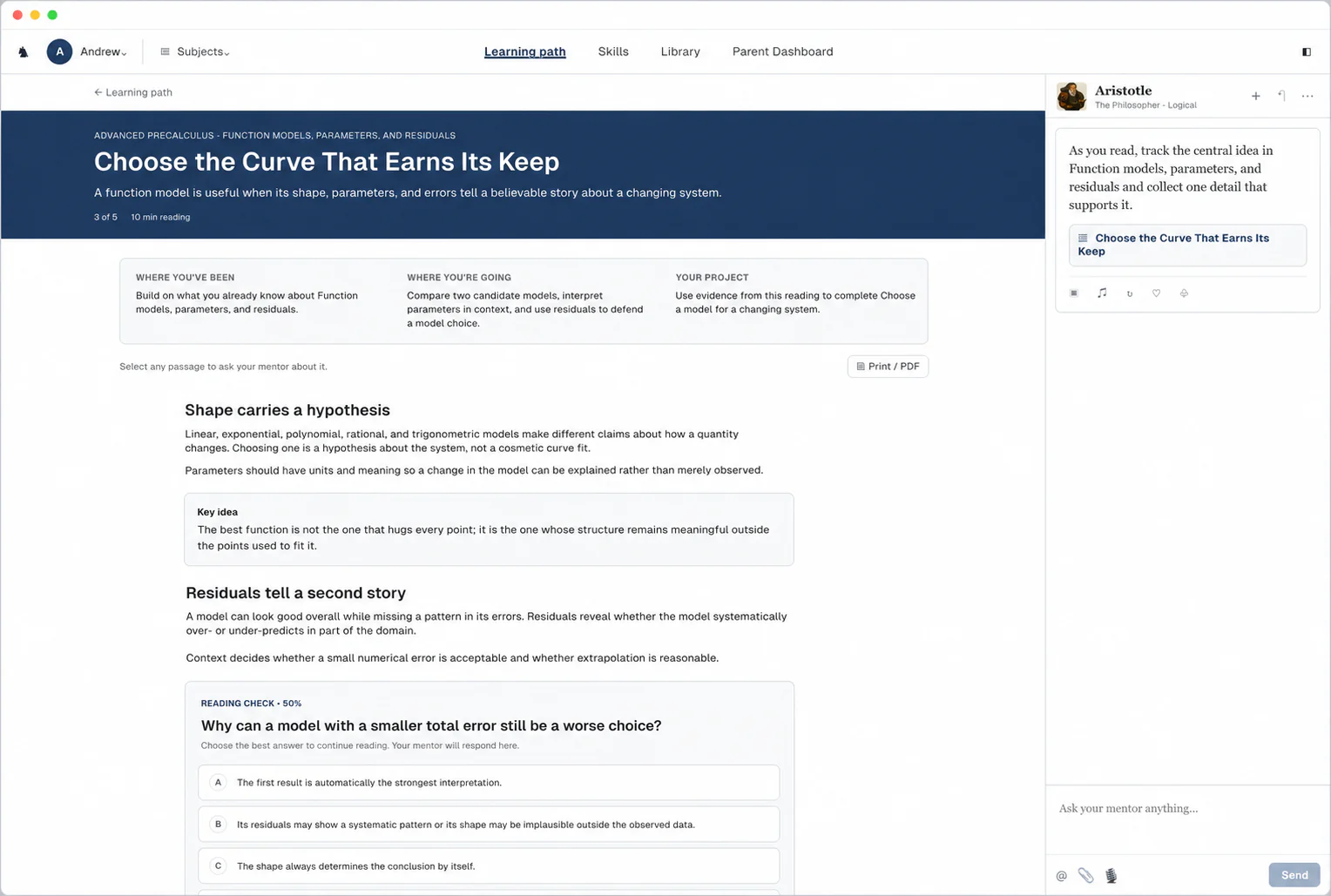
A function model is useful when its shape, parameters, and errors tell a believable story about a changing system.
- Lesson
- Choose the Curve That Earns Its Keep
- Goal
- Compare two candidate models, interpret parameters in context, and use residuals to defend a model choice.
How a lesson works
A 10-minute reading
This example lesson comes from the unit on function models, parameters, and residuals. It moves from “Shape carries a hypothesis” to “Residuals tell a second story” and builds to one idea: the best function is not the one that hugs every point; it is the one whose structure remains meaningful outside the points used to fit it.
Help inside the reading
Any line of “Choose the Curve That Earns Its Keep” can go to our Always-On Mentor: your child highlights it to ask a question, and the mentor can draw the idea step by step on its board or, after a missed answer, explain it another way.
A check halfway through
Your child answers “Why can a model with a smaller total error still be a worse choice?” before reading on, and the Reading Check at the end asks new questions.
A project your child hands in
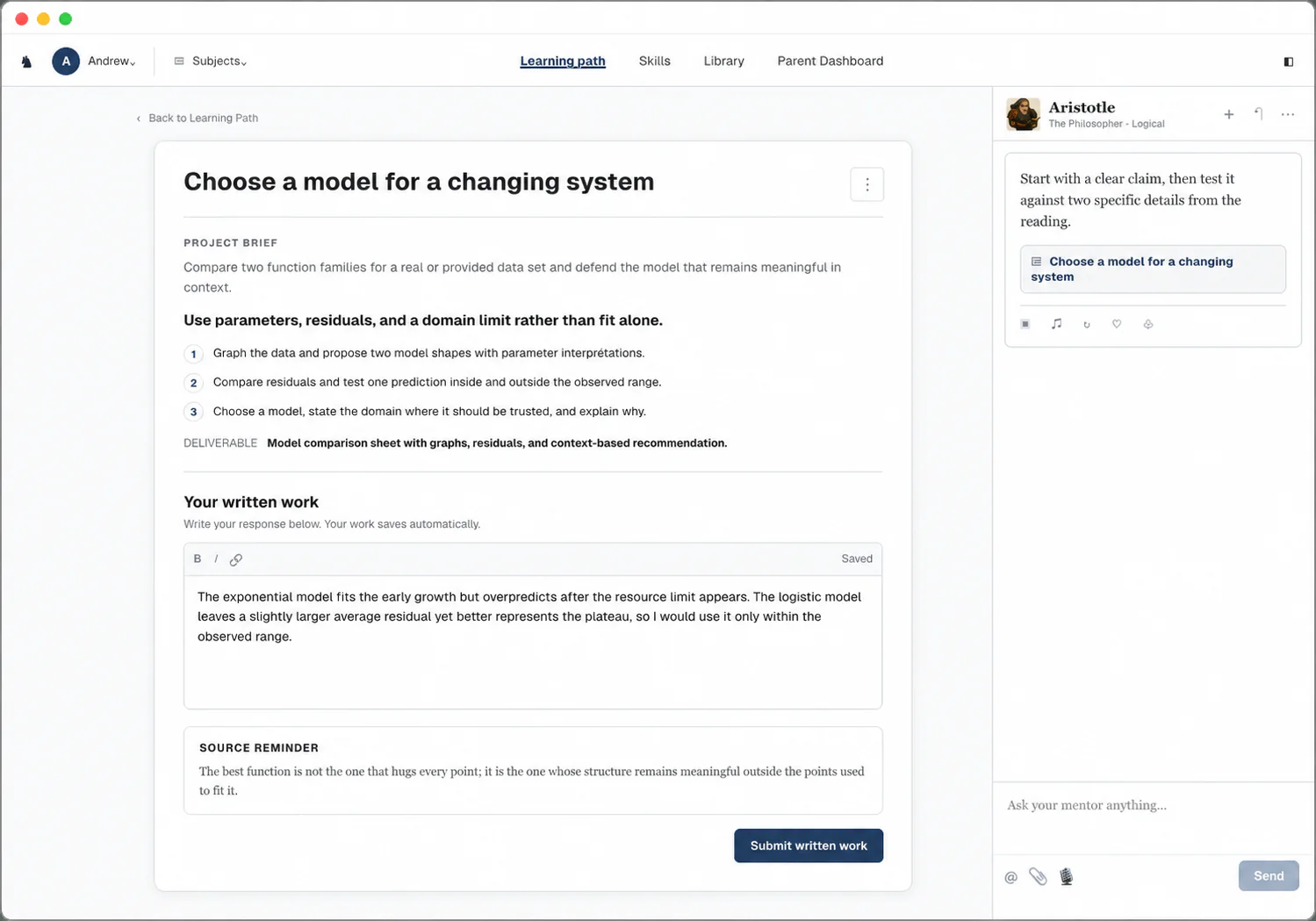
Compare two function families for a real or provided data set and defend the model that remains meaningful in context.
- Task
- Use parameters, residuals, and a domain limit rather than fit alone
- Hand in
- Model comparison sheet with graphs, residuals, and context-based recommendation
See the reasoning behind the answer
Lessons alternate representation work, mixed calculator practice, error correction, and a modeling problem that requires explanation. Advanced Precalculus runs through 18 units and 54 skills, starting with polynomial and rational functions, exponential and logarithmic functions, and trigonometric and polar functions.
- Calculator and no-calculator solution sets
- Multi-representation function analyses
- Modeling tasks with assumptions and interpretation
Units and skills
Advanced Precalculus18 units · 54 skills
Polynomial and rational functions3 skills
- Use procedural and symbolic fluency to solve problems involving Polynomial and rational functions
- Connect multiple representations of Polynomial and rational functions
- Communicate and defend mathematical reasoning about Polynomial and rational functions
Exponential and logarithmic functions3 skills
- Use procedural and symbolic fluency to solve problems involving Exponential and logarithmic functions
- Connect multiple representations of Exponential and logarithmic functions
- Communicate and defend mathematical reasoning about Exponential and logarithmic functions
Trigonometric and polar functions3 skills
- Use procedural and symbolic fluency to solve problems involving Trigonometric and polar functions
- Connect multiple representations of Trigonometric and polar functions
- Communicate and defend mathematical reasoning about Trigonometric and polar functions
Functions involving parameters3 skills
- Use procedural and symbolic fluency to solve problems involving Functions involving parameters
- Connect multiple representations of Functions involving parameters
- Communicate and defend mathematical reasoning about Functions involving parameters
Rates of change3 skills
- Use procedural and symbolic fluency to solve problems involving Rates of change
- Connect multiple representations of Rates of change
- Communicate and defend mathematical reasoning about Rates of change
Model selection3 skills
- Use procedural and symbolic fluency to solve problems involving Model selection
- Connect multiple representations of Model selection
- Communicate and defend mathematical reasoning about Model selection
Transformations and compositions3 skills
- Use procedural and symbolic fluency to solve problems involving Transformations and compositions
- Connect multiple representations of Transformations and compositions
- Communicate and defend mathematical reasoning about Transformations and compositions
Inverses3 skills
- Use procedural and symbolic fluency to solve problems involving Inverses
- Connect multiple representations of Inverses
- Communicate and defend mathematical reasoning about Inverses
Multiple representations3 skills
- Use procedural and symbolic fluency to solve problems involving Multiple representations
- Connect multiple representations of Multiple representations
- Communicate and defend mathematical reasoning about Multiple representations
Graph analysis3 skills
- Use procedural and symbolic fluency to solve problems involving Graph analysis
- Connect multiple representations of Graph analysis
- Communicate and defend mathematical reasoning about Graph analysis
Calculator and no-calculator reasoning3 skills
- Use procedural and symbolic fluency to solve problems involving Calculator and no-calculator reasoning
- Connect multiple representations of Calculator and no-calculator reasoning
- Communicate and defend mathematical reasoning about Calculator and no-calculator reasoning
Cumulative modeling3 skills
- Use procedural and symbolic fluency to solve problems involving Cumulative modeling
- Connect multiple representations of Cumulative modeling
- Communicate and defend mathematical reasoning about Cumulative modeling
Multiple quantitative representations3 skills
- Use procedural and symbolic fluency to solve problems involving Multiple quantitative representations
- Connect multiple representations of Multiple quantitative representations
- Communicate and defend mathematical reasoning about Multiple quantitative representations
Graph construction and interpretation3 skills
- Use procedural and symbolic fluency to solve problems involving Graph construction and interpretation
- Connect multiple representations of Graph construction and interpretation
- Communicate and defend mathematical reasoning about Graph construction and interpretation
Written mathematical justification3 skills
- Use procedural and symbolic fluency to solve problems involving Written mathematical justification
- Connect multiple representations of Written mathematical justification
- Communicate and defend mathematical reasoning about Written mathematical justification
Advanced Precalculus cumulative assessment3 skills
- Use procedural and symbolic fluency to solve problems involving Advanced Precalculus cumulative assessment
- Connect multiple representations of Advanced Precalculus cumulative assessment
- Communicate and defend mathematical reasoning about Advanced Precalculus cumulative assessment
Advanced Precalculus exam-mode practice3 skills
- Use procedural and symbolic fluency to solve problems involving Advanced Precalculus exam-mode practice
- Connect multiple representations of Advanced Precalculus exam-mode practice
- Communicate and defend mathematical reasoning about Advanced Precalculus exam-mode practice
Advanced Precalculus reflection and transfer3 skills
- Use procedural and symbolic fluency to solve problems involving Advanced Precalculus reflection and transfer
- Connect multiple representations of Advanced Precalculus reflection and transfer
- Communicate and defend mathematical reasoning about Advanced Precalculus reflection and transfer
Questions parents ask
How does Advanced Precalculus prepare my student for AP Precalculus?
- Advanced Precalculus follows the AP Precalculus framework unit by unit, as its skill tree shows. Your teen explains and applies the ideas in written responses and projects, so the work shows which skills are secure and which need more practice.
How does a homeschooler register for an AP exam?
- An AP coordinator at an AP-authorized local school arranges registration. Use College Board’s homeschool exam guidance to find a host school. That school sets its deadlines and outside-student policies; its coordinator orders the exam, collects fees, and tells your child where and when to test.
Which course title goes on a homeschool transcript?
- Advanced Precalculus, not AP Precalculus. The AP designation requires College Board Course Audit authorization of the course, which framework alignment does not give. We generate the transcript with that title, ready for you to sign as homeschool administrator.
How can AP scores earn college credit?
- Colleges award credit under their own AP score policies. College Board reports scores on a 1–5 scale, separately from our coursework grades; check the college’s required score and whether it grants credit, placement, or both.
Advanced Precalculus, with the teaching and records handled
$49/month after the trial.