Advanced United States Government and Politics homeschool curriculum.
Your student studies the Constitution, government institutions, public opinion, and policy debates.
A personalized lesson from the course
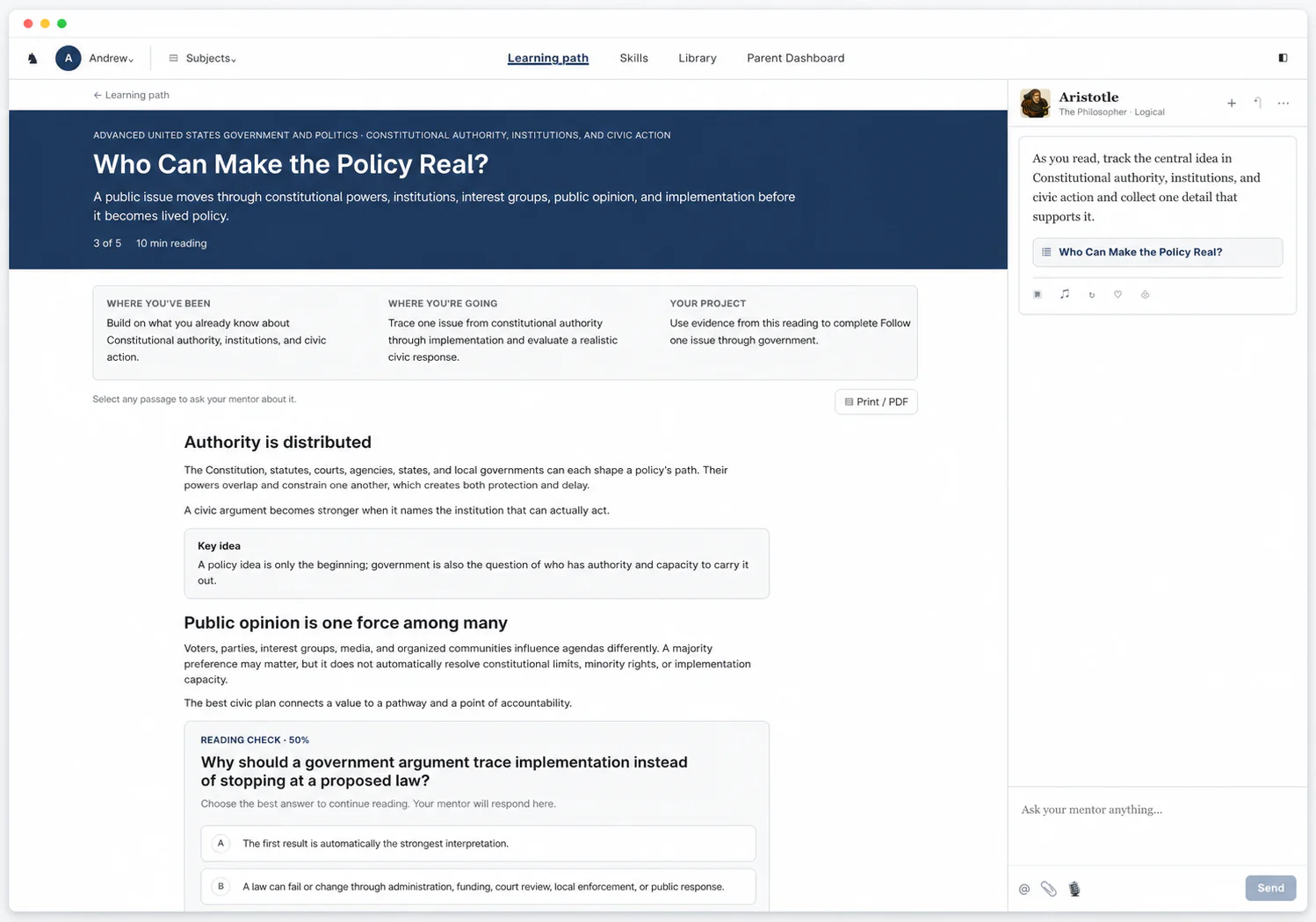
A public issue moves through constitutional powers, institutions, interest groups, public opinion, and implementation before it becomes lived policy.
- Lesson
- Who Can Make the Policy Real?
- Goal
- Trace one issue from constitutional authority through implementation and evaluate a realistic civic response.
How a lesson works
A 10-minute reading
This example lesson comes from the unit on constitutional authority, institutions, and civic action. It moves from “Authority is distributed” to “Public opinion is one force among many” and builds to one idea: a policy idea is only the beginning; government is also the question of who has authority and capacity to carry it out.
Help inside the reading
Your child can highlight any line of “Who Can Make the Policy Real?” and ask our Always-On Mentor about it or ask for a visual, and it offers help on its own whenever they seem stuck.
A check halfway through
Your child answers “Why should a government argument trace implementation instead of stopping at a proposed law?” before reading on, and the Reading Check at the end asks new questions.
A project your child hands in
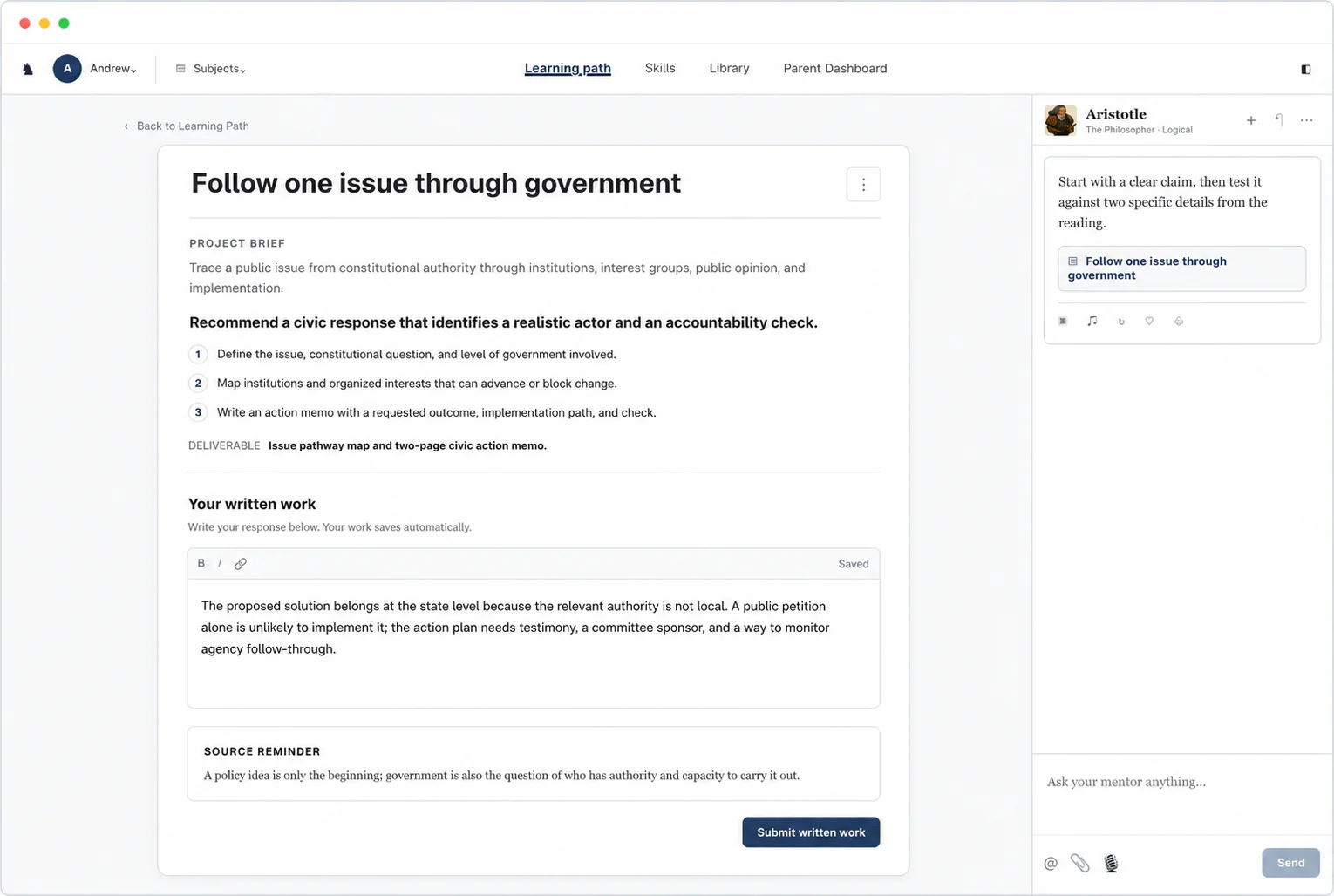
Trace a public issue from constitutional authority through institutions, interest groups, public opinion, and implementation.
- Task
- Recommend a civic response that identifies a realistic actor and an accountability check
- Hand in
- Issue pathway map and two-page civic action memo
Arguments backed by evidence
Students connect a founding document or institution to a court case, dataset, current event, and short political argument. Advanced United States Government and Politics runs through 25 units and 125 skills, starting with foundations of American democracy, interactions among branches, and civil liberties and civil rights.
- Foundational-document and court-case analyses
- Quantitative political interpretations
- Argument essays and an applied civics project
Units and skills
Advanced United States Government and Politics25 units · 125 skills
Foundations of American democracy5 skills
- Apply political concepts and processes to Foundations of American democracy
- Apply Supreme Court reasoning to a case involving Foundations of American democracy
- Analyze political data connected to Foundations of American democracy
- Analyze a foundational or political source about Foundations of American democracy
- Construct a constitutional or political argument about Foundations of American democracy
Interactions among branches5 skills
- Apply political concepts and processes to Interactions among branches
- Apply Supreme Court reasoning to a case involving Interactions among branches
- Analyze political data connected to Interactions among branches
- Analyze a foundational or political source about Interactions among branches
- Construct a constitutional or political argument about Interactions among branches
Civil liberties and civil rights5 skills
- Apply political concepts and processes to Civil liberties and civil rights
- Apply Supreme Court reasoning to a case involving Civil liberties and civil rights
- Analyze political data connected to Civil liberties and civil rights
- Analyze a foundational or political source about Civil liberties and civil rights
- Construct a constitutional or political argument about Civil liberties and civil rights
American political ideologies5 skills
- Apply political concepts and processes to American political ideologies
- Apply Supreme Court reasoning to a case involving American political ideologies
- Analyze political data connected to American political ideologies
- Analyze a foundational or political source about American political ideologies
- Construct a constitutional or political argument about American political ideologies
Political participation5 skills
- Apply political concepts and processes to Political participation
- Apply Supreme Court reasoning to a case involving Political participation
- Analyze political data connected to Political participation
- Analyze a foundational or political source about Political participation
- Construct a constitutional or political argument about Political participation
Foundational documents5 skills
- Apply political concepts and processes to Foundational documents
- Apply Supreme Court reasoning to a case involving Foundational documents
- Analyze political data connected to Foundational documents
- Analyze a foundational or political source about Foundational documents
- Construct a constitutional or political argument about Foundational documents
Supreme Court reasoning5 skills
- Apply political concepts and processes to Supreme Court reasoning
- Apply Supreme Court reasoning to a case involving Supreme Court reasoning
- Analyze political data connected to Supreme Court reasoning
- Analyze a foundational or political source about Supreme Court reasoning
- Construct a constitutional or political argument about Supreme Court reasoning
Quantitative political analysis5 skills
- Apply political concepts and processes to Quantitative political analysis
- Apply Supreme Court reasoning to a case involving Quantitative political analysis
- Analyze political data connected to Quantitative political analysis
- Analyze a foundational or political source about Quantitative political analysis
- Construct a constitutional or political argument about Quantitative political analysis
Current policy debates5 skills
- Apply political concepts and processes to Current policy debates
- Apply Supreme Court reasoning to a case involving Current policy debates
- Analyze political data connected to Current policy debates
- Analyze a foundational or political source about Current policy debates
- Construct a constitutional or political argument about Current policy debates
Political argumentation5 skills
- Apply political concepts and processes to Political argumentation
- Apply Supreme Court reasoning to a case involving Political argumentation
- Analyze political data connected to Political argumentation
- Analyze a foundational or political source about Political argumentation
- Construct a constitutional or political argument about Political argumentation
Applied civics project5 skills
- Apply political concepts and processes to Applied civics project
- Apply Supreme Court reasoning to a case involving Applied civics project
- Analyze political data connected to Applied civics project
- Analyze a foundational or political source about Applied civics project
- Construct a constitutional or political argument about Applied civics project
Presentation of findings5 skills
- Apply political concepts and processes to Presentation of findings
- Apply Supreme Court reasoning to a case involving Presentation of findings
- Analyze political data connected to Presentation of findings
- Analyze a foundational or political source about Presentation of findings
- Construct a constitutional or political argument about Presentation of findings
Source credibility and provenance5 skills
- Apply political concepts and processes to Source credibility and provenance
- Apply Supreme Court reasoning to a case involving Source credibility and provenance
- Analyze political data connected to Source credibility and provenance
- Analyze a foundational or political source about Source credibility and provenance
- Construct a constitutional or political argument about Source credibility and provenance
Claim, evidence, and reasoning5 skills
- Apply political concepts and processes to Claim, evidence, and reasoning
- Apply Supreme Court reasoning to a case involving Claim, evidence, and reasoning
- Analyze political data connected to Claim, evidence, and reasoning
- Analyze a foundational or political source about Claim, evidence, and reasoning
- Construct a constitutional or political argument about Claim, evidence, and reasoning
Counterargument and qualification5 skills
- Apply political concepts and processes to Counterargument and qualification
- Apply Supreme Court reasoning to a case involving Counterargument and qualification
- Analyze political data connected to Counterargument and qualification
- Analyze a foundational or political source about Counterargument and qualification
- Construct a constitutional or political argument about Counterargument and qualification
Dated evidence and changing conditions5 skills
- Apply political concepts and processes to Dated evidence and changing conditions
- Apply Supreme Court reasoning to a case involving Dated evidence and changing conditions
- Analyze political data connected to Dated evidence and changing conditions
- Analyze a foundational or political source about Dated evidence and changing conditions
- Construct a constitutional or political argument about Dated evidence and changing conditions
Competing contemporary perspectives5 skills
- Apply political concepts and processes to Competing contemporary perspectives
- Apply Supreme Court reasoning to a case involving Competing contemporary perspectives
- Analyze political data connected to Competing contemporary perspectives
- Analyze a foundational or political source about Competing contemporary perspectives
- Construct a constitutional or political argument about Competing contemporary perspectives
Inquiry proposal and source approval5 skills
- Apply political concepts and processes to Inquiry proposal and source approval
- Apply Supreme Court reasoning to a case involving Inquiry proposal and source approval
- Analyze political data connected to Inquiry proposal and source approval
- Analyze a foundational or political source about Inquiry proposal and source approval
- Construct a constitutional or political argument about Inquiry proposal and source approval
Research artifact, presentation, and defense5 skills
- Apply political concepts and processes to Research artifact, presentation, and defense
- Apply Supreme Court reasoning to a case involving Research artifact, presentation, and defense
- Analyze political data connected to Research artifact, presentation, and defense
- Analyze a foundational or political source about Research artifact, presentation, and defense
- Construct a constitutional or political argument about Research artifact, presentation, and defense
Multiple quantitative representations5 skills
- Apply political concepts and processes to Multiple quantitative representations
- Apply Supreme Court reasoning to a case involving Multiple quantitative representations
- Analyze political data connected to Multiple quantitative representations
- Analyze a foundational or political source about Multiple quantitative representations
- Construct a constitutional or political argument about Multiple quantitative representations
Graph construction and interpretation5 skills
- Apply political concepts and processes to Graph construction and interpretation
- Apply Supreme Court reasoning to a case involving Graph construction and interpretation
- Analyze political data connected to Graph construction and interpretation
- Analyze a foundational or political source about Graph construction and interpretation
- Construct a constitutional or political argument about Graph construction and interpretation
Written mathematical justification5 skills
- Apply political concepts and processes to Written mathematical justification
- Apply Supreme Court reasoning to a case involving Written mathematical justification
- Analyze political data connected to Written mathematical justification
- Analyze a foundational or political source about Written mathematical justification
- Construct a constitutional or political argument about Written mathematical justification
Advanced United States Government and Politics cumulative assessment5 skills
- Apply political concepts and processes to Advanced United States Government and Politics cumulative assessment
- Apply Supreme Court reasoning to a case involving Advanced United States Government and Politics cumulative assessment
- Analyze political data connected to Advanced United States Government and Politics cumulative assessment
- Analyze a foundational or political source about Advanced United States Government and Politics cumulative assessment
- Construct a constitutional or political argument about Advanced United States Government and Politics cumulative assessment
Advanced United States Government and Politics exam-mode practice5 skills
- Apply political concepts and processes to Advanced United States Government and Politics exam-mode practice
- Apply Supreme Court reasoning to a case involving Advanced United States Government and Politics exam-mode practice
- Analyze political data connected to Advanced United States Government and Politics exam-mode practice
- Analyze a foundational or political source about Advanced United States Government and Politics exam-mode practice
- Construct a constitutional or political argument about Advanced United States Government and Politics exam-mode practice
Advanced United States Government and Politics reflection and transfer5 skills
- Apply political concepts and processes to Advanced United States Government and Politics reflection and transfer
- Apply Supreme Court reasoning to a case involving Advanced United States Government and Politics reflection and transfer
- Analyze political data connected to Advanced United States Government and Politics reflection and transfer
- Analyze a foundational or political source about Advanced United States Government and Politics reflection and transfer
- Construct a constitutional or political argument about Advanced United States Government and Politics reflection and transfer
Questions parents ask
How does Advanced United States Government and Politics prepare my student for AP United States Government and Politics?
- Advanced United States Government and Politics follows the AP United States Government and Politics framework unit by unit, as its skill tree shows. Your teen explains and applies the ideas in written responses and projects, so the work shows which skills are secure and which need more practice.
How does a homeschooler register for an AP exam?
- An AP coordinator at an AP-authorized local school arranges registration. Use College Board’s homeschool exam guidance to find a host school. That school sets its deadlines and outside-student policies; its coordinator orders the exam, collects fees, and tells your child where and when to test.
Which course title goes on a homeschool transcript?
- Advanced United States Government and Politics, not AP United States Government and Politics. The AP designation requires College Board Course Audit authorization of the course, which framework alignment does not give. We generate the transcript with that title, ready for you to sign as homeschool administrator.
How can AP scores earn college credit?
- Colleges award credit under their own AP score policies. College Board reports scores on a 1–5 scale, separately from our coursework grades; check the college’s required score and whether it grants credit, placement, or both.
Advanced United States Government and Politics, with the teaching and records handled
$49/month after the trial.