Advanced Human Geography homeschool curriculum.
Your student uses maps and data to study population, culture, cities, politics, and development.
A personalized lesson from the course
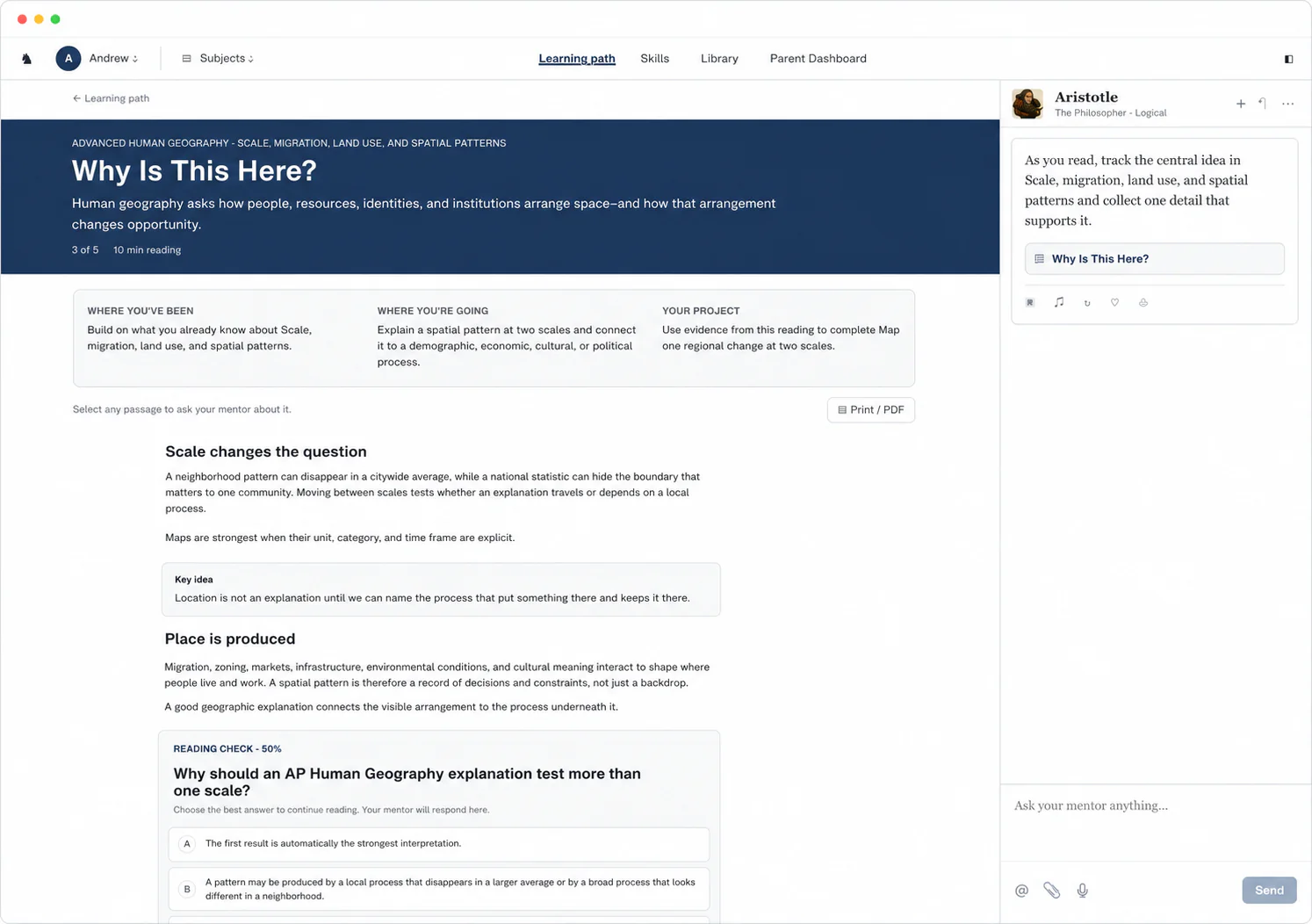
Human geography asks how people, resources, identities, and institutions arrange space, and how that arrangement changes opportunity.
- Lesson
- Why Is This Here?
- Goal
- Explain a spatial pattern at two scales and connect it to a demographic, economic, cultural, or political process.
How a lesson works
A 10-minute reading
This example lesson comes from the unit on scale, migration, land use, and spatial patterns. It moves from “Scale changes the question” to “Place is produced” and builds to one idea: location is not an explanation until we can name the process that put something there and keeps it there.
Help inside the reading
Your child can highlight any line of “Why Is This Here?” and ask our Always-On Mentor about it or ask for a visual, and it offers help on its own whenever they seem stuck.
A check halfway through
Your child answers “Why should an AP Human Geography explanation test more than one scale?” before reading on, and the Reading Check at the end asks new questions.
A project your child hands in
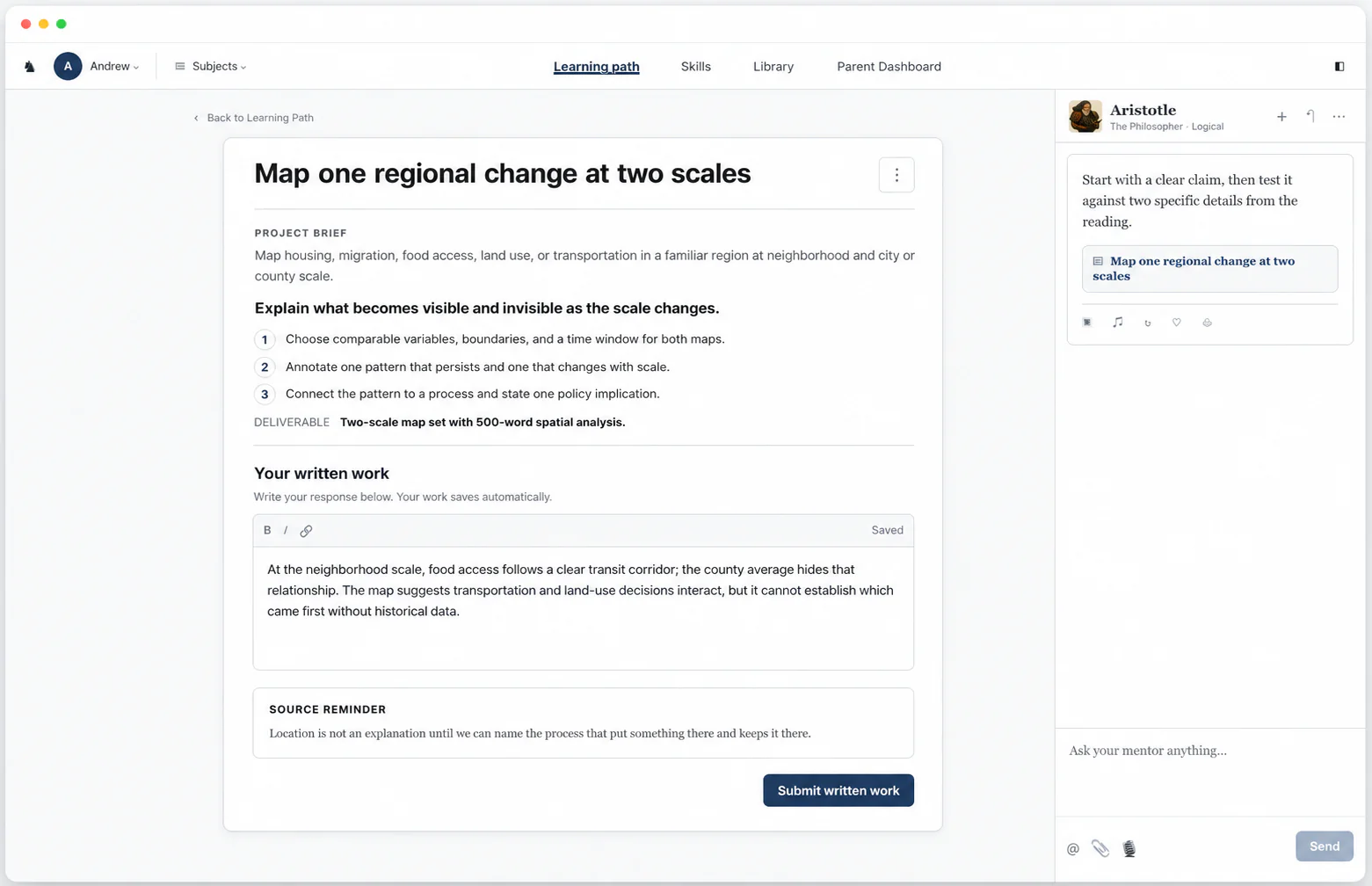
Map housing, migration, food access, land use, or transportation in a familiar region at neighborhood and city or county scale.
- Task
- Explain what becomes visible and invisible as the scale changes
- Hand in
- Two-scale map set with 500-word spatial analysis
Arguments backed by evidence
Students move between a core concept, a map or dataset, a current case, and a short explanation of pattern and process. Advanced Human Geography runs through 25 units and 125 skills, starting with geographic thinking, population and migration, and cultural patterns.
- Annotated maps and spatial data interpretations
- Regional case studies
- Multi-stimulus geographic arguments
Units and skills
Advanced Human Geography25 units · 125 skills
Geographic thinking5 skills
- Explain geographic concepts and processes in Geographic thinking
- Analyze spatial relationships involving Geographic thinking
- Analyze geographic data connected to Geographic thinking
- Analyze maps, images, and sources related to Geographic thinking
- Analyze Geographic thinking across geographic scales
Population and migration5 skills
- Explain geographic concepts and processes in Population and migration
- Analyze spatial relationships involving Population and migration
- Analyze geographic data connected to Population and migration
- Analyze maps, images, and sources related to Population and migration
- Analyze Population and migration across geographic scales
Cultural patterns5 skills
- Explain geographic concepts and processes in Cultural patterns
- Analyze spatial relationships involving Cultural patterns
- Analyze geographic data connected to Cultural patterns
- Analyze maps, images, and sources related to Cultural patterns
- Analyze Cultural patterns across geographic scales
Political patterns5 skills
- Explain geographic concepts and processes in Political patterns
- Analyze spatial relationships involving Political patterns
- Analyze geographic data connected to Political patterns
- Analyze maps, images, and sources related to Political patterns
- Analyze Political patterns across geographic scales
Agriculture and rural land use5 skills
- Explain geographic concepts and processes in Agriculture and rural land use
- Analyze spatial relationships involving Agriculture and rural land use
- Analyze geographic data connected to Agriculture and rural land use
- Analyze maps, images, and sources related to Agriculture and rural land use
- Analyze Agriculture and rural land use across geographic scales
Cities and urban land use5 skills
- Explain geographic concepts and processes in Cities and urban land use
- Analyze spatial relationships involving Cities and urban land use
- Analyze geographic data connected to Cities and urban land use
- Analyze maps, images, and sources related to Cities and urban land use
- Analyze Cities and urban land use across geographic scales
Industrial and economic development5 skills
- Explain geographic concepts and processes in Industrial and economic development
- Analyze spatial relationships involving Industrial and economic development
- Analyze geographic data connected to Industrial and economic development
- Analyze maps, images, and sources related to Industrial and economic development
- Analyze Industrial and economic development across geographic scales
Maps and spatial scale5 skills
- Explain geographic concepts and processes in Maps and spatial scale
- Analyze spatial relationships involving Maps and spatial scale
- Analyze geographic data connected to Maps and spatial scale
- Analyze maps, images, and sources related to Maps and spatial scale
- Analyze Maps and spatial scale across geographic scales
Geospatial data5 skills
- Explain geographic concepts and processes in Geospatial data
- Analyze spatial relationships involving Geospatial data
- Analyze geographic data connected to Geospatial data
- Analyze maps, images, and sources related to Geospatial data
- Analyze Geospatial data across geographic scales
Regional case studies5 skills
- Explain geographic concepts and processes in Regional case studies
- Analyze spatial relationships involving Regional case studies
- Analyze geographic data connected to Regional case studies
- Analyze maps, images, and sources related to Regional case studies
- Analyze Regional case studies across geographic scales
Current geographic change5 skills
- Explain geographic concepts and processes in Current geographic change
- Analyze spatial relationships involving Current geographic change
- Analyze geographic data connected to Current geographic change
- Analyze maps, images, and sources related to Current geographic change
- Analyze Current geographic change across geographic scales
Multi-stimulus geographic argument5 skills
- Explain geographic concepts and processes in Multi-stimulus geographic argument
- Analyze spatial relationships involving Multi-stimulus geographic argument
- Analyze geographic data connected to Multi-stimulus geographic argument
- Analyze maps, images, and sources related to Multi-stimulus geographic argument
- Analyze Multi-stimulus geographic argument across geographic scales
Source credibility and provenance5 skills
- Explain geographic concepts and processes in Source credibility and provenance
- Analyze spatial relationships involving Source credibility and provenance
- Analyze geographic data connected to Source credibility and provenance
- Analyze maps, images, and sources related to Source credibility and provenance
- Analyze Source credibility and provenance across geographic scales
Claim, evidence, and reasoning5 skills
- Explain geographic concepts and processes in Claim, evidence, and reasoning
- Analyze spatial relationships involving Claim, evidence, and reasoning
- Analyze geographic data connected to Claim, evidence, and reasoning
- Analyze maps, images, and sources related to Claim, evidence, and reasoning
- Analyze Claim, evidence, and reasoning across geographic scales
Counterargument and qualification5 skills
- Explain geographic concepts and processes in Counterargument and qualification
- Analyze spatial relationships involving Counterargument and qualification
- Analyze geographic data connected to Counterargument and qualification
- Analyze maps, images, and sources related to Counterargument and qualification
- Analyze Counterargument and qualification across geographic scales
Dated evidence and changing conditions5 skills
- Explain geographic concepts and processes in Dated evidence and changing conditions
- Analyze spatial relationships involving Dated evidence and changing conditions
- Analyze geographic data connected to Dated evidence and changing conditions
- Analyze maps, images, and sources related to Dated evidence and changing conditions
- Analyze Dated evidence and changing conditions across geographic scales
Competing contemporary perspectives5 skills
- Explain geographic concepts and processes in Competing contemporary perspectives
- Analyze spatial relationships involving Competing contemporary perspectives
- Analyze geographic data connected to Competing contemporary perspectives
- Analyze maps, images, and sources related to Competing contemporary perspectives
- Analyze Competing contemporary perspectives across geographic scales
Multiple quantitative representations5 skills
- Explain geographic concepts and processes in Multiple quantitative representations
- Analyze spatial relationships involving Multiple quantitative representations
- Analyze geographic data connected to Multiple quantitative representations
- Analyze maps, images, and sources related to Multiple quantitative representations
- Analyze Multiple quantitative representations across geographic scales
Graph construction and interpretation5 skills
- Explain geographic concepts and processes in Graph construction and interpretation
- Analyze spatial relationships involving Graph construction and interpretation
- Analyze geographic data connected to Graph construction and interpretation
- Analyze maps, images, and sources related to Graph construction and interpretation
- Analyze Graph construction and interpretation across geographic scales
Written mathematical justification5 skills
- Explain geographic concepts and processes in Written mathematical justification
- Analyze spatial relationships involving Written mathematical justification
- Analyze geographic data connected to Written mathematical justification
- Analyze maps, images, and sources related to Written mathematical justification
- Analyze Written mathematical justification across geographic scales
Formal visual analysis5 skills
- Explain geographic concepts and processes in Formal visual analysis
- Analyze spatial relationships involving Formal visual analysis
- Analyze geographic data connected to Formal visual analysis
- Analyze maps, images, and sources related to Formal visual analysis
- Analyze Formal visual analysis across geographic scales
Context, purpose, and audience5 skills
- Explain geographic concepts and processes in Context, purpose, and audience
- Analyze spatial relationships involving Context, purpose, and audience
- Analyze geographic data connected to Context, purpose, and audience
- Analyze maps, images, and sources related to Context, purpose, and audience
- Analyze Context, purpose, and audience across geographic scales
Advanced Human Geography cumulative assessment5 skills
- Explain geographic concepts and processes in Advanced Human Geography cumulative assessment
- Analyze spatial relationships involving Advanced Human Geography cumulative assessment
- Analyze geographic data connected to Advanced Human Geography cumulative assessment
- Analyze maps, images, and sources related to Advanced Human Geography cumulative assessment
- Analyze Advanced Human Geography cumulative assessment across geographic scales
Advanced Human Geography exam-mode practice5 skills
- Explain geographic concepts and processes in Advanced Human Geography exam-mode practice
- Analyze spatial relationships involving Advanced Human Geography exam-mode practice
- Analyze geographic data connected to Advanced Human Geography exam-mode practice
- Analyze maps, images, and sources related to Advanced Human Geography exam-mode practice
- Analyze Advanced Human Geography exam-mode practice across geographic scales
Advanced Human Geography reflection and transfer5 skills
- Explain geographic concepts and processes in Advanced Human Geography reflection and transfer
- Analyze spatial relationships involving Advanced Human Geography reflection and transfer
- Analyze geographic data connected to Advanced Human Geography reflection and transfer
- Analyze maps, images, and sources related to Advanced Human Geography reflection and transfer
- Analyze Advanced Human Geography reflection and transfer across geographic scales
Questions parents ask
How does Advanced Human Geography prepare my student for AP Human Geography?
- Advanced Human Geography follows the AP Human Geography framework unit by unit, as its skill tree shows. Your teen explains and applies the ideas in written responses and projects, so the work shows which skills are secure and which need more practice.
How does a homeschooler register for an AP exam?
- An AP coordinator at an AP-authorized local school arranges registration. Use College Board’s homeschool exam guidance to find a host school. That school sets its deadlines and outside-student policies; its coordinator orders the exam, collects fees, and tells your child where and when to test.
Which course title goes on a homeschool transcript?
- Advanced Human Geography, not AP Human Geography. The AP designation requires College Board Course Audit authorization of the course, which framework alignment does not give. We generate the transcript with that title, ready for you to sign as homeschool administrator.
How can AP scores earn college credit?
- Colleges award credit under their own AP score policies. College Board reports scores on a 1–5 scale, separately from our coursework grades; check the college’s required score and whether it grants credit, placement, or both.
Advanced Human Geography, with the teaching and records handled
$49/month after the trial.