3rd grade homeschool curriculum
A full curriculum, starting at your child's level, with lessons connected to their interests and progress you can see.
See the work in 3rd grade
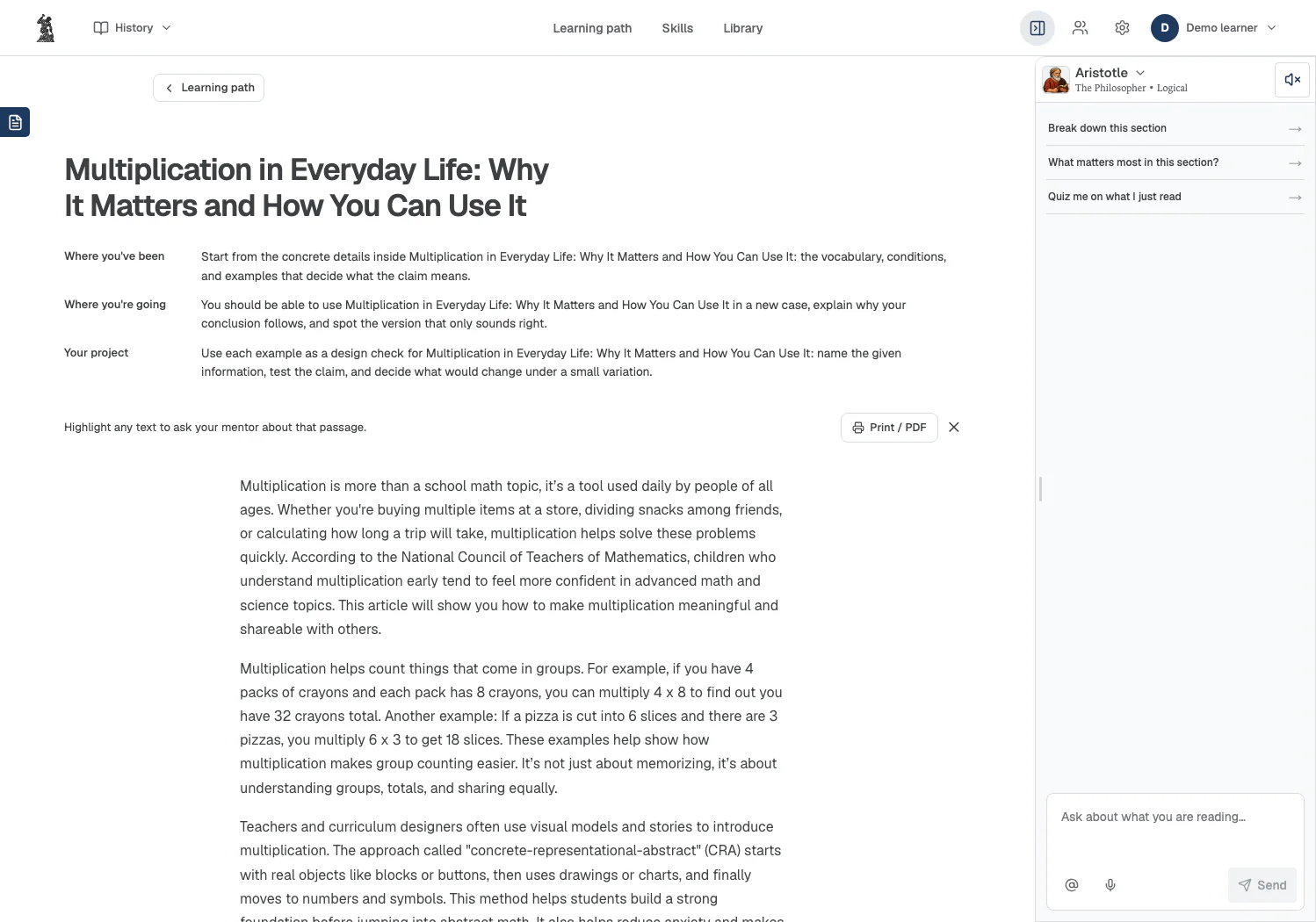
Your child reads how equal groups, like packs of crayons and slices of pizza, become multiplication.
- Lesson
- Multiplication in Everyday Life
- Goal
- Use multiplication in a new case and explain why the answer follows
- Project
- Test each example: name what is given and what changes
Your parent dashboard
- Today
- Each subject's lesson, and whether it's done
- Grades
- Every submission graded instantly, with written feedback, so you never grade
- Records
- Attendance log and learning summary, ready to export
- Documents
- Transcripts and state-aware compliance drafts, written for you and ready to sign

3rd grade scope and sequence
Math7 units · 40 skills
Place value to 100,0006 skills
- Compose a number to 100,000 using place value
- Write a number to 100,000 in expanded notation
- Compare two numbers to 100,000 using symbols
- Round a whole number to the nearest ten
- Round a whole number to the nearest hundred
- Locate a whole number on an open number line
Fractions as numbers6 skills
- Name a fraction from equal parts of a whole
- Place a unit fraction on a number line
- Explain that a whole is the sum of its unit fractions
- Find an equivalent fraction with a picture
- Compare two fractions with the same numerator
- Compare two fractions with the same denominator
Multiplication and division6 skills
- Model a multiplication fact with an array
- Use equal groups to write a multiplication sentence
- Recall multiplication facts through ten by ten
- Use a related multiplication fact to divide
- Divide a set into equal groups to find the size of each group
- Divide a set into equal groups to find the number of groups
Problem solving and patterns6 skills
- Solve a one-step multiplication problem in context
- Solve a two-step problem with addition and subtraction
- Represent a problem with a strip diagram
- Write an equation with an unknown for a story problem
- Complete an input-output table from a rule
- Describe the rule of a number pattern
Geometry and measurement7 skills
- Classify a two-dimensional figure by its attributes
- Identify a quadrilateral by its sides and angles
- Find the area of a rectangle by tiling with unit squares
- Find the perimeter of a figure with given side lengths
- Tell time to the nearest minute
- Measure liquid volume with a marked container
- Measure weight with a balance and standard units
Data analysis5 skills
- Build a frequency table from a set of observations
- Read a dot plot to answer a question
- Read a pictograph with a scaled key
- Read a bar graph with a scaled interval
- Solve a one-step problem using data from a graph
Personal financial literacy4 skills
- Explain the difference between income and a gift
- Sort expenses as planned or unplanned
- Explain why a person saves for a goal
- Compare the cost of two choices
Reading6 units · 27 skills
Comprehension strategies5 skills
- Make a prediction and confirm it with the text
- Ask a question about a confusing part and reread
- Create a mental image from descriptive language
- Summarize a text in the order events happened
- Use background knowledge to make sense of a passage
Literary elements5 skills
- Identify the main character and a trait with evidence
- Describe the setting and how it affects the plot
- Sequence the plot as beginning, middle, and end
- Explain the problem and how it is solved
- State the theme of a story in one sentence
Informational text5 skills
- State the central idea of an informational text
- Identify supporting details for a central idea
- Use a heading to locate information
- Read a diagram or caption to add information
- Explain how a text is organized
Poetry and drama4 skills
- Identify rhyme and rhythm in a poem
- Explain what a stanza contributes to a poem
- Identify the parts of a drama such as scenes and dialogue
- Explain what a character says about the situation
Vocabulary in reading4 skills
- Use context clues to determine word meaning
- Use a prefix to infer the meaning of a new word
- Use a suffix to infer the meaning of a new word
- Choose the correct meaning of a multiple-meaning word
Fluency and evidence4 skills
- Read a grade-level passage with accurate phrasing
- Adjust reading rate for a difficult passage
- Quote a detail from the text to support an answer
- Explain why a detail supports an idea
Writing and language6 units · 25 skills
The writing process5 skills
- Brainstorm ideas for a chosen topic
- Plan a piece of writing with a simple outline
- Write a first draft from a plan
- Revise a draft to add a missing detail
- Edit a draft for capitals and end punctuation
Paragraph writing4 skills
- Write a topic sentence for a paragraph
- Add supporting details to a topic sentence
- Write a closing sentence that fits the paragraph
- Keep every sentence in a paragraph on one topic
Narrative writing4 skills
- Write a narrative with a clear beginning
- Order events with time-order words
- Add a sensory detail to a narrative
- Write an ending that resolves the narrative
Informational writing4 skills
- State a fact and explain it
- Group related facts together
- Use a text feature such as a heading in writing
- Write an introduction that names the topic
Opinion writing4 skills
- State an opinion clearly
- Give a reason that supports an opinion
- Use a linking word to connect an opinion and a reason
- Write a closing that restates the opinion
Inquiry and speaking4 skills
- Generate a question worth researching
- Gather information from a provided source
- Present information clearly to an audience
- Listen and ask a relevant follow-up question
Science7 units · 34 skills
Investigation and measurement5 skills
- Ask a testable question about an observation
- Choose a tool to measure length, mass, or temperature
- Record observations in a data table
- Explain why an investigation is repeated
- Communicate a result using a drawing and labels
Matter and its properties5 skills
- Describe an object by its measurable physical properties
- Compare the mass of two objects using a balance
- Measure the volume of a liquid
- Classify matter as a solid, a liquid, or a gas
- Predict what happens to matter when it is heated
Forms of energy5 skills
- Identify mechanical energy in a moving object
- Identify light energy from a source
- Identify sound energy from a vibration
- Identify thermal energy transfer between objects
- Trace energy from its source to its use
Force and motion4 skills
- Describe the motion of an object as a pattern
- Explain how a push or a pull changes motion
- Explain how gravity pulls objects toward Earth
- Compare motion on a smooth and a rough surface
Earth materials and weather5 skills
- Compare soil samples by texture and colour
- Explain how rocks form part of the land
- Describe the steps of the water cycle
- Record weather over several days and describe a pattern
- Explain why seasons change during a year
Sun, moon, and planets4 skills
- Describe the Sun as a source of light and heat
- Describe the pattern of the Moon's appearance
- Explain why the Sun appears to move across the sky
- Name the planets in order from the Sun
Organisms and environments6 skills
- Match a structure of a plant to its function
- Match a structure of an animal to its function
- Sequence the stages of an animal life cycle
- Explain how an inherited trait passes to offspring
- Trace energy through a simple food chain
- Predict how an environmental change affects an organism
History5 units · 25 skills
How communities change4 skills
- Compare a community in the past with the same community today
- Sequence events on a community timeline
- Explain how transportation changed daily life
- Explain how a community grew around a resource
People who shaped communities7 skills
- Explain why a community honours a founder
- Describe a contribution of Benjamin Franklin
- Describe a contribution of Harriet Tubman
- Explain how one person's choice affected many people
- Describe a contribution of George Washington
- Describe a contribution of Thomas Edison
- Describe a contribution of Susan B. Anthony
Heroes and holidays5 skills
- Explain why Independence Day is observed
- Explain why Martin Luther King Jr. Day is observed
- Explain why Memorial Day is observed
- Connect a holiday to the event it remembers
- Explain why Thanksgiving is observed
Evidence from the past4 skills
- Use a photograph as evidence about the past
- Use an artifact to infer how people lived
- Distinguish a primary from a secondary source
- Explain what a source cannot tell you
Local and national stories5 skills
- Explain the origin of a local landmark
- Retell a founding story of the United States
- Compare two accounts of the same event
- Explain why the Statue of Liberty was given to the United States
- Explain what happened at the first Fourth of July
FAQ
- What happens when my child is stuck in a lesson?
- Our Always-On Mentor stays beside every reading, so help is one question away. If a word problem stops your child, they can highlight it and ask, or ask the mentor to draw the equal groups on its board. When they seem stuck, it offers help without being asked.
- How much time does school take each day?
- There is no fixed daily length. Each lesson shows its estimated time, and our Parent Dashboard adds up the day, so you can see the hours against your state's instruction-time rules.
- Why is 3rd grade a turning point?
- Reading carries more of the work this year: children use it to follow science and history lessons and solve word problems. Placement checks reading separately from subject knowledge, so you can see which skill needs attention.
Build 3rd grade around your child
Start with the 3rd grade skills your child needs next, with room to move ahead in one subject and review in another.
Start your 14-day free trial
$149/month per child after the trial.