Advanced 2-D Art and Design homeschool curriculum.
The portfolio develops through photography, graphic design, collage, pattern, and image-making, all tied to a sustained investigation.
A personalized lesson from the course
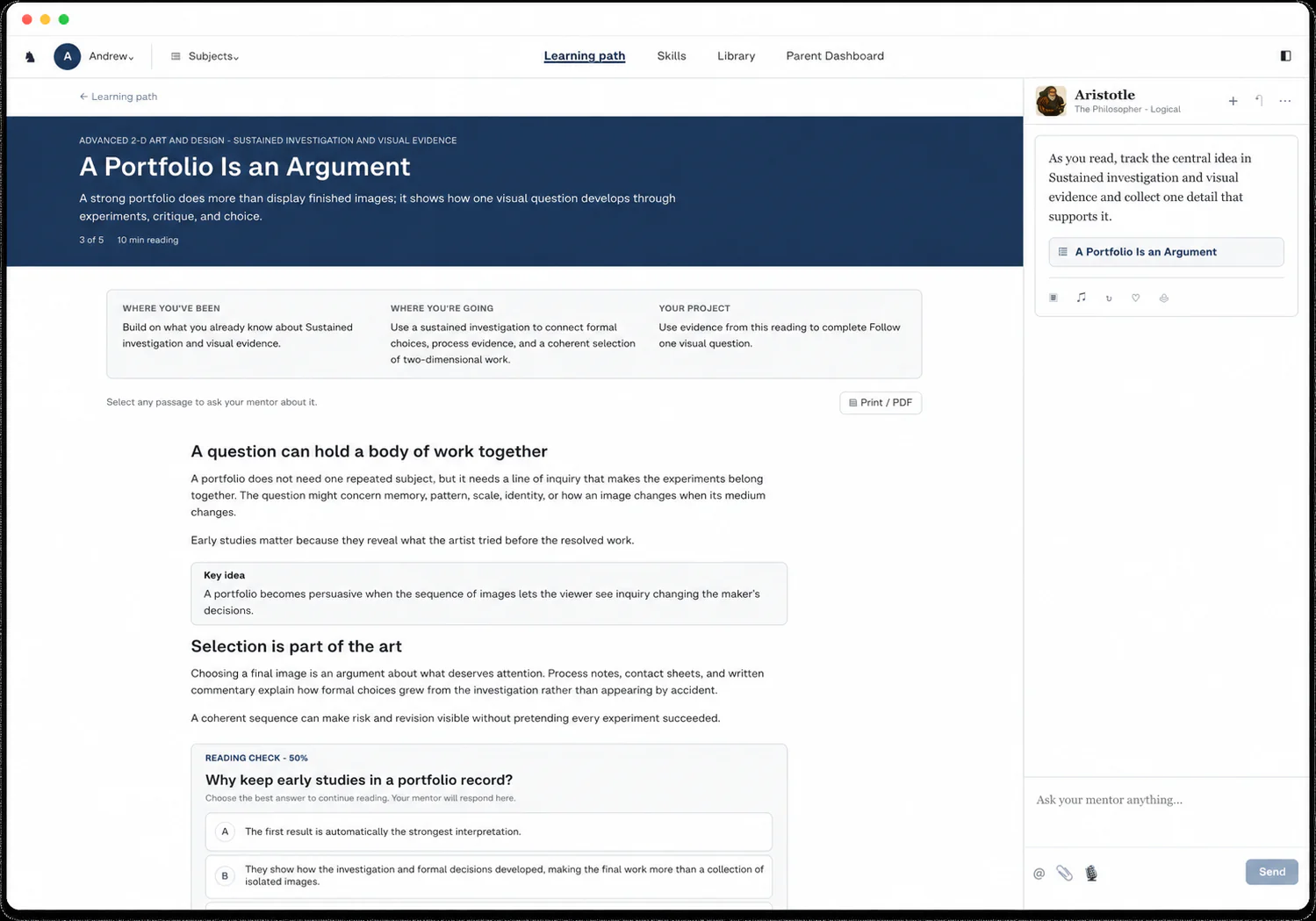
A strong portfolio does more than display finished images; it shows how one visual question develops through experiments, critique, and choice.
- Lesson
- A Portfolio Is an Argument
- Goal
- Use a sustained investigation to connect formal choices, process evidence, and a coherent selection of two-dimensional work.
How a lesson works
A 10-minute reading
This example lesson comes from the unit on sustained investigation and visual evidence. It moves from “A question can hold a body of work together” to “Selection is part of the art” and builds to one idea: a portfolio becomes persuasive when the sequence of images lets the viewer see inquiry changing the maker's decisions.
Help inside the reading
Our Always-On Mentor stays beside “A Portfolio Is an Argument” the whole way through, answering questions about any highlighted line and, during the Reading Check, clarifying a question without giving the answer away.
A check halfway through
Your child answers “Why keep early studies in a portfolio record?” before reading on, and the Reading Check at the end asks new questions.
A project your child hands in
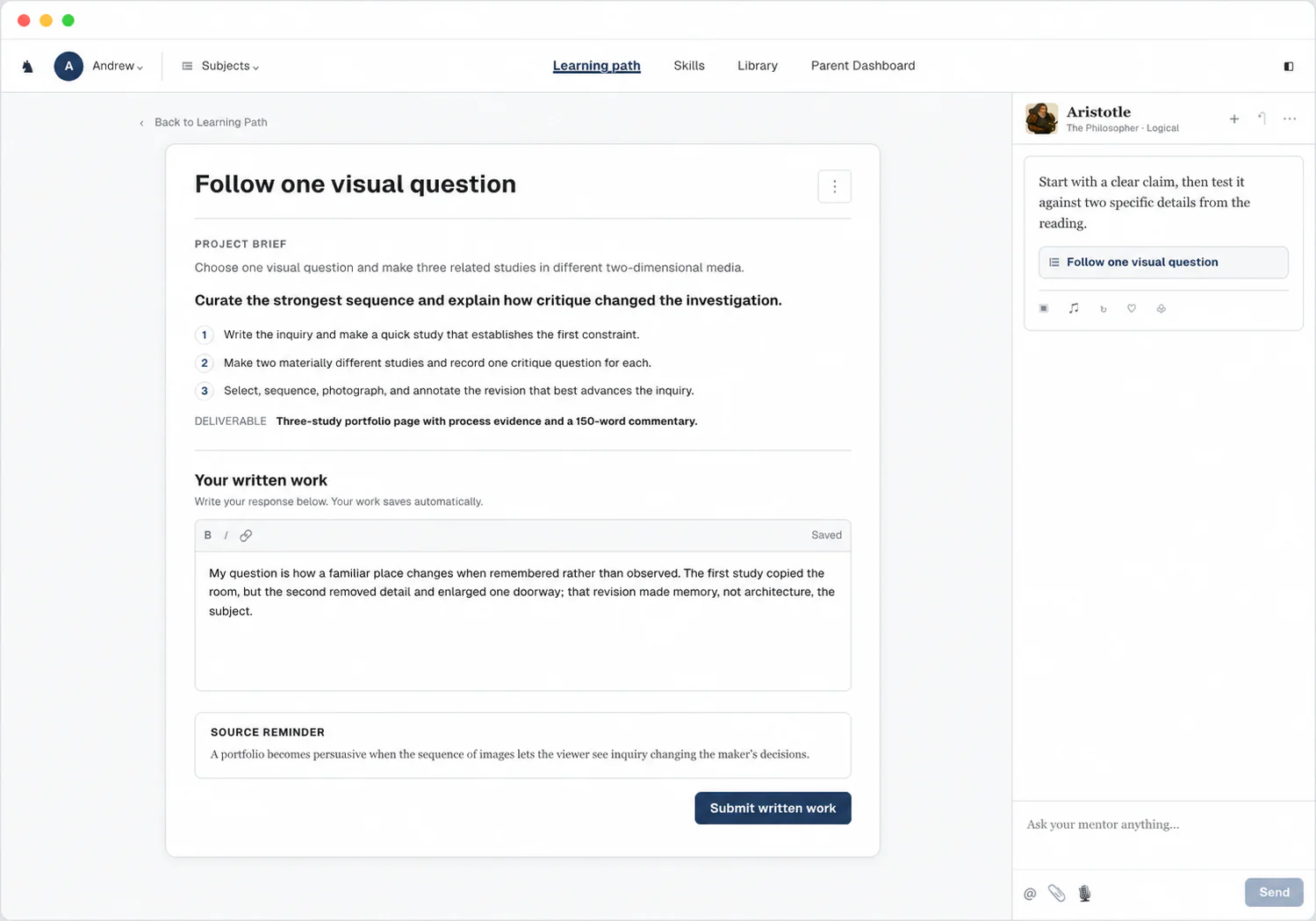
Choose one visual question and make three related studies in different two-dimensional media.
- Task
- Curate the strongest sequence and explain how critique changed the investigation
- Hand in
- Three-study portfolio page with process evidence and a 150-word commentary
Build the portfolio as the work develops
Expect regular making, careful photographs of each piece, critique, and revision beyond the first successful draft. Advanced 2-D Art and Design runs through 19 units and 95 skills, starting with inquiry and sustained investigation, design elements and principles, and photography and image making.
- Process documentation that shows experiments and decisions
- Written commentary connecting inquiry to formal choices
- A curated selection of resolved two-dimensional work
The AP portfolio has two sections
- Sustained Investigation60% of AP score
- 15 digital images, with written evidence explaining the inquiry, experimentation, and revisions.
- Selected Works40% of AP score
- 5 digital images of 5 artworks, with written descriptions of ideas, materials, and processes.
Units and skills
Advanced 2-D Art and Design19 units · 95 skills
Inquiry and sustained investigation5 skills
- Analyze formal choices and relationships in Inquiry and sustained investigation
- Explain how context, purpose, and audience shape Inquiry and sustained investigation
- Develop and test an original inquiry through Inquiry and sustained investigation
- Document experimentation, critique, and revision in Inquiry and sustained investigation
- Select, justify, and present evidence of mastery in Inquiry and sustained investigation
Design elements and principles5 skills
- Analyze formal choices and relationships in Design elements and principles
- Explain how context, purpose, and audience shape Design elements and principles
- Develop and test an original inquiry through Design elements and principles
- Document experimentation, critique, and revision in Design elements and principles
- Select, justify, and present evidence of mastery in Design elements and principles
Photography and image making5 skills
- Analyze formal choices and relationships in Photography and image making
- Explain how context, purpose, and audience shape Photography and image making
- Develop and test an original inquiry through Photography and image making
- Document experimentation, critique, and revision in Photography and image making
- Select, justify, and present evidence of mastery in Photography and image making
Graphic and communication design5 skills
- Analyze formal choices and relationships in Graphic and communication design
- Explain how context, purpose, and audience shape Graphic and communication design
- Develop and test an original inquiry through Graphic and communication design
- Document experimentation, critique, and revision in Graphic and communication design
- Select, justify, and present evidence of mastery in Graphic and communication design
Collage and mixed media5 skills
- Analyze formal choices and relationships in Collage and mixed media
- Explain how context, purpose, and audience shape Collage and mixed media
- Develop and test an original inquiry through Collage and mixed media
- Document experimentation, critique, and revision in Collage and mixed media
- Select, justify, and present evidence of mastery in Collage and mixed media
Surface and pattern5 skills
- Analyze formal choices and relationships in Surface and pattern
- Explain how context, purpose, and audience shape Surface and pattern
- Develop and test an original inquiry through Surface and pattern
- Document experimentation, critique, and revision in Surface and pattern
- Select, justify, and present evidence of mastery in Surface and pattern
Iteration and experimentation5 skills
- Analyze formal choices and relationships in Iteration and experimentation
- Explain how context, purpose, and audience shape Iteration and experimentation
- Develop and test an original inquiry through Iteration and experimentation
- Document experimentation, critique, and revision in Iteration and experimentation
- Select, justify, and present evidence of mastery in Iteration and experimentation
Materials and processes5 skills
- Analyze formal choices and relationships in Materials and processes
- Explain how context, purpose, and audience shape Materials and processes
- Develop and test an original inquiry through Materials and processes
- Document experimentation, critique, and revision in Materials and processes
- Select, justify, and present evidence of mastery in Materials and processes
Critique and revision5 skills
- Analyze formal choices and relationships in Critique and revision
- Explain how context, purpose, and audience shape Critique and revision
- Develop and test an original inquiry through Critique and revision
- Document experimentation, critique, and revision in Critique and revision
- Select, justify, and present evidence of mastery in Critique and revision
Written evidence5 skills
- Analyze formal choices and relationships in Written evidence
- Explain how context, purpose, and audience shape Written evidence
- Develop and test an original inquiry through Written evidence
- Document experimentation, critique, and revision in Written evidence
- Select, justify, and present evidence of mastery in Written evidence
Selected works5 skills
- Analyze formal choices and relationships in Selected works
- Explain how context, purpose, and audience shape Selected works
- Develop and test an original inquiry through Selected works
- Document experimentation, critique, and revision in Selected works
- Select, justify, and present evidence of mastery in Selected works
Portfolio presentation5 skills
- Analyze formal choices and relationships in Portfolio presentation
- Explain how context, purpose, and audience shape Portfolio presentation
- Develop and test an original inquiry through Portfolio presentation
- Document experimentation, critique, and revision in Portfolio presentation
- Select, justify, and present evidence of mastery in Portfolio presentation
Sustained artifact development5 skills
- Analyze formal choices and relationships in Sustained artifact development
- Explain how context, purpose, and audience shape Sustained artifact development
- Develop and test an original inquiry through Sustained artifact development
- Document experimentation, critique, and revision in Sustained artifact development
- Select, justify, and present evidence of mastery in Sustained artifact development
Selection, reflection, and presentation5 skills
- Analyze formal choices and relationships in Selection, reflection, and presentation
- Explain how context, purpose, and audience shape Selection, reflection, and presentation
- Develop and test an original inquiry through Selection, reflection, and presentation
- Document experimentation, critique, and revision in Selection, reflection, and presentation
- Select, justify, and present evidence of mastery in Selection, reflection, and presentation
Formal visual analysis5 skills
- Analyze formal choices and relationships in Formal visual analysis
- Explain how context, purpose, and audience shape Formal visual analysis
- Develop and test an original inquiry through Formal visual analysis
- Document experimentation, critique, and revision in Formal visual analysis
- Select, justify, and present evidence of mastery in Formal visual analysis
Context, purpose, and audience5 skills
- Analyze formal choices and relationships in Context, purpose, and audience
- Explain how context, purpose, and audience shape Context, purpose, and audience
- Develop and test an original inquiry through Context, purpose, and audience
- Document experimentation, critique, and revision in Context, purpose, and audience
- Select, justify, and present evidence of mastery in Context, purpose, and audience
Advanced 2-D Art and Design cumulative assessment5 skills
- Analyze formal choices and relationships in Advanced 2-D Art and Design cumulative assessment
- Explain how context, purpose, and audience shape Advanced 2-D Art and Design cumulative assessment
- Develop and test an original inquiry through Advanced 2-D Art and Design cumulative assessment
- Document experimentation, critique, and revision in Advanced 2-D Art and Design cumulative assessment
- Select, justify, and present evidence of mastery in Advanced 2-D Art and Design cumulative assessment
Advanced 2-D Art and Design exam-mode practice5 skills
- Analyze formal choices and relationships in Advanced 2-D Art and Design exam-mode practice
- Explain how context, purpose, and audience shape Advanced 2-D Art and Design exam-mode practice
- Develop and test an original inquiry through Advanced 2-D Art and Design exam-mode practice
- Document experimentation, critique, and revision in Advanced 2-D Art and Design exam-mode practice
- Select, justify, and present evidence of mastery in Advanced 2-D Art and Design exam-mode practice
Advanced 2-D Art and Design reflection and transfer5 skills
- Analyze formal choices and relationships in Advanced 2-D Art and Design reflection and transfer
- Explain how context, purpose, and audience shape Advanced 2-D Art and Design reflection and transfer
- Develop and test an original inquiry through Advanced 2-D Art and Design reflection and transfer
- Document experimentation, critique, and revision in Advanced 2-D Art and Design reflection and transfer
- Select, justify, and present evidence of mastery in Advanced 2-D Art and Design reflection and transfer
Questions parents ask
How does Advanced 2-D Art and Design prepare my student for AP 2-D Art and Design?
- Advanced 2-D Art and Design follows the AP 2-D Art and Design framework unit by unit, as its skill tree shows. Your teen explains and applies the ideas in written responses and projects, so the work shows which skills are secure and which need more practice.
How does my child submit an AP art portfolio?
- Your child submits through AP Digital Portfolio with coordinator-arranged access, following the AP coordinator’s earlier deadline and AP’s May deadline. Upload images and written evidence; mark all three components final: Sustained Investigation Images, Sustained Investigation Written Evidence, and Selected Works.
How do I find a school that tests homeschoolers?
- Search College Board’s AP Course Ledger by city or state and the exam subject. Call nearby schools, ask for the AP coordinator, and ask whether they accept homeschooled students this year. Start early: each AP-authorized host school sets its own deadlines and outside-student policies.
Which course title goes on a homeschool transcript?
- Advanced 2-D Art and Design, not AP 2-D Art and Design. The AP designation requires College Board Course Audit authorization of the course, which framework alignment does not give. We generate the transcript with that title, ready for you to sign as homeschool administrator.
How can AP scores earn college credit?
- Colleges award credit under their own AP score policies. College Board reports scores on a 1–5 scale, separately from our coursework grades; check the college’s required score and whether it grants credit, placement, or both.
Advanced 2-D Art and Design, with the teaching and records handled
$49/month after the trial.
Sources (7)
- College Board: AP Course Audit for homeschool providers
- College Board: Self-study and AP courses
- College Board: Join a class or exam section
- College Board: AP scores
- College Board: College credit and placement
- College Board: Art portfolio submission
- College Board: AP 2-D Art and Design portfolio requirements