Calculus for your homeschool
Your teen connects rates of change and accumulation to problems they can picture, then learns the mathematics behind them.
A lesson built around your child
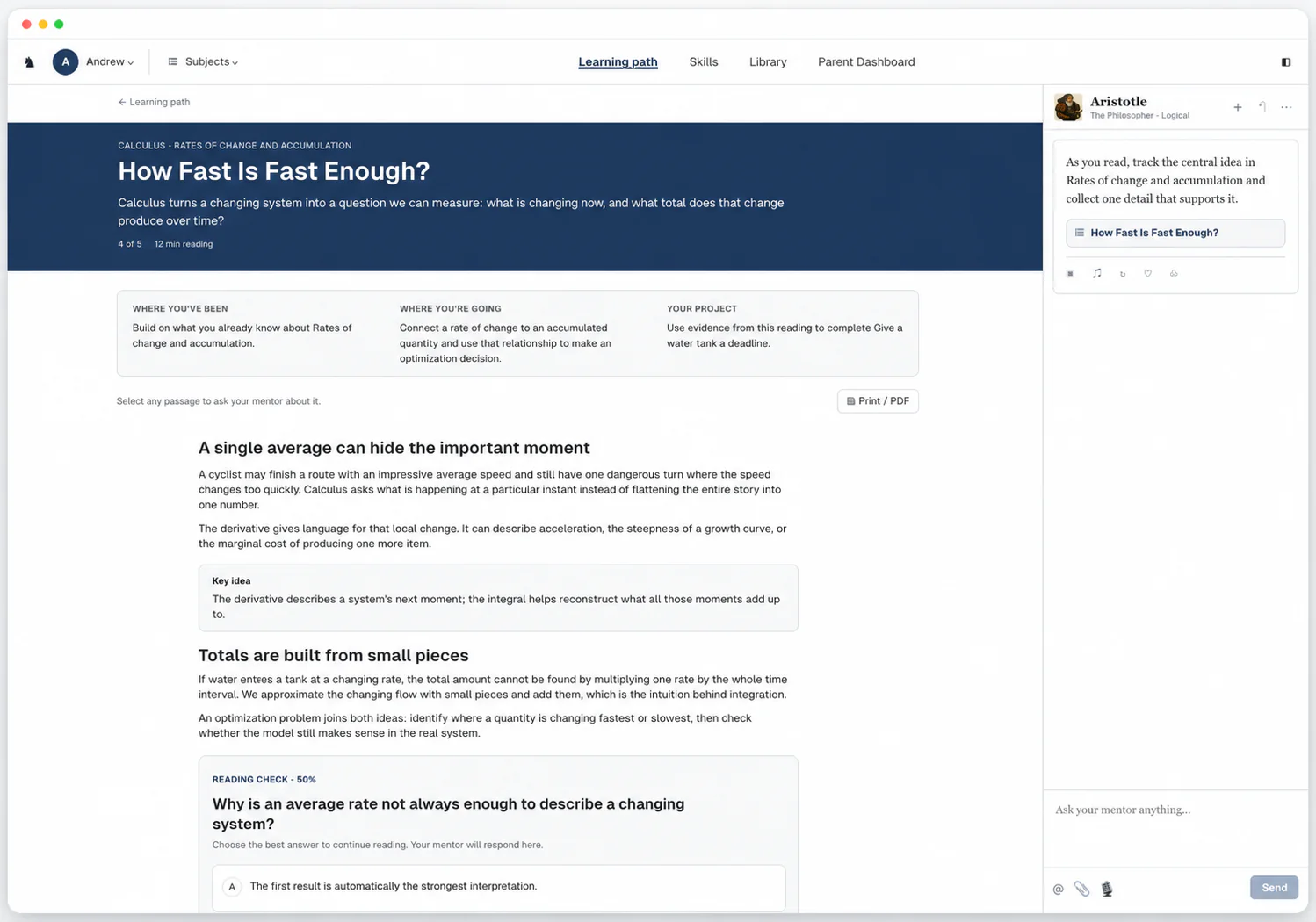
Calculus turns a changing system into a question we can measure: what is changing now, and what total does that change produce over time?
- Lesson
- How Fast Is Fast Enough?
- Goal
- Connect a rate of change to an accumulated quantity and use that relationship to make an optimization decision.
How a lesson works
A 12-minute reading
This example lesson comes from the unit on rates of change and accumulation. It moves from “A single average can hide the important moment” to “Totals are built from small pieces” and builds to one idea: the derivative describes a system's next moment; the integral helps reconstruct what all those moments add up to.
Help inside the reading
If a derivative answer does not fit the graph, our Always-On Mentor can help your teen check the function, algebra, limit, or interpretation. Your child can also highlight any line of “How Fast Is Fast Enough?” to ask about it or ask for a visual, and the mentor offers help on its own when they seem stuck.
A check halfway through
Your child answers “Why is an average rate not always enough to describe a changing system?” before reading on, and the Reading Check at the end asks new questions.
A project your child hands in
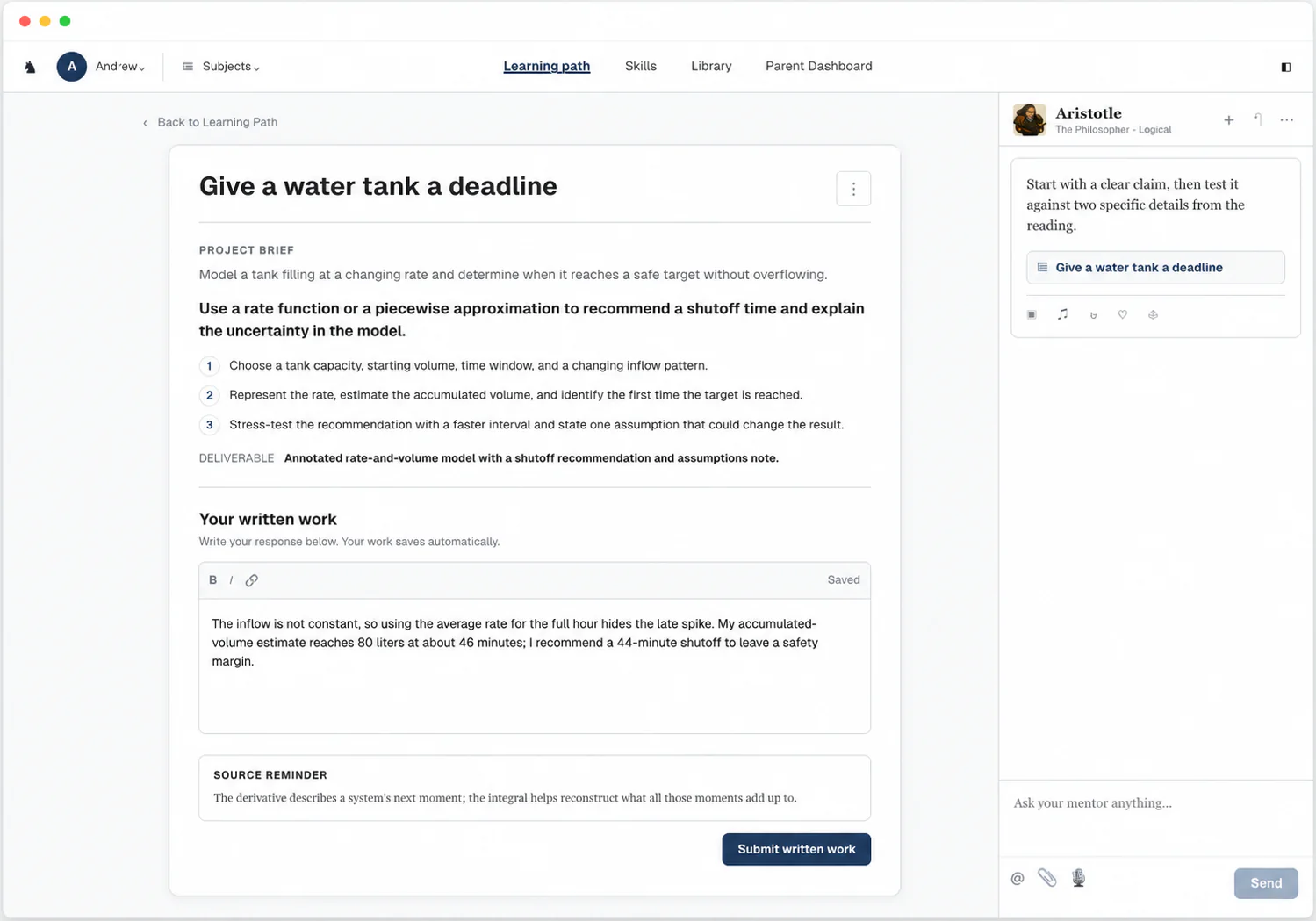
Model a tank filling at a changing rate and determine when it reaches a safe target without overflowing.
- Task
- Use a rate function or a piecewise approximation to recommend a shutoff time and explain the uncertainty in the model
- Hand in
- Annotated rate-and-volume model with a shutoff recommendation and assumptions note
Your parent dashboard
- Today
- Each subject's lesson, and whether it's done
- Grades
- Every submission graded instantly, with written feedback, so you never grade
- Records
- Attendance log and learning summary, ready to export

Units and skills by grade
Grades 3 to 5 each have their own calculus units. From grade 6 through grade 12, calculus is one full course: the same 5 units at every grade. Each grade adds a few skills of its own, and your child's grade sets how deep each unit goes.
Grade 33 units · 9 skills
Multiplicative growth patterns, rate tables, fractional change3 skills
- Multiplicative Growth Patterns
- Rate Tables
- Fractional Change
Area accumulation grids, coordinate graph stories, maximum and minimum contexts3 skills
- Area Accumulation Grids
- Coordinate Graph Stories
- Maximum and Minimum Contexts
Average rate of change preview, pattern rules, calculus readiness project3 skills
- Average Rate of Change Preview
- Pattern Rules
- Calculus Readiness Project
Grade 43 units · 9 skills
Decimal change patterns, line graph rates, area approximation with rectangles3 skills
- Decimal Change Patterns
- Line Graph Rates
- Area Approximation with Rectangles
Multiplicative comparison rates, input-output rules, curved graph interpretation3 skills
- Multiplicative Comparison Rates
- Input-output Rules
- Curved Graph Interpretation
Local maximum and minimum, unit rate review, graph change project3 skills
- Local Maximum and Minimum
- Unit Rate Review
- Graph Change Project
Grade 53 units · 9 skills
Coordinate plane functions, volume change contexts, fractional rates3 skills
- Coordinate Plane Functions
- Volume Change Contexts
- Fractional Rates
Area approximation, sequence patterns, graph features3 skills
- Area Approximation
- Sequence Patterns
- Graph Features
Average rate of change, function rule comparison, modeling change project3 skills
- Average Rate of Change
- Function Rule Comparison
- Modeling Change Project
Grades 6 to 125 units · 67 skills
Limits15 skills
- Estimate a limit from a table
- Estimate a limit from a graph
- Evaluate a limit by substitution
- Simplify a rational expression to evaluate a limit
- Identify a discontinuity from a graph
- Evaluate a one-sided limit
- Identify an infinite limit
- Use limit laws
- Describe a value approached by a pattern
- Describe left and right approach from a table
- Use a table to show approaching behavior
- Identify removable discontinuity from a graph
- Evaluate limits from piecewise graphs
- Use graph behavior to identify a vertical asymptote
- Use squeeze theorem in a simple trigonometric limit
Derivatives15 skills
- Find a derivative using the power rule
- Find a derivative using the product rule
- Find a derivative using the quotient rule
- Find a derivative using the chain rule
- Interpret derivative as instantaneous rate of change
- Differentiate exponential functions
- Differentiate logarithmic functions
- Use implicit differentiation
- Describe rate of change from a graph
- Estimate instantaneous rate from a tangent
- Connect slope of secant lines to average rate
- Estimate derivative from a small interval
- Find derivatives of trigonometric functions
- Use chain rule with a trigonometric function
- Differentiate an inverse trigonometric function
Applications of derivatives15 skills
- Find critical points
- Use first derivative sign to identify increasing intervals
- Use second derivative sign to identify concavity
- Solve a basic optimization problem
- Use tangent line approximation
- Solve a related rates problem
- Use derivative units in context
- Find absolute extrema on a closed interval
- Identify local maximum and minimum from a graph
- Identify increasing intervals from a graph
- Use rate of change to optimize a simple model
- Use derivative sign to locate a turning point
- Use second derivative to describe concavity
- Solve a related-rates problem with implicit differentiation
- Use L'Hopital's rule for an indeterminate form
Integrals15 skills
- Find an antiderivative using the power rule
- Estimate area with a Riemann sum
- Evaluate a definite integral with the fundamental theorem
- Interpret an integral as accumulated change
- Use u-substitution
- Interpret average value of a function
- Use net area from a graph
- Estimate accumulated distance from equal time intervals
- Estimate area by counting grid squares
- Use rectangles to approximate area under a curve
- Approximate accumulated change with unequal intervals
- Use substitution in a contextual accumulation problem
- Interpret a definite integral in units
- Use definite integrals to compare two accumulated quantities
- Set up an integral for volume by cross sections
Sequences and series7 skills
- Write terms of a recursively defined sequence
- Find a partial sum of a series
- Identify a geometric series
- Use the ratio test for convergence
- Find a limit of a simple sequence
- Use nth-term test for divergence
- Use geometric-series sum formula
Questions parents ask
Which grades can use this Calculus curriculum?
- Grades 3 to 12. The skill trees on this page show the units and skills by grade. Placement checks your child's current skills, so the first lesson can sit before or after their grade.
What should my child know before starting?
- Starting skills include Algebra 2 completion with strong understanding, solid geometry foundation, and comfort with complex multi-step problems. If placement finds a gap, the course starts with those skills.
How much of the teaching do I do?
- None of it. The course explains each new idea and checks how your child uses it, while the mentor answers questions as they work. Every submission is graded as soon as it comes in, so you never grade it yourself.
Can I use the record for high-school planning?
- Yes. The subject record holds every graded assignment with its written feedback, ready to export. We generate a transcript from the course records, ready for you to sign.
Calculus, taught around your child
Advanced math support that does not depend on you staying one chapter ahead.
$49/month after the trial.