Philosophy for your homeschool
Your teen builds an argument, takes a serious objection to it, and revises the reasoning where it falls short.
A lesson built around your child
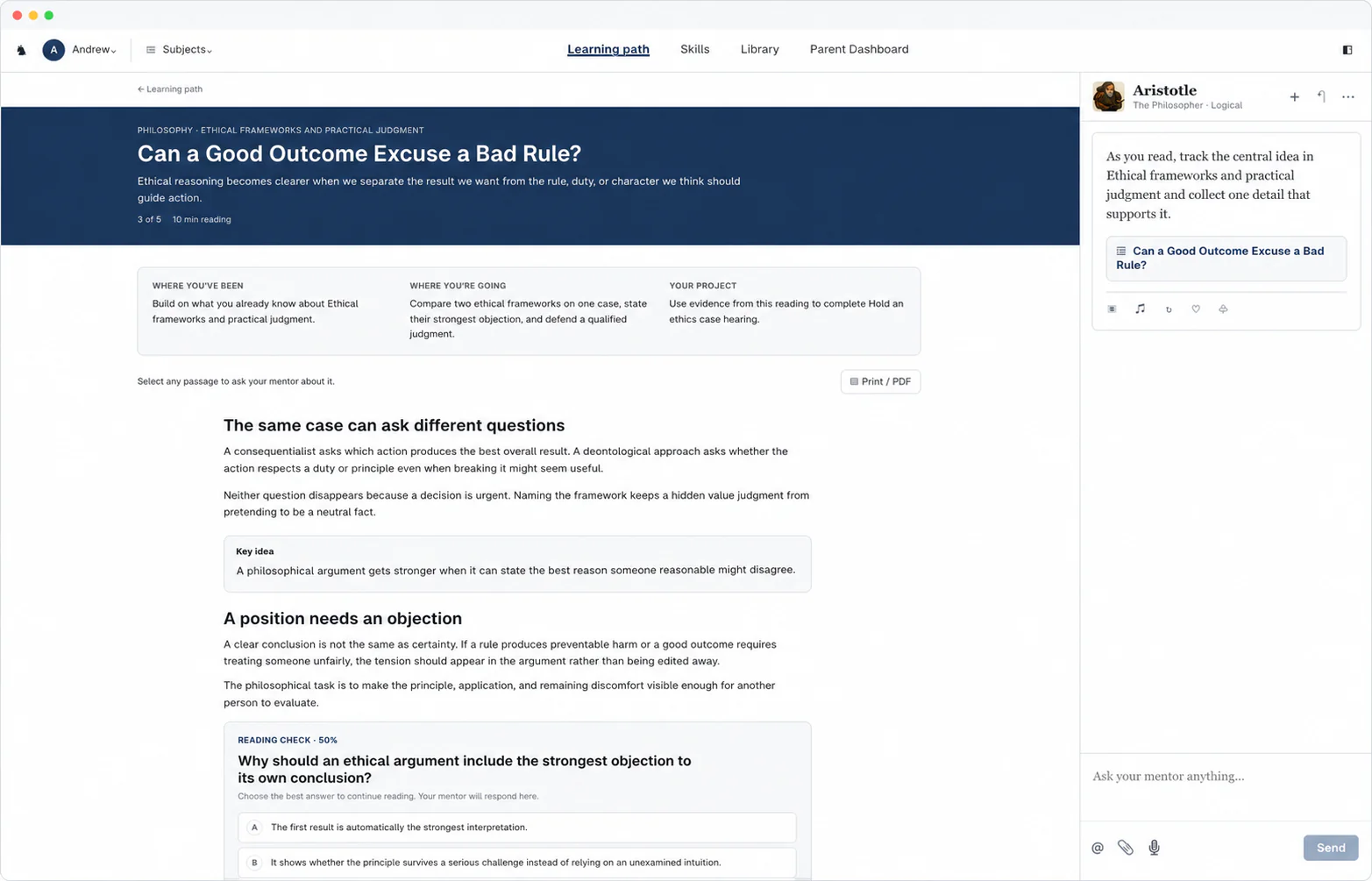
Ethical reasoning becomes clearer when we separate the result we want from the rule, duty, or character we think should guide action.
- Lesson
- Can a Good Outcome Excuse a Bad Rule?
- Goal
- Compare two ethical frameworks on one case, state their strongest objection, and defend a qualified judgment.
How a lesson works
A 10-minute reading
This example lesson comes from the unit on ethical frameworks and practical judgment. It moves from “The same case can ask different questions” to “A position needs an objection” and builds to one idea: a philosophical argument gets stronger when it can state the best reason someone reasonable might disagree.
Help inside the reading
If two parts of an argument conflict, our Always-On Mentor can point out the contradiction and let your teen decide how to answer it. Your child can also highlight any line of “Can a Good Outcome Excuse a Bad Rule?” to ask about it or ask for a visual, and the mentor offers help on its own when they seem stuck.
A check halfway through
Your child answers “Why should an ethical argument include the strongest objection to its own conclusion?” before reading on, and the Reading Check at the end asks new questions.
A project your child hands in
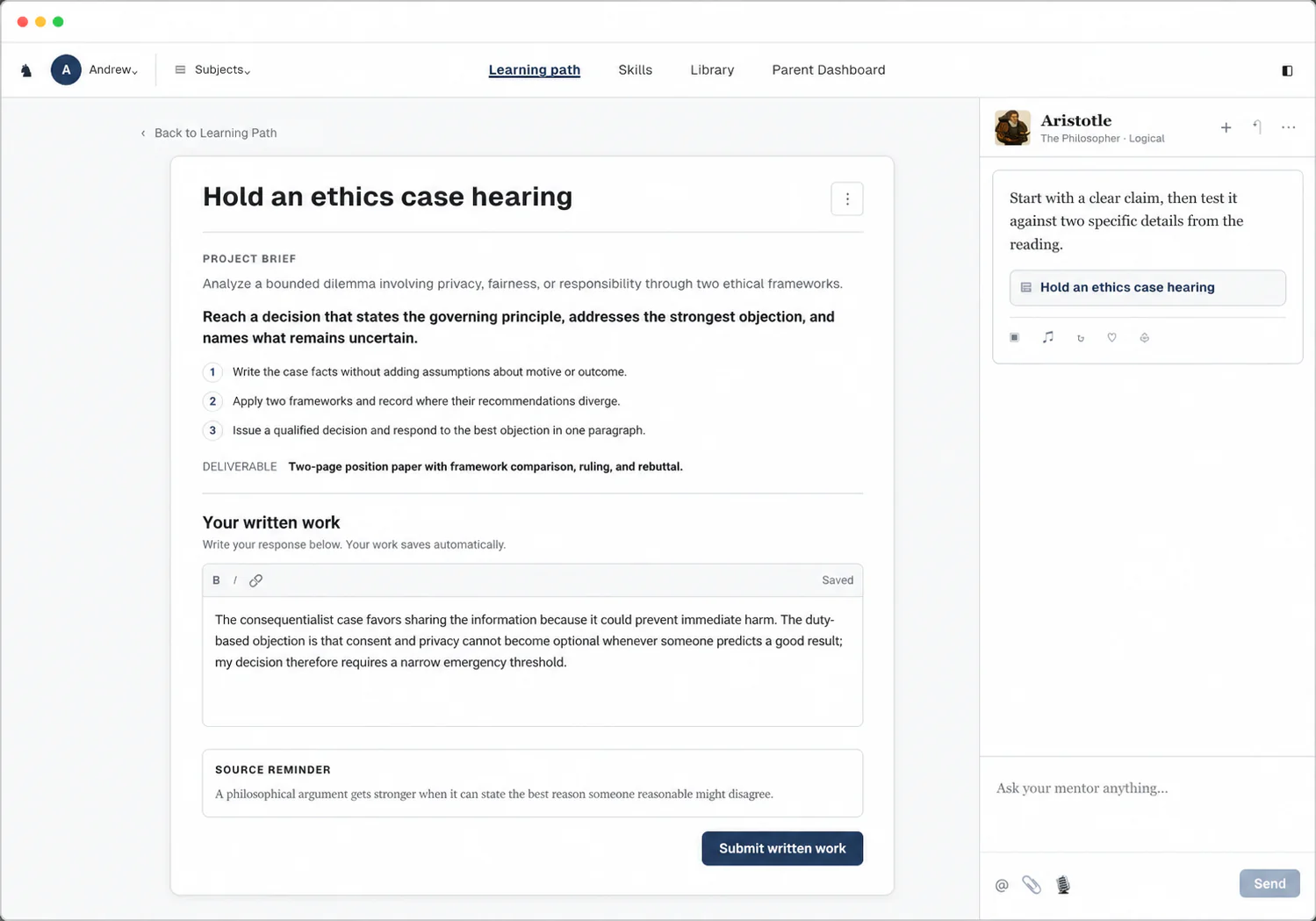
Analyze a bounded dilemma involving privacy, fairness, or responsibility through two ethical frameworks.
- Task
- Reach a decision that states the governing principle, addresses the strongest objection, and names what remains uncertain
- Hand in
- Two-page position paper with framework comparison, ruling, and rebuttal
Your parent dashboard
- Today
- Each subject's lesson, and whether it's done
- Grades
- Every submission graded instantly, with written feedback, so you never grade
- Records
- Attendance log and learning summary, ready to export

Units and skills
The course teaches philosophy through precise questions, rebuilding arguments, logic, ethics, knowledge, reality, the mind, political philosophy, art, and written defense. Philosophy is one skill tree for every grade with 12 units, from arguments, validity, and soundness to philosophical essay capstone, and your child's grade sets how deep each unit goes.
Philosophy12 units · 60 skills
Arguments, validity, and soundness5 skills
- Define the vocabulary, boundaries, and common misconceptions of Arguments, validity, and soundness
- Explain the main actors, mechanisms, sequence, and constraints in Arguments, validity, and soundness
- Interpret evidence, data, cases, or examples connected to Arguments, validity, and soundness
- Apply Arguments, validity, and soundness to a realistic argument or ethical dilemma
- Create a philosophical argument essay that justifies decisions about Arguments, validity, and soundness
Logic, fallacies, and conceptual analysis5 skills
- Define the vocabulary, boundaries, and common misconceptions of Logic, fallacies, and conceptual analysis
- Explain the main actors, mechanisms, sequence, and constraints in Logic, fallacies, and conceptual analysis
- Interpret evidence, data, cases, or examples connected to Logic, fallacies, and conceptual analysis
- Apply Logic, fallacies, and conceptual analysis to a realistic argument or ethical dilemma
- Create a philosophical argument essay that justifies decisions about Logic, fallacies, and conceptual analysis
Epistemology and theories of knowledge5 skills
- Define the vocabulary, boundaries, and common misconceptions of Epistemology and theories of knowledge
- Explain the main actors, mechanisms, sequence, and constraints in Epistemology and theories of knowledge
- Interpret evidence, data, cases, or examples connected to Epistemology and theories of knowledge
- Apply Epistemology and theories of knowledge to a realistic argument or ethical dilemma
- Create a philosophical argument essay that justifies decisions about Epistemology and theories of knowledge
Metaphysics, identity, and causation5 skills
- Define the vocabulary, boundaries, and common misconceptions of Metaphysics, identity, and causation
- Explain the main actors, mechanisms, sequence, and constraints in Metaphysics, identity, and causation
- Interpret evidence, data, cases, or examples connected to Metaphysics, identity, and causation
- Apply Metaphysics, identity, and causation to a realistic argument or ethical dilemma
- Create a philosophical argument essay that justifies decisions about Metaphysics, identity, and causation
Ethics, virtue, duty, and consequences5 skills
- Define the vocabulary, boundaries, and common misconceptions of Ethics, virtue, duty, and consequences
- Explain the main actors, mechanisms, sequence, and constraints in Ethics, virtue, duty, and consequences
- Interpret evidence, data, cases, or examples connected to Ethics, virtue, duty, and consequences
- Apply Ethics, virtue, duty, and consequences to a realistic argument or ethical dilemma
- Create a philosophical argument essay that justifies decisions about Ethics, virtue, duty, and consequences
Political philosophy and justice5 skills
- Define the vocabulary, boundaries, and common misconceptions of Political philosophy and justice
- Explain the main actors, mechanisms, sequence, and constraints in Political philosophy and justice
- Interpret evidence, data, cases, or examples connected to Political philosophy and justice
- Apply Political philosophy and justice to a realistic argument or ethical dilemma
- Create a philosophical argument essay that justifies decisions about Political philosophy and justice
Philosophy of science and explanation5 skills
- Define the vocabulary, boundaries, and common misconceptions of Philosophy of science and explanation
- Explain the main actors, mechanisms, sequence, and constraints in Philosophy of science and explanation
- Interpret evidence, data, cases, or examples connected to Philosophy of science and explanation
- Apply Philosophy of science and explanation to a realistic argument or ethical dilemma
- Create a philosophical argument essay that justifies decisions about Philosophy of science and explanation
Philosophy of mind and consciousness5 skills
- Define the vocabulary, boundaries, and common misconceptions of Philosophy of mind and consciousness
- Explain the main actors, mechanisms, sequence, and constraints in Philosophy of mind and consciousness
- Interpret evidence, data, cases, or examples connected to Philosophy of mind and consciousness
- Apply Philosophy of mind and consciousness to a realistic argument or ethical dilemma
- Create a philosophical argument essay that justifies decisions about Philosophy of mind and consciousness
Aesthetics and interpretation5 skills
- Define the vocabulary, boundaries, and common misconceptions of Aesthetics and interpretation
- Explain the main actors, mechanisms, sequence, and constraints in Aesthetics and interpretation
- Interpret evidence, data, cases, or examples connected to Aesthetics and interpretation
- Apply Aesthetics and interpretation to a realistic argument or ethical dilemma
- Create a philosophical argument essay that justifies decisions about Aesthetics and interpretation
Major philosophers and texts5 skills
- Define the vocabulary, boundaries, and common misconceptions of Major philosophers and texts
- Explain the main actors, mechanisms, sequence, and constraints in Major philosophers and texts
- Interpret evidence, data, cases, or examples connected to Major philosophers and texts
- Apply Major philosophers and texts to a realistic argument or ethical dilemma
- Create a philosophical argument essay that justifies decisions about Major philosophers and texts
Applied ethics and modern dilemmas5 skills
- Define the vocabulary, boundaries, and common misconceptions of Applied ethics and modern dilemmas
- Explain the main actors, mechanisms, sequence, and constraints in Applied ethics and modern dilemmas
- Interpret evidence, data, cases, or examples connected to Applied ethics and modern dilemmas
- Apply Applied ethics and modern dilemmas to a realistic argument or ethical dilemma
- Create a philosophical argument essay that justifies decisions about Applied ethics and modern dilemmas
Philosophical essay capstone5 skills
- Define the vocabulary, boundaries, and common misconceptions of Philosophical essay capstone
- Explain the main actors, mechanisms, sequence, and constraints in Philosophical essay capstone
- Interpret evidence, data, cases, or examples connected to Philosophical essay capstone
- Apply Philosophical essay capstone to a realistic argument or ethical dilemma
- Create a philosophical argument essay that justifies decisions about Philosophical essay capstone
Questions parents ask
Which grades can use this Philosophy curriculum?
- One Philosophy skill tree serves grades 3 to 12, with course pages for 9th grade and high school. Placement checks your child's current skills, so the first lesson can sit before or after their grade.
What should my child know before starting?
- Starting skills include reading comprehension, interest in big questions, and willingness to examine beliefs. If placement finds a gap, the course starts with those skills.
How much of the teaching do I do?
- None of it. The course explains each new idea and checks how your child uses it, while the mentor answers questions as they work. Every submission is graded as soon as it comes in, so you never grade it yourself.
Can I use the record for high-school planning?
- Yes. The subject record holds every graded assignment with its written feedback, ready to export. We generate a transcript from the course records, ready for you to sign.
Philosophy, taught around your child
Clearer thinking that transfers to writing, debate, science, and daily decisions.
$49/month after the trial.