Communications for your homeschool
Your child shapes a message for a particular audience, checks whether it was understood, and improves the delivery.
A lesson built around your child
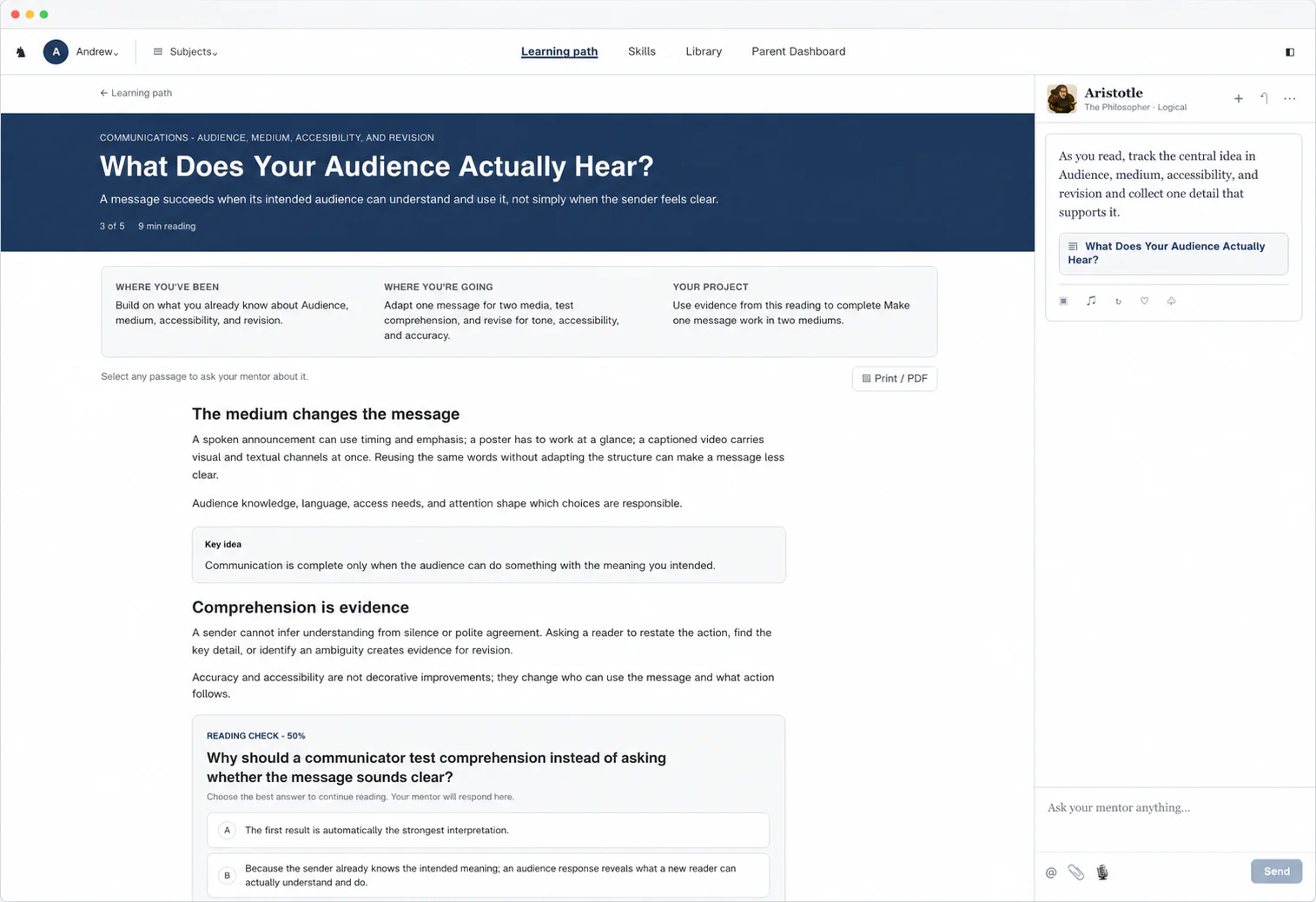
A message succeeds when its intended audience can understand and use it, not simply when the sender feels clear.
- Lesson
- What Does Your Audience Actually Hear?
- Goal
- Adapt one message for two media, test comprehension, and revise for tone, accessibility, and accuracy.
How a lesson works
A 9-minute reading
This example lesson comes from the unit on audience, medium, accessibility, and revision. It moves from “The medium changes the message” to “Comprehension is evidence” and builds to one idea: communication is complete only when the audience can do something with the meaning you intended.
Help inside the reading
If a presentation loses its audience, our Always-On Mentor can help your child check the main point, order, and examples without scripting it. Your child can also highlight any line of “What Does Your Audience Actually Hear?” to ask about it or ask for a visual, and the mentor offers help on its own when they seem stuck.
A check halfway through
Your child answers “Why should a communicator test comprehension instead of asking whether the message sounds clear?” before reading on, and the Reading Check at the end asks new questions.
A project your child hands in
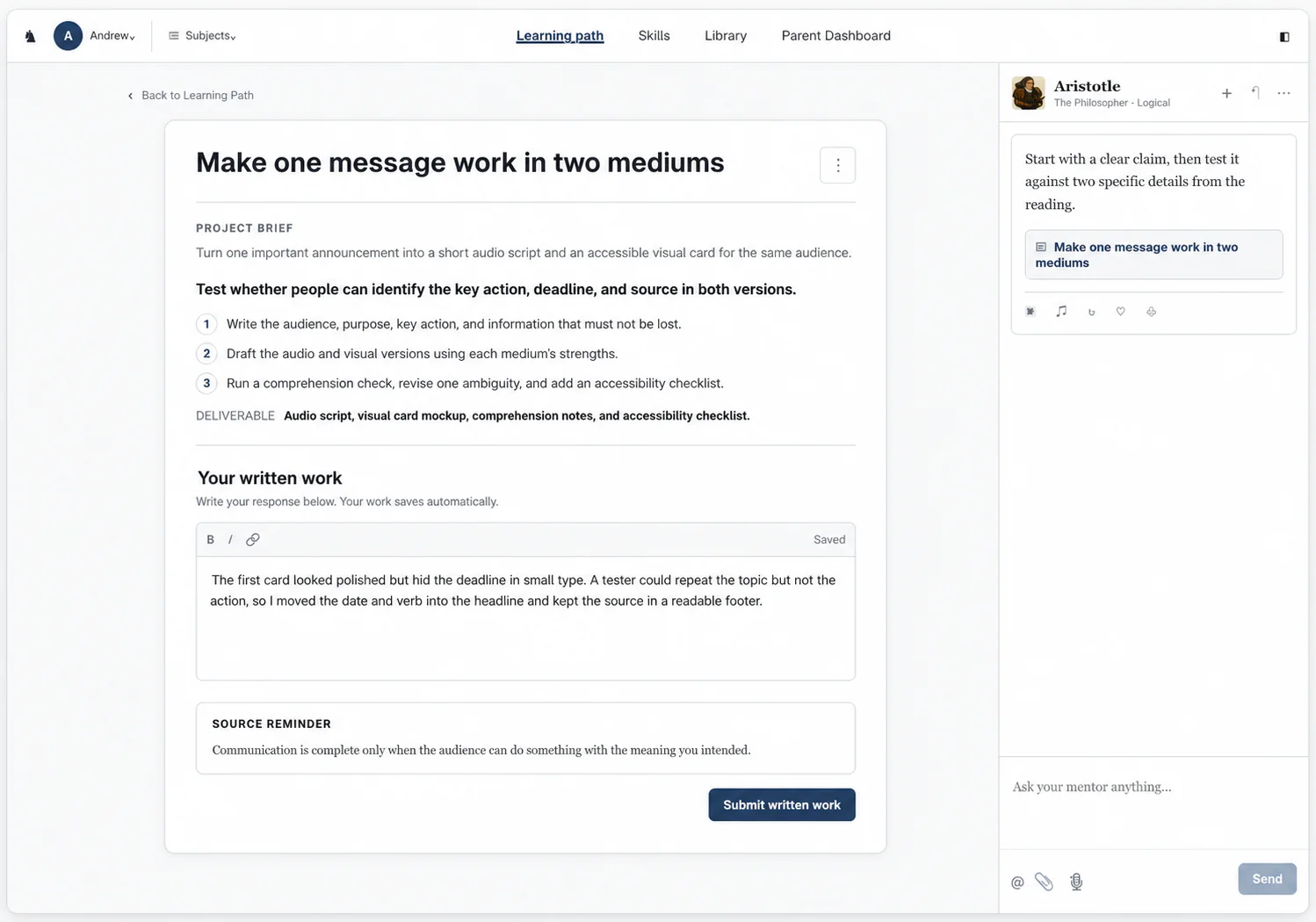
Turn one important announcement into a short audio script and an accessible visual card for the same audience.
- Task
- Test whether people can identify the key action, deadline, and source in both versions
- Hand in
- Audio script, visual card mockup, comprehension notes, and accessibility checklist
Your parent dashboard
- Today
- Each subject's lesson, and whether it's done
- Grades
- Every submission graded instantly, with written feedback, so you never grade
- Records
- Attendance log and learning summary, ready to export

Units and skills
Develops communication as a practical skill across writing, speaking, media, persuasion, and collaboration. Communications is one skill tree for every grade with 12 units, from message purpose, audience, and channel to strategic communications campaign, and your child's grade sets how deep each unit goes.
Communications12 units · 60 skills
Message purpose, audience, and channel5 skills
- Define the vocabulary, boundaries, and common misconceptions of Message purpose, audience, and channel
- Explain the main actors, mechanisms, sequence, and constraints in Message purpose, audience, and channel
- Interpret evidence, data, cases, or examples connected to Message purpose, audience, and channel
- Apply Message purpose, audience, and channel to a realistic real audience communication problem
- Create a communication plan that justifies decisions about Message purpose, audience, and channel
Listening, interviewing, and questioning5 skills
- Define the vocabulary, boundaries, and common misconceptions of Listening, interviewing, and questioning
- Explain the main actors, mechanisms, sequence, and constraints in Listening, interviewing, and questioning
- Interpret evidence, data, cases, or examples connected to Listening, interviewing, and questioning
- Apply Listening, interviewing, and questioning to a realistic real audience communication problem
- Create a communication plan that justifies decisions about Listening, interviewing, and questioning
Clear prose and information hierarchy5 skills
- Define the vocabulary, boundaries, and common misconceptions of Clear prose and information hierarchy
- Explain the main actors, mechanisms, sequence, and constraints in Clear prose and information hierarchy
- Interpret evidence, data, cases, or examples connected to Clear prose and information hierarchy
- Apply Clear prose and information hierarchy to a realistic real audience communication problem
- Create a communication plan that justifies decisions about Clear prose and information hierarchy
Public speaking structure and delivery5 skills
- Define the vocabulary, boundaries, and common misconceptions of Public speaking structure and delivery
- Explain the main actors, mechanisms, sequence, and constraints in Public speaking structure and delivery
- Interpret evidence, data, cases, or examples connected to Public speaking structure and delivery
- Apply Public speaking structure and delivery to a realistic real audience communication problem
- Create a communication plan that justifies decisions about Public speaking structure and delivery
Persuasion, rhetoric, and credibility5 skills
- Define the vocabulary, boundaries, and common misconceptions of Persuasion, rhetoric, and credibility
- Explain the main actors, mechanisms, sequence, and constraints in Persuasion, rhetoric, and credibility
- Interpret evidence, data, cases, or examples connected to Persuasion, rhetoric, and credibility
- Apply Persuasion, rhetoric, and credibility to a realistic real audience communication problem
- Create a communication plan that justifies decisions about Persuasion, rhetoric, and credibility
Visual communication and slide design5 skills
- Define the vocabulary, boundaries, and common misconceptions of Visual communication and slide design
- Explain the main actors, mechanisms, sequence, and constraints in Visual communication and slide design
- Interpret evidence, data, cases, or examples connected to Visual communication and slide design
- Apply Visual communication and slide design to a realistic real audience communication problem
- Create a communication plan that justifies decisions about Visual communication and slide design
Media literacy and platform incentives5 skills
- Define the vocabulary, boundaries, and common misconceptions of Media literacy and platform incentives
- Explain the main actors, mechanisms, sequence, and constraints in Media literacy and platform incentives
- Interpret evidence, data, cases, or examples connected to Media literacy and platform incentives
- Apply Media literacy and platform incentives to a realistic real audience communication problem
- Create a communication plan that justifies decisions about Media literacy and platform incentives
Interpersonal conflict and negotiation5 skills
- Define the vocabulary, boundaries, and common misconceptions of Interpersonal conflict and negotiation
- Explain the main actors, mechanisms, sequence, and constraints in Interpersonal conflict and negotiation
- Interpret evidence, data, cases, or examples connected to Interpersonal conflict and negotiation
- Apply Interpersonal conflict and negotiation to a realistic real audience communication problem
- Create a communication plan that justifies decisions about Interpersonal conflict and negotiation
Journalism, verification, and attribution5 skills
- Define the vocabulary, boundaries, and common misconceptions of Journalism, verification, and attribution
- Explain the main actors, mechanisms, sequence, and constraints in Journalism, verification, and attribution
- Interpret evidence, data, cases, or examples connected to Journalism, verification, and attribution
- Apply Journalism, verification, and attribution to a realistic real audience communication problem
- Create a communication plan that justifies decisions about Journalism, verification, and attribution
Organizational communication and briefs5 skills
- Define the vocabulary, boundaries, and common misconceptions of Organizational communication and briefs
- Explain the main actors, mechanisms, sequence, and constraints in Organizational communication and briefs
- Interpret evidence, data, cases, or examples connected to Organizational communication and briefs
- Apply Organizational communication and briefs to a realistic real audience communication problem
- Create a communication plan that justifies decisions about Organizational communication and briefs
Crisis communication and reputation5 skills
- Define the vocabulary, boundaries, and common misconceptions of Crisis communication and reputation
- Explain the main actors, mechanisms, sequence, and constraints in Crisis communication and reputation
- Interpret evidence, data, cases, or examples connected to Crisis communication and reputation
- Apply Crisis communication and reputation to a realistic real audience communication problem
- Create a communication plan that justifies decisions about Crisis communication and reputation
Strategic communications campaign5 skills
- Define the vocabulary, boundaries, and common misconceptions of Strategic communications campaign
- Explain the main actors, mechanisms, sequence, and constraints in Strategic communications campaign
- Interpret evidence, data, cases, or examples connected to Strategic communications campaign
- Apply Strategic communications campaign to a realistic real audience communication problem
- Create a communication plan that justifies decisions about Strategic communications campaign
Questions parents ask
Which grades can use this Communications curriculum?
- One Communications skill tree serves grades 3 to 12, with course pages for 9th grade and high school. Placement checks your child's current skills, so the first lesson can sit before or after their grade.
What should my child know before starting?
- Starting skills include basic reading and writing, willingness to speak publicly, and interest in communication. If placement finds a gap, the course starts with those skills.
How much of the teaching do I do?
- None of it. The course explains each new idea and checks how your child uses it, while the mentor answers questions as they work. Every submission is graded as soon as it comes in, so you never grade it yourself.
Can I use the record for high-school planning?
- Yes. The subject record holds every graded assignment with its written feedback, ready to export. We generate a transcript from the course records, ready for you to sign.
Communications, taught around your child
Communication skills that improve through feedback instead of performance anxiety.
$49/month after the trial.